After joining Olympique Lyon in the summer having previously been manager of Bundesliga sides Bayer Leverkusen and Borussia Dortmund, as well as Eredivisie giants Ajax before that, Peter Bosz hasn’t enjoyed a great start to life at Groupama Stadium. While clearly having a good mind for the game, Bosz’s past managerial posts haven’t always gone well at all. For example, Bosz’s time at Dortmund ended just 15 league games into the 2017/18 season, with a record of six wins, four draws and five losses. At the time of his departure, BVB were on an eight-game winless run in the Bundesliga. Now, at Ligue 1’s winter break, Bosz has guided Lyon to six wins, seven draws and five losses in France’s top-flight so far — a true mixed bag of results — leaving Les Gones sitting in 13th place after 18 games (it should be noted that most other Ligue 1 sides have played 19 games, which does influence Lyon’s standing slightly. However, even assuming Lyon won their game in hand, they’d likely only climb to 10th place.)
A bottom-half finish for Les Gones this term would be their first time finishing in the bottom half of France’s top-flight since 1996 and a real statement about the club’s descent from the dominant heights they reached in the 2000s. Of course, all of the responsibility for this doesn’t lie with the manager alone. Plenty of people have contributed to the results we’re seeing on the pitch for Les Gones this season and a lot of that work had been done even before Bosz’s arrival in the summer. However, you could also argue that now, with the season at the midway point, Bosz is the person most responsible for figuring out a way of ending Lyon’s poor campaign and turning things around. This is a team that made it to the UEFA Champions League semi-final just two seasons ago, remember, and plenty of the quality from that side remains in the current Lyon team.
In this tactical analysis and team-focused scout report, I’ll highlight some issues with what I believe to be the biggest area of concern for Les Gones at present — their susceptibility to leaving their goalkeeper exposed both in later defensive phases and in defensive transitions. While Lyon’s actual goals conceded per 90 (1.35) isn’t disastrously bad, ranking them with the ninth-worst goals per 90 ratio in France’s top-flight, it’s still too many goals going in the wrong end, as it’s equal to their goals scored (26). However, perhaps even more alarming is the fact that Les Gones’ xGA (31.39) is the second-highest xGA of any Ligue 1 side, just 0.14 lower than Lorient, highlighting the level of vulnerability in their defence. They’ve also conceded the third-most shots (12.12 per 90) of any team in France’s top-flight this season, while their xGA per shot (0.134) is the joint-fourth highest xGA per shot in Ligue 1, indicating that they’re not just conceding a high volume of shots but they’re conceding a high volume of high-quality chances.
I hope that this analysis focusing on Bosz’s strategy and tactics shares some useful ideas as to why this has been the case for Les Gones this term, as well as identifying some ways in which Bosz could potentially look to improve his team to fix these problems. All data and stats analysed in this scout report are from Wyscout unless otherwise stated.
Issues with aggressive / 1v1 defending
Lyon have primarily used a 4-2-3-1 this season, with soon-to-be free agent Jason Denayer (982 mins) and ex-Bayern Munich centre-back Jérôme Boateng (1037 mins) being Bosz’s preferred partnership at the heart of defence. Sinaly Diomandé (633 mins), Castello Lukeba (433 mins) and Damien Da Silva (408 mins) are other notable players to have featured at centre-back for Les Gones this term.
In Lyon’s four-at-the-back system, Denayer or Lukeba, the latter of whom is left-footed, have primarily played on the left while Boateng and Da Silva, both of whom are right-footed like Denayer, have primarily played on the right. Diomandé, also right-footed, has been deployed on either side, but slightly more often on the right than on the left. In their last two Ligue 1 games, likely with a view to changing things to end their poor run, Bosz has lined his team up in a three-centre-back shape, with Boateng performing the central centre-back role in both of those games. In Bosz’s three-centre-back system, Boateng acts as the least aggressive defender in the centre — a role that suits him well. They’ve likely chosen to switch to this system because another body in central defence provides an extra layer of protection at the back in case one defender is beaten while finding space around three centre-backs can also be naturally more difficult than finding space around two centre-backs.
Non-aggressive defending from the centre-backs has been a relatively common part of Lyon games this season. Lukeba and Da Silva have engaged in the most defensive duels of any Lyon centre-back, ranking 28th and 29th for defensive duels per 90 among Ligue 1 centre-backs with at least 400 minutes this term — still not an extremely high ranking, but given that Bosz’s side has been one of Ligue 1’s most possession-dominant (58.6% average — the third-most possession in Ligue 1), this may not come as a massive shock and will come somewhat as a result of the system and tactics.
Interestingly, though, Boateng (5.29 per 90), Denayer (3.94 per 90) and Diomandé (3.55 per 90) all engage in a relatively low number of defensive duels among Ligue 1 centre-backs, especially the latter two. Is this a result of preference or system/instructions? Probably a mix of both but I do find it interesting that for such an aggressive side without the ball (Lyon have the third-lowest PPDA — 9.53 — of any Ligue 1 side this term, basically indicating they press with the third-most intensity) in general, both members of their main centre-back partnership aren’t very aggressive and this creates a unique, sometimes negative result on the pitch, which we’ll analyse further later in this section of analysis.
However, all centre-backs must engage in defensive duels at some stage and while Diomandé (72%) and Lukeba (71.88%) have a good defensive duel success rate, Da Silva (63.33%), Boateng (60.66%) and Denayer (60.47%) have very low defensive duel success rates compared to other Ligue 1 centre-backs with 400 minutes or more. Again, we see Lyon’s main centre-back partnership popping up in a negative light here. From this, we can say that Lyon’s main two centre-backs 1. Don’t engage in many defensive duels and 2. Tend to fare relatively poorly in the defensive duels they do contest.
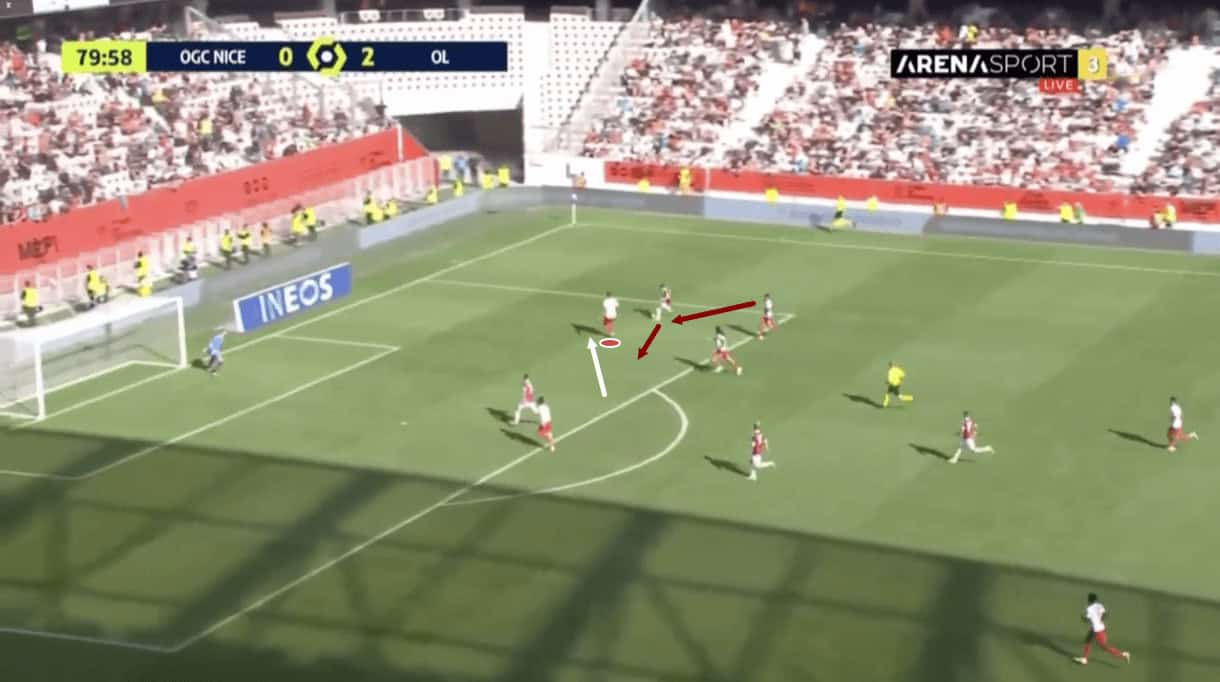
Both Boateng and Denayer are experienced centre-backs, with the former having won just about everything there is to win in the game, but I think part of the explanation for their poor performance in defensive duels and, ultimately, Lyon’s poor defensive record, lies with their defensive technique in situations when they’re forced to defend aggressively. Take figure 1, for example. Here, the opposition have progressed down Lyon’s left wing behind the full-back and into the box, drawing Boateng on this occasion into a 1v1 as left centre-back Denayer was slightly higher, having been beaten earlier in the move.
As the German centre-back approaches, he leaves a lot of space open on the inside for the dribbler to cut into while moving away from the centre of the box, as opposed to backing into it and giving himself a better chance of turning when the attacker makes a move. As this passage of play progresses, we see the attacker burst past Boateng into the centre of the box by exploiting the centre-back’s less-than-helpful movement and body positioning.

![Burnley Vs Manchester United [2–2] – Premier League 2025/2026: The Red Devils New Ideas And Potential Tactical Changes – Tactical Analysis](https://totalfootballanalysis.com/wp-content/uploads/2026/01/Burnley-2-2-Manchester-United-tactical-analysis-350x250.png "Burnley Vs Manchester United [2–2] – Premier League 2025/2026: The First Steps Of The Post-Rúben Amorim Era – Tactical Analysis 5")