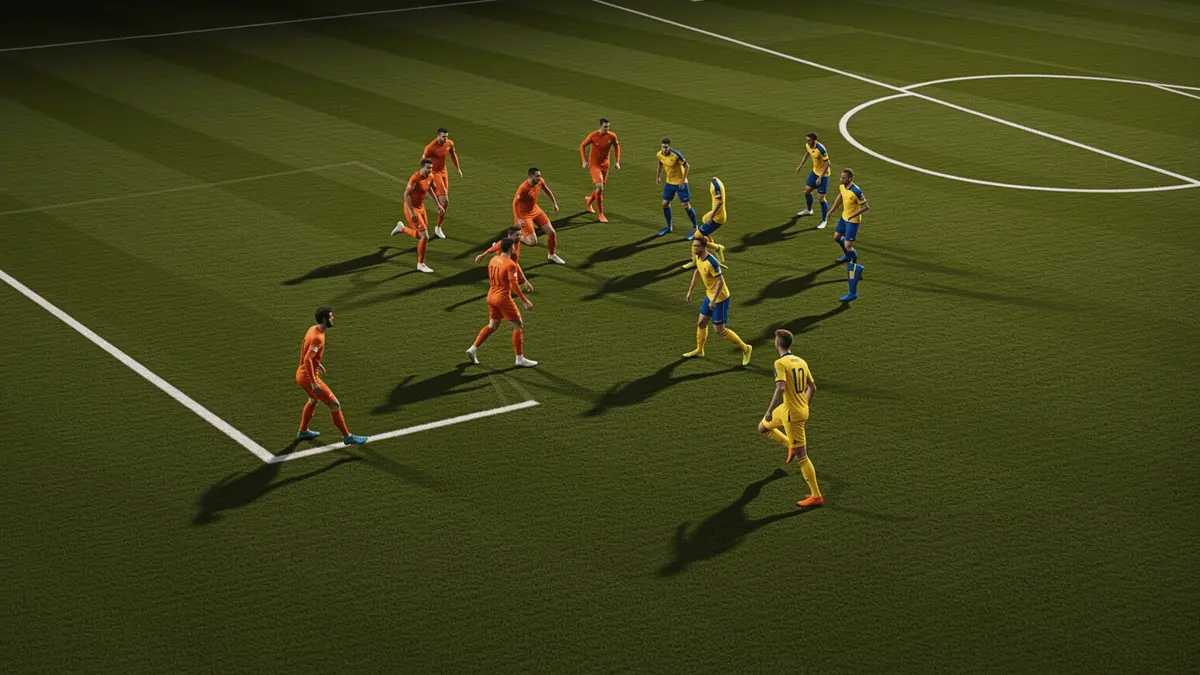
Netherlands’ 5-1 dismantling of Sweden at the 2026 World Cup was more than a margin-of-victory statement – it was proof that Ronald Koeman’s side had resolved, at least temporarily, the structural hesitancy that blunted their attacking play against Japan. This analysis examines why the Dutch positional system worked so cleanly against Sweden’s passive shape, how Oranje repeatedly manufactured central overloads from asymmetrical positioning, and where the defensive architecture still carries risks that better opponents will eventually punish.
Formation and Positional Dynamics: Why the 4-3-3 Looked Different
Netherlands lined up in a 1-4-3-3, but the internal positioning bore little resemblance to the symmetric, evenly-spaced version of that shape that created problems against Japan. Brian Brobbey held the striker role, while Donyell Malen occupied the nominal left wing without functioning as a true width holder. Malen’s movement was predominantly inward – connecting between the lines in deeper zones rather than stretching Sweden’s backline laterally – which freed Tijjani Reijnders and Ryan Gravenberch to select higher, more central positions without creating congestion.
The structural departure from the Japan match was most visible on the right side. Denzel Dumfries pushed into advanced positions from the first exchanges, rather than sitting as a cautious supporting fullback. Stefan de Vrij analogue Jordan Teze – actually it was Jan Paul van Hecke – had licence to drive inward off the right centre-back position, occupying the channel between Sweden’s flank and their midline. Meanwhile, Jurriën Timber-adjacent Devyne Rensch equivalent Bart van der Ven stood higher and more inward-facing rather than as a third centre-back in the build-up, positioning himself in the passing lane toward Cody Gakpo on the left. The effect was a progressive structure that got into Sweden’s defensive half with far fewer recycled sequences than the opener.
Exploiting Sweden’s Passive 5-3-2 Midblock
Sweden’s defensive shape was a 1-5-3-2 midblock – passive by design, with their halfbacks refusing to step out aggressively and their front two providing minimal pressure on the Dutch backline. The structural problem with that setup against patient positional play is that it assigns numerical superiority to the back, creates a compact mid-zone, but leaves the outer pressing triggers undermanned. Against asymmetric positioning, it becomes even less coherent.
Netherlands exploited this through asymmetry on both sides of the pitch. The central mechanism was releasing Frenkie de Jong as a free anchor in front of the Swedish defensive block. De Jong dropped extremely deep – close to the two central defenders – which created a dilemma for Sweden’s midfield three. If Nygren stepped to cover Van der Ven’s inward carry, De Jong became available centrally with no marker. If the Swedish midfielders shifted to track De Jong, Reijnders, positioned high and central between Nygren and Karlström, received in space behind the pressing movement. Gravenberch, playing at a slightly lower register than Reijnders, added a third option: short combinations through the half-spaces that bypassed Sweden’s press entirely.
Gakpo’s positioning on the left was the product of this system rather than isolated individual quality. Reijnders’ early binding runs pulled Swedish defenders away from Gakpo’s channel, giving the Liverpool winger repeated inward dribble angles at pace. Pre-match analysis of this fixture had flagged Gakpo as the primary threat in behind Sweden’s shape, and the positional structure Koeman deployed validated that assessment from the first half-hour. Gakpo reached five World Cup goals in seven appearances across the tournament, a conversion rate that underlines his value in this specific role.
Dumfries’ role was also decisive. His early forward runs forced Sweden’s right midfielders into recovery positions, creating the crossing angles and final-third combinations that directly prepared the majority of Oranje’s goals. Both Dumfries and Gakpo had direct involvement in setting up almost every scoring opportunity – the width came from the fullback zone, the cutting edge came from the half-spaces.
The Opening Goal and Its Warning for Future Opponents
The first goal arrived from a mechanism that opposing coaches should study carefully. Bart Verbruggen played a direct long ball centrally toward Brobbey, who was facing a 3-against-1 situation against the Swedish backline. Sweden’s response was to concentrate every nearby player on winning the first ball. Brobbey’s intelligent positioning – constantly moving in the direct line of the Swedish presser rather than holding a static target position – allowed him to lay off excellently to the advancing Reijnders and Gravenberch. From there, individual execution closed out the sequence.
The structural lesson is that Sweden’s passive approach created an incoherence in their second-ball defence. When they chose to press the long ball situation high, they had not organised the spacing to defend the drop-off. Brobbey’s value in this system extends beyond conventional striker metrics – he functions as a controlled release valve under pressure, capable of executing flick-ons and layoffs that trigger the third-man combinations Netherlands prefer. Any team planning to press Verbruggen’s distribution must first solve how to prevent De Jong from receiving as the immediate link after the first contact.
Asymmetry, Gravenberch’s Carries, and the Central Overloads
Classical 4-3-3 positional play generates symmetry around the ball – equal spacing on both sides, longer pass distances, and a tendency toward lateral circulation that struggles against compact five-man defensive lines. Netherlands broke that pattern repeatedly through deliberate asymmetry, particularly from left to right, where the combination of De Jong’s depth, Reijnders’ height, and Van der Ven’s inward shift created differential spacing that stretched Sweden’s defensive structure without width for width’s sake.
Gravenberch’s long progressive carries were the wild card. Against elite opposition, covering defenders anticipate through-balls and positional rotations; they do not always account for a midfielder capable of driving 40-50 metres with the ball under control before releasing into the final third. Gravenberch’s carry quality – his ability to bridge large distances at pace without losing possession – repeatedly bypassed Sweden’s midline entirely, arriving in zones where the defensive organisation had not yet reset. The risk calculus is specific to his individual quality: a less assured carrier would turn the ball over at a far higher rate, generating counter-attack exposure. With Gravenberch, the carry is a controlled offensive action, not a gamble.
After the Drink Break: Sweden’s Shape Change and the 3v2 Dividend
Sweden’s tactical adjustment at the drink break – shifting from their passive 1-5-3-2 to a more aggressive 1-4-2-3-1 or 1-4-4-2 – was designed to generate pressing pressure and reduce the central overload Netherlands had been exploiting. It produced the opposite effect. With Nygren now positioned higher alongside Gyökeres, the central midfield became a 3-against-2 structure in Netherlands’ favour. De Jong was almost always available. Gravenberch between the lines was the secondary option. Viktor Lindelöf‘s hesitancy when stepping out to engage created further dislocation in Sweden’s defensive shape.
Alexander Isak‘s declining intensity was a compounding factor. Isak, who had been Sweden’s most credible threat in the opening stages, progressively withdrew from his pressing responsibilities as the scoreline widened. Substitute Anthony Elanga injected attacking movement but was tactically undisciplined without the ball – his positioning off the press opened central lanes rather than closing them. By the final twenty minutes, Netherlands were managing the game at their own tempo with minimal defensive engagement from the Swedish front line.
The Structural Vulnerabilities Netherlands Cannot Ignore
The 5-1 scoreline obscures the degree to which Netherlands’ defensive organisation remains systemically fragile. The man-marking structure across the pitch – predominantly opponent-oriented rather than space-oriented – generated repeated coordination failures. Malen and Dumfries were the most visible instance, tracking the same runner on multiple occasions and leaving adjacent zones unoccupied. This is not simply a communication problem between two individuals; it is a consequence of a pressing system that prioritises direct opponent coverage over lane protection.
The second-ball defending was the clearest expression of this. When possession transitioned in disorganised phases, Netherlands’ players tracked their assigned opponents into the last line rather than shielding the inside channel. The result was gaps between the midline and the last four that a more accomplished team would have exploited with vertical half-space runs. Van Dijk and Van Hecke were measurably less aggressive in forward defending than they had been against Japan – reportedly because Sweden’s capacity for 2-against-2 attacks in behind made stepping out tactically riskier – but the consequence was a last line that sat deeper than the defensive structure required, inviting exactly the kind of space between the lines that better opponents will find.
Gyökeres created a significant chance almost immediately after the opening goal, exploiting the gap left by the rigid man-marking of the controllers after a simple vertical position change by a Swedish midfielder. That Verbruggen saved it, and that Sweden’s finishing was poor throughout, prevented a more uncomfortable narrative around the 5-1 win. The Group F picture favours Netherlands at the top, but the knockout phase will provide opponents with both the preparation time and the individual quality to make those defensive fissures consequential.
Summerville, Intensity Drop, and the Broader Tournament Question
The substitutions after the 4-0 mark were largely inert – the exception being Crysencio Summerville, whose energy and directness stood in contrast to the general drop in concentration that accompanied the comfortable scoreline. Summerville’s goal at 5-1 was incidental; his attitude on the pitch was the meaningful signal, and his celebration reportedly captured the looseness of the final thirty minutes more accurately than the scoreline did.
The broader pattern is one Koeman will need to manage. The tournament-level analysis of Netherlands’ chances has consistently noted their capacity for tactical drift when the competitive pressure reduces – a tendency that becomes a structural risk once knockout margins arrive. The system works when the pressing geometry is maintained, when De Jong has the vertical freedom the Sweden game provided, and when Dumfries and Gakpo stay connected in the chance-creation loop. When concentration drops, those are the exact connections that deteriorate first.
Verdict
Netherlands’ performance against Sweden was the clearest demonstration yet that Koeman’s 4-3-3 – when executed with the asymmetric positioning, early forward movement, and carry-through-the-lines dynamism that defined this game – can overload even organised defensive shapes at World Cup level. De Jong’s freedom as a central pivot, Brobbey’s intelligent movement as a layoff and pressing reference, and the Dumfries-Gakpo combination as the primary goal-creation axis all functioned in genuine systemic harmony.
The defensive vulnerabilities are real and documented. Man-marking that is opponent-oriented rather than space-oriented will be tested severely by opponents who are faster, more direct, and more tactically disciplined in their build-up than Sweden proved to be. The 5-1 scoreline is the right result for the attacking quality Netherlands showed; it is also, quietly, a slightly misleading picture of how secure Oranje look when they do not have the ball.