The fixture between the Dragões (FC Porto) and The Leões (Sporting) dates back to 1922, and tempers have heightened since their very first meeting, making for exciting matchups. Games have always been close between the top dogs in Portuguese football, as within this matchup Porto has scored 86 goals, three more than Sporting’s 83 goals. Meeting for the 241st time, the stakes could not have been higher as both teams battled for the coveted league title, with Porto sitting on 59 points beforehand, with Sporting as the hunting pack having accumulated 53 so far during the season.
While this old rivalry remains, a present-day conflict could brew between Porto manager Sérgio Conceição with his craft style and defensive solidity against Sporting manager Rúben Amorim, a fresh face in the managerial game, making others take notice. With everything to play for; the battle between the players, besides the battle within the dugouts.
This tactical analysis will look into Porto’s supremacy during the first half, while also discussing quickly taking the lead during the opening exchanges. Last, I will delve into how Sporting came away from the Estádio do Dragão with a point, despite having ten men on the field.
Line-up
On the home side, Porto made use of a 4-3-3 formation, comprising Diogo Costa in goal. In defence, João Mário and Zaidu Sanusi were at full-back with ex-Premier League defender Chancel Mbemba and former Real Madrid defender Pepe at centre-back. In midfield, Otávio, Mateus Uribe, Vitinha and Fábio Vieira. In attack, was the striker partnership of Evanilson and Mehdi Taremi.
Sporting Lisbon utilised a 3-4-2-1 formation, starting in goal with Antonio Adán. Within Sporting’s back three, Zouhair Feddal, former Liverpool player Sebastián Coates and Gonçalo Inácio. The wing-back positions were occupied by Ricardo Esgaio and Matheus Reis, with the double-pivot marshalled by Manuel Ugarte and Matheus Nunes. In attack, Nuno Santos and ex-PSG Pablo Sarabia just behind Paulinho up-front.

FC Porto’s first-half dominance & use of wide areas
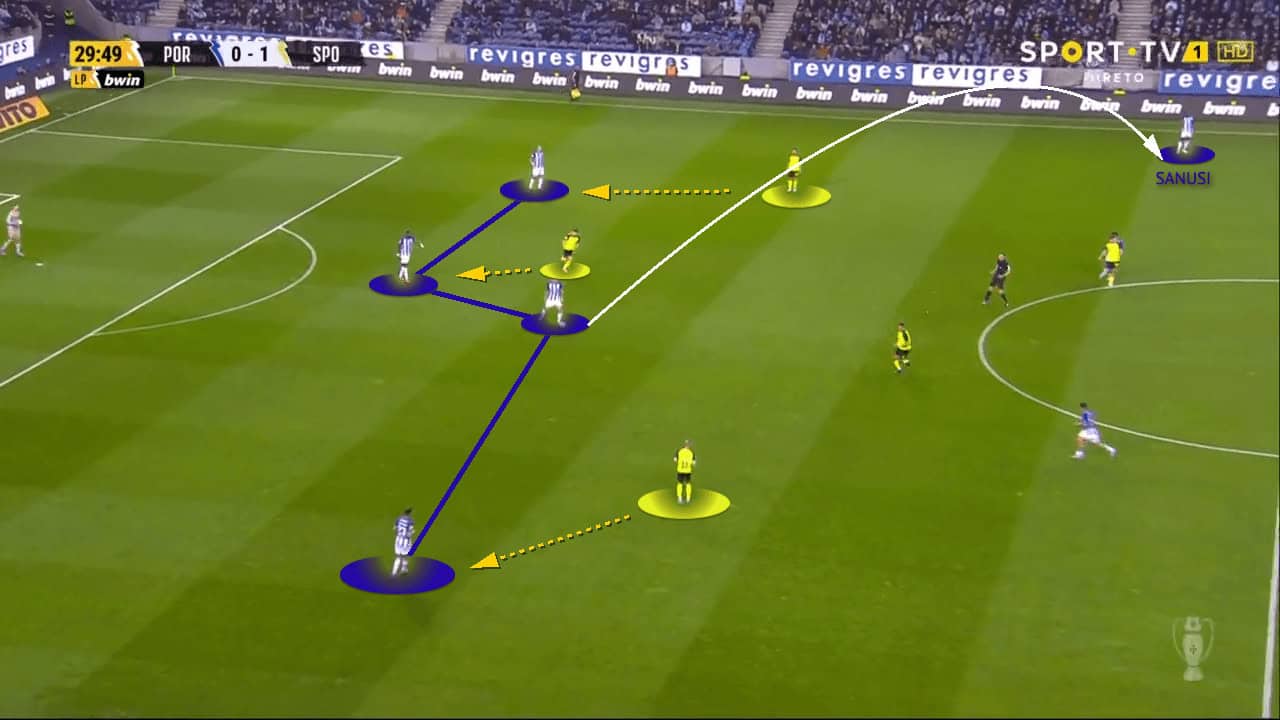
As this fiery fixture kicked off, Porto stamped their authority from the very first kick. Sticking to their 4-3-3 shape in possession, Porto coach Sérgio Conceição had a coherent plan to bypass Sporting medium block, starting from the first phase of play. While some teams may focus more on centrality regarding ball progression, Porto was more inclined to use the wide areas when working the ball forwards. During the build-up phase, Porto faced a Sporting side who did not press aggressively but attempted to deny central passages to Porto’s double pivot. To counter this defensive structure, Porto had a few solutions. Most commonly, one of the double-pivot comprising Vitinha or Mateus Uribe would drop slightly deeper, creating a 3v3 or 4v3. From this position, Porto worked the ball wide to the far-side full-back high and wide.


![Lazio Vs Napoli [0–2] – Serie A 2025/2026: Maurizio Sarri Zonal Marking Weaknesses And Unsuccessful Attacking Choices – Tactical Analysis](https://totalfootballanalysis.com/wp-content/uploads/2026/01/Lazio-Vs-Napoli-tactical-analysis--350x250.png "Lazio Vs Napoli [0–2] – Serie A 2025/2026: How Antonio Conte Tactics Exploited Structural Flaws – Tactical Analysis 6")