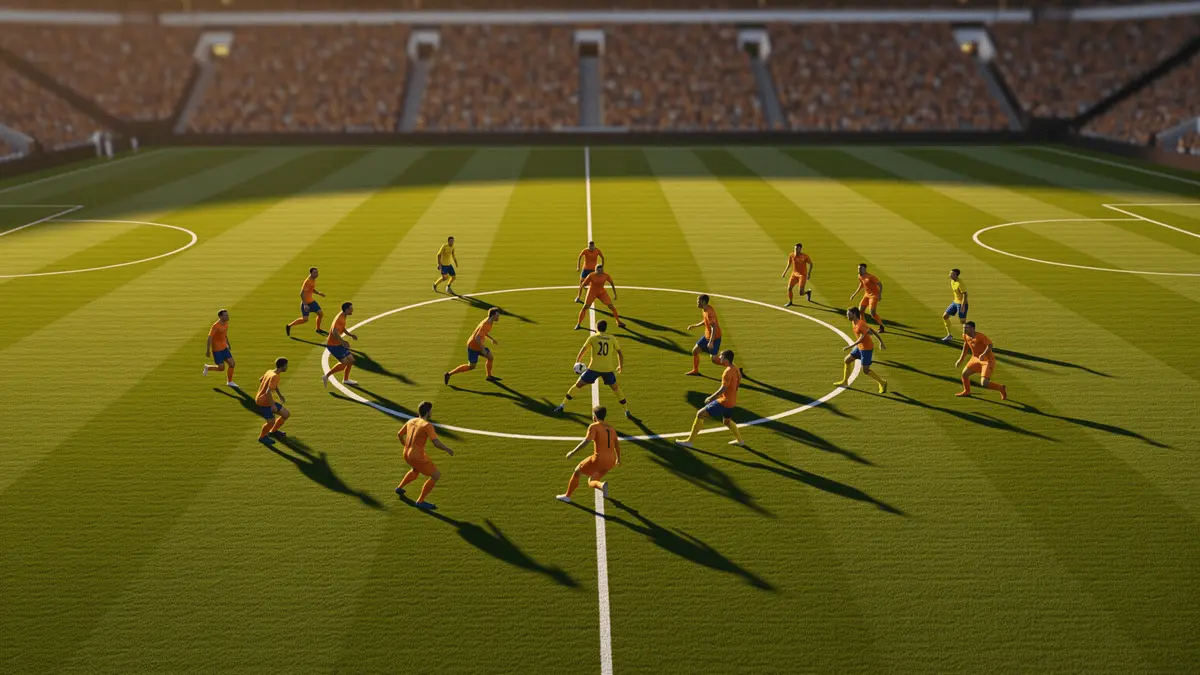
Netherlands’ 5-1 victory over Sweden in Houston sent Oranje to the top of Group F and did something the Japan win had not: it demonstrated that Ronald Koeman’s side could sustain attacking positional play with consistent structural logic rather than individual moments. This analysis examines what changed from the Japan match, why Sweden’s defensive setup ultimately made their collapse inevitable, and where the Dutch defensive architecture remains genuinely exposed despite the scoreline.
Formation and Positional Dynamics: A Different 4-3-3
Netherlands lined up in their familiar 1-4-3-3, but the internal geometry bore little resemblance to the conservative iteration fielded against Japan. The most significant adjustment was structural rather than personnel-based: Brian Brobbey started as the focal point, and Donyell Malen occupied the nominal right-wing position without behaving like a width-holding winger at all. Malen drifted inside persistently, operating as a second connecting midfielder rather than a touchline threat, which compressed Sweden’s defensive block horizontally and dragged their right-sided cover away from the channels.
Denzel Dumfries moved to the front line early in the match, exploiting the space Malen’s inward movement vacated. Stefan de Vrij’s replacement at right centre-back, Jan-Paul van Hecke, and Mickey van der Ven on the left both pushed higher than typical build-up defenders, with Van der Ven positioning himself inside rather than offering width. That gave the Dutch five players operating at or near the highest line at various moments, destabilising Sweden’s block reference points and creating overloads that a passive 5-3-2 midblock was structurally unable to address.
Ryan Gravenberch was the connective tissue throughout. He controlled tempo by dropping into deeper zones when the build-up required an extra body, then drove forward to bridge distances with carries that forced Swedish midfielders to commit. Frenkie de Jong was the primary circulation target: Dutch positional play is oriented around getting De Jong free centrally, and once he received in space, the angles for Gakpo inside, Dumfries in behind, or Brobbey through the centre all opened simultaneously.
Why Sweden’s Passive 5-3-2 Was Always Going to Break
Sweden under Graham Potter set up in a 1-5-3-2 midblock, deliberately passive and compact, conceding the wide areas as a calculated trade to keep central access to Viktor Gyökeres and Alexander Isak denied. Against a statically symmetrical 4-3-3, that shape can frustrate – forcing long passing distances and limiting penetration into the half-spaces. The Dutch response dismantled the premise of the trade.
By creating asymmetrical positions – more players in tighter proximity on the left side, with Dumfries and Van der Ven providing depth on the right – Netherlands shortened their passing distances to a level where Sweden’s outer pressing line became irrelevant. That outer line, composed of the ball-near wingback, ball-near midfielder, and ball-near striker, was routinely bypassed before it could compress. Once Netherlands played through that line, the angles to De Jong as a free pivot, to Gakpo drifting inside, and to Brobbey in the box all remained available simultaneously.
Brobbey’s role deserves specific attention. He spent large portions of the match in 1-vs-2 or 1-vs-3 situations inside the penalty area – not because Netherlands were playing him poorly, but because Sweden refused to let their fullbacks step out and chose to maintain numerical superiority against the striker rather than contest width. That decision made sense as a structural concession only if Sweden’s last line won every individual duel. They did not. Brobbey’s intelligent positioning – continuously moving into the direct shadow of Swedish pressers to receive layoffs – meant that his contributions to the first two goals came from reads rather than physical dominance. Pre-match previews had identified Dutch crossing volume as a threat, but the more damaging mechanism was the central combination play triggered by Gravenberch’s carries and De Jong’s pivoting.
Brobbey scored twice inside the first 17 minutes, giving Netherlands a cushion that immediately invalidated Sweden’s entire defensive rationale. A passive midblock requires patience and a low-scoring environment; conceding twice before the 20th minute forced Sweden to re-examine their structure mid-game in ways their squad was not equipped to handle.
De Jong’s Dominance and the Swedish Midfield Dilemma
De Jong’s control of the match was partly a product of his own quality and partly a consequence of Sweden’s midfield being placed in an unsolvable positional problem. Jens-Linus Nygren was regularly tasked with tracking Van der Ven’s forward movement, which pulled him out of the central lanes. When Nygren stepped out, the coverage responsibility for De Jong fell to the remaining Swedish midfielders – Karlström and one of the wider central three – but Joakim Sternberg Rijnders‘ high, central positioning between those players made any shift toward De Jong immediately create a free Gravenberch or a free Rijnders in behind.
Isak and Gyökeres applied minimal pressure without the ball, which compounded the midfield problem. Both strikers were willing to let De Jong receive uncontested in his own half, and their sporadic pressing attempts lacked accurate coverage shadows that might have denied him the first touch. The analysis notes that against a player of De Jong’s quality – and Van Dijk in possession – that is no simple assignment, but the absence of any coordinated front-line press allowed the Dutch circulation to function at a tempo Sweden’s shape could never match.
The First Goal as a Warning for Future Opponents
Sweden’s opening concession came from a situation they could theoretically have controlled. Bart Verbruggen played a long ball to Brobbey, Sweden concentrated entirely on winning the first ball, and when Brobbey laid it back to the advancing Rijnders and Gravenberch, the Dutch had numbers and momentum in a single movement. The structural point is significant: pressing high without organised second-ball defence is not pressing – it is gambling.
Whoever plans to apply sustained high pressure to Netherlands in later rounds faces a specific problem that this goal illustrates precisely. Verbruggen is capable of playing a controlled long pass through the centre, and Brobbey’s layoff quality means that the second-ball zone – the area behind the first duel – must be covered by a dedicated player, not assumed to belong to the team that applies pressure. Sweden had no answer for the third-man combination through De Jong, and that pattern will recur against any team that presses without structural depth behind their front line.
Gakpo’s Goals and the Post-Break Collapse
Cody Gakpo scored twice after halftime, both as direct products of the asymmetrical left-side combinations that Netherlands had been constructing throughout the first half. Dumfries’ crossing accuracy from the right and Gakpo’s inward movement from the left created crossing zones that Sweden’s last line – passive and unwilling to engage fullbacks in high duels – could not adequately address.
After the drink break, Sweden shifted to a 1-4-2-3-1 or 1-4-4-2 structure, bringing Nygren alongside Gyökeres to add a body to the forward line. The tactical logic was to apply more pressure on the Dutch build-up, but the consequence in possession phases was a 3-vs-2 Dutch advantage in the centre, which De Jong or Gravenberch between the lines exploited almost without resistance. Victor Lindelöf defended hesitantly when required to step out from the back line, and Isak’s visible drop in intensity as the match progressed removed any pressing mechanism that might have made the numerical disadvantage workable.
Substitute Anthony Elanga brought pace and offensive directness but failed to track back with the structural discipline Sweden needed. His presence added width without adding defensive compactness, which only enlarged the central spaces Netherlands were already occupying comfortably. Crysencio Summerville’s introduction from the Dutch bench had the opposite effect – immediate direct dribbling, width, and the energy that several other Dutch substitutes conspicuously lacked in the final half hour.
The Defensive Vulnerabilities That a 5-1 Scoreline Obscures
The scoreline risks obscuring how frequently Netherlands’ defensive structure created exploitable space. The core problem is a rigidity in man-marking that prioritises the direct opponent over the inside lane. When Sweden made vertical position switches in the half-spaces – moving a midfielder into the zone between the Dutch midline and last line – neither Van Dijk nor Van Hecke consistently communicated or stepped out to intercept. The Dutch controllers followed the runners toward the last line rather than maintaining lane discipline, which left gaps in behind the midfield for Sweden to attack before Verbruggen’s saves and Swedish finishing errors closed the issue.
Malen and Gakpo both failed to close passing lanes toward the wide zones when Netherlands were defending, which allowed Sweden’s fullbacks and wingbacks to receive in space before the Dutch wingbacks could press. The coordination between Malen and Dumfries in man-marking was particularly poor – both were drawn to the same opponent on multiple occasions, leaving another Swedish player free in a different zone. That is not a minor communication error; it is a systematic issue with how the man-marking principles are being applied across the front and middle line.
Gyökeres came to a significant chance almost immediately after Netherlands went 1-0 up – a reminder that the structural vulnerabilities did not disappear with the early lead. Sweden’s inability to convert those moments owed as much to Verbruggen’s positioning and their own finishing quality as it did to Dutch defensive organisation. Group F’s broader dynamics mean that conceding this kind of space against a higher-quality attacking unit would carry much heavier consequences than a 5-1 scoreline implies.
Analytical Verdict
Netherlands’ performance against Sweden represented a genuine step forward in attacking clarity relative to the Japan match. The positional asymmetry, Gravenberch’s distance-bridging carries, and De Jong’s central circulation created a system that Sweden’s passive 5-3-2 had no answer for once Brobbey’s early goals removed the structural patience the block depended on. 10 shots, 5 goals – a finishing rate that reflects both sharp execution and the quality of the positions Netherlands constructed rather than individual improvisation.
The defensive side of the ledger is considerably less reassuring. The man-marking rigidity, the failure to close wide passing lanes, the inconsistent aggression from Van Dijk and Van Hecke in forward defending, and the absence of coordinated communication between the midline and last line are not problems a 5-1 scoreline fixes. Netherlands’ tournament prospects will be shaped by whether Koeman can tighten the defensive structure without sacrificing the attacking positional ambition that dismantled Sweden so comprehensively. Against a front line with Isak and Gyökeres’ quality but sharper finishing and a more organised second-ball press, those exposed zones between the Dutch lines would look significantly more threatening.