In July 2021, Rogério Ceni and Flamengo parted ways after a turbulent period at the club. As a result, Ceni’s ability to manage big clubs was in question. He had performed well at Fortaleza but in a much smaller scenario. Three months later, he returned to the club where he became a football legend, São Paulo, in an attempt to prove himself as one of Brazil’s top managers. After an inconsistent end to the 2021 season, Ceni’s São Paulo have started this season tremendously well, nearly winning the Paulista state championship.
While a few experienced players such as ex-Bayern Rafinha, Patrick, Alisson, and Nikão were signed during the transfer window, their recent success can be attributed to their youth academy. Nearly half of their starting eleven against Palmeiras in the Paulista final were academy products. Known as the ‘Meninos de Cotia’, São Paulo’s youth academy has produced talents such as Casemiro, Lucas, David Neres, and Antony.
In this tactical analysis, São Paulo’s tactics throughout different phases of the game will be analysed in detail. Moreover, this analysis should illustrate how Ceni’s São Paulo play ahead of the 2022 Brasileiro.
Overview
São Paulo had one of the best attacks in the Paulista with 27 goals from 23.68 xG. Furthermore, they had an xGA of just 10.8 – the lowest in the Paulista. It is fair to say Ceni’s São Paulo were effective on both ends. Key metrics can indicate the team’s overall behaviour both in and out of possession. They maintained the highest average PPDA in the Paulista at 7.3. With the ball, they averaged 60.9% possession, only behind Corinthians’ 62.5%. Further metrics include 448 passes per 90, while only 7.66% of them being long. This highlights their controlled approach to possession, based on short and high tempo passing. Finally, they did not average a lot of 1v1s dribbling, which further emphasises this pass-first mentality. In summary, Ceni’s São Paulo look to dominate the ball with controlled possession and a high press.
As far as formations, São Paulo are very dynamic. They line up in a 4-1-3-2, but the structure constantly changes depending on situations and players available. The back four is fairly consistent, with Rafinha, Diego Costa, Léo, and either Welington or Reinaldo being regulars. Pablo Maia is a crucial piece in this São Paulo side. The 20-year-old deep-lying midfielder is crucial to São Paulo’s construction and protecting the backline. Rodrigo Nestor performs a dynamic role in the midfield. While he is the central attacking midfielder, he often drifts deeper into the midfield, both in and out of possession. Alisson and Igor Gomes are usually the other two attacking midfielders, but other players have also been tested. In the attack, Éder plays alongside Calleri, who has been São Paulo’s top goalscorer in the Paulista.
Build up
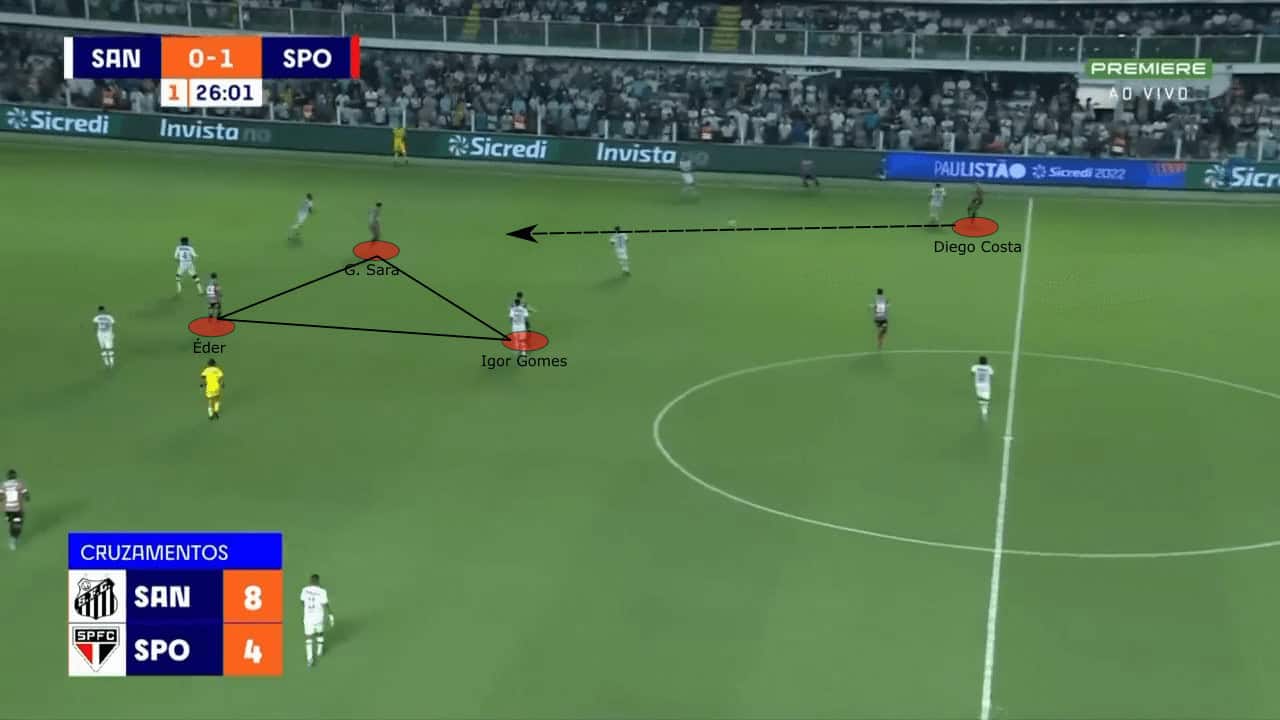
During the build up phase, São Paulo look to maintain their 4-1-3-2 structure. The centre-backs split the goalkeeper while the fullbacks push up wide. Behind the first line of pressure, Pablo Maia will look to find gaps to receive the ball. As they are structured with a single pivot, they look to build through the middle. São Paulo will often have numerical superiority in the midfield as they line up with four players there. The objective is to always take advantage of this superiority. Below is an example of Pablo Maia’s positioning behind the first line of pressure.

As Santos’ centre-forward blocks Diego Costa from receiving the ball, Pablo Maia shows in the space created in the middle. After receiving, he immediately plays Diego Costa behind the centre-forward.