The use of the 4-2-3-1 out-of-possession has gained popularity in recent years, with various teams using different systems within this shape.
Within any pressing shape, variations can be gained by adjusting the roles of players within the press and the intentions of their movements while pressing.
Having previously written about the 3-4-3 in this regard, this tactical analysis will focus on the 4-2-3-1 and the various formations seen from teams that press from this shape.
I will examine the relative advantages and disadvantages of each scheme, as well as assess the overall flexibility of the formation.
As a disclaimer, examining pressing variations is a challenging topic simply because the formation of a 4-2-3-1 is itself a variation of a 4-3-3.
As a result, in terms of pressing variations, we will examine the variations of teams that use the 4-2-3-1 as their base or starting formation.
Why is the 4-2-3-1 so popular?
The rise of the 4-2-3-1 formation likely comes in part from the increasing use of a 4-3-3 with a single pivot when in possession.
The 4-2-3-1 formation naturally aligns with this formation, particularly in its midfield stagger, with an attacking midfielder occupying a similar space to an opposition holding midfielder.
We can see the most obvious 4-2-3-1 pressing structure against a 4-3-3 below.
The striker is tasked with pressing the two centre-backs, while the wingers usually protect the central areas and half-space initially before then being triggered to press the full-back in a wide area.
The pressing ten (attacking midfielder) can man-mark the pivot, while the two holding midfielders can also match up man for man with the other two opposition central midfielders.
Without a forward dropping or a defender moving forward, a 4-3-3 finds it challenging to create numerical superiority against a 4-2-3-1.

Dealing with the 2 vs 1
One of the important factors in pressing high in a 4-2-3-1 is maintaining constant pressure on the centre-backs.
If you use a variation of the 4-2-3-1, which involves one striker pressing two centre-backs, this can be challenging, as the switches between each centre-back make it difficult to maintain constant pressure on the ball.
As a result, teams have to find strategies to combat this.
Below is an example that can be used.
The slightly adjusted pressing structure aims to cut off the ball near side of the pitch in order to force a switch across to the other centre back.
We see the winger now starts slightly wider and gets closer to his full-back in order to deter the centre-back from playing into him.
Because this winger moves wider, increased occupation of the half-space is needed.
Additionally, in addition to marking an opposition central midfielder, the pressing ten can also focus more zonally and occupy this space.
The striker drops deeper and looks to keep the pivot in his cover shadow.
As a result, all the ball near options are cut off, and the obvious pass to the opposite centre-back is played.

We can see that once the ball is played, it acts as a trigger for the striker to press and make an arced run to cut off the passing lane from where the ball just came.
As a result, pressure can be applied while cutting off one side of the pitch and restricting the opposition’s options.
In response to this, the in-possession team is likely to drop its ball near midfielder closer to the ball.
The holding midfielder can then mark this player, while the ball-far-holding midfielder must get across to cover the space left behind by the pressing midfielder.
As a result, the formation is left in a 4-1-4-1 temporarily.
We will discuss midfield staggering later in the article.

Another variation which can be used to maintain pressure on the backline is the use of the pressing ten as a second striker.
Bayern Munich often uses this tactic and will commit Thomas Müller higher to press one centre back, while Robert Lewandowski presses the other.
The central midfielders become fairly man-oriented against their opposition’s central midfielders, and so Bayern Munich often transition from their 4-2-3-1 formation into a 4-4-2 while out of possession.
 We can see an example of this pressing scheme below with Müller pressing a centre back and Bayern now in a 4-4-2.
As we can see in the above example, this clearly aligns with a 4-4-2 shape, but having only two central midfielders does open up the possibility for midfield overloads.
We can see, for example, that Borussia Dortmund is able to create an overload in a 3-4-3 formation against Bayern’s 4-4-2.
Müller presses the centre backs and doesn’t focus on the pivot, so a 3v2 is created in midfield with a 2v1 created on Joshua Kimmich.
This image allows us to easily imagine that if Müller does look to cut access to a deeper pivot, then Bayern can remain balanced, and it becomes difficult to overload them.
Compromising between this balance and constant pressure on the ball is one of the main overall conundrums while pressing in a 4-2-3-1.

Showing The Opposition Centrally
In simplistic terms, when teams look to progress past an opponent, they can do so by playing through, around or over.
On the flip side, as a defender or defensive unit, you can show the opposition central passes, wide passes or long passes.
These options enable variations on an individual level, although they also have an impact on the entire team.
Building on the idea of preventing overloads while maintaining pressure on the centre-backs, one functional variation involves the inside forwards pressing inwards, cutting off the passing lane to the full-backs.
The press is triggered by a switch from centre back to centre back, so both the striker and an inside forward can apply pressure on the two centre backs.
The pressing ten can stay deeper on the pivot, allowing the pressing team to maintain a three-man midfield, which is difficult to overload.

Another variation on this would be to have the number ten perform a dual role, with this player’s role now involving the player marking the pivot before then making a pressing run on the centre back while still covering the pivot in their cover shadow.
You can then organise a pressing trap where you have pressure from two directions on the centre back.
The midfield can remain balanced and is in a 3v3 if the pressing ten does their job.
You could also allow the pressing ten to press the first centre back while keeping the pivot in their cover shadow.

In deeper areas where a goalkeeper comes into play, the full-back can push higher to press a higher full-back.
Thus, situationally, teams will adopt a back three at times, further proof that discussing formations is fairly useless.
To go full Klopp, you could assign your striker the sole role of covering the pivot, so you then rely solely on the wingers and inside forwards to press the centre-backs while keeping the full-backs in their cover shadow.
Your pressing ten would then have little reason to stay too high up the pitch unless the pivot became overloaded, at which point the central player would push higher and act as a pressing ten.

We can see Jordan Henderson situationally becomes a pressing ten in order to press a deeper pivot for Liverpool here against Manchester City before Mohamed Salah then makes that arced run to show City into a central area.
The system Liverpool use is much more of a 4-3-3 as their system seeks to prevent having a high pressing ten often, but, situationally, it sometimes moves to a 4-2-3-1.
Discussing the differences between the two is pointless, as many different formations arise sporadically and situationally during a game.
Looking at the intentions of the players is far more helpful.

Showing the opposition wide
In contrast to leaving the centre open, the 4-2-3-1 structure can be used to cut off access centrally and, therefore, force the opposition into wide areas.
Showing the opposition into a wide area generally means there is less pressure on the ball, and a more passive approach is taken. However, teams can act on certain triggers to apply pressure to the ball.
We can see an example of Klopp’s Dortmund against Bayern Munich, where Klopp’s Dortmund side often employs a more passive 4-2-3-1 formation, which often falls back into a 4-4-1-1.
The wingers sit deep to allow the full-backs space, while the striker and pressing ten cover the double pivot of Bayern Munich.
Because the Dortmund central midfielders are not occupied, they can provide cover in front of the defence and the half-space and can mark higher midfielders or dropping forwards.

A pressing ten could be used almost as a zonal marker around the pivot space in order to prevent the deeper midfielders from pressing high up the pitch, which, therefore, helps when the ball goes wide.

Once the ball goes wide, nearby options for the ball carrier can be cut off, as we can see below.
Depending on your intentions as a team, you could have your pressing striker back press against the nearby pivot, which allows your pressing ten to help cover higher opposition midfielders.
This, in turn, enables your deeper midfielders to cover the back four effectively.
This approach is likely to force the opposition back often; therefore, a more aggressive approach would be for the pressing ten to simply mark the pivot.

Showing the opposition long tends to involve high-intensity man marking all over the pitch, matching up to ensure constant pressure is on the ball, and nearby passing options are covered is which is generally used to force teams long.
We’ve already briefly covered this so that we won’t dedicate a section to it.
Each direction you show the opposition has its own advantages and disadvantages.
Showing centrally is generally a high-risk, high-reward strategy, as recoveries in this area are generally ‘higher quality’ (lead to better ball progression) compared to recoveries in wide areas.
Central areas allow for better ball progression from recoveries.
Still, they also enable better ball progression for the in-possession team, making it generally harder to press players in this area.
Wide areas allow for easier pressing but with fewer rewards.
Back threes and diamonds
The examples so far have mainly focused on the 4-2-3-1 matching up against variations of the 4-3-3 and 4-4-2 formations, so it is useful to examine how other formations can interact with the 4-2-3-1.
The first formation we will look at it is the diamond and how its narrow four-man midfield can create overloads in midfield.
We can see an example of the diamond being used here against a basic 4-2-3-1 set up.
A pivot drops deeper and should be pressed by the pressing ten usually.
However, this player is overloaded with players in front of them and to their right.
As a result of this overload, the right-winger may tuck in, but if they tuck in too much, the switch to the left full-back opens up.
The two eights in the diamond take up positions on either side of the pressing ten, so, depending on the position of the ball, at least one of the holding midfielders in the pressing team is likely to have to move higher.
In this example, it is the left-sided midfielder who moves higher to press, however, again an overload can be created this time through the use of an attacking midfielder.
The in-possession team can experiment with angles to open up passing lanes for this open player, with optimal spacing between the six and eight required to open up the central lane.
The use of a 4-2-2-2 would also be useful here to create such overloads.

As a result of these overloads, from the pressing team’s point of view, it is vital that they find ways to create numerical equality or temporarily nullify these overloads where possible.
We can see an example of this below, with the striker helping to nullify the overload by maintaining pressure on the ball while keeping the pivot in his cover shadow.
As a result, the pressing team can focus more on the player behind them, and technically, they can have a 4v4 overall.

The use of a back three by the opposition makes it even more difficult for the pressing team to maintain pressure on the ball, and as a result, the team in possession can often find that their backline has more time to control the ball.
We can see an example below where if the nearest player rushes in to press while showing to the wing, the pressing team would be forced to commit a full-back higher.
Teams can still remain stable in this structure, but for me, it isn’t the ideal scenario.
We can see in this example that the winger, therefore, stays deeper and protects the half-space, while the opposition central midfielders split to create a passing lane between the two very man-oriented pressing midfielders.
If centre-backs are left unpressured, they can often drive forward with the ball and look to trigger a press from the second line, which helps to create overloads.

Teams will, therefore, look for ways to put pressure on the backline in order to force immediate turnovers.
We can see an example below of Bayern Munich’s 4-2-3-1 press against Borussia Dortmund’s 3-4-3.
If the one striker could force the ball in one direction to a wide centre-back, the attacking midfielder would push forward to create a 4-4-2 for Bayern.
The winger would sit deeper and protect the half-space, and get in a position to press the wing-back, while Bayern’s two central midfielders could press Dortmund’s two central midfielders.
Because the pressing ten had committed onto the backline as a striker, it was now a 2v2 in midfield, so when Julian Brandt (highlighted) dropped from Dortmund’s forward line, he could create a 3v2 overload in the midfield area.
Bayern opted to apply pressure on the ball rather than to nullify and cover overloads, and so Bayern’s midfielders had the role of managing these overloads, which they did excellently.
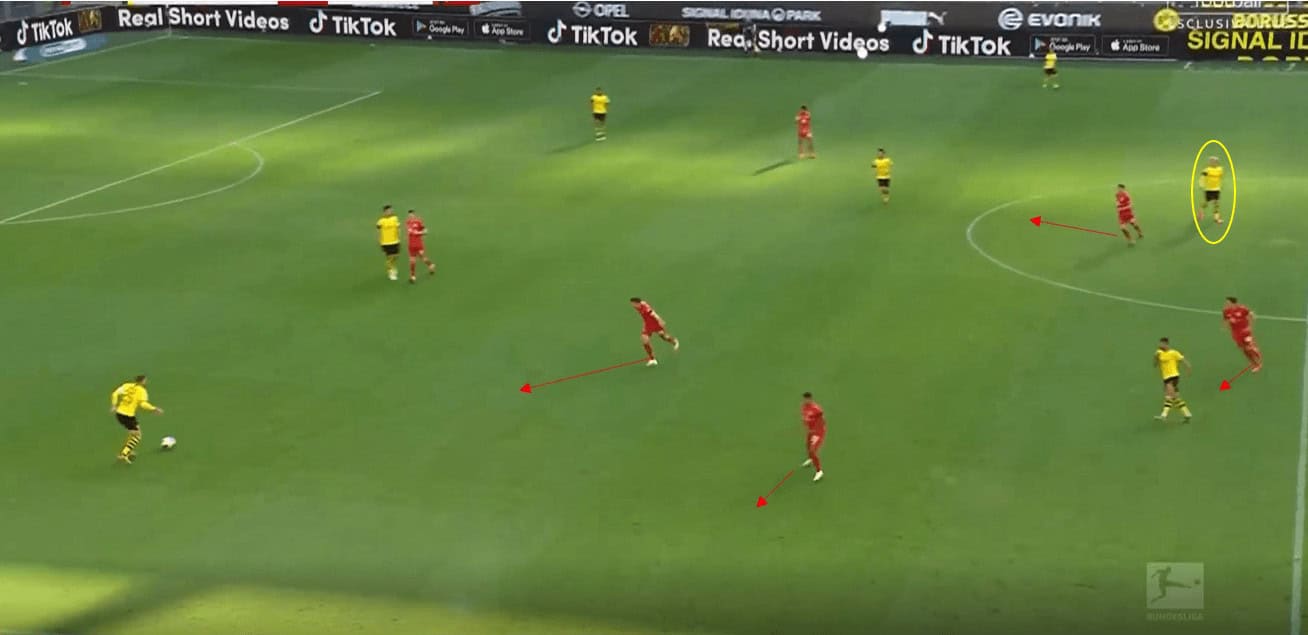
We can see an example of a back three creating more overloads here, with two central midfielders overloading the pressing ten.
The depth of these players can cause problems for the deeper-pressing midfielders within the 4-2-3-1 formation, and if offensive midfielders are used in these areas, overloads can be created.
We can see all the potential possibilities highlighted below, with overloads able to be created regardless of which player presses the ball near the pivot.

As we saw in previous variations against a back four, using the wingers to press inwards can often be a very useful strategy.
We can see an example of this below, against a 3-4-1-2 formation, where the pressure from the winger allows the pressing ten to commit to a midfielder, which helps reduce the chance of overloads being created.
Again, pressing triggers previously highlighted can be used here to lock the ball into one side of the pitch, which enables the best chance of maintaining pressure on the ball.
The full-back is likely to push slightly higher here in anticipation of the opposition potentially working the ball wide.

Conclusion
This tactical theory analysis has sought to explore some ideas surrounding the 4-2-3-1 and why it can often be a useful pressing scheme due to its staggered midfield formation, which helps to press against opposing pivots.
Like every formation, the 4-2-3-1 has advantages and disadvantages ,and the number of different roles each player can have allows for many variations of the formation.
Usually, the 4-2-3-1 formation serves as the base for the side before they react situationally to the opposition’s movement.
We see this with teams like Bayern Munich, where the press can transition from a 4-1-4-1 to a 4-4-2 and a 4-3-3, depending on the situation.
As I mentioned earlier in the article, it is the intentions and decision-making of the players that determine variations within shapes, and these decisions, made collectively, come together to form the ‘tactics’ of the team.



![Lazio Vs Napoli [0–2] – Serie A 2025/2026: Maurizio Sarri Zonal Marking Weaknesses And Unsuccessful Attacking Choices – Tactical Analysis](https://totalfootballanalysis.com/wp-content/uploads/2026/01/Lazio-Vs-Napoli-tactical-analysis--350x250.png "Lazio Vs Napoli [0–2] – Serie A 2025/2026: How Antonio Conte Tactics Exploited Structural Flaws – Tactical Analysis 25")