
After another successful season in which they won a third consecutive Belgian Pro League title, Club Brugge were once again on the hunt for a new permanent manager. After Phillipe Clement left to join AS Monaco at the beginning of the year, the club brought in Alfred Schreuder for the second half of last season. The Dutchman was a success, leading the club to the title, but he was offered the Ajax job in the summer, which proved too good of an opportunity to turn down.
After a short search, the club decided to promote within, handing the reins over to former player Carl Hoefkens. The Belgian had been a youth coach for the club for the few seasons prior, primarily working with the U18 and U21 teams. He also was regularly involved with the first team, working as an assistant coach under both Clement and Schreuder. The early results have been mixed, with Brugge not having the greatest start domestically but flying in the UEFA Champions League so far. This tactical analysis and scout report will take an early look at some tactics and trends that Hoefkens is starting to implement, and analyse how even though results have been mixed at times this season, the future is bright for Club Brugge under Carl Hoefkens.
Formational setup
Though it is still early days in Carl Hoefkens’ time in charge of Club Brugge, two formations are starting to stick out.

As the graphic above shows, through over half of the young season so far, Hoefkens has stuck with the 3-5-2 formation that Phillipe Clement started to implement near the end of his tenure and that Alfred Schreuder carried on through his. However, in more recent matches, the Belgian tactician has opted for a back four system, more specifically a 4-3-3. As this tactical analysis moves on, it will be illustrated how, at times, Hoefkens may alternate between a back-three and back-four shape.
Build up play
The first thing that will be analysed closely in this piece is the way that Club Brugge look to build up play under Carl Hoefkens. The Belgian champions have normally been a possession-based side, and this season has been no different. So far this term, Club Brugge have averaged around 56% possession, which shows their tendency of being a side that likes to build out from the back has not changed under their new manager.
This section will highlight Club Brugge’s build-up shape, as well as how positional movements are key to them quickly progressing the ball into the attacking areas of the pitch.

The image above shows an example of one shape that Club Brugge look to set up in during the build-up phases of play. It is essentially a 4-3-3, with the weak side full-back pushing higher up and the winger on the weak side tucking inside centrally to allow the full-back space to get forward down the flank.
The ball side full-back stays deeper, almost becoming a third centre-back during this phase of play. The midfield three form a triangle, and the more advanced two frequently will make movements off the ball, with former West Ham United target Hans Vanaken usually looking to split the attackers and make runs in behind the defence. The front three stay rather flat, with them looking to pin the defenders back so Brugge can build slowly through the backline and midfield.
At times, however, the defenders will look to play the ball long into the wide channels, with Club Brugge looking to create overloads in these wide areas. Though they would rather look to build up slowly, playing it long is an option if they get the matchups that they are looking for.

The image above again shows the build-up shape for Club Brugge, with it essentially being a slightly off-centred 4-3-3 shape. In this example, however, the left winger, Kamal Sowah, is positioned between both the striker and right winger, allowing Hans Vanaken a more free-roaming role on the left side, but still tucked in to allow the weak side fullback room to get forward. The next image goes over how this sequence develops, and what Hoefkens ideally wanted to happen.

In the previous image, Dennis Odoi was in possession for Club Brugge. This next image shows the next pass he played, to right winger Andreas Skov Olsen. Standard were operating out of a 3-5-2 formation, with the wingback for Standard stepping out to engage Skov Olsen as he received the pass. Former Leicester City player Kamal Sowah makes a run behind the defence, dragging the right centre-back of Standard out of position.
With the midfielder for the home side stuck in two minds over who to go towards, this left Casper Nielsen free, and with a gap to run into as a result of the right centre-back being dragged out of position by Sowah’s run. Unfortunately, Skov Olsen is not able to notice this quickly enough and gets it poked away from him, with the ball going out of play. Judging by the reaction of Hoefkens as the ball went out, he also noticed this intelligent movement to create space and knew that a good attacking chance went begging.
Creating overloads in the wide areas in attack
When analysing Club Brugge in attack so far this season under Carl Hoefkens, two things stand out when watching them in this phase of play. The first is their ability to create overloads, notably in wide areas. Under the Belgian manager, Club Brugge look to utilise the width, with their wide players being key to how they develop attacks and create chances. In Andreas Skov Olsen and Kamal Sowah, Hoefkens has two extremely talented wide players at his disposal — the former becoming one of Brugge’s best players since joining from Bologna in January of this year.

The data viz above shows Andreas Skov Olsen’s winger actions for Club Brugge so far this season in both the Belgian Pro League and UEFA Champions League. As illustrated above, he is heavily involved in the attacks, with a majority of the attacking moves finding their way to his side of the pitch. Following are a couple of examples of these overloads that Club Brugge looks to create in these wide areas, as well as keeping the width and attacking the wide channels as their primary route of attack.

The image above shows a good example of the attacking overloads that Club Brugge look to create in the wide areas, with Skov Olsen eventually being the creator of the goalscoring chance. As the example above shows, Club have created a 3v2 overload in this wide channel, with the FC Porto centre-back circled not stepping out of position to make attempt to make numbers even as this would open up the space between him and the other centre-back for the midfielder to run into behind him. This allows Skov Olsen the time and space on the ball once it is played to him, which opens up the crossing option towards former Barcelona striker Ferran Jutgla making a run into the box.
Even though Jutgla does not get onto the end of the cross, this can illustrate the danger that these attacking principles can cause. This is especially true when attacking down Skov Olsen’s side, with the Danish playmaker having five goals and three assists so far this season in all competitions.

The image above shows another example of Club Brugge looking to exploit the space in the wide channels by creating overloads. It must be prefaced by saying this attack resulted in the Cercle Brugge press breaking down, but the same general ideas are still prevalent in this example.
Once again, Club Brugge were able to exploit the opposition’s defence, creating an overload in this wide channel, with the three attackers again forming a triangle like the previous example. In this match, Club Brugge played a 3-5-2, with the player on the ball, Clinton Mata, being the right-sided centre-back. Skov Olsen is once again operating as the wide player, with Hans Vanaken shifting over in this sequence to create a numbers-up situation. The ball is played to Skov Olsen, who is able to get in behind and send another dangerous cross into the box, which unfortunately is cleared away by the Cercle Brugge defender. Again, another dangerous attack resulted from the same type of sequence.
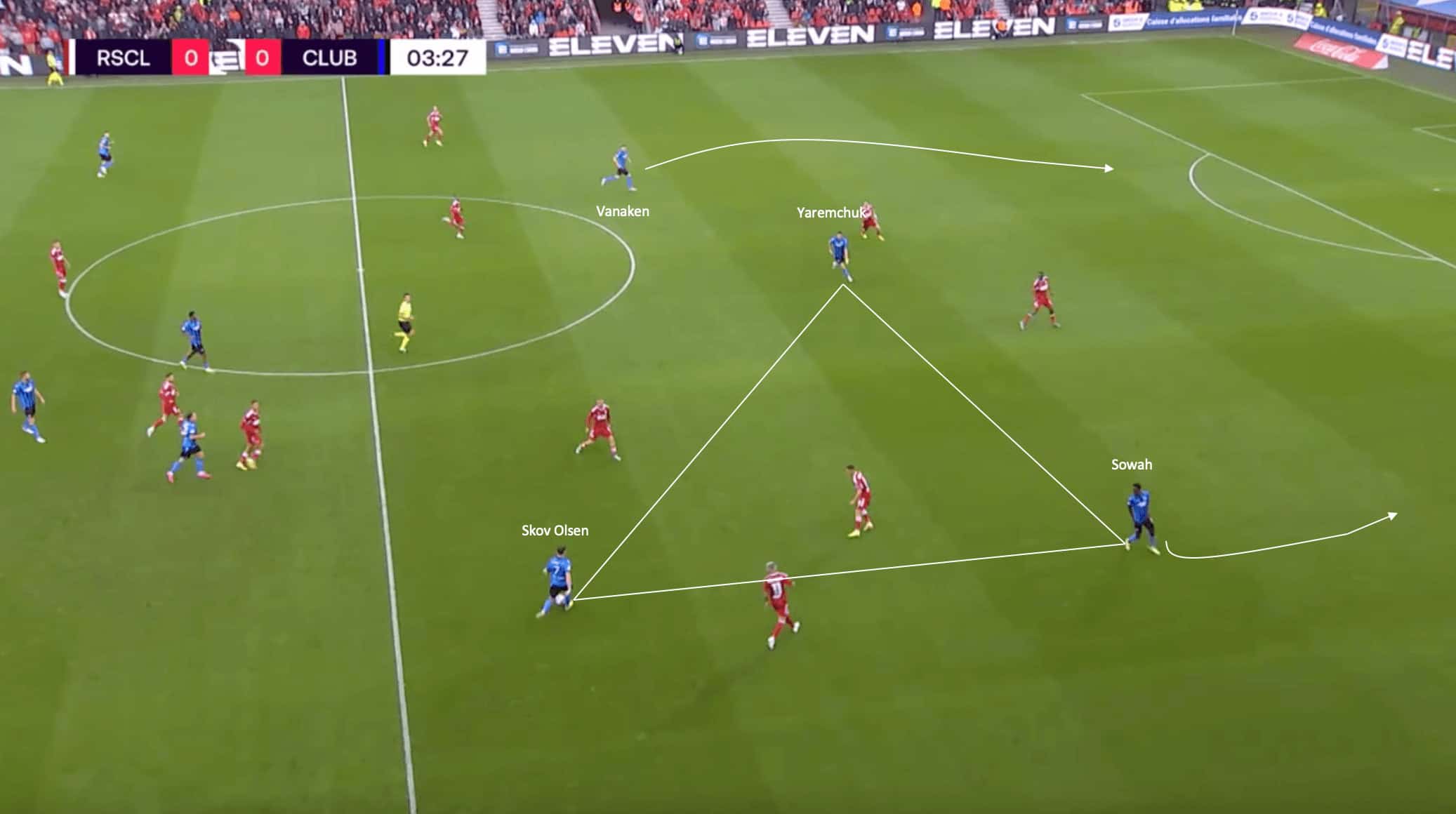
This final example shows another overload situation, but this time in a bigger section of the pitch, along with the intricate movement to occupy spaces left free by teammates. In this phase of play above, Skov Olsen is in possession, but occupying a deeper midfield position. The left winger, Kamal Sowah, has turned up in Skov Olsen’s position, occupying the space and becoming a wide option in this nearside wide channel.
Noticing the potential of an overload, Ukrainian striker Roman Yaremchuk drifts a bit wide, becoming a passing option for the Danish playmaker. These intricate movements cause the Standard Liége backline to get stretched, allowing Hans Vanken the space to run past the blind side of the defenders and into the box unmarked.
Skov Olsen’s ensuing pass finds Yaremchuk centrally, who can play it first time to Sowah, who after not being tracked, is free in behind to send a cross into the box. Vanaken also runs through unmarked, but unfortunately, Sowah’s cross is hit straight at the goalkeeper, preventing a very good goalscoring opportunity.
As this section has shown, while the attacking tactics that Carl Hoefkens has implemented at Club Brugge are not complex, they are highly effective. Utilizing this space out wide and creating overloads has created quality chances for the Belgian champions so far this season, especially with the talent that Hoefkens has at his disposal in these wide areas.
Keeping a high line and defending aggressively
When it comes to the defensive setup of Club Brugge under Carl Hoefkens, the most noticeable thing is how the backline is positioned. They normally hold a very high line, with the centre-backs positioning themselves near the halfway line when Club Brugge have possession in the attacking third. While this is a risky strategy, it pairs well with their philosophy of trying to win the ball back quickly and aggressively. In this section of the analysis, we will look more closely at this defensive strategy from Club Brugge, and why there are benefits, and detriments as well.

The image above shows an example of the high defensive line that Club Brugge like to try and hold. In this phase of play, Standard Liége won possession back just outside their penalty box, and this image shows the backline’s position after the first pass from Standard into the midfield.
While holding a high line in this fashion could be beneficial for offside traps, it is very tough to always get right, with a perfectly timed pass putting a forward through on goal for a 1v1 opportunity against the goalkeeper. Nothing good comes of this attack from Standard, but it can illustrate where the centre-backs of Club look to position themselves in transitional defensive moments.

As mentioned earlier, Club Brugge have also become a highly aggressive side defensively under Carl Hoefkens, with an example of that from their UEFA Champions League match against FC Porto above. Once again, the Club Brugge backline is holding a high line, and this is where we can see some aggressive defending from the Belgian side’s defenders. In this specific instance, the right-sided centre-back, Brandon Mechele, steps way up into midfield to challenge the Porto player after possession is turned over. The ensuing slide tackle results in a recovery of possession for the Belgian side, which allows them to continue to build.
These couple of examples were able to give a brief look at the type of defensive style that is starting to develop at Club Brugge under the management of Carl Hoefkens. While this is a high-risk defensive style of play, it could be huge for a side in creating chances going forward, when successful.
Conclusion
As this tactical analysis and scout report piece has shown, Club Brugge are beginning to develop an identity under Carl Hoefkens. Although it is still early in his time in charge of the Belgian giants, the early returns are promising for the future.
