
When talking about positional football, people think that it requires high-quality players to execute the tactics, such as Pep Guardiola’s Manchester City, Barcelona, and Bayern Munich. However, this is not something luxury for the big clubs only, since smaller teams might also play in that way if the clubs believed in the coach, including Graham Potter’s Östersunds FK and Brighton, Henrik Rydström’s Kalmar FF, Maurizio Sarri at Empoli and Roberto De Zerbi at Sassuolo if we recall the old days.
In Spain, Paco Jémez is another coach who embraced such kind of playing philosophy and who is also highly respected by Guardiola. At the end of 2021, he was appointed as the UD Ibiza head coach and given a contract until the end of the season. The club impressed with three consecutive victories after the arrival of Jémez, with score lines such as 6-2 and 5-0.
This tactical analysis will give an outline on what the new Ibiza looks like. Within one month, Jémez implemented structures, movements, and concepts to build a dynamic team, which was interesting.
Build-up, second phase & chance creation
In the first three games, Jémez played his side in a 4-2-3-1 with an almost unchanged lineup. David Goldar and Juan Ibiza played paired up as the centre-backs, with Miguel Cifuentes and Gonzalo Escobar as the full-backs. The midfield trio was formed by Pape Diop, Javi Lara, and Miguel Ángel Guerrero, except in the Málaga game, Lara was replaced by Manu Molina. The wingers were Mateusz Bogusz and Cristian Herrera, but we might see Miki Villar playing more because the Leeds United loanee suffered from a cruciate ligament rupture lately. Sergio Castel was the striker who started all games.

In the construction of the attack, the core was the four deep players in the centre as they must be deep. In the build-up, the full-backs mostly provide the width in the wide zones. Cifuentes was deeper in the first game but then Ibiza went out on the left side more often in the other two games. We must mention Escobar’s impressive performance against Málaga as the 24-year-old Argentine was dynamic with his movements and decisions.
Initially, the shape of Ibiza was a 2-2 because that was natural from their formation. However, the 6s was not moving behind the first line to receive the ball, and most of the time one of them would drop out as a half centre-back or as the third centre-back to receive. That also created a “+1” advantage against teams pressing with two strikers (3v2). But that 3v2 can also be formed by the goalkeeper as Álex Domínguez was required to participate in the attack as well. The above image shows Ibiza were able to bypass the first pressing line because the centre-back used the maximum width of the pitch. Then, finding Diop in the centre.
But it was about the manipulation of the second line. Only by doing so, Ibiza could create the free player in the first phase. By dropping the attacking players, the 10, or even the wingers around the second line, they kept the opposition midfielders deep. That’s why it was a 4-2-3-1 on paper, but sometimes it looked like a 4-1-2-3 as Lara would push higher into the same horizontal grid with Guerrero. In this scenario, they occupied the “2” of Alcórcon’s 5-2-3, so Diop had the space to receive.

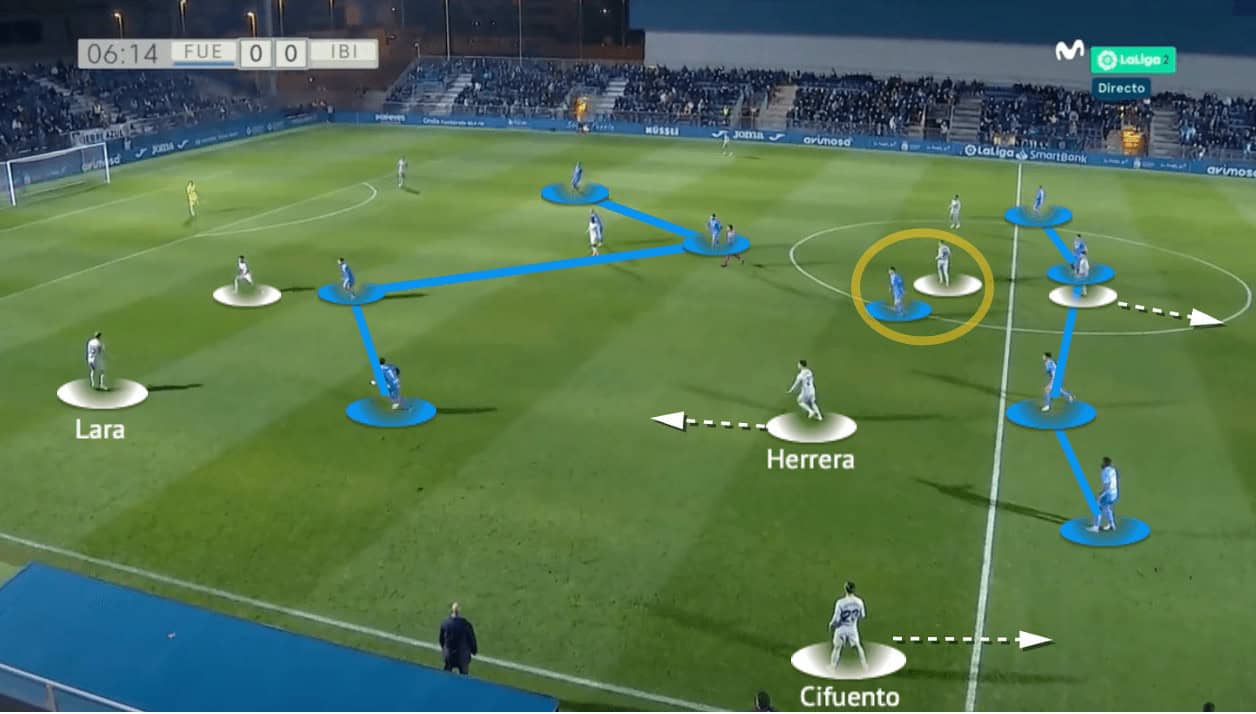
The manipulation of the second line could also be done alternatively, which was shown in the Fuenlabrada game where the opponents played a switch from a 4-1-4-1 to a 4-4-2. To create spaces for the deep Ibiza midfielders, Herrera and Castel moved into spaces behind the second line to drag the opposition midfielders down as circled. So, Diop and Lara had a 2v1 on the 10 of Fuenlabrada, and one of them would be free.
In the first game, Ibiza’s attacks were leaning on the right side with the right-back high and wide. The combinations on that side were often involving the collaboration of the winger and the full-back, they made movements accordingly to free each other while creating more passing options for the ball.
The above image is one of the attacking moves on the right side, it also included the positional concepts we mentioned previously. This time, Lara dropped to form a back three, with Diop as the holding midfielder. The manipulation of the second line was provided by Guerrero, who fixed the opposition 6 in the centre, and so Herrera became the free player in the half-spaces.

In the second and the third game, as explained in the above analysis, since Escobar demonstrated a high level of intelligence to solve the press, Ibiza played out on the left side more often. The wingers in general were given more freedom, as they no longer hold the touchlines to provide the widths constantly. Also, the combination between Cifuentes and Herrera did not work well in the
Against Alcórcon, Bogusz went infield more often to add an extra player in the centre, The Polish winger was dynamic and important to the team because he also possesses the pace to threaten the spaces behind, but he often dropped into the half-spaces in a correct timing to receive. Simultaneously, Escobar could run forward movements accordingly. If Bogusz is in the half-spaces, Escobar should run past the second line out wide to attack the wide spaces, creating temporary 2v1 situations on the right-back. If the left-winger stayed wider, Escobar could make some underlapping runs in the half-spaces and that was how he scored at Malága away from home.
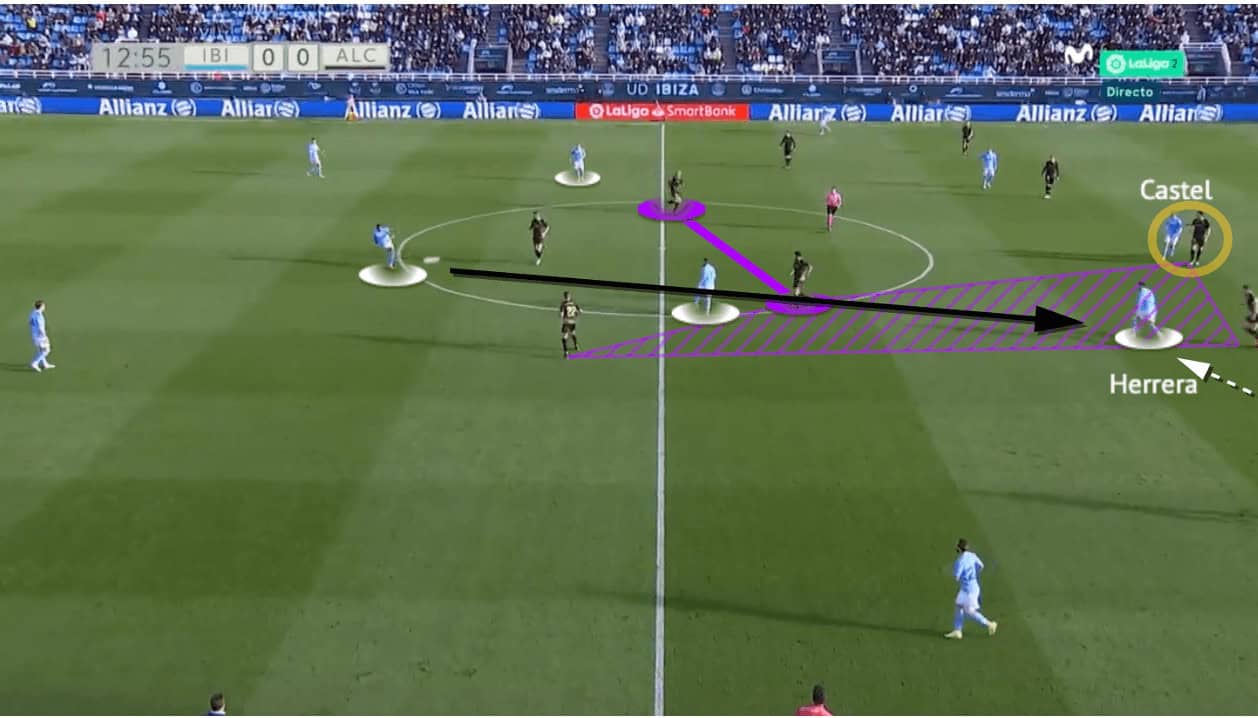
The same was spotted on the right side too, as Cifuentes went high and wide, Herrera could play in the half-spaces and receive in front of the last line as shown in the above image. This tactic also required the help of teammates as well, since the striker (Castel) should always be occupying the centre-back closer to the ball side, instead of staying in spaces.
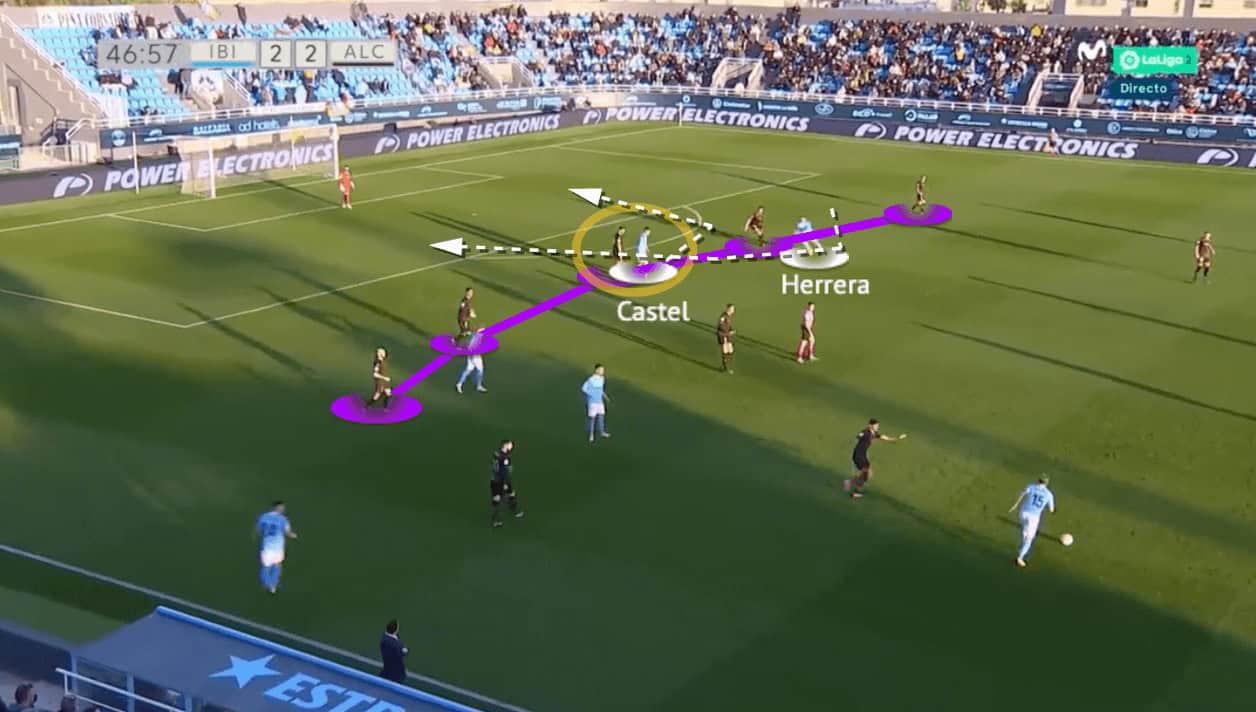
Apart from manipulating the second line, Jémez also wanted his team to search for the attacking depth constantly to engage or fix the last line of the defence. Therefore, the front three would always make runs in behind within different gaps. This could also be a way to create opportunities as well.
The above image shows an attacking move of Ibiza that Jémez might be including in the training sessions, which Herrera began his run from the right side, all the way to the channel on the inside. Simultaneously, Castel moved outward then run behind to avoid offside, so he would be eventually free for a tap in if Lara played an overhead pass, and Herrera serve the chance on the plate for the striker. This was one of the dangerous attacks, and with the same move, Castel found the net in the first half.
High pressing and defending
To dominate the opponents with more possession, the team must be able to press well so they could have the ball. Ibiza under Jémez averaged the PPDA at 5.72, if we compared to the league standard, that was very aggressive as 91% sides of the La Liga 2 ranged the PPDA at from 8 to 11. But how exactly would Jémez’s troops press? This section would address this question.
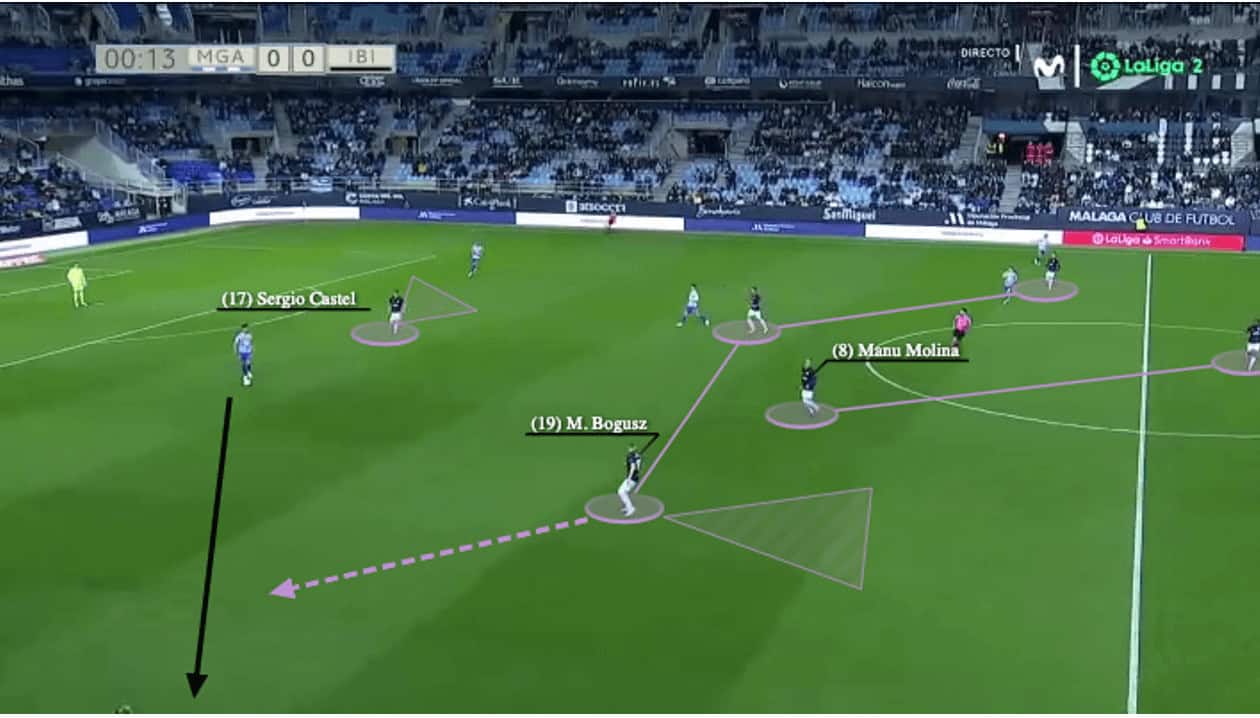
Ibiza’s pressing was initially in a 4-2-3-1 shape, with the striker cutting the passing lane between centre-backs to force the ball one side. Then, depending on the playing styles, formations, strengths, and weaknesses of the opponents, the winger would press the other centre-back, or delayed the press and lure the attack going outside.
In this case, Bogusz held the press and stayed in the half-spaces to narrow that vertical passing lane, so he invited the centre-back to pass the ball to the right-back. Then, it was a trigger for the left-winger jumping out to press, this run was expected to be a sprint, so the intensity was also maintained.
Also, we can note that Modina was higher than his partner, as Jémez always wanted Diop to cover the press. The midfield roles would be explained more later.
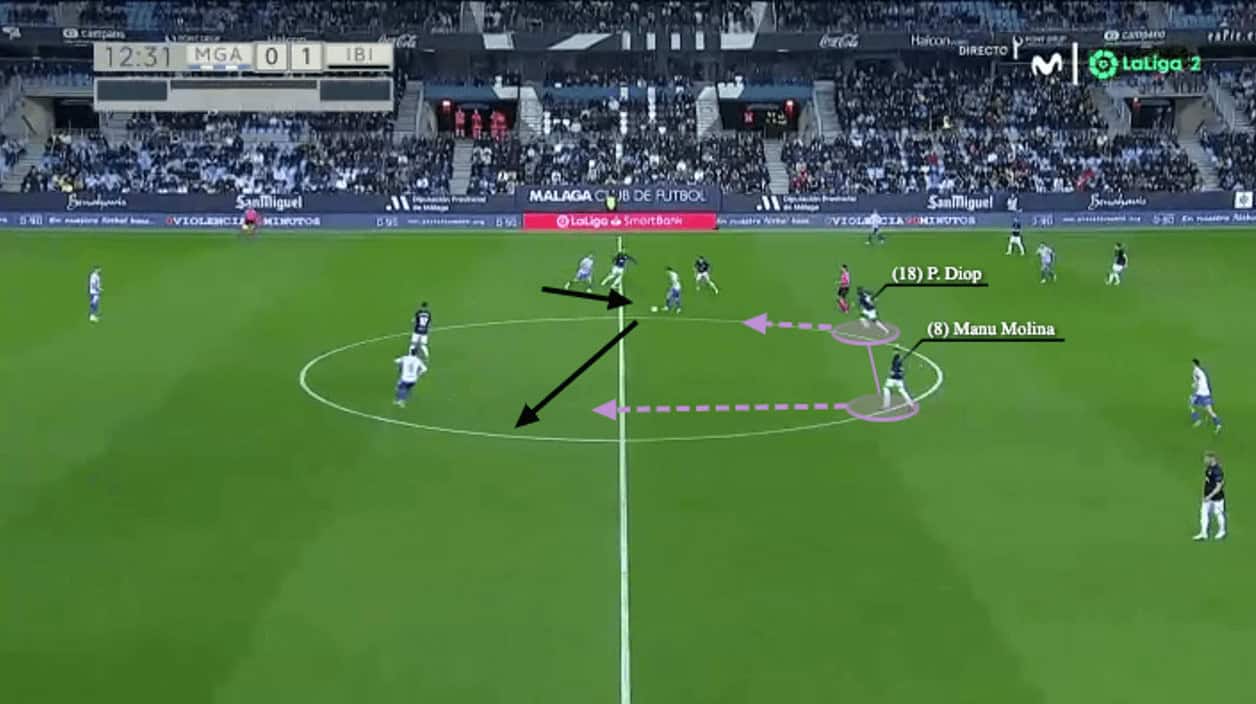
Here, this example shows the quality required by the midfielders. They must be able to close spaces in front and press vertically. Intriguingly, the choice in the midfield also determined the outcome. The partnership of Lara and Diop was milder, and both were not intense enough to close spaces, but they managed to start together because of the quality they possessed on the ball.
Comparatively, with Molina, Ibiza could be very aggressive in the press. As the game continued, the 30-year-old midfielder was even granted the permission to press higher as a 10. In the above example, it shows how alert were the Ibiza midfielders when the team was pressing. When the square pass was made in the midfield, Molina jumped out to intercept as Ibiza’s 6s should always keep a good eye on spaces in front.
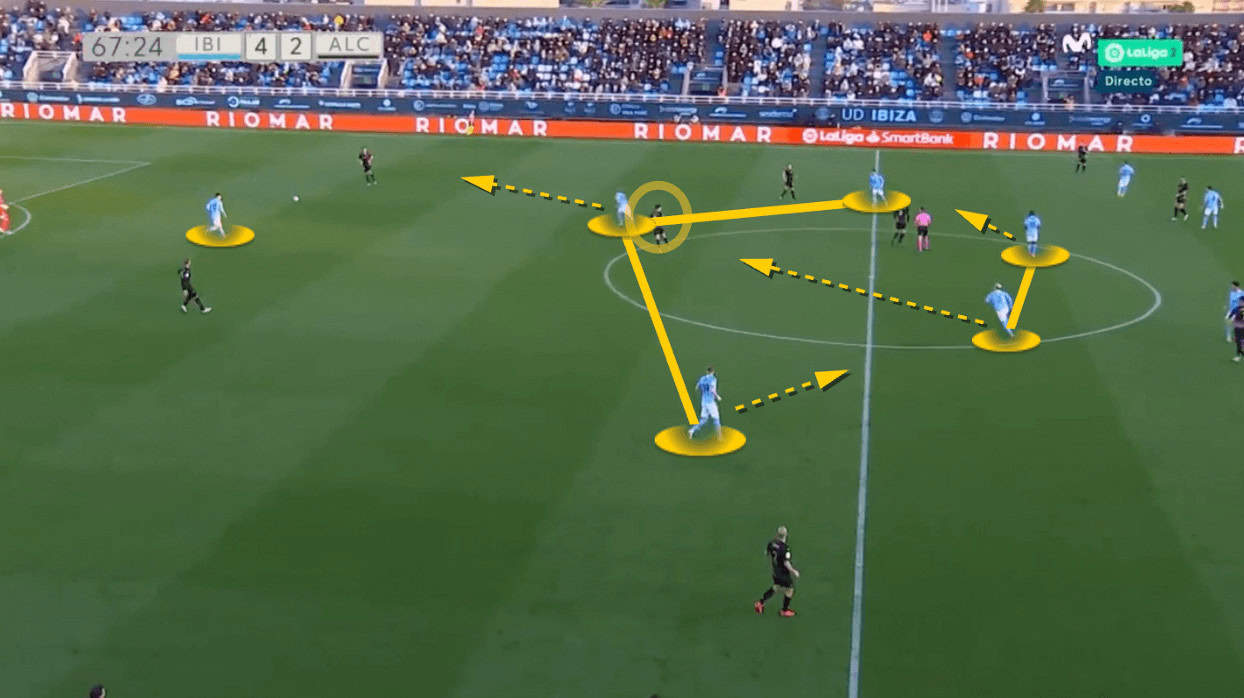
This was also important as a defensive cover. In this situation above, when the Ibiza 10 went out to press the centre-cack, it was not the winger to get in to mark the opposition defensive midfielder. Instead, it was the Ibiza 6 to jump out of press, while the wingers were retreating to protect deeper spaces.
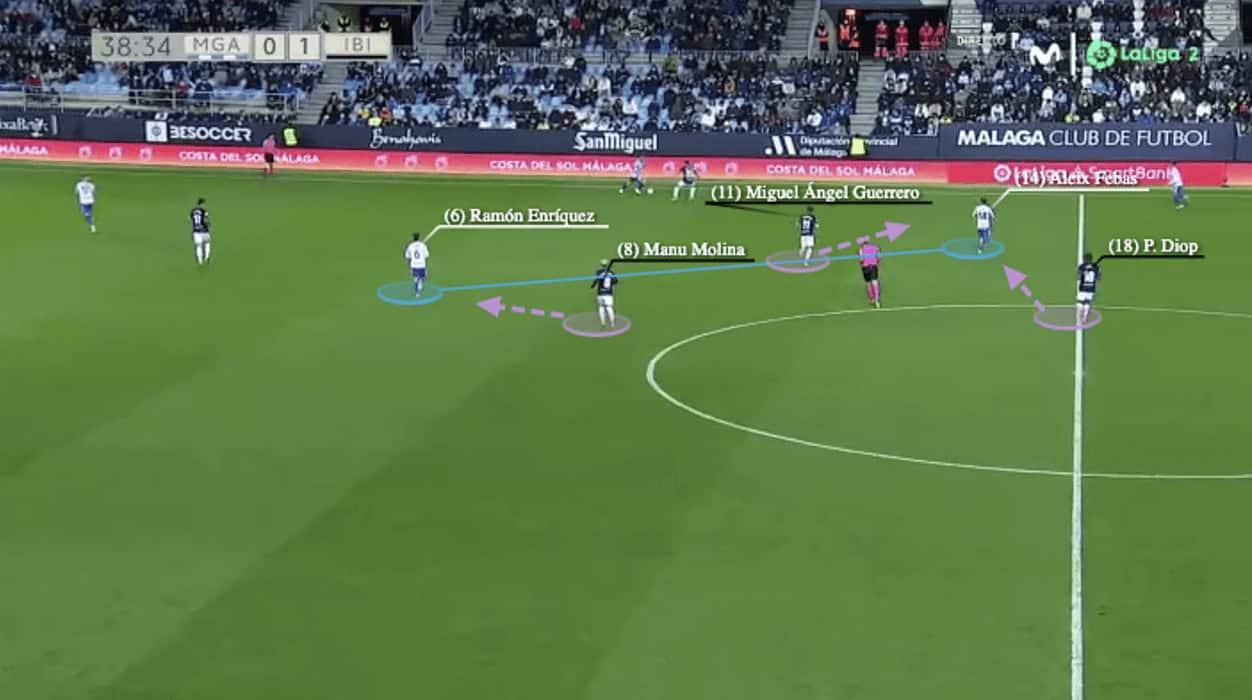
A secret of Ibiza’s defence was the pressing and cover concept with the application of “+1” numerical superiority in the midfield. For example, they had three midfielders against Malága’s 4-4-2, and the three Ibiza midfielders always moved together to make sure they had one more man on the ball side to close the wide spaces.
So, even the Malága 6s split to stretch Ibiza, they had enough coverage. As highlighted above, Ramón Enríquez and Aleix Febas spread two horizontal grids to separate Guerrero and Molina, but Ibiza were very compact because Diop always scanned and covered his teammates from the centre. Even the pressing intensity of the 35-year-old midfielder might be lacking, he was good at delaying the progression of the attack with his body orientation.
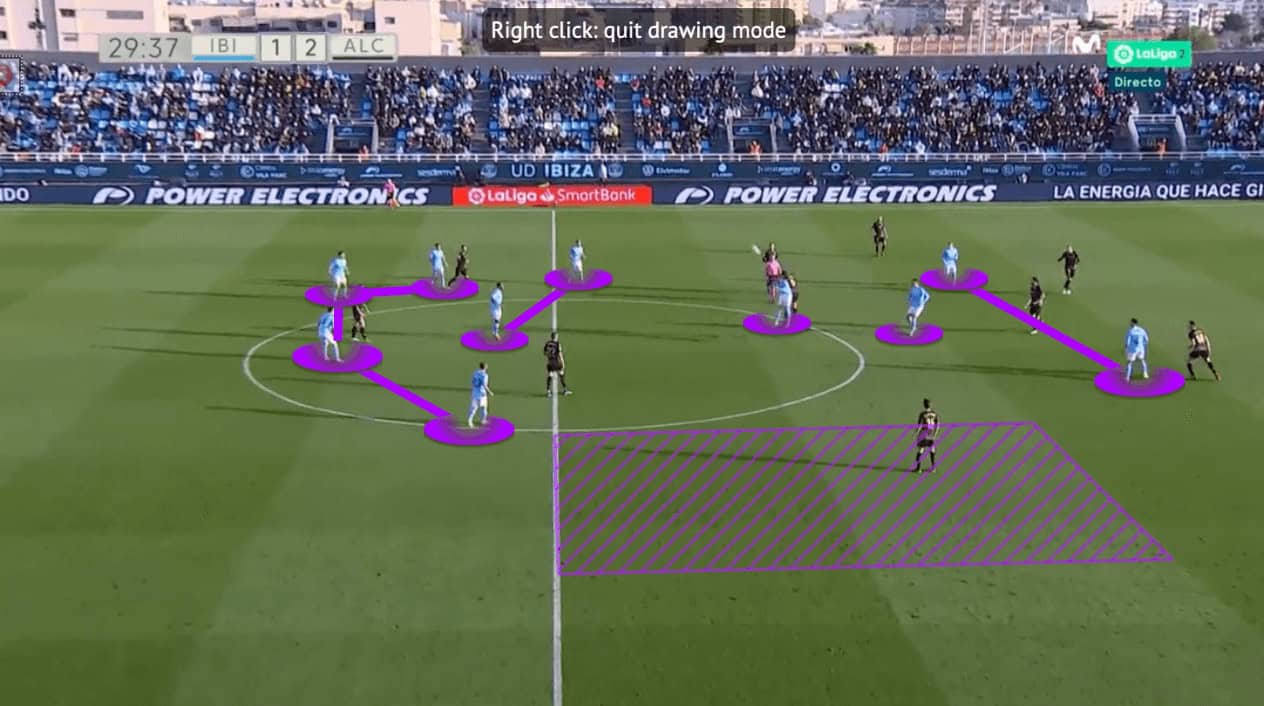
However, in the Alcórcon game, Jémez’s troops conceded some opportunities in the first half that could be costly. The main issue was the wide defending as a result of losing second ball battles. The second ball structure was exposing the wide spaces and the weaknesses of the 6s. Since the wingers were staying high and around the last line for potential flips or runs in behind, the outside spaces in front of full-backs were opened. In this scenario, zone purple was big and this was a space uncontrollable if the ball dropped there, the 6s could not close that space effectively.
Then, when the opposition came, Ibiza messed up a bit in the zonal defensive system as the full-back did not move out enough to limit the angle of the wide player. The communication between the centre-back and full-back could be improved since they conceded so many balls in spaces behind.
Transitions
According to José Mourinho, transitions have become a very important part of modern football. A team must be able to perform in four phases, not only in the attacking and defending phases. For teams like Jémez’s Ibiza, they could establish a better control with a rest defence structure.
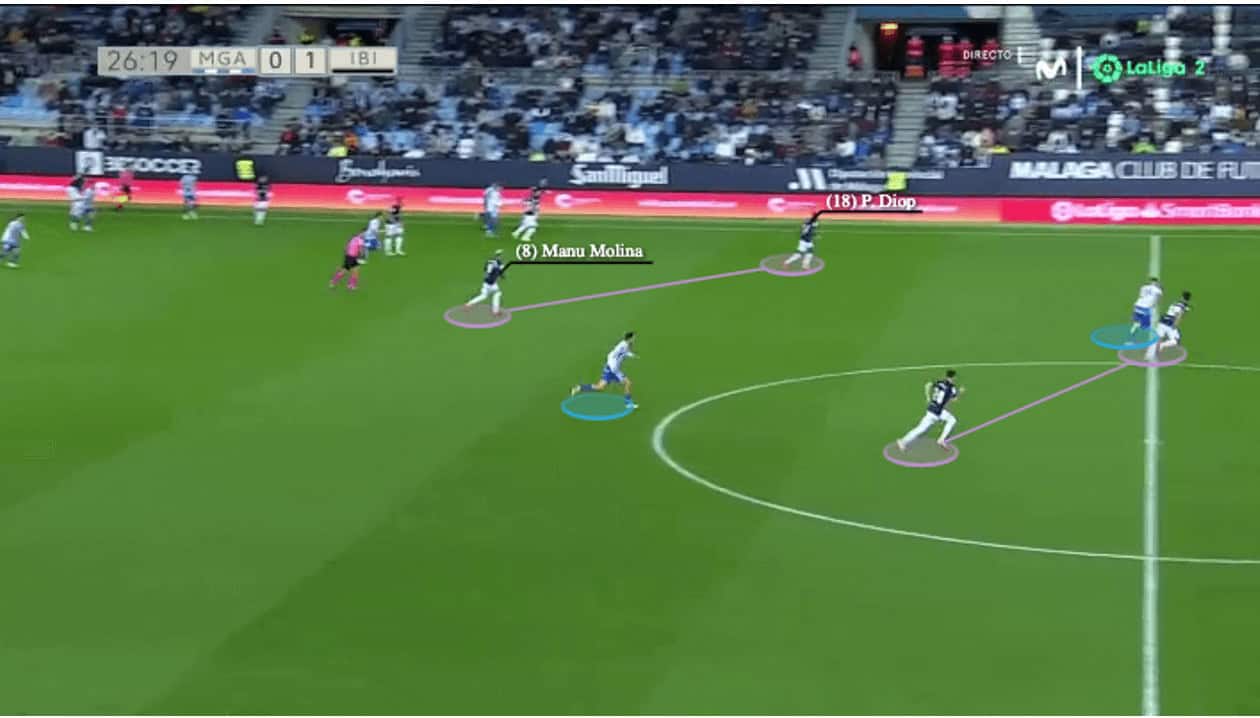
Naturally appearing from the 4-2-3-1 formation, and also given Ibiza were using four deep players in the construction of the attack, the rest defence was also formed by four players as well. It was a zonal structure, meaning that regardless of the opponents’ rest offence structure, the shape should always be a 2-2 or a 3-1. The centre-backs must be fully aware of the spaces behind because the 6s were more responsible for picking the clearances as shown in the above image.
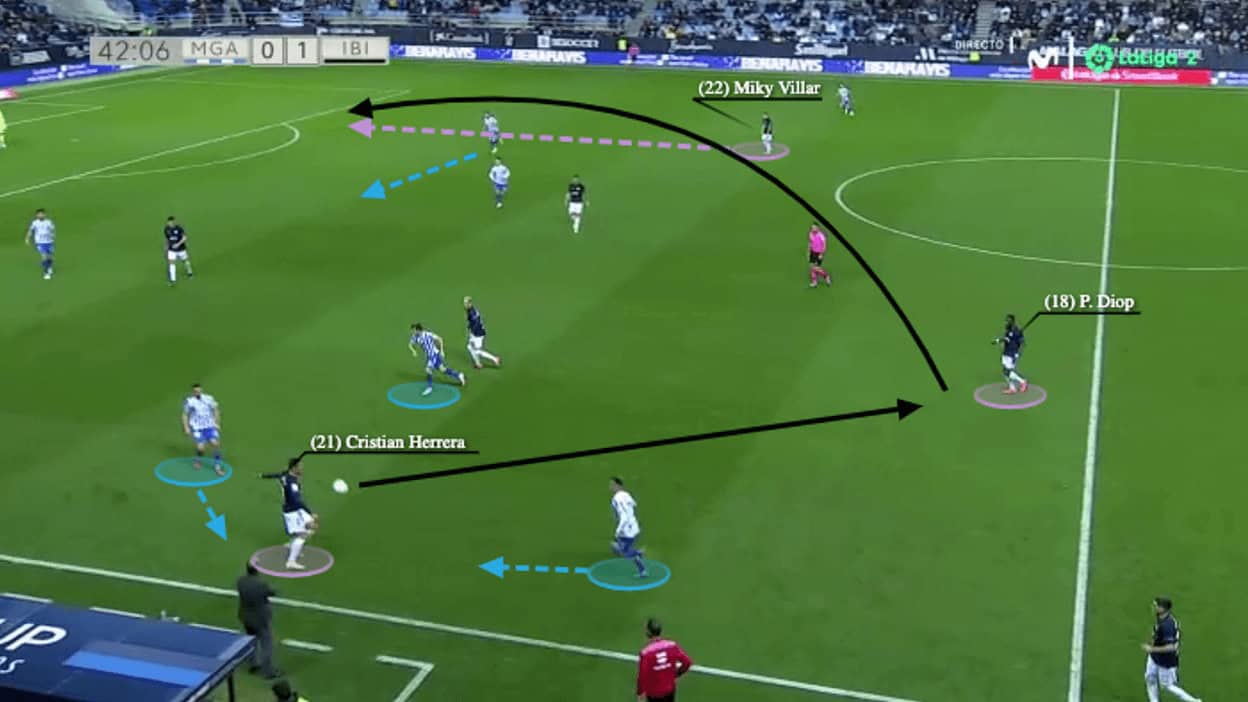
In the offensive transitions, maybe the Jémez’s style of play might give a false impression of keeping possession for its sake. On the contrary, possession was no more than a tool to control the game or attacking in a better condition. If the gaps were presented, Ibiza players would not hesitate to make runs in behind and that was especially obvious in the offensive transitions. Hence, retaining possession, making short passes were not the strict guidelines once they recovered possession, they needed to seize the moment to create clear-cut opportunities.
Under Jémez, they had scored goals in this phase, such as Bogusz’s 1v1 goal at Alcórcon. In the above image, we give another example on how quick the Ibiza attack could be. It was a scenario in which Ibiza just regained possession, when Herrera gave the ball to Diop, the 35-year-old midfielder did not pass the ball back to keep the ball. Instead, he spotted the early run of Villar, and did not hesitate to release the winger. The aggressiveness and forward-thinking mindset of Ibiza during the offensive transitions was also another source of chance creations.
Conclusion
The start of Jémez at Ibiza was really good. In the first three games, the xGs are higher than the xGA (2.44-1.9; 3.22-1.39; 1.26-0.56). This analysis mainly introduces Ibiza in the second half of the season from the team’s perspective. Individually, several players also thrived under the new head coach, including the likes of Bogusz, Lara, and Diop. We don’t know whether Jémez would be staying longer at Ibiza, but if we would, probably the position they need reinforcement is the central midfielder, as the 6s are already 35 and 36, more energy and fresh legs might be injected. Let’s see how high could they achieve in this campaign.
