Total Football Analysis
Once.Sport
  • Football Analysis
    • Data Analysis
    • Formations
      • 2-2-4 Formation
      • 2-3-5 Formation
      • 3-1-4-2 Formation
      • 3-2-2-3 Formation
      • 3-2-4-1 Formation
      • 3-1-6 Formation
      • 3-3-4 Formation
      • 3-4-1-2 Formation
      • 3-4-2-1 Formation
      • 3-4-3 Formation
      • 3-5-1-1 Formation
      • 3-5-2 Formation
      • 4-1-4-1 Formation
      • 4-2-2-2 Formation
      • 4-2-3-1 Formation
      • 4-2-4 Formation
      • 4-3-1-2 Formation
      • 4-3-3 Formation
      • 4-4-2 Formation
      • 4-5-1 Formation
      • 5-3-2 Formation
      • 5-4-1 Formation
      • 6-3-1 Formation
    • Head Coach Analysis
    • Match Analysis
    • Player Analysis
    • Recruitment Analysis
    • Set Piece Analysis
    • Tactical Theory
    • Tactical Preview
    • Team Analysis
    • Training Analysis
    • Tactical Analysis
    • Scouting Report
  • Competition
    • ALL Competitions
    • English Premier League
    • Champions League
    • La Liga
    • Bundesliga
    • Serie A
    • Ligue 1
    • Eredivisie
    • EFL Championship
    • FIFA World Cup 2022
    • WEURO 2022
    • Women’s Super League
    • NWSL
    • Belgian First Division A
    • A-League
    • Liga Profesional de Argentina
    • Austrian Bundesliga
    • Campeonato Brasileiro Série A
    • DFB Pokal
    • 1. HNL
    • Danish Superliga
    • EFL League One
    • EFL League Two
    • FA Cup
    • EFL Cup
    • Indian Super League
    • K-League
    • J1 League
    • Liga MX
    • Copa América 2021
    • Copa del Rey
    • MLS
    • Eliteserien
    • Euro 2020
    • Primeira Liga
    • Scottish Premiership
    • Allsvenskan
    • Europa League
    • UEFA Nations League
    • Liga AUF Uruguaya
  • Coaches
    • All Coaches
    • Alfred Schreuder
    • Ange Postecoglou
    • Antonio Conte
    • Arne Slot
    • Bo Svensson
    • Brendan Rodgers
    • Bruno Lage
    • Carlo Ancelotti
    • Christophe Galtier
    • Claude Puel
    • Claudio Ranieri
    • David Moyes
    • Dean Smith
    • Diego Simeone
    • Domenico Tedesco
    • Frank Lampard
    • Eddie Howe
    • Edin Terzić
    • Emma Hayes
    • Erik ten Hag
    • Ernesto Valverde
    • Gennaro Gattuso
    • Gerardo Seoane
    • Gian Piero Gasperini
    • Giovanni van Bronckhorst
    • Graham Potter
    • Igor Tudor
    • Imanol Alguacil
    • Jesse Marsch
    • Jonas Eidevall
    • Jorge Sampaoli
    • José Bordalás
    • José Mourinho
    • Julen Lopetegui
    • Julian Nagelsmann
    • Julien Stéphan
    • Jürgen Klopp
    • Luciano Spalletti
    • Lucien Favre
    • Manuel Pellegrini
    • Marcelo Bielsa
    • Marco Rose
    • Marco Silva
    • Massimiliano Allegri
    • Mauricio Pochettino
    • Maurizio Sarri
    • Mikel Arteta
    • Niko Kovač
    • Nuno Espírito Santo
    • Oliver Glasner
    • Patrick Vieira
    • Paulo Fonseca
    • Pep Guardiola
    • Peter Bosz
    • Rafa Benítez
    • Ralf Rangnick
    • Ralph Hasenhüttl
    • Roger Schmidt
    • Roy Hodgson
    • Sean Dyche
    • Sérgio Conceição
    • Simone Inzaghi
    • Sonia Bompastor
    • Stefano Pioli
    • Steffen Baumgart
    • Steven Gerrard
    • Thiago Motta
    • Thomas Frank
    • Thomas Tuchel
    • Unai Emery
    • Vincenzo Italiano
    • Xavi
  • Teams
    • ALL Teams
    • AC Milan
    • Ajax Amsterdam
    • Arsenal
    • AS Monaco FC
    • Atalanta
    • Atlético Madrid
    • FC Barcelona
    • FC Bayern Munich
    • Borussia Dortmund
    • Celtic FC
    • Chelsea FC
    • Everton F.C.
    • Inter Milan
    • Juventus F.C.
    • Leeds United F.C.
    • Liverpool FC
    • Manchester City
    • Manchester United FC
    • Paris Saint-Germain
    • Rangers FC
    • RB Leipzig
    • Real Madrid CF
    • Tottenham Hotspur
    • West Ham United
  • Players
    • ALL Players
    • Alisson Becker
    • Bukayo Saka
    • Erling Haaland
    • Harry Kane
    • Jack Grealish
    • John Stones
    • Julián Alvarez
    • Kalvin Phillips
    • Kevin De Bruyne
    • Kyle Walker
    • Kylian Mbappé
    • Lamine Yamal
    • Lionel Messi
    • Luis Díaz
    • Mohamed Salah
    • Phil Foden
    • Virgil Van Dijk
  • Contact
  • Write For TFA
No Result
View All Result
No Result
View All Result
Total Football Analysis
No Result
View All Result
Home Competitions EFL League One

EFL League One 2019/20: Ipswich Town vs Sunderland – tactical analysis

Daryl Gouilard by Daryl Gouilard
August 12, 2019
in EFL League One, Match Analysis
0
EFL League One 2019/20: Ipswich Town vs Sunderland - Tactical Analysis tactics

Artwork by @Chapulana

The first matchday of League One witnessed some interesting results as the highly rated teams secured their first points of the season. Ipswich and Sunderland were two of the names that have gone through difficult ties but still able to bring home the points. These two former Championship teams faced each other at Portman Road on match week two.

Their states were quite different from each other as Ipswich were just relegated from the Championship. They struggled last season for a spot in the league but eventually fell short. However, in this window, they have shown a clear intention of returning by securing new signings like Luke Garbutt or James Norwood.

For Sunderland, this will be their second season in League One after finishing second-best in the play-offs to Charlton. They have had a very tepid transfer window with many of their key players departing, but they have brought in names such as Jordan Willis and George Dobson to bolster the squad. With a very experienced squad on his hands, Jack Ross must surely be expecting for a return to the Championship.

This tactical analysis will provide an analysis on the 1-1 draw between the two teams. Using statistics and graphs, we will point out how Sunderland’s tactics secured the one point away from home.

Lineups

Paul Lambert lined his side up in a 4-4-2 formation with Tomáš Holý his first choice in goal. Youngster Luke Woolfenden started alongside club captain Luke Chambers as centre-backs, while Janoi Donacien and Myles Kenlock played as full-backs.

Protecting the central defensive partnership was another pair of young veterans in Flynn Downes and Cole Skuse. Danny Rowe and new signing Luke Garbutt provided the width while Kayden Jackson and League Two top-scorer James Norwood were responsible for the goals.

EFL League One 2019/20: Ipswich Town vs Sunderland - Tactical Analysis tactics
Ipswich and Sunderland’s lineups [Wyscout.com]
Ross’ Sunderland started with a 4-3-3 formation that consisted of four new signings. Contrast to the 3-4-3 lineup from above, centre-backs Tom Flanagan and Jordan Willis positioned in front of Jon McLaughlin’s goal. On both wings were wing-backs Denver Hume and Conor McLaughlin while Aiden McGeady and Lynden Gooch played as wingers.

Centrally, another new signing George Dobson completed the midfield line with Dylan McGeouch and Luke O’Nien. Upfront, Marc McNulty became the fourth signings to appear in the squad.

Ipswich’s style of play

Out of possession, Ipswich defended with a 4-4-2 defensive structure. They also adopted a high defensive line to support the press upfront. The strikers would apply pressure on Sunderland’s centre-backs and prevent the build-up. When the ball was circulated to the midfielders, Jackson and Norwood dropped deep and switched their marking target to Dobson and McGeouch.

The midfield line shifted freely in between the channel and limited the spaces surrounding them. It prevented the opposition strikers from positioning themselves between the lines and sit on the shoulder for a counter-attack. Also, it made it easier to create numerical superiority in defence and allowed them to defend the box in an efficient way.
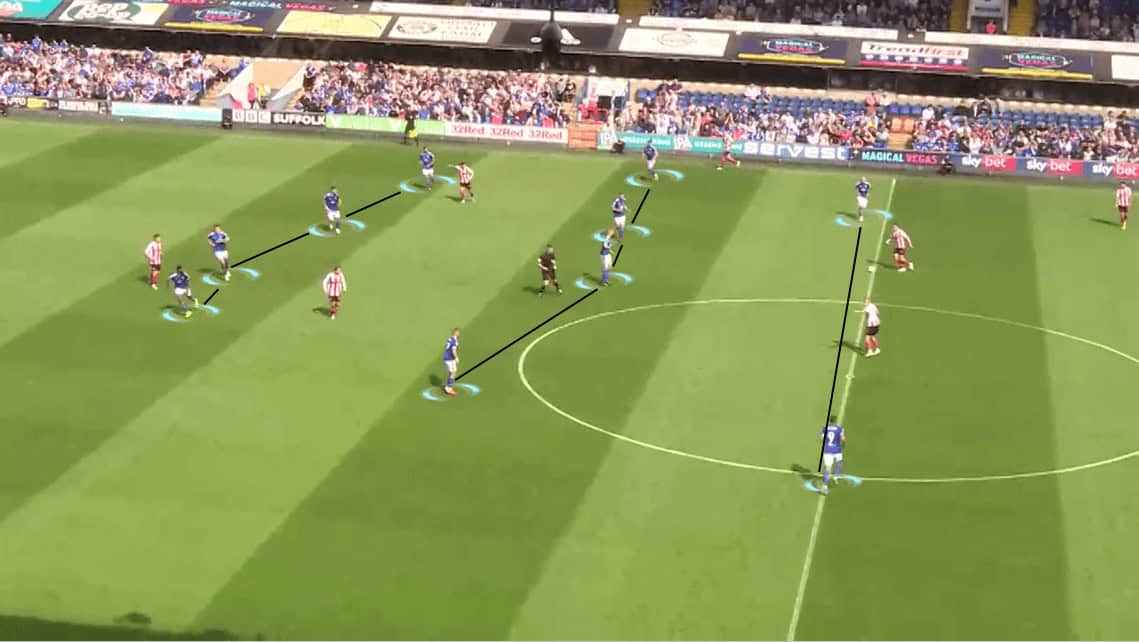
EFL League One 2019/20: Ipswich Town vs Sunderland - Tactical Analysis tactics
Ipswich’s 4-4-2 defensive structure

When the ball reached Ipswich’s defensive third, their narrow shape would shift along with the ball. This allowed them to create an overload in a certain area similar to the situation below.

After Sunderland distributed wide, four of their players would move to the flank and match the number. Although they still remained a part of the structure, filling in the spaces on the wide space meant that the opposition couldn’t enter the box with the ball. Also, by creating a cage that locked two possible passing options up, Ipswich defenders had forced Sunderland to make a backpass and restart the attack.
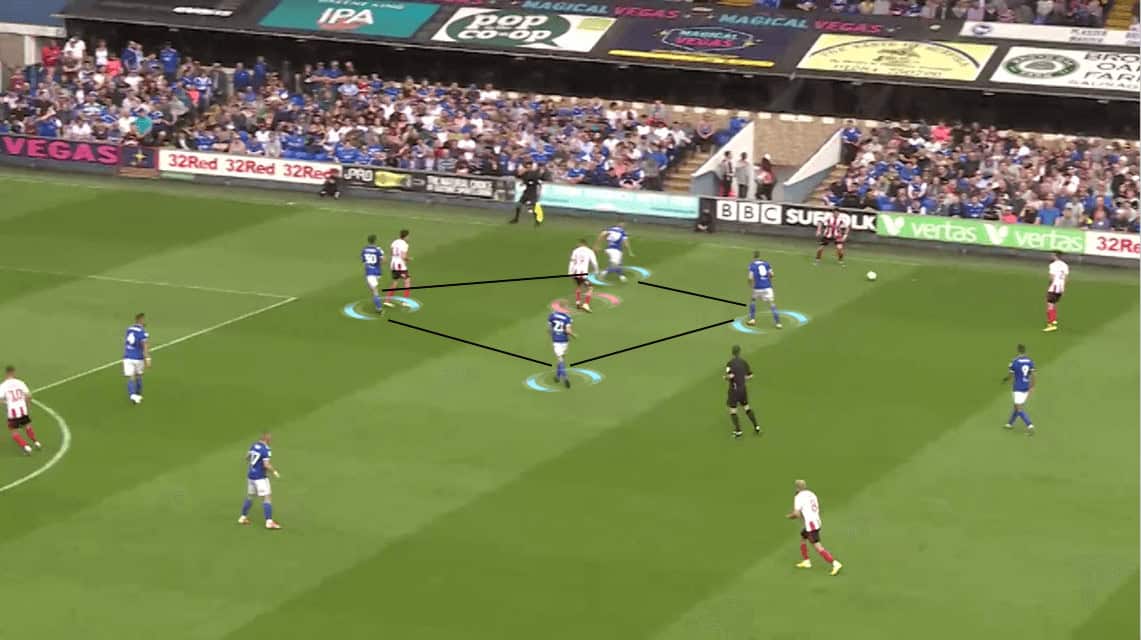
EFL League One 2019/20: Ipswich Town vs Sunderland - Tactical Analysis tactics
Ipswich players created a cage to lock up two Sunderland players

High up the pitch, they adopted a similar press out wide which involved the borderline. Three players stayed inside and formed a pressing shape to push the ball-carrier into the wide area. They kept a sufficient distance between each other as this would help them provide supports if the ball was heading to one of their teammates.

In case one of the players decided to come short and provide a passing option, they would stretch the shape out and locked him up too. Superior in numbers, Ipswich could tackle the ball and recover possession to counter-attack.
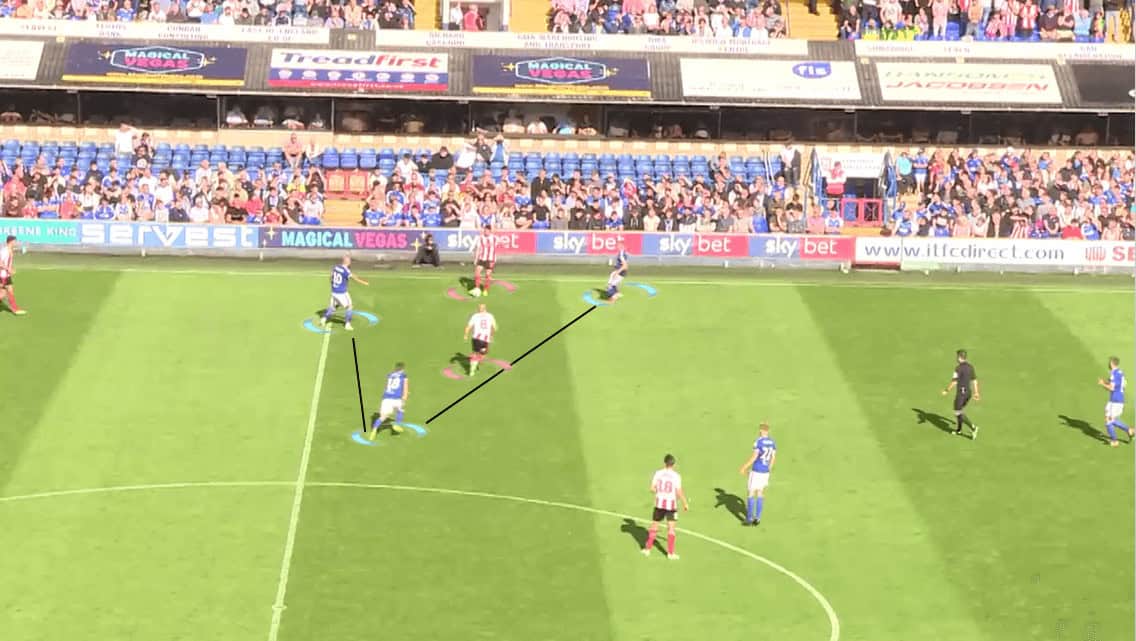
EFL League One 2019/20: Ipswich Town vs Sunderland - Tactical Analysis tactics
Ipswich’s pressing trap inside the wide space

But playing with a high defensive line created a huge disadvantage for Ipswich. Sunderland were able to play long balls into the spaces behind the line for McNulty, who has the pace to sprint with the ball. One of those situations had turned into Sunderland’s only goal of the game.

From a long throw-in, Chambers ran after the ball but faced the pressure from McNulty. The club captain eventually lost the ball in a duel with the former Coventry’s striker and he picked out Gooch’s run with a short pass.
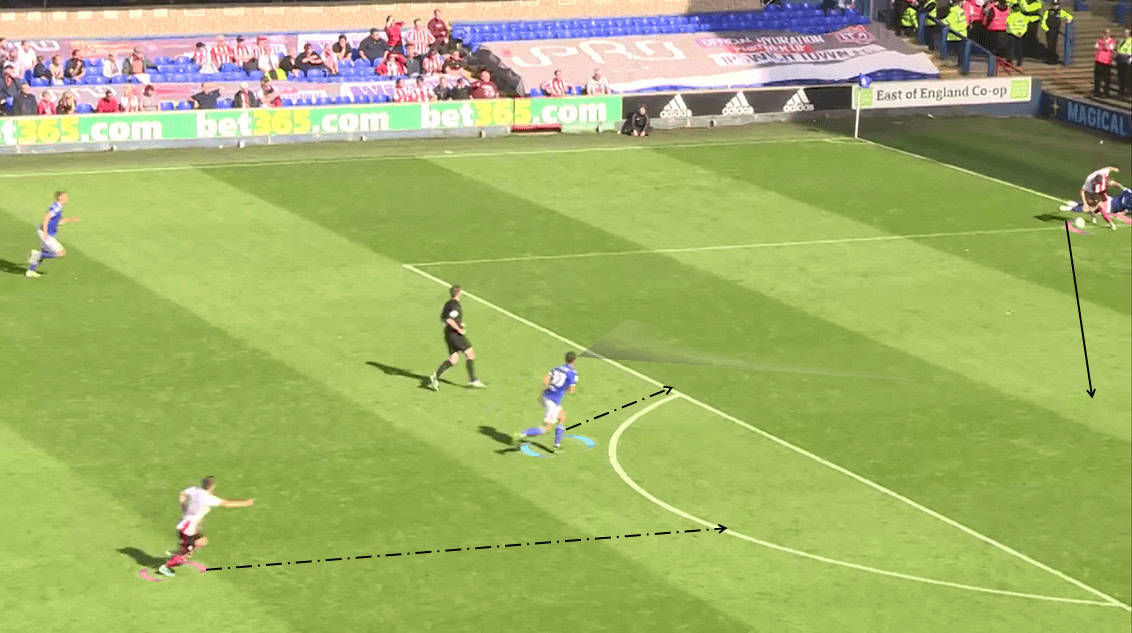
EFL League One 2019/20: Ipswich Town vs Sunderland - Tactical Analysis tactics
McNulty won the duel over Chambers and assisted Gooch’s equalising goal

In attack, they relied on direct passes and long balls to bring their teammates up the pitch. Although the precision of most passes might not be very high, they were able to reduce the build-up time. This is why they didn’t hold much of the possession but still created seventeen chances towards McLaughlin’s goal.

The average position and passing map also showed the directness of their pass through the density of passing arrows. There weren’t many links created on the field besides between the central midfielders and after Alan Judge was subbed on.

Also, notice how high Jackson’s average position is. He acted as the target man and usually worked between the spaces of Sunderland’s defenders. Meanwhile, his partner, Norwood, had the tendency of dropping deep and brought his teammates into play. The duo also capitalised on Sunderland defenders’ heavy touches to steal the ball and sprinted towards the goal.

EFL League One 2019/20: Ipswich Town vs Sunderland - Tactical Analysis tactics
Ipswich’s average position and passmap [Wyscout.com]
They also attempted to put in crosses and utilised the physicality of the strikers. Usually, the crosses came from the right-hand side. But, surprisingly, two of the three most crossers were two substitutes, Judge and Andre Dozzell.

When Judge was on the field, he occupied the right midfielder spot of Rowe, who couldn’t leave his mark. The former Brentford man tended to dribble up the right flank and distributed the ball into the box. Jackson also shifted wide on several occasions to pick up the ball and crossed the ball towards the head of Norwood.

EFL League One 2019/20: Ipswich Town vs Sunderland - Tactical Analysis tactics
Ipswich’s crossing graph [Wyscout.com]

Sunderland’s style of play

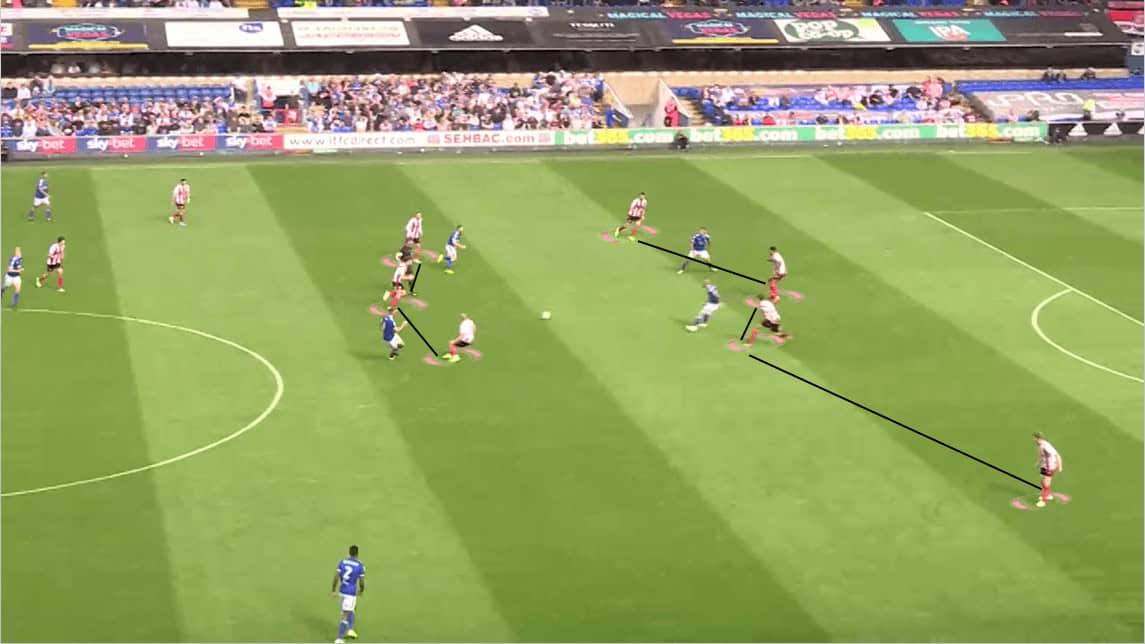
According to Wyscout, Sunderland lined up with a 3-4-3 formation with Conor McLaughlin occupying one of the centre-back’s position. But on the field, the Northern Irish defender usually drifted wide and occupied the right wide space. This turned their backline into a back-four.

O’Nien joined the midfield three and screened the spaces in front of and behind themselves. But there were major problems that Sunderland occasionally showed in the game.
EFL League One 2019/20: Ipswich Town vs Sunderland - Tactical Analysis tactics
Sunderland’s 4-3-3 defensive structure

Firstly, they usually left their original position just to follow one of the opposition’s player. This created spaces in between the defenders and even in front of the box. Clearly, Jackson and Norwood had capitalised this effectively through position interchanging.

Secondly, the midfield line sat very high and joined the press alongside the strikers. Again, spaces were created between the channels and both of Ipswich’s wingers, Judge and Garbutt occasionally moved in and worked the inside area.

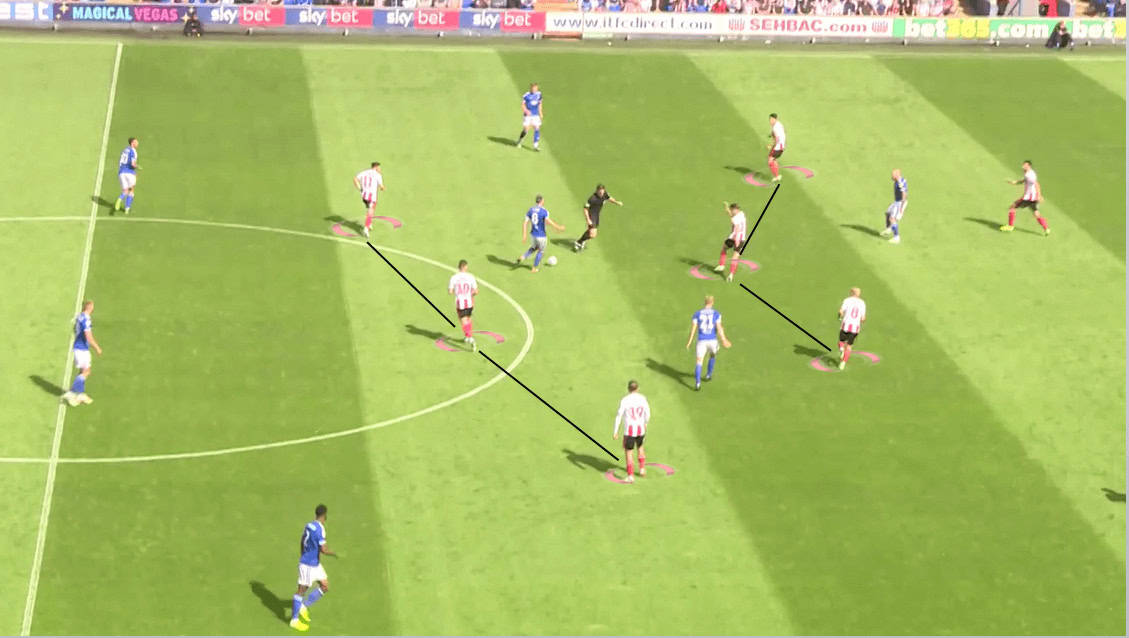
As we speak about Sunderland’s press, they formed two pressing lanes and tightened the spaces available surrounding the ball-carrier. Rather than marking the possible passing options, the midfielders would actively get stuck in and tackle the ball inside the ball carrier’s feet. Meanwhile, the strikers provided supports behind and prevented a backpass option.

They pressed aggressively and didn’t leave too much time and space for the ball-carrier to scan the field for passing options. This would allow Sunderland to recover possession much quicker and created a counter-attack with a stable number that could overload the opposition. But it also meant that they have to take the risk of making more fouls, which stood at a total of twelve.
EFL League One 2019/20: Ipswich Town vs Sunderland - Tactical Analysis tactics
Sunderland’s two pressing lanes

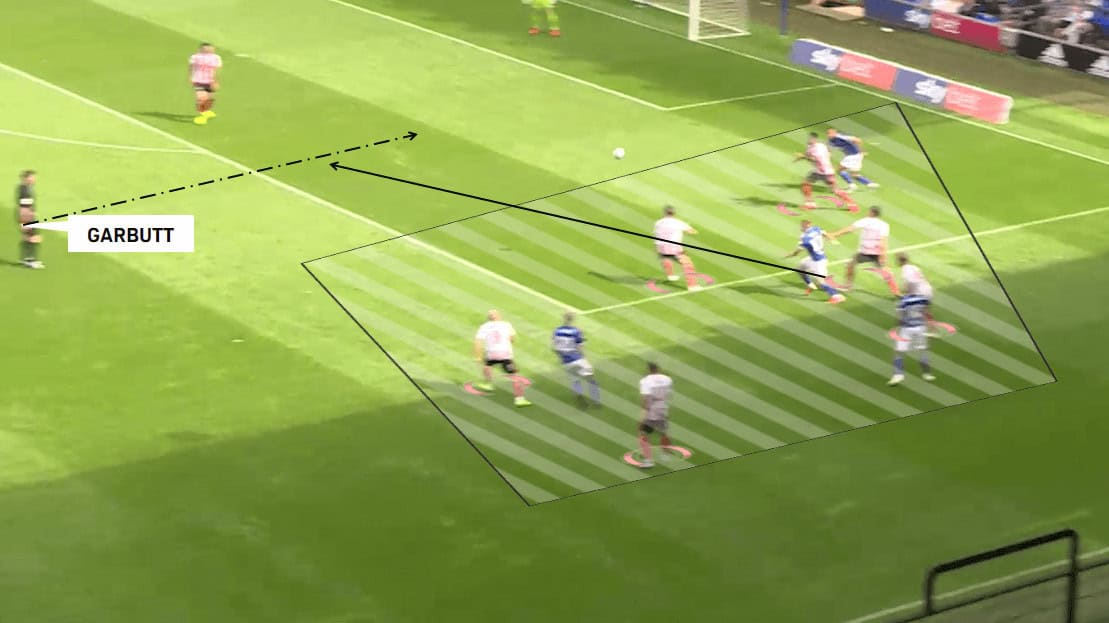
When Ipswich distributed the ball into their final third, they would overload the area surrounding the ball-carrier. By continuously using the same aggressive principles, winning the ball quickly was a must for them. Again, this strategy came along with a major problem which cost them two points.

Inside the first twenty minutes, there were at least two similar situations happened. One of them is demonstrated below. When Rowe was controlling the ball, Sunderland attempted to overload the area with six defensive players while Ipswich only had four. Although Flanagan’s duel was a success, he cleared the ball right in Garbutt’s run. The former Everton defender entered the zone which was occupied by only one player and his solo effort eventually beaten McLaughlin.
EFL League One 2019/20: Ipswich Town vs Sunderland - Tactical Analysis tactics
Sunderland failed to make the most out of their strategy and led to Garbutt’s opening goal

In their quest to find the equalising goal, they faced a stubborn, disciplined Ipswich defensive structure. Most of their attacks were stopped or intercepted by the opposition and they could only approach Holý’s goal three times. Besides Gooch’s goal that we have analysed above, he also had two more attempts on goal which went wide and was blocked.

They adapted high tempo attacking football and relied on quick passes and combinations. It was a very good strategy to deal with Ipswich’s defence but they couldn’t connect the players to each other.

EFL League One 2019/20: Ipswich Town vs Sunderland - Tactical Analysis tactics
Sunderland’s shotmap [Wyscout.com]
The players were able to move freely across the field and filled every possible space. As long as they were in the passing range of the ball-carrier, they could pick up the ball and drag their teammates along. Usually, O’Nien would be the player that filled in the mentioned role. Playing on the right-hand side of the midfield three, he tended to drift centrally while Dobson and McGeouch stayed deeper.

When the former Wycombe midfielder picked up the ball, the wingers started to move into free spaces and McNulty kept the distance between him and O’Neil for a low-risk pass. Their attacking transition only occurred in a few seconds as Ross wanted his player to reach Ipswich’s 16-yard box as soon as possible. This quickness ultimately killed off the attacks as misplaced passes occurred constantly as they tried to find teammates’ runs in the process.

Conclusion

Sunderland have had a tough time at the Portman Road as they struggled to limit the danger of Ipswich’s attacks inside the first half. Garbutt’s opening goal was a perfect example of that statement. They played with high urgency and tried to distribute the ball into the final third quickly. This style of play did cost them a very underperform first half, but their high press brought them the equaliser when they needed the most.

Ross might need to rethink of how Sunderland will play throughout this season as this game pointed out many disadvantages. For Lambert’s side, it’s fair to say that they have dominated this game. By capitalising the errors that the opposition usually showed during the match, they had a positive start in which they have built on during the remaining time. They only lacked a bit of luck to keep three points at home, but this will be a momentum for them heading into their next match against Luton in the EFL Cup.


tfaMagazineWebAugust
Artwork by @chapulana

If you love tactical analysis, then you’ll love the digital magazines from totalfootballanalysis.com – a guaranteed 100+ pages of pure tactical analysis covering topics from the Premier League, Serie A, La Liga, Bundesliga and many, many more. Buy your copy of the July issue for just ₤4.99 here, or even better sign up for a ₤50 annual membership (12 monthly issues plus the annual review) right here.

Previous Post

Victor Osimhen Scouting Report At Royal Charleroi SC 2019/20

Next Post

EFL League One 2019/20: Rotherham United vs Lincoln City – tactical analysis

Next Post
EFL League One 2019/20: Rotherham United vs Lincoln City - tactical analysis tactics

EFL League One 2019/20: Rotherham United vs Lincoln City - tactical analysis

  • About Total Football Analysis
  • Contact Total Football Analysis
  • Write For Total Football Analysis
  • Advertise
  • Privacy Policy
  • Cancellation / Refund Policy
  • Resources
  • Terms Of Service

© 2026 Total Football Analysis

No Result
View All Result
  • Football Analysis
    • Data Analysis
    • Formations
      • 2-2-4 Formation
      • 2-3-5 Formation
      • 3-1-4-2 Formation
      • 3-2-2-3 Formation
      • 3-2-4-1 Formation
      • 3-1-6 Formation
      • 3-3-4 Formation
      • 3-4-1-2 Formation
      • 3-4-2-1 Formation
      • 3-4-3 Formation
      • 3-5-1-1 Formation
      • 3-5-2 Formation
      • 4-1-4-1 Formation
      • 4-2-2-2 Formation
      • 4-2-3-1 Formation
      • 4-2-4 Formation
      • 4-3-1-2 Formation
      • 4-3-3 Formation
      • 4-4-2 Formation
      • 4-5-1 Formation
      • 5-3-2 Formation
      • 5-4-1 Formation
      • 6-3-1 Formation
    • Head Coach Analysis
    • Match Analysis
    • Player Analysis
    • Recruitment Analysis
    • Set Piece Analysis
    • Tactical Theory
    • Tactical Preview
    • Team Analysis
    • Training Analysis
    • Tactical Analysis
    • Scouting Report
  • Competition
    • ALL Competitions
    • English Premier League
    • Champions League
    • La Liga
    • Bundesliga
    • Serie A
    • Ligue 1
    • Eredivisie
    • EFL Championship
    • FIFA World Cup 2022
    • WEURO 2022
    • Women’s Super League
    • NWSL
    • Belgian First Division A
    • A-League
    • Liga Profesional de Argentina
    • Austrian Bundesliga
    • Campeonato Brasileiro Série A
    • DFB Pokal
    • 1. HNL
    • Danish Superliga
    • EFL League One
    • EFL League Two
    • FA Cup
    • EFL Cup
    • Indian Super League
    • K-League
    • J1 League
    • Liga MX
    • Copa América 2021
    • Copa del Rey
    • MLS
    • Eliteserien
    • Euro 2020
    • Primeira Liga
    • Scottish Premiership
    • Allsvenskan
    • Europa League
    • UEFA Nations League
    • Liga AUF Uruguaya
  • Coaches
    • All Coaches
    • Alfred Schreuder
    • Ange Postecoglou
    • Antonio Conte
    • Arne Slot
    • Bo Svensson
    • Brendan Rodgers
    • Bruno Lage
    • Carlo Ancelotti
    • Christophe Galtier
    • Claude Puel
    • Claudio Ranieri
    • David Moyes
    • Dean Smith
    • Diego Simeone
    • Domenico Tedesco
    • Frank Lampard
    • Eddie Howe
    • Edin Terzić
    • Emma Hayes
    • Erik ten Hag
    • Ernesto Valverde
    • Gennaro Gattuso
    • Gerardo Seoane
    • Gian Piero Gasperini
    • Giovanni van Bronckhorst
    • Graham Potter
    • Igor Tudor
    • Imanol Alguacil
    • Jesse Marsch
    • Jonas Eidevall
    • Jorge Sampaoli
    • José Bordalás
    • José Mourinho
    • Julen Lopetegui
    • Julian Nagelsmann
    • Julien Stéphan
    • Jürgen Klopp
    • Luciano Spalletti
    • Lucien Favre
    • Manuel Pellegrini
    • Marcelo Bielsa
    • Marco Rose
    • Marco Silva
    • Massimiliano Allegri
    • Mauricio Pochettino
    • Maurizio Sarri
    • Mikel Arteta
    • Niko Kovač
    • Nuno Espírito Santo
    • Oliver Glasner
    • Patrick Vieira
    • Paulo Fonseca
    • Pep Guardiola
    • Peter Bosz
    • Rafa Benítez
    • Ralf Rangnick
    • Ralph Hasenhüttl
    • Roger Schmidt
    • Roy Hodgson
    • Sean Dyche
    • Sérgio Conceição
    • Simone Inzaghi
    • Sonia Bompastor
    • Stefano Pioli
    • Steffen Baumgart
    • Steven Gerrard
    • Thiago Motta
    • Thomas Frank
    • Thomas Tuchel
    • Unai Emery
    • Vincenzo Italiano
    • Xavi
  • Teams
    • ALL Teams
    • AC Milan
    • Ajax Amsterdam
    • Arsenal
    • AS Monaco FC
    • Atalanta
    • Atlético Madrid
    • FC Barcelona
    • FC Bayern Munich
    • Borussia Dortmund
    • Celtic FC
    • Chelsea FC
    • Everton F.C.
    • Inter Milan
    • Juventus F.C.
    • Leeds United F.C.
    • Liverpool FC
    • Manchester City
    • Manchester United FC
    • Paris Saint-Germain
    • Rangers FC
    • RB Leipzig
    • Real Madrid CF
    • Tottenham Hotspur
    • West Ham United
  • Players
    • ALL Players
    • Alisson Becker
    • Bukayo Saka
    • Erling Haaland
    • Harry Kane
    • Jack Grealish
    • John Stones
    • Julián Alvarez
    • Kalvin Phillips
    • Kevin De Bruyne
    • Kyle Walker
    • Kylian Mbappé
    • Lamine Yamal
    • Lionel Messi
    • Luis Díaz
    • Mohamed Salah
    • Phil Foden
    • Virgil Van Dijk
  • Contact
  • Write For TFA
  • Login

© 2026 Total Football Analysis