



When looking back at the roots of the women’s game in Europe, it might surprise some people to learn that one of the earliest countries to embrace its potential was Poland. The Eastern European nation fielded its female national team for the first time in 1981 in a friendly against Italy in Catania, which ended 3-0 in the home side’s favour.
However, despite being pioneers of the continental women’s game, Poland do still have yet to qualify for a major tournament finals, with them coming close on several occasions but never quite managing to get over the line. For many, this has been due to players from the country never being professional historically and their domestic league lacking the right support, but things are changing for the better in that regard, with more effort being put into nurturing the game at home and ensuring that the Ekstraliga (the women’s top flight) is as competitive a division as possible with the ability to attract new audiences both in Poland and abroad.
What has aided that progression has been the fact that there is always one story or another emerging from the league. Something that has attracted a great deal of attention in 2023/24 has been the rise of Pogoń Szczecin Women. They are only in their second season back in existence after being dissolved following the 2012/13 campaign but currently sit second in the table, just three points behind defending champions GKS Katowice Women.
With them in such a strong position, it is not entirely out of the question that they could win the league this year, and to do so would be quite an accomplishment. With that in mind, this tactical analysis will take a closer look at their revival on the field, setting out the tactical foundations they initially laid down before highlighting how they built on them during the current campaign. The scout report will also indicate where they can keep improving in the future as they strive to ensure that they continue along their current trajectory.
Establishing an identity
When Pogoń Szczecin Women came back into the Ekstraliga fold in 2022, they entered a very different world from the one that they withdrew from nine years earlier, with teams generally much stronger than they had been used to and positive results and points harder to accrue. It was, therefore, imperative that they quickly settled back into life in the top flight, which is why the 2022/23 season was all about building an on-field identity without setting any real targets.
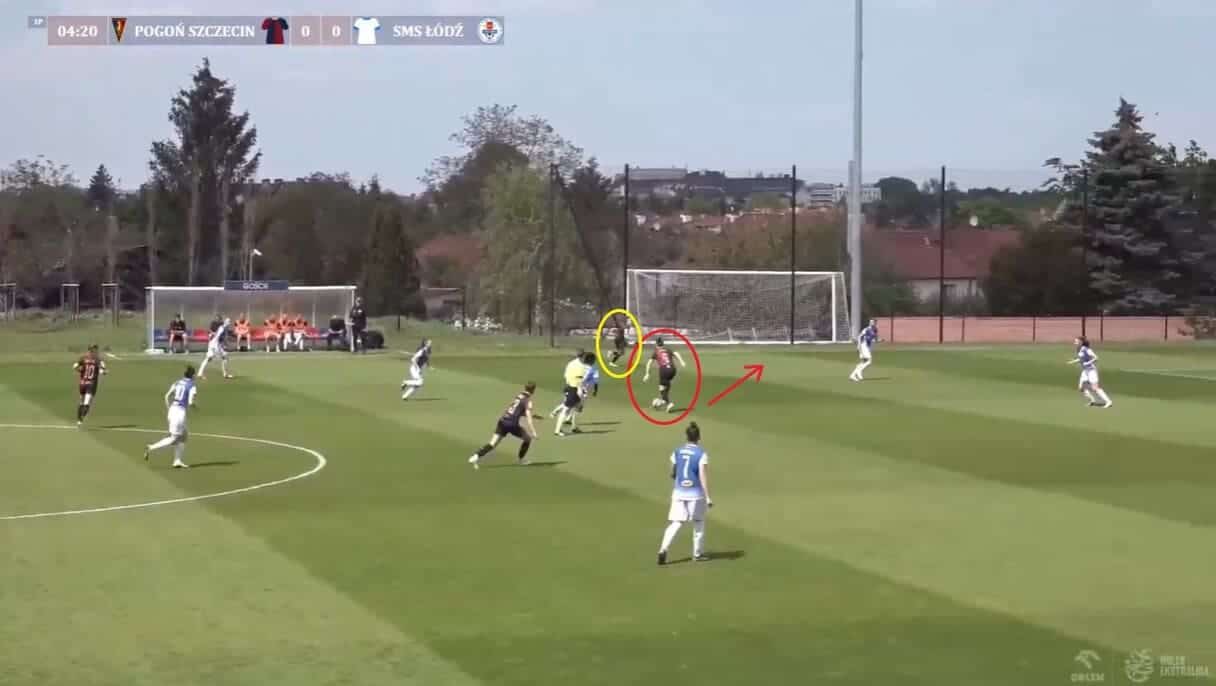
When looking at their performances during that campaign, it becomes immediately clear that they wanted to implement a modern style of play, with their game plan revolving around quick transitions and being expansive whenever they had possession.
However, it was not simply about getting the ball up the pitch as quickly as possible because they also wanted to ensure that they didn’t rush things and risk losing possession whilst building attacks. As a result, it was common for situations like this to occur, with the ball being passed around at the back for a few phases as Pogoń waited for the right moment to send it up the pitch, which they have done here due to Emilia Zdunek positioning herself between the UKS SMS Łódź Women lines and offering a passing option for the ball to travel towards.
Once the ball had arrived at her feet, the next phase of the attack could commence, which was where they looked to shift it wide in order to make full use of the spaces available to them on the wings. This was aided by the fact that they predominantly set up with a 4-2-3-1 formation in their first campaign back in existence, with it used in 32% of their games, and that gave them natural passing option on the wings that they could continually target.
As a result, when Zdunek turned to move the ball onwards here, her only thought was to look towards the wide channels, knowing that there would be a teammate there ready for her to connect with (in this case, Agnieszka Garbowska was the one waiting in that area, with her then taking the ball behind the Łódź defensive line and having a shot on goal). This cohesion and accuracy of passing (which was an impressive 73.9%) was what allowed Pogoń to have 54.24% possession per game across 2022/23 and to average three goals per game.
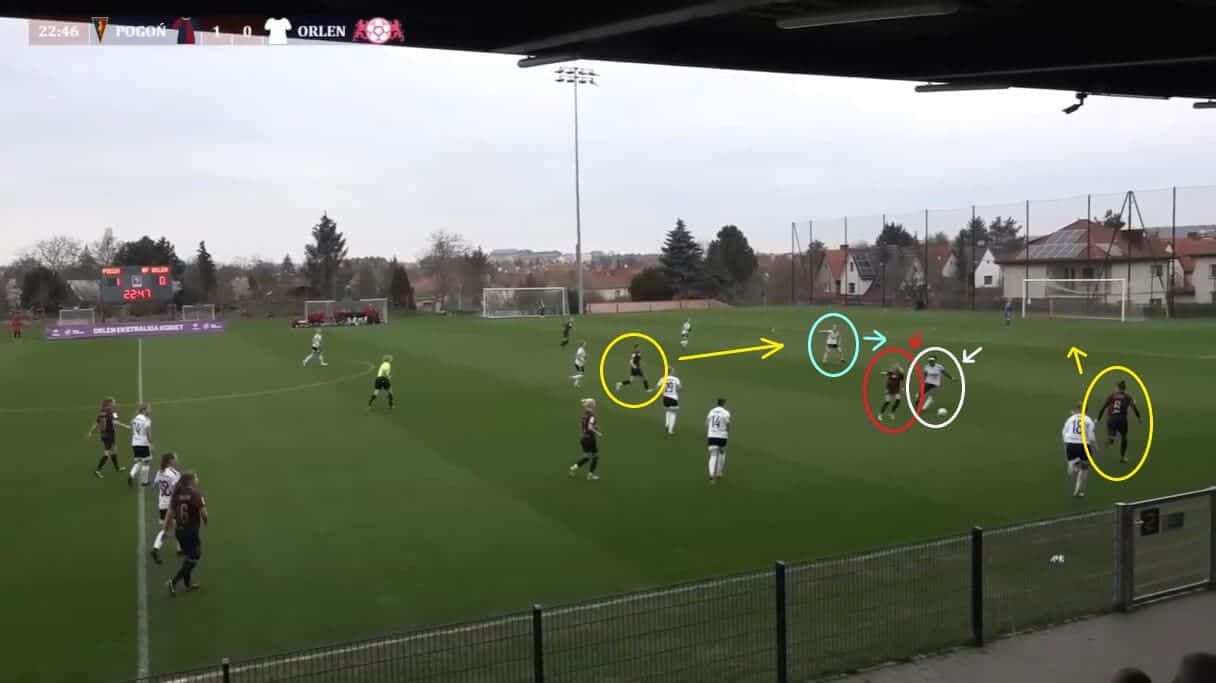
This didn’t work in every game, though. There were some outings when Pogoń needed to adapt its tactics and find new ways to break down its opponents, particularly those who tended to sit back more whenever they didn’t have the ball.
AP Orlen Gdańsk Women (as they are now known) were one of those who took that option, but it never phased Pogoń. Instead, they used those matches as a chance to demonstrate another side to their game in that they looked to make a series of vertical movements in a bid to manipulate the defenders into leaving spaces open. In this case, that saw striker Natalia Oleszkiewicz dropping back whilst both Zdunek and Karolina Łaniewska make the opposite runs and move around and behind her.
This has forced Orlen into reacting, and what they opted to do here was to cover the threat that they felt that Oleszkiewicz still posed, with Kimberly Sanford staying tight to her, and yet that then allowed Pogoń to move the ball behind her and to exploit the space that had been left open. With Ewelina Piórkowska now forced into a 2-v-1 situation against the dual threat of Zdunek and Łaniewska, the advantage is with Pogoń, and that led to them scoring here when it initially looked as if Orlen had done everything that they needed to do to keep them at bay.
It was mentioned at the beginning of this section that Pogoń took their tactical inspiration from modern methods, and that is reflected in the way that these rotations mirror how Barcelona Femení looked to play when they had Jenni Hermoso leading their line. With Hermoso having a tendency to drop back in the same way as Oleszkiewicz did here, it was common to see both Alexia Putellas and Aitana Bonmatí moving behind her and making the same runs as Zdunek and Laniewska did here, and it was a dynamic that worked well for them and which Pogoń feel will aid their bid to be just as tough a team to play against.
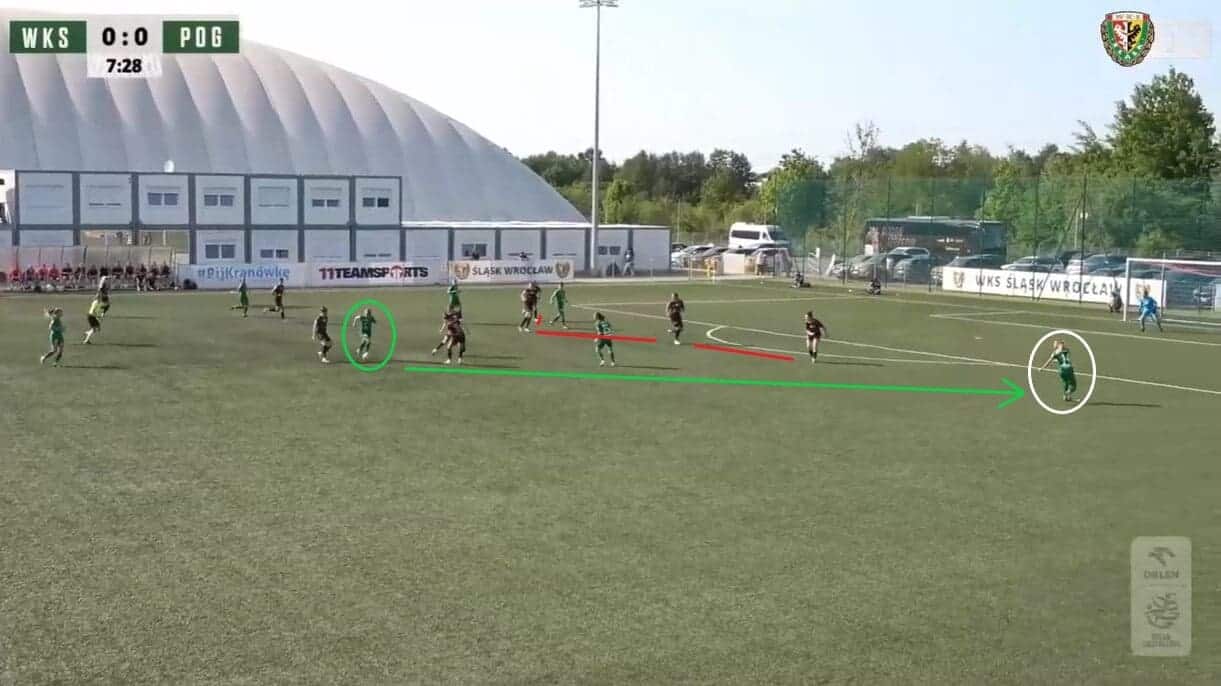
This clarity around the field was also apparent in their defensive play, with them once again having a clear idea of how they wanted to set up and what their priorities were when they were without the ball. That, too, helped them establish their identity early on and ensure that they were able to match the exciting nature of their attacking play with solidity at the back.
The key tactic they employed when inside their own third was to keep their back line relatively close together and shift them across the pitch as needed, meaning that they didn’t leave gaps open and had numbers around the ball at all times. This proved to be an effective strategy for them to employ, with them continually working as a unit to neutralise each threat in turn. In this case, that was shown through them following the ball across the pitch as Śląsk Wrocław Women’s Klaudia Adamek dribbled it across the spine of the pitch before getting tight to wing-back Aleksandra Żurek as soon as the ball had been sent towards her, with Zuzanna Radochońska closing Żurek down before Patrycja Michalczyk eventually cleared the danger.
With Pogoń winning 65.9% of their defensive duels last season, it was clear to see how effective this proved to be in helping them to protect their goal, and it was instrumental in them ending the season in a commendable fifth position in the Ekstraliga table and demonstrating to the other sides in the top flight that they were not there solely to make up the numbers.
Challenging for honours
However, Pogoń Szczecin Women knew that they could not simply sit still and that they needed to build on that positivity if they were to start fighting for silverware, so they looked to develop those tactics ahead of the 2023/24 campaign and to add new layers to their play. This was aided in no small part by the decision to appoint Piotr Łęczyński as their new head coach, with him being regarded as one of the brightest young coaches in the country and someone with plenty of different ideas about how to achieve success.
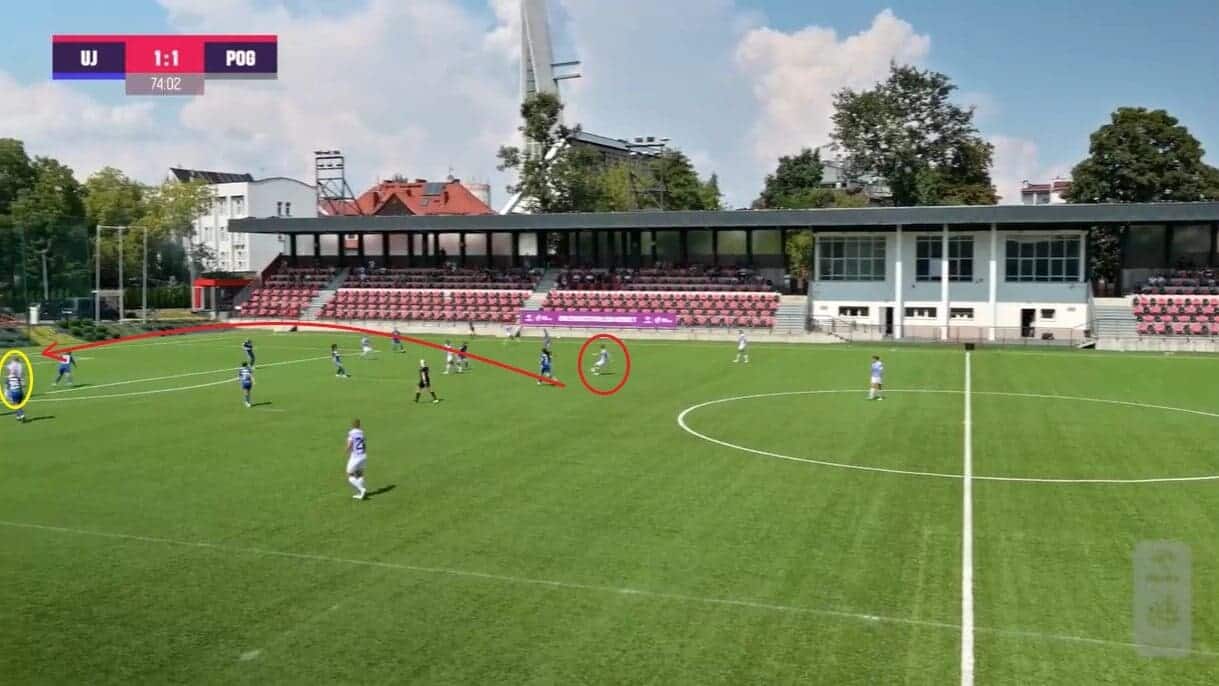
One of the things that Łęczyński has looked to alter since his appointment is a desire to move up the pitch with a greater urgency, which has led to fewer moments this season when Pogoń have retained the ball for extended periods in the backfield, and they have instead looked to make more forward passes earlier in on their transitions.
To make that possible, Pogoń’s tactics this season have revolved around making a higher volume of long passes, just as has happened here when Zdunek (who has switched shirt numbers with Martyna Brodzik this season and who now wears 10 on her back) received the ball and instantly sent it towards Oleszkiewicz inside the UJ Kraków Women goal area.
This is not to say that Łęczyński does not believe in his side retaining the ball and minimising the risk of it being given away because he does share those values and wants to keep them in his side’s overall game plan. However, it is simply the case that he also wants to catch opponents out and exploit any gaps that appear in their back lines before they have had a chance to seal them off, which paid off here as Kraków were not ready for the shot when it did come, and Oleszkiewicz was, therefore, able to score a relatively simple goal.
When considering that Pogoń has netted 2.86 times this season, this slight tweak in their attacking mentality has undoubtedly led to their being more productive overall, and so it can be considered a successful development in their game.
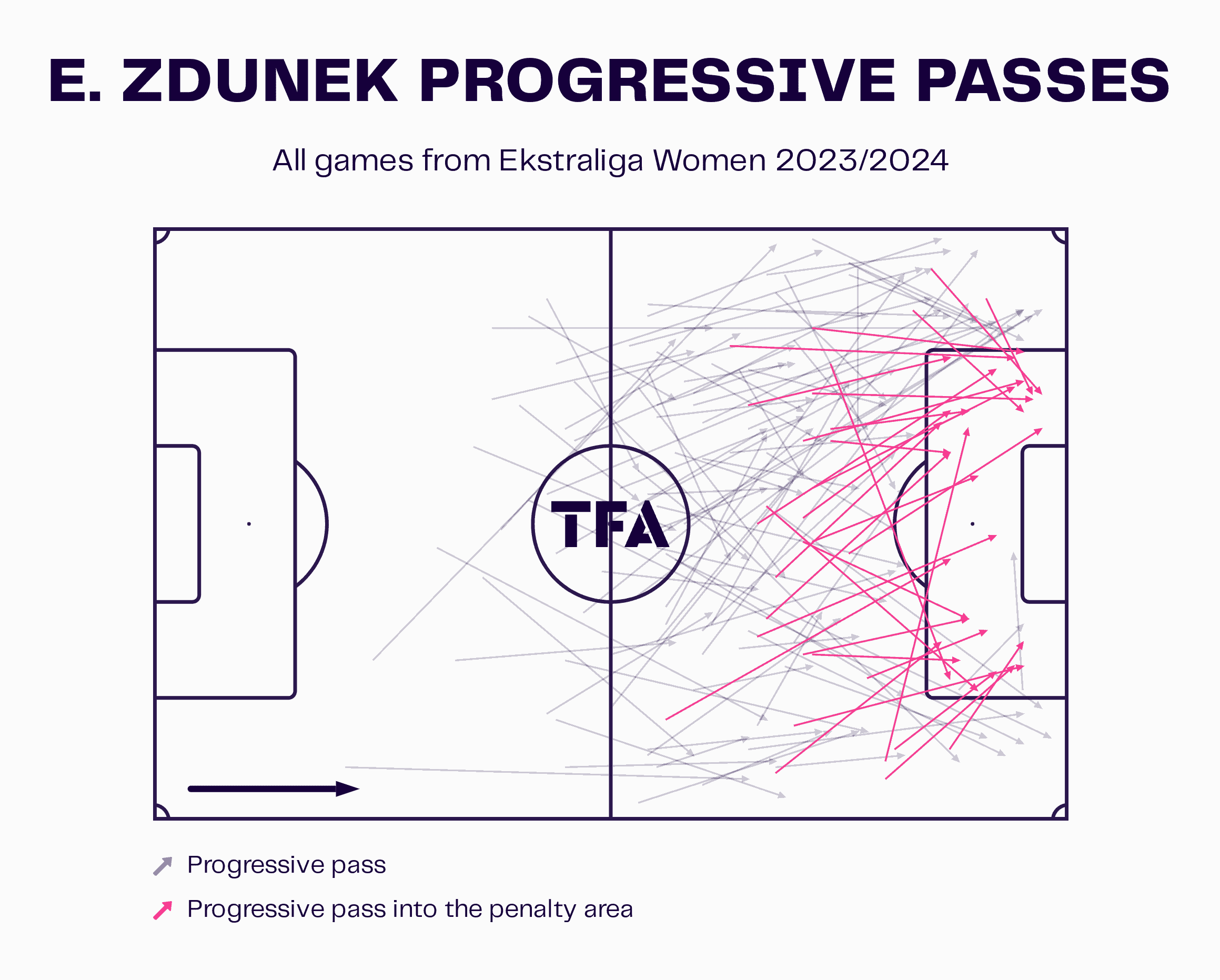
This is not the only time that Zdunek has played a vital role in creating chances in this manner, with her demonstrating both last season and in this one that she is the type of player that Pogoń have to have on the pitch at all times if they want to test their opponents continually.
As this graphic indicates, she has made a vast number of progressive passes during the current campaign and has been someone that opposing sides have really needed to shut down as quickly as possible, with her six goals, three assists and individual passing accuracy of 68% highlighting just how dangerous she has been when allowed any time to control the ball and to connect with those around her.
However, it is not only a case of Zdunek gaining possession in deeper areas and then passing the ball forwards, with it also evident from the graphic that many of them have come from wider areas, too. Therefore, she is someone who poses a threat regardless of where she is on the pitch, and there is no doubt that keeping her fit for each of their remaining league fixtures will be crucial if Pogoń are to have any chance of lifting the Ekstraliga trophy at the end of the campaign.
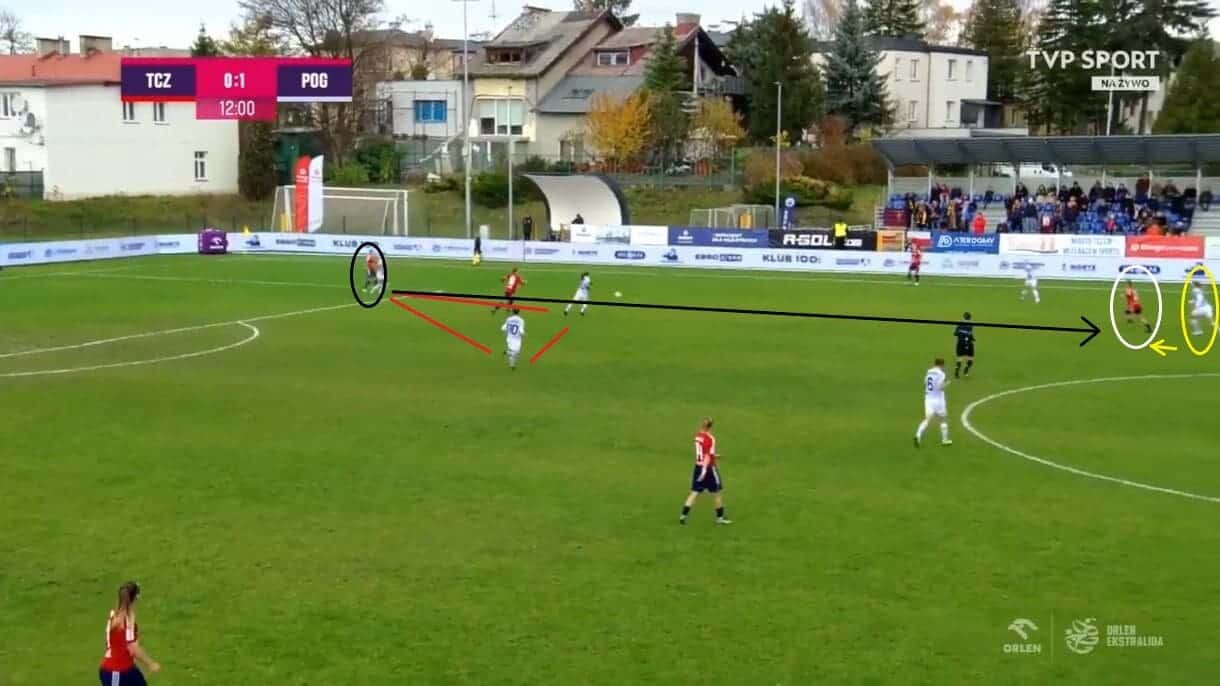
Another thing that Łęczyński has introduced is a desire to win the ball as high up the field as possible through well-executed presses, with him wanting to force opponents into making mistakes on a more consistent basis and therefore giving his team a better chance of creating meaningful goalscoring opportunities in promising areas and again taking those facing them by surprise. Again, this is not to say that they weren’t doing this before the current campaign, with there being some instances last season when they were trying to close opponents down, but there has definitely been a stronger emphasis put on it this season.
It has been helped by them changing to a 4-1-4-1 shape as their favoured formation, with it being used in 26% of their matches, and it is another thing that has paid off due to them looking a lot more dangerous around the field. Here, the trio of Oleszkiewicz, Zdunek and Jaylen Crim have united to force Pogoń Tczew Women defender Weronika Andrzejewska into releasing the ball earlier than she might have liked to, and the next phase then sees the ball arrive at the feet of Julia Jędrzejewska, who is already being closed down by Marianna Litwiniec.
As a result, Pogoń can win the ball inside Tczew’s half here and launch an attack of their own from high up the field. This shows how well they have made this work for them and how it has been another key reason for them taking several steps forward in their development.
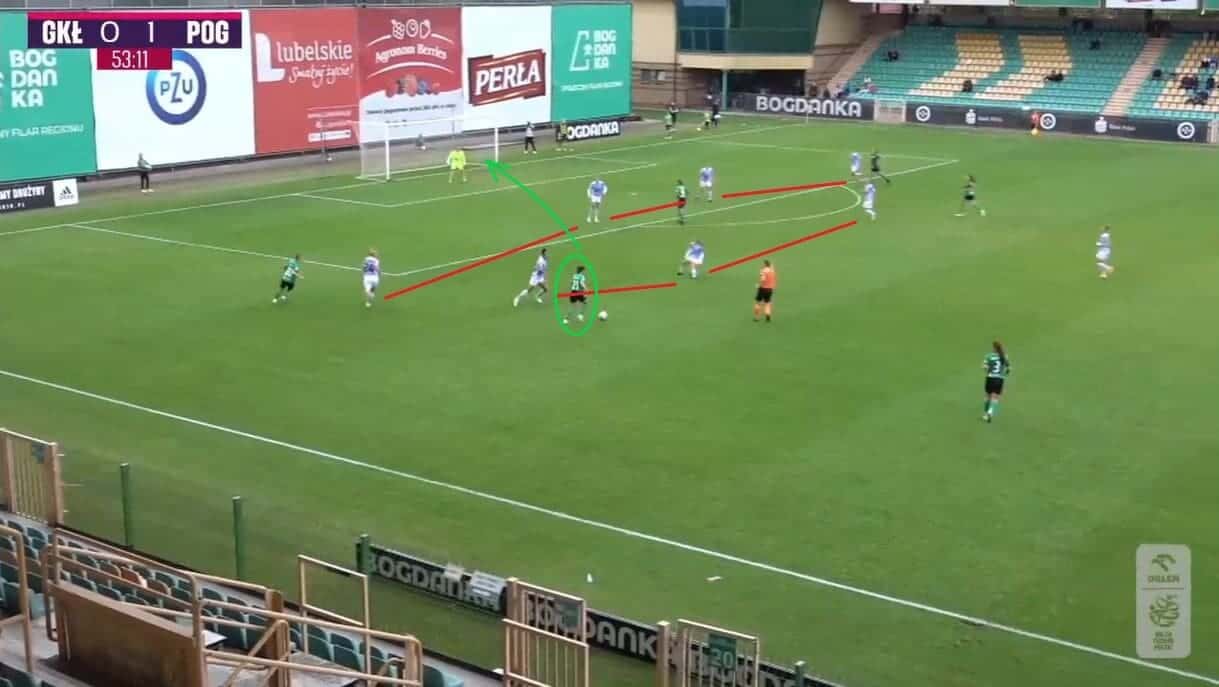
It is not only in attack that Pogoń have looked to add new complexities to their play, though, with them recognising that any team with a desire to challenge for honours needs to be robust out of possession, too. With that in mind, Łęczyński has kept the same basic structure as they had last season when inside their own half but has added another layer to it, with the result shown here as Górnik Łęczna Women try to move the ball into the Pogoń goal area but are forced to shoot at goal from further out, with Oliwia Rapacka the player left frustrated here.
The other advantage that comes from having two lines in front of goal is that it gives Pogoń added security when winning balls at the back, too, with them previously clearing aerial threats and then hoping that one of their own players can get on the end of the loose ball, but they now have the knowledge that one of those in front of them will tidy up those second phases. So, there is less of a chance of them being caught out as they try to get back into their positions.
With Pogoń conceding just 0.79 goals per game this season, this is another development that has worked out well for them, and the fact that it limited the threat that Górnik, who have a reputation for developing some outstanding goalscoring talent (such as Tottenham Hotspur Women’s Nikola Karczewska, who has scored eight goals on loan at Frauen-Bundesliga side Bayer Leverkusen Frauen), could create here shows how instrumental it has been in taking them from a mid-table side to one now looking increasingly capable of competing for silverware.
Future progression
Regardless of what does happen this season, there is now absolutely no doubt that Pogoń Szczecin Women are a team firmly on the rise and that they are not a side that anyone anywhere should underestimate. It surely won’t be long before they do start to get their hands onto league or cup trophies once again.
However, if they are to do so, they will need to keep developing their tactics and ensure that those aspects of their play that have not been going so well are tightened up. Some key areas require special attention as they look towards future campaigns.
It has already been made clear throughout the analysis that Pogoń’s attacking play does not contain many faults, with there being a lot to like about how they have kept moving the ball around the pitch and have used every square inch of the field available to them in their bid to play with an expansive mindset.
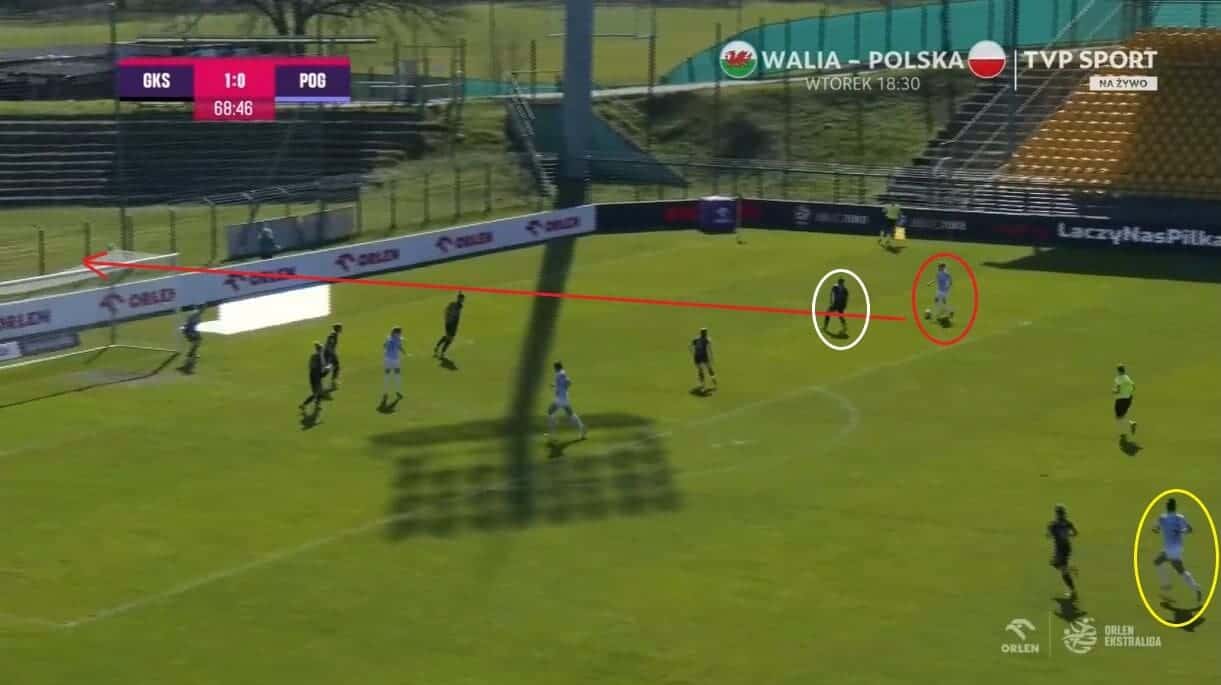
However, they are not perfect, and one thing that does need to be improved is their decision-making. There are plenty of situations when they have got into the final third and have then not made the right decision regarding whether to cross, pass, or shoot at goal.
This situation highlighted how much of a detriment this has been for them at times, with Garbowska advancing up the pitch following a quick break and reaching the edge of the Katowice goal area before seeing her path closed down by Aleksandra Nieciąg and forcing her to make a decision as to what she does next. She does have several options to select from, with the best perhaps being to cut the ball back for Crim to run onto behind her, but she ends up trying her luck at goal instead, with her effort missing the target.
Given that Katowice won this match 1-0 and are currently three points ahead of Pogoń in the league table, it could well be that this result helps to determine the destination of the Ekstraliga trophy for this season. Therefore, if they miss out this time, tidying up these aspects of their play will be vital if they want to topple the defending champions from their perch.
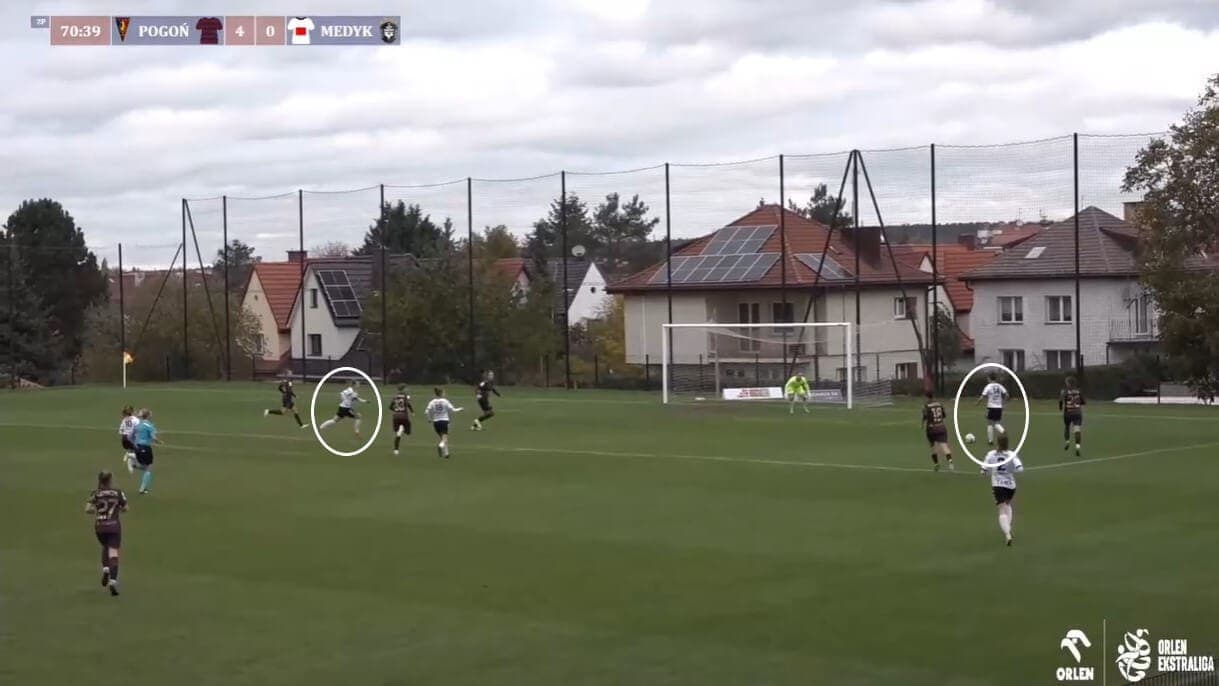
It has also already been mentioned that Pogoń has been very effective in transitional moments. They pass up the field urgently but accurately as they look to exploit any territory that their opponents leave unprotected inside their own third.
However, the reverse transitions have been much more problematic for them, with several sides playing quick passes between their lines and catching them out in much the same way as they have looked to do to them. One team who particularly highlighted this weakness was Medyk Konin, with wing-backs Oliwia Jaśniak and Milica Andrić providing constant options around the field and both enjoying the freedom of Szczecin at times whenever they have had the ball at their feet.
Therefore, whilst Pogoń has looked a lot more secure and watertight this season when they have had time to get their shape in place, they have looked a lot more susceptible to conceding goals when teams have hit them on the break in the manner that Konin did. This is, therefore, something else that they need to address ahead of the following campaign if they want to be in the best place possible to either win or defend the title next season.
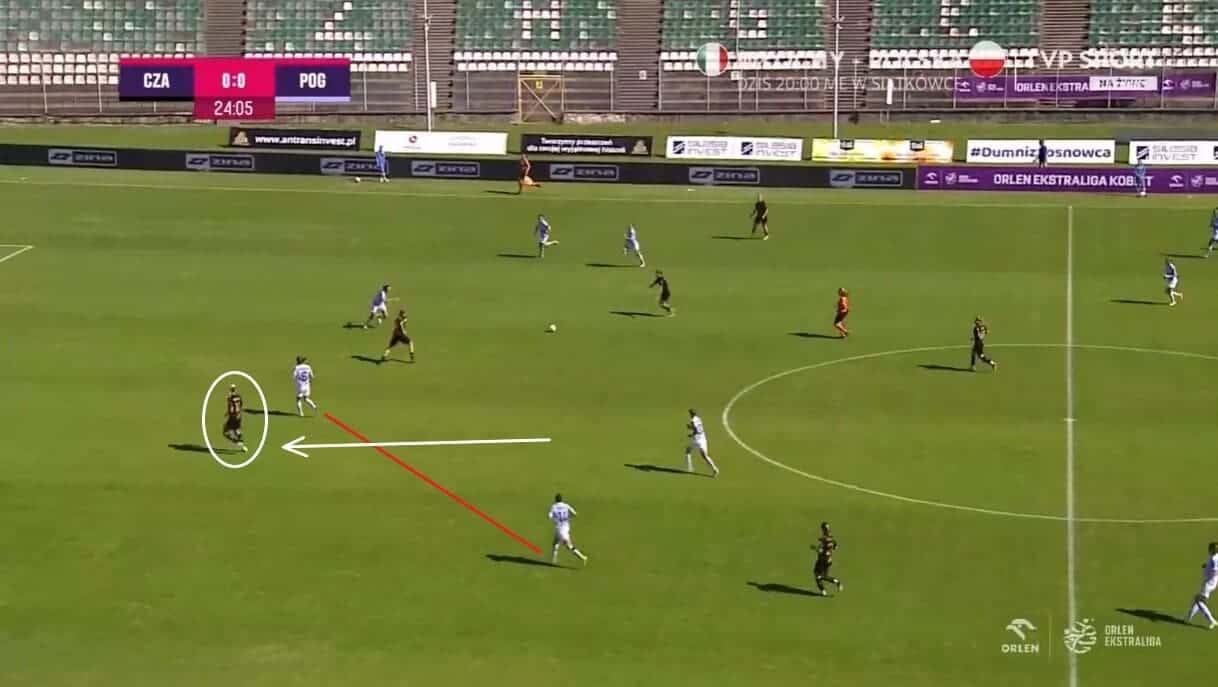
The other thing that has sometimes cost them has been individual mistakes in key moments, which every team experiences but which Pogoń have seen lead to yet more goals being given away far too easily. In this case, the issue is that the ball has been given away and that right-back Alicja Dyguś has not tracked back quickly enough. The result is that there is now a gaping hole on the near side of the pitch, and Czarni Sosnowiec Women’s Karlīna Miksone has been able to exploit it.
Once she had made her run through, Pogoń were always going to be at a disadvantage, with Miksone scoring five times this season already and showing her attacking threat whilst featuring for her native Latvia during their opening Euro 2025 qualifiers against North Macedonia and Moldova. She is not a player short of confidence or quality, and that is highlighted here as she finds the top corner from a good distance out once Nikol Kaletka rolls it into her path, and, whilst there is nothing to say that the goal would have been prevented if Dyguś had been there, it certainly made it a lot easier for Miksone that she wasn’t.
Conclusion
In conclusion, this tactical analysis has looked in detail at Polish side Pogoń Szczecin Women, highlighting how they have built a tactical identity since re-entering existence in 2022 and indicating how they have then built on those early ideas during their second campaign in a bid to go from a mid-table side to one capable of lifting the Ekstraliga trophy.
There is no doubt when breaking down Pogoń’s performances that they are the type of team that any fan would love to watch, with their style of play appealing to those who appreciate the fast nature of the modern game and the way that teams can move the ball around at speed in a bid to create plenty of attacking opportunities. However, it should also be remembered that they are still a team in development when compared to others in the top flight. So they are far from the finished article and do still have plenty to improve on if they do want to establish themselves as one of Poland’s leading clubs.
With six games remaining in the current domestic season in Poland, Pogoń’s title hopes are still ablaze. There’s a glimmer of possibility that they could overtake Katowice and snatch the trophy from their grasp. Regardless of the outcome, the team’s resilience and determination have shone through, providing a beacon of hope for the future.

