


We’re currently six games into the 2023/24 WE League season — Japan’s top-tier Women’s Football division. This season sees Cerezo Osaka enter WE League for the very first time, having been competing in the semi-professional Nadeshiko League prior to the current campaign.
Six games into the season, Osaka sit seventh out of 12 teams, having picked up seven points (two wins and a draw) from their fixtures thus far. This is not a bad return for the Nobuhito Toriizuka-led side in their first WE League season, especially when you consider that Cerezo Osaka have the youngest squad in their division, with an average squad age of just 21.5.
Toriizuka’s side have conceded eight goals so far this term — the fourth-highest amount in the league; however, they’ve got the second-lowest xGA in the division along with the lowest xGA per shot at 0.077, which shines a more positive light on their overall defensive performances.
While they sit seventh on the table, their expected points (xPTS) tally sees them in fifth, again providing some encouragement for the young squad based on the underlying numbers indicating the quality of chances created and chances conceded sees them performing even better than they the actual numbers would suggest relative to their competition.
This tactical analysis piece will provide some analysis of how Toriizuka has set his side up out of possession this term and how these defensive tactics have been crucial to his side’s positive first-ever six games in WE League.
Goalkeeper’s performance
Rina Yamashita has been Cerezo Osaka’s number one this term. According to Wyscout, she’s largely delivered in line with the expected numbers, though as per figure 1, she’s marginally underperformed as a shot-stopper, though not to a drastic extent. Still, we’d say her overall shot-stopping performances have been something of a mixed bag.

From observing her between the sticks for Cerezo Osaka, we would be remiss to ignore the fact that she has committed several poor errors that have led to her team conceding a preventable goal — we must bear this in mind when judging the numbers on the viz above, as the numbers alone don’t tell the whole picture.
Again, as mentioned earlier, per Wyscout, Osaka have got the second-lowest xGA in WE League for 2023/24 right now but have conceded the fourth-most goals. This is partly a result of the ‘keeper’s poorer errors.
Furthermore, as mentioned, Toriizuka’s team have got the lowest xGA per shot in their division for the 2023/24 campaign at present. Yet, there have been times when Yamashita has allowed low-quality chances to pass by her despite her teammates’ efforts to deny the opposition clear-cut opportunities.
In general, Yamashita must improve her ability to deal with airborne balls played into the box from wide and towards her goal from a distance. Her reactions also leave something to be desired at times and can be a negative aspect of her game.
With that said, let’s not be overly critical. As displayed, she has generally performed almost on par with what would be expected of her, even if the goalkeeper has occasionally committed some undesirable errors, indicating that she has gone some way to making up for those errors in other aspects of her performance.
She has been quite agile in getting down into the corners or, indeed, up to the top corners and keeping well-struck shots from hitting the net in those prime locations, particularly on her right, as we can see from some of the green dots and how they’re placed on figure 1.
At 22 years old, Yamashita is a young goalkeeper with plenty of time to continue developing her game and improve on the weaknesses we’ve identified. Should she do so, she has great potential to enjoy a long career in top-flight football. However, we must stress there are clear weaknesses she and her coaches must address to achieve that.
Pressing
On a more positive note, the primary reason for Cerezo Osaka’s defensive success this season has undoubtedly been the team’s sometimes impenetrable pressing structure.
Toriizuka has set his team up exclusively in a 4-4-2 this season. They’ve typically pressed from a mid-block designed to restrict space centrally, relentlessly pestering opposition ball carriers and forcing turnovers. Thanks to their organisation, as well as the players’ combination of exceptional energy and commitment to the team’s strategy, Toriizuka’s defensive tactics have been a hit for the team in their first WE League season.

Osaka have made 79 high regains this league season so far, a result of their aggressive pressing tactics that have seen them average a PPDA of 8.2 in their six league games this season so far — the second-lowest in WE League — along with a challenge intensity of 7.0, the second-highest in WE League.
Both of these statistics are indicative of a team that plays aggressively without the ball, denying their opponents many opportunities to complete passes to one another before a defensive action is made, which is the type of team that Toriizuka’s side certainly can be identified as.
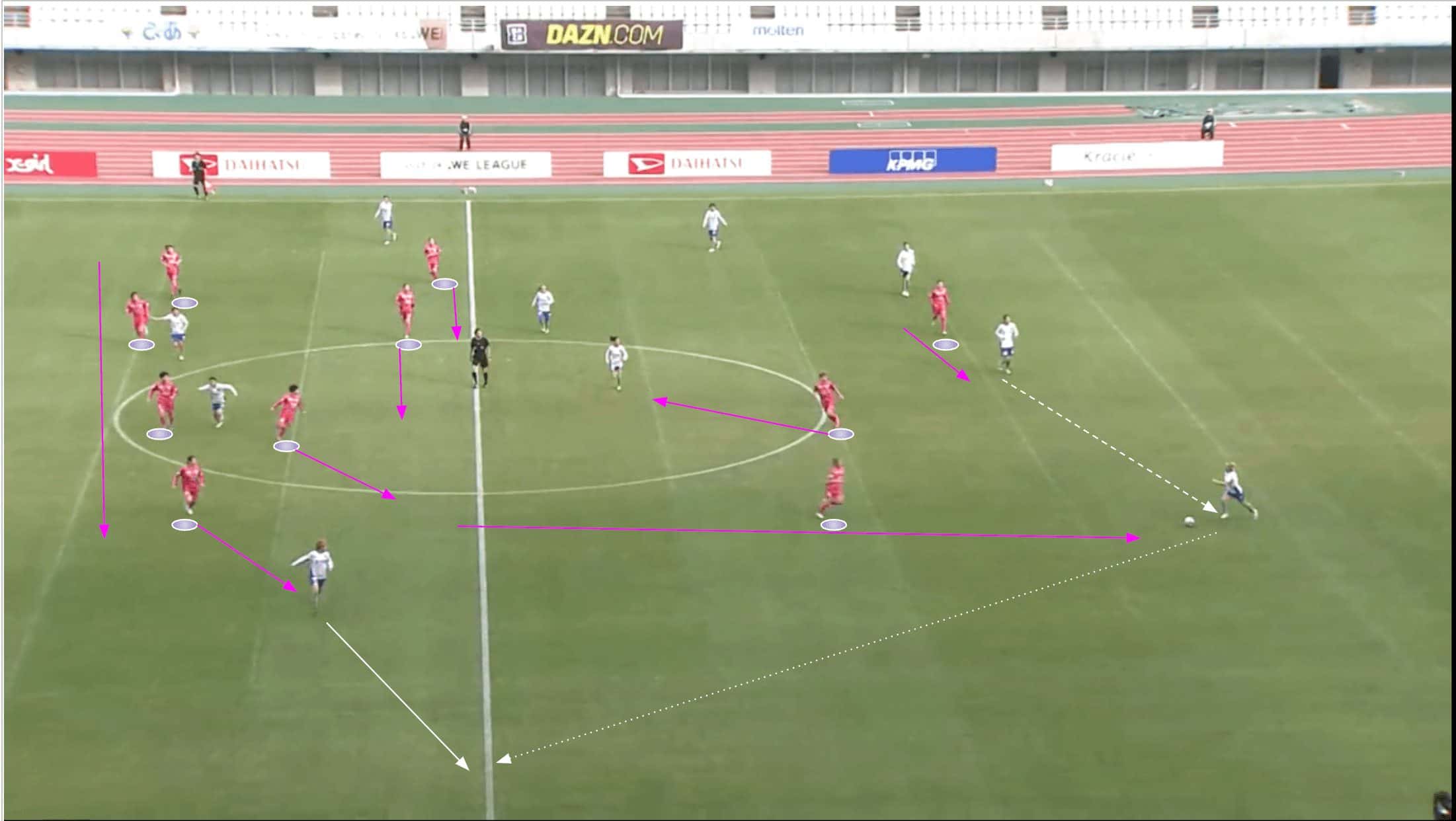
Within their 4-4-2 shape, the two forwards typically lead the press, staggering their positioning so that the ball-near forward will advance to close down the ball-carrying centre-back while the other remains a bit deeper, retaining access to the other centre-back while also covering the deepest opposition midfielder.
When the ball is played wider, perhaps to one of the opposition full-backs, as we saw in this example above where the left-back has received possession, one of Osaka’s wide midfielders typically breaks away from the midfield pack, joining the front two in order to ensure the opposition doesn’t easily overload Osaka in this area of the pitch.
As Osaka’s right midfielder jumps to close down the opposition left-back, the rest of their midfield line shuffles over to cover the space now open due to the pressing midfielder’s decision and to keep the centre of the pitch congested, maintaining as much coverage of that area as possible.

In this case, the left-back plays the ball out to the winger, who drifted out wide to try and take advantage of some space there after Osaka’s right midfielder pressed higher.
The receiver was followed and quickly confronted by Osaka’s right-back, while the ball-carrying winger’s nearby passing options were also all quickly picked up by Osaka bodies as they reorganised themselves using the new receiver and the space around them as a reference.
It’’s typical to see Toriizuka’s side pressing in a space-oriented manner, which makes playing through them on a particular wing quite challenging and forces the opponent to have to play through them via a switch; this can be more difficult, especially when pressure is high on the ball-carrier, and they don’t have time to pick out their pass.
The winger was rushed into her next move — a lofted pass that ended up inaccurate due to the aggressiveness of Osaka’s press. This leads to a turnover and a chance for Toriizuka’s side to now build an attack.
From this example, we can take note of a couple of Toriizuka’s fundamental pressing principles: 1. Pressing as a unit and covering space behind a player when they jump, and 2. Quickly closing down the player in possession as well as rapidly reorganising to mark their clearest passing options tightly.
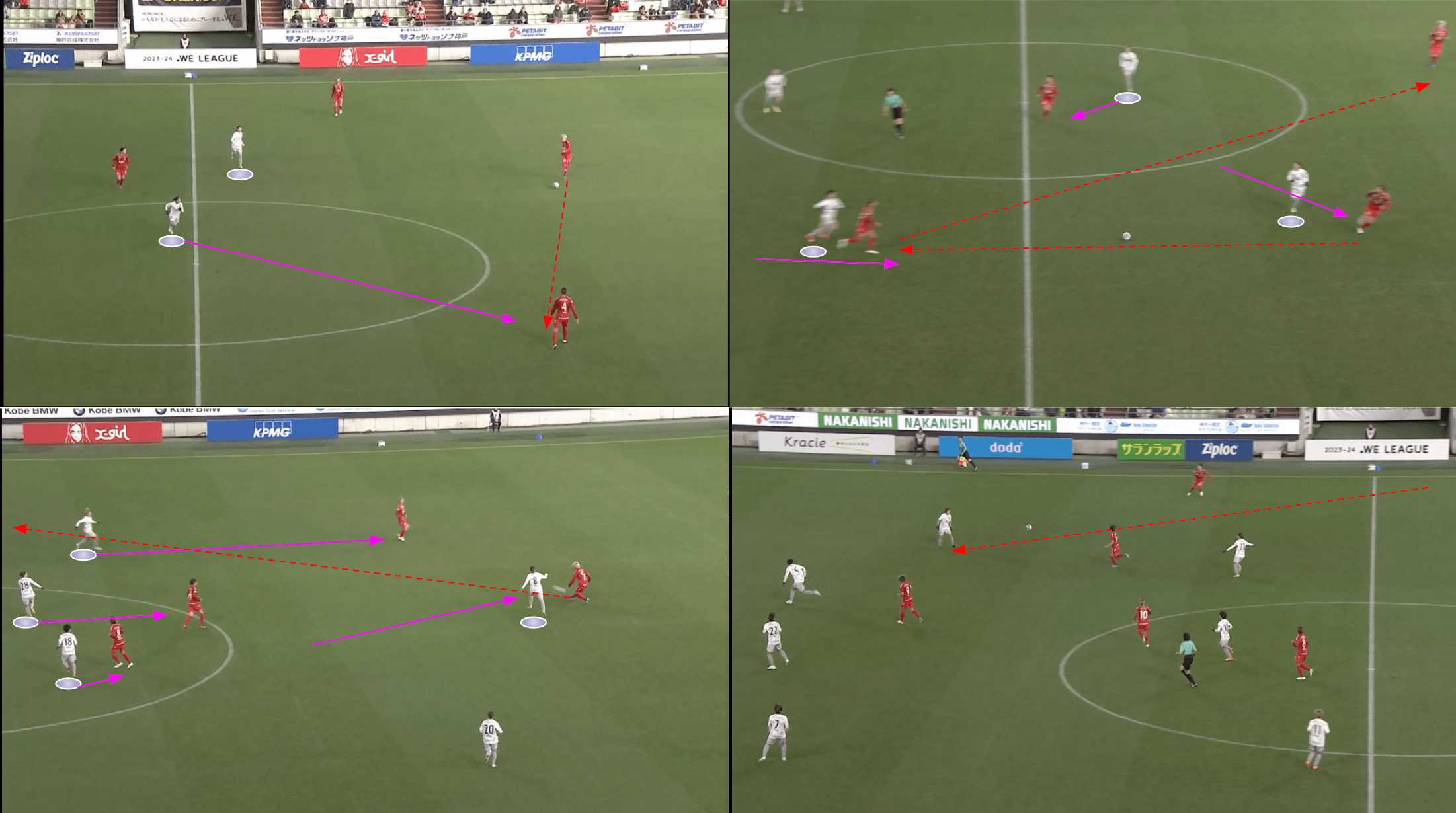
We see a similar set of pressing principles as described above here in figure 5. Firstly, Osaka’s right-striker presses the opposition’s left centre-back as they receive the ball; after they manage to play the ball forward to a midfielder dropping to receive and that player is followed closely by an Osaka midfielder, the ball is forced backwards, allowing Toriizuka’s left-striker to close that new receiver down as they receive the backpass.
In this example above, we see two primary pressing triggers that many teams throughout world football will use to make their opponents uncomfortable and force turnovers. Firstly, the pass into midfield sees a player receiving with his back to goal — Osaka’s midfielder ensures they stay tight, and the receiver can’t turn out, so ball progression is impossible.
The other common pressing trigger occurs as the ball is played backwards. Teams usually like to press on a backpass like this, as the ball moving backwards buys the defensive side time to move up, gain some territory and cut off that new receiver’s best passing options, changing the picture for them drastically between the time the pass was played and the time they receive the ball while also closing them down so they don’t have time to react and rethink their next move.
The result of this effective, well-organised, and intelligent pressing from the Cerezo Osaka players is that the ball is forced long and inaccurately, allowing the young Osaka team to regain possession and rebuild from the back.
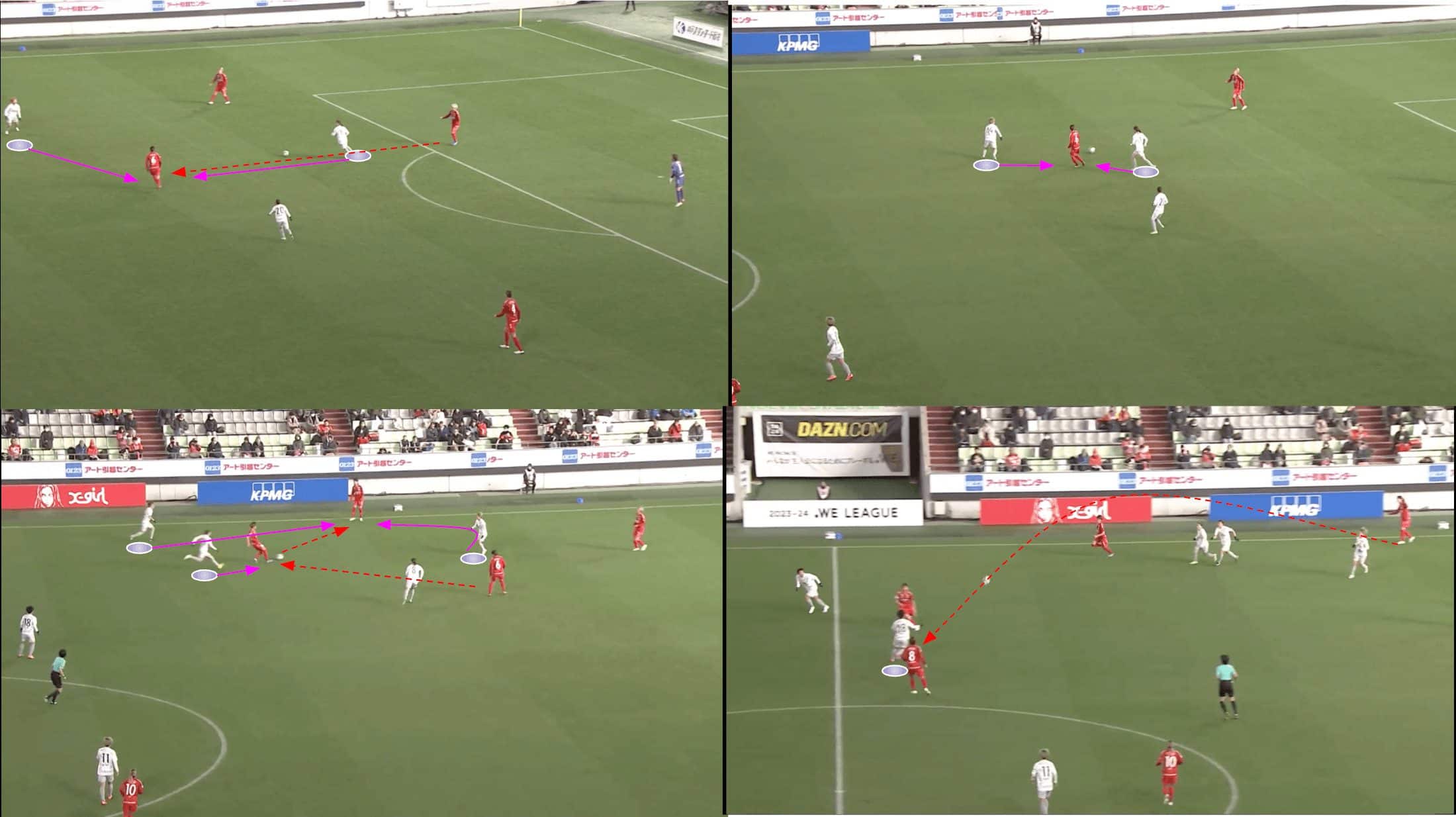
We see a couple of similar examples of how aggressive this Osaka team are at closing players down when receiving with their backs to where they want to be playing in figure 6 — another example from Osaka’s recent clash with Kobe Leonessa, who are consistently one of WE League’s title contenders.
Though Osaka lost this game 3-1, the scoreline flatters Kobe, as Osaka made life difficult for them throughout the contest through their aggressive midfield pressure, particularly with how they closed players down when receiving in the middle of the park and constantly reorganised themselves to keep the pressure on regardless of where the opponent played the ball to.
First, the opposition’s deep midfielder receives behind the pressing forward, but the forwards reacted to close that player down at the same time as a midfielder was pressing from behind, forcing that receiver into a rushed pass.
As the next player received pressure from all angles again as the forwards dropped back to cut off many passing lanes into seemingly safer regions of the pitch as other players advanced from behind to deny opportunities for ball progression.
As the ball ultimately makes its way out to the opposition’s right-back, who is extremely restricted for space due to the sideline and has several Osaka bodies immediately closing in on her, a rushed, inaccurate pass once again occurs, allowing Osaka to regain possession on the halfway line.
Osaka apply these fundamental pressing principles well. Combined with their seemingly endless energy and excellent commitment to the coach’s ideals, they have formed a formidable defensive unit in the opening stages of their first WE League season.
Defending in their own half
When defending inside their half, as opposed to closing off the opposition’s space further upfield, a key element of Osaka’s approach lies in their organisation and, once more, the work rate and commitment from players positioned further upfield.
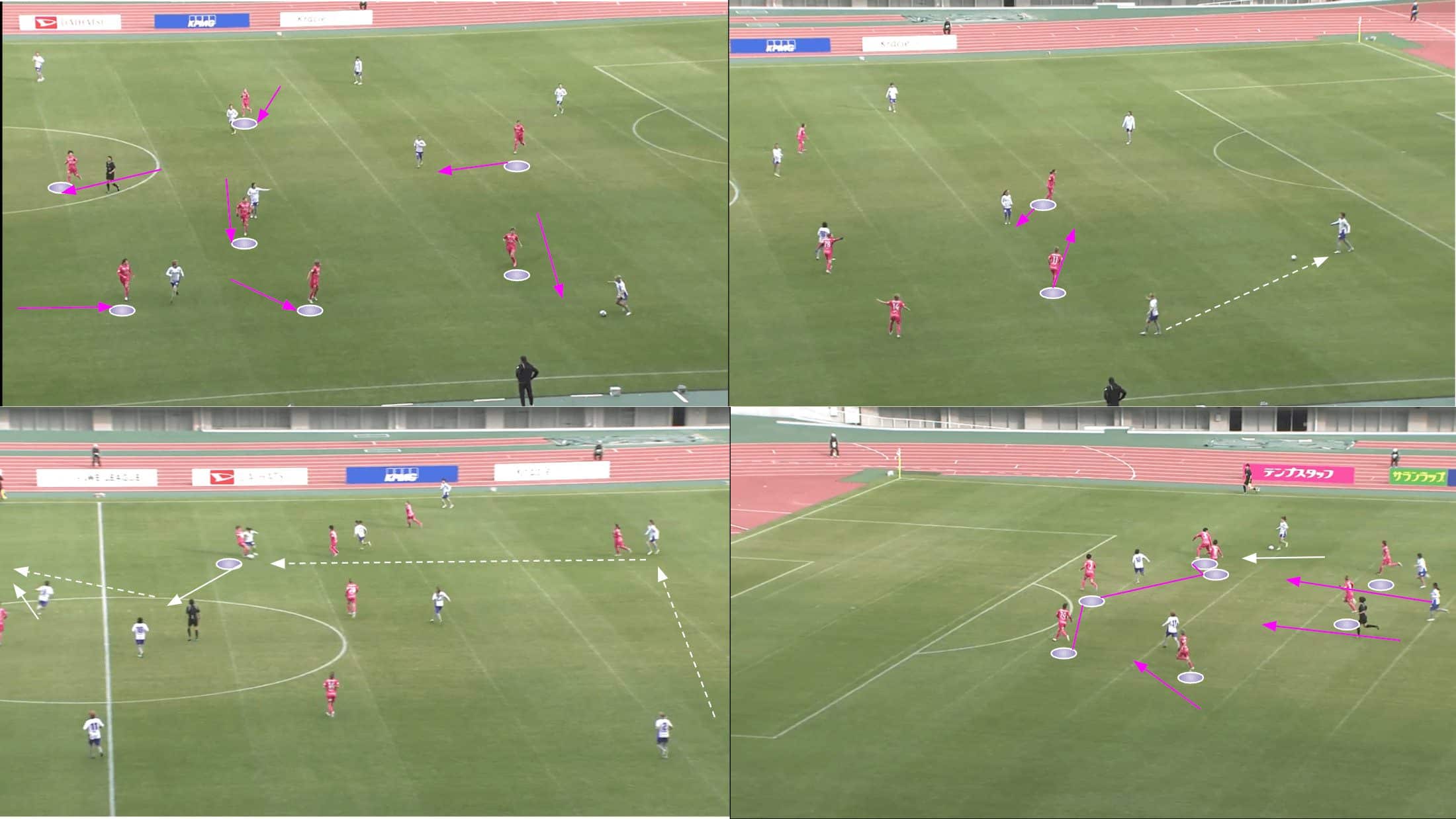
We see a familiar sight in the upper half of figure 7, as Osaka press on the right in their 4-4-2 shape, with the right-back advancing just into the picture in the top-left of our image and the midfield shifting over to cover the centre while the ball-near forward closes down the opposition’s ball-carrier.
In this instance, the eventual long pass from the opposition is successful for a change. Due to their aggression, Osaka can be caught out in between their midfield and defensive lines. Here, the receiver coming inside was able to release the forward ahead of him into Osaka’s half, giving her an opportunity to run at their backline.
What’s impressive here is how Osaka’s backline remains calm. They know exactly how to handle this situation mentally, tactically and technically, keeping a reasonable distance from the attacker while still being primed to pounce if a poor touch or otherwise worthy opportunity to take possession back occurs.
Meanwhile, this buys Osaka’s midfielders and forwards time to track back, which they diligently do, meaning that by the end of this image sequence, Osaka’s defensive structure isn’t extremely vulnerable as it may have been had the midfield been slower tracking back or had the ball-near defender rushed in and given the opponent a chance to move beyond them.
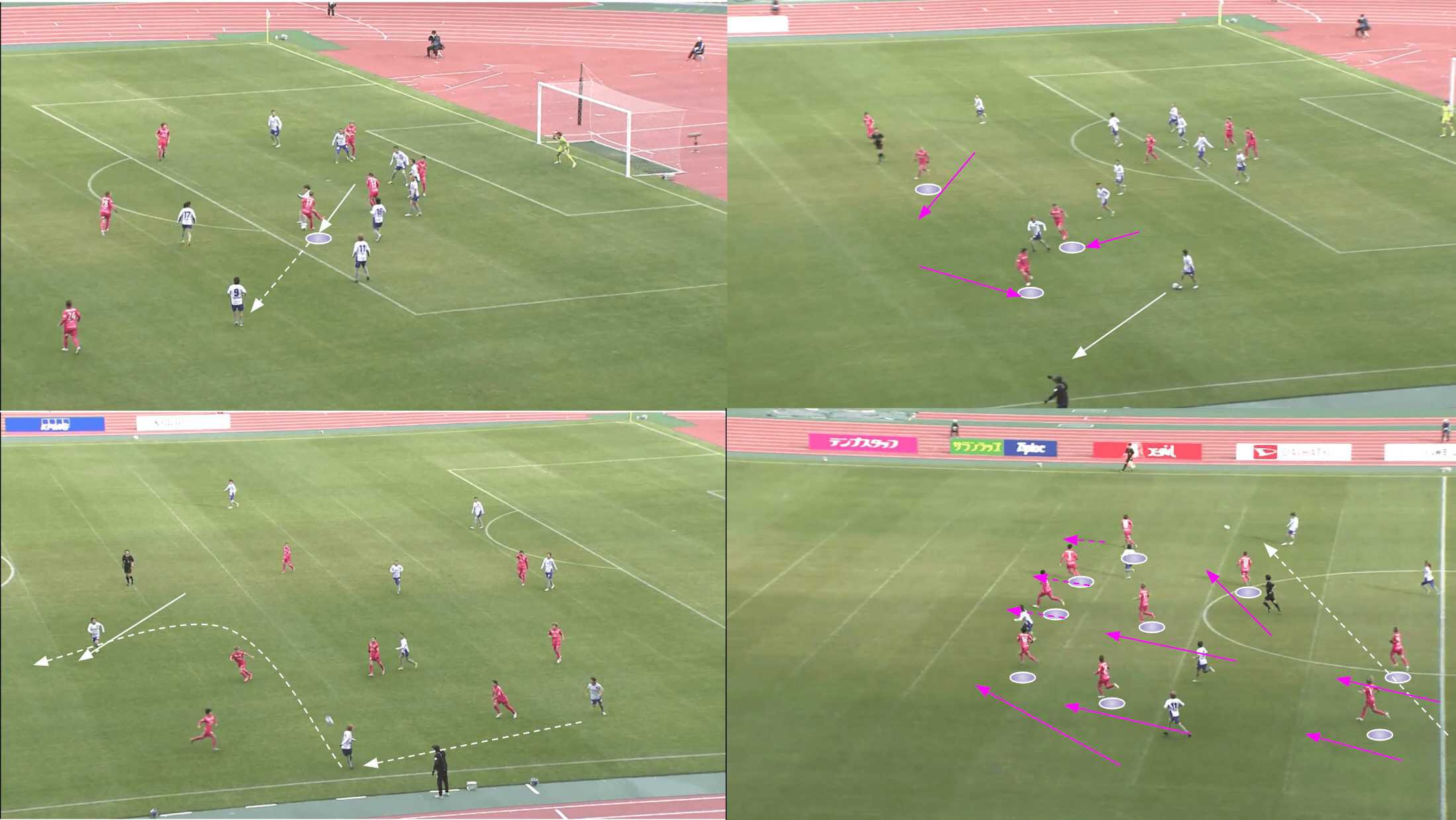
Figure 8 shows similar principles being applied as Osaka perform a defensive transition.
Toriizuka’s side love counterpressing aggressively and treat this method of defensive transition almost like a playmaking asset within their team. Frequently, as figure 2 indicated, this works out well, and Osaka can generate goalscoring opportunities via their counterpressing. However, on this occasion, the opposition got past their counterpress and found a way to exploit the space between their midfield and defensive lines.
This space is a natural weak point in Osaka’s structure due to their defensive methods, but they can often guard it by denying the ball-carrier space and time to target it effectively. However, the possibility it will be exploited, as seen in figures 7 and 8, is generally real.
Yet again, here, we have to note how impressive Osaka’s recovery is. Shortly after the ball is played in behind and the opposition try to go through on the opposite side of the pitch, Osaka have seven bodies back despite having just had seven bodies positioned on the edge of the opponent’s box shortly before, as seen in the first three images of this sequence.
Osaka are a fit and mentally strong team firmly committed to their defensive duties, and this commitment, along with their physical attributes, have played a vital role in their strong defensive performances this term.
Conclusion
In conclusion, our analysis has highlighted some of the fundamental principles and attributes present within Toriizuka’s young Cerezo Osaka team, which have led to their respectable start to life in WE League.
Should they work out some of their fixable issues, such as those discussed in our first section, along with a tendency to give the ball away cheaply in their half during the build-up phase a bit too often, they can expect their impressive defensive numbers to get even better, potentially making their first WE League season one to remember.

