


Club Libertad is on the verge of being crowned integral Paraguayan champions after winning the 2023 Apertura League and by currently leading the Clausura League.
They won the first phase of the season comfortably with 51 points (16 wins, three draws and three defeats), 10 ahead of the second-placed Cerro Porteño.
They are a talent factory who were responsible for the development of some young prospects who are currently performing in MLS and Premier League clubs, such as Julio Enciso and Enso González.
Ariel Galeano, the head coach for the second part of the season, can conduct this Paraguayan side to the title in this weekend’s match against the seven-placed Sportivo Luqueño.
The victory mathematically gives them the title; yet, as we see it, the draw could also be a sufficient result, since there will be two more games to be disputed.
As we will lay out further in this article, we characterised Libertad as a perfectly balanced team at the Paraguayan competitions.
With 40 goals scored and only 11 conceded in 19 games, they are their national championship’s best attack and defence.
Most of their offensive success has to do with their attacking trio (Héctor Villalba, Óscar ‘Tacuara’ Cardozo and Lorenzo Melgarejo), who already made 78 direct goal contributions this season.
In this tactical analysis, we’re going to try to unveil some of Ariel Galeano’s tactics and secrets for their success in this second part of the season.
Ariel Galeano Offensive Strategy

As demonstrated below, in the majority of the situations, they are organised in a classic 4-3-3 or in a 4-1-2-3, to be more specific.
They can adapt their offensive strategy in accordance with the team they’re going to face, yet the primary model is this.
Libertad seems like a European team playing in a South American championship due to their build-up, short-pass strategy and also due to their transition avoidance.
One of the most interesting features is related to the wingers’ positioning.
Ariel Galeano instructs them to be positioned inside so that they can explore the space between the lines and increase the bound with the striker, Cardozo.
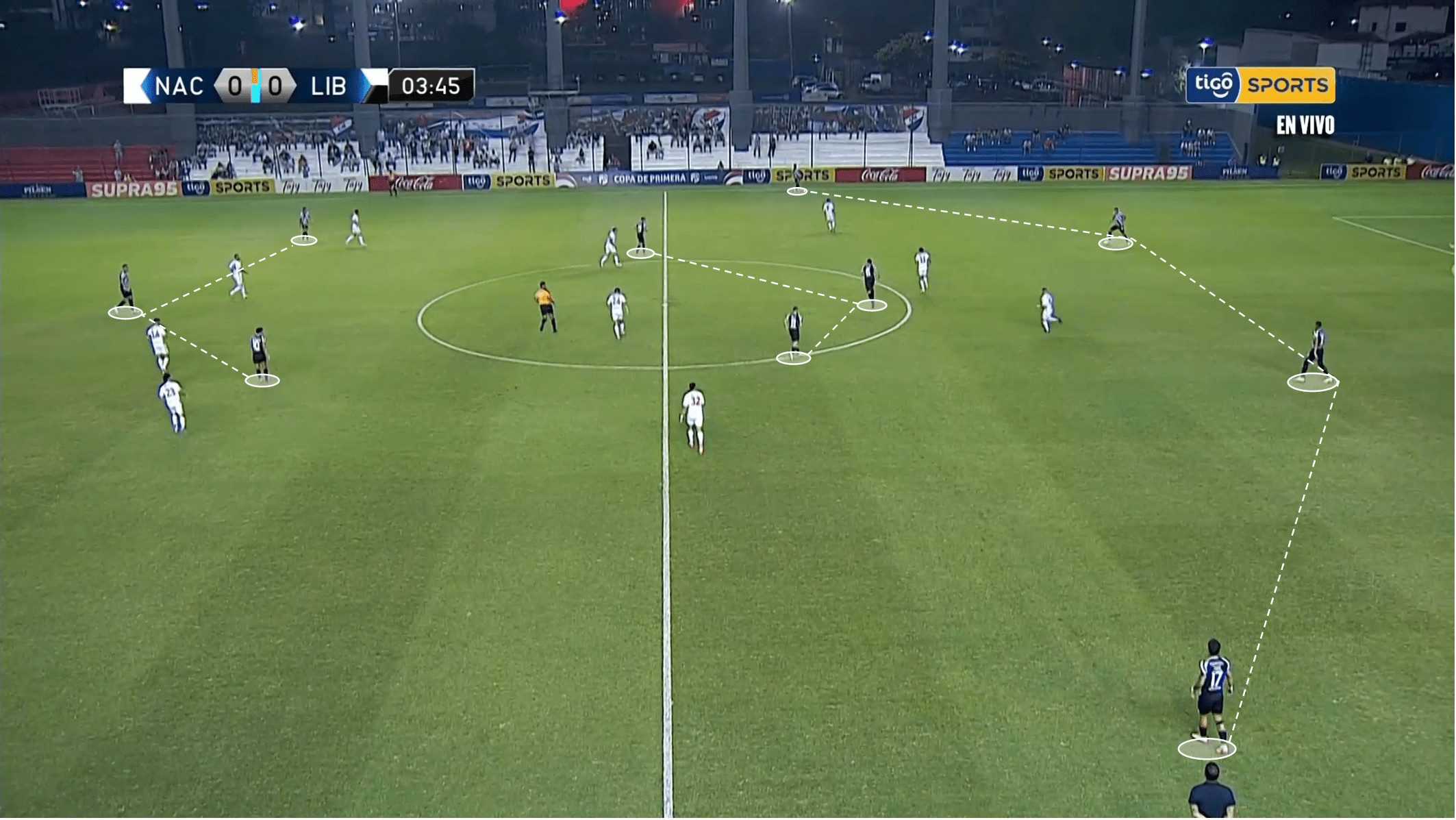 Another reason for this particular tactic can be associated with the opposition’s defensive organisation.
In other words, the centre-back and full-back have to decide who will mark the winger when he’s inside.
Here is where things get complicated because if the full-back is holding, the winger leaves a big gap for the full-back to explore.
Such a situation can be mitigated with the defensive support of the winger by denying a potential numeric inferiority play by the flank.
Still, we’ll go through this matter further on this piece.

This interior positioning eventually will attract the opposition, leaving space for the full-backs to explore and conduct dangerous plays, mostly by the left due to Matías Espinoza’s attacking irreverence.
This Paraguayan game plan reminds me of Fernando Diniz’s Fluminense, especially when they overload one specific sector, bearing in mind the opposite flank.
The ex-Roma Iván Piris (right-back) and Espinoza (left-back) are open, waiting for the ball to conduct a 2v1 or a 2v2 play with the winger.
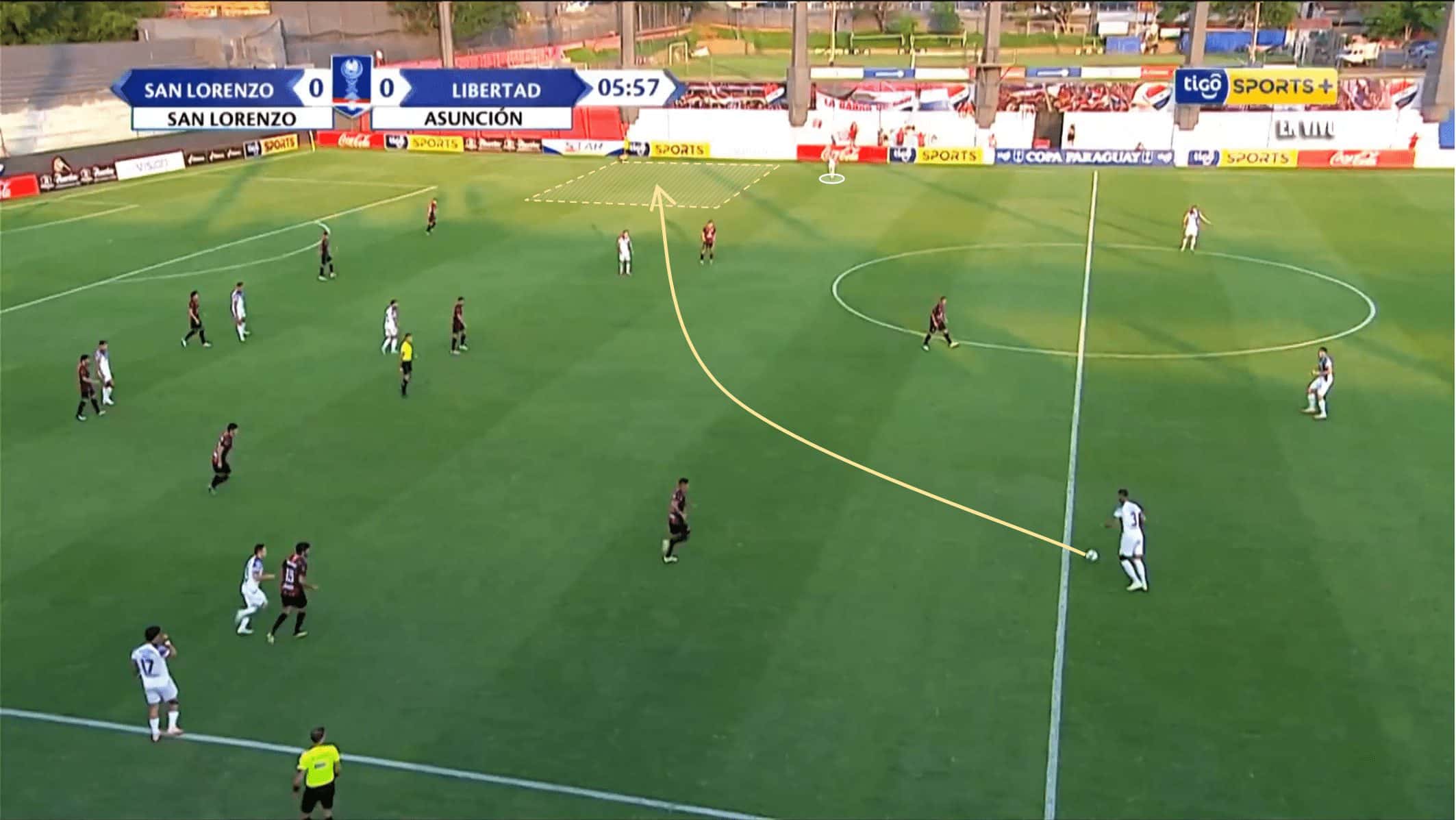
The function of the three midfielders also has a massive relevance in Libertad’s attacking phase, especially because of their linking obligations.
Álvaro Campuzano plays a crucial role in the game, controlling the pace and making sound decisions while attacking.
Looking at the data, he ranked in the 88.8th percentile on received passes and in the 77.7th percentile on both effective and executed passes per game.
Moreover, during our analysis, we also observed that Libertad seems to prioritise a more backtracked construction, and in some cases, one of the midfielders descends right near Campuzano, normally the ball-side player.
This can be useful if the opposition’s pressing is succeeding and the team is struggling to make the ball reach more advanced zones of the pitch.
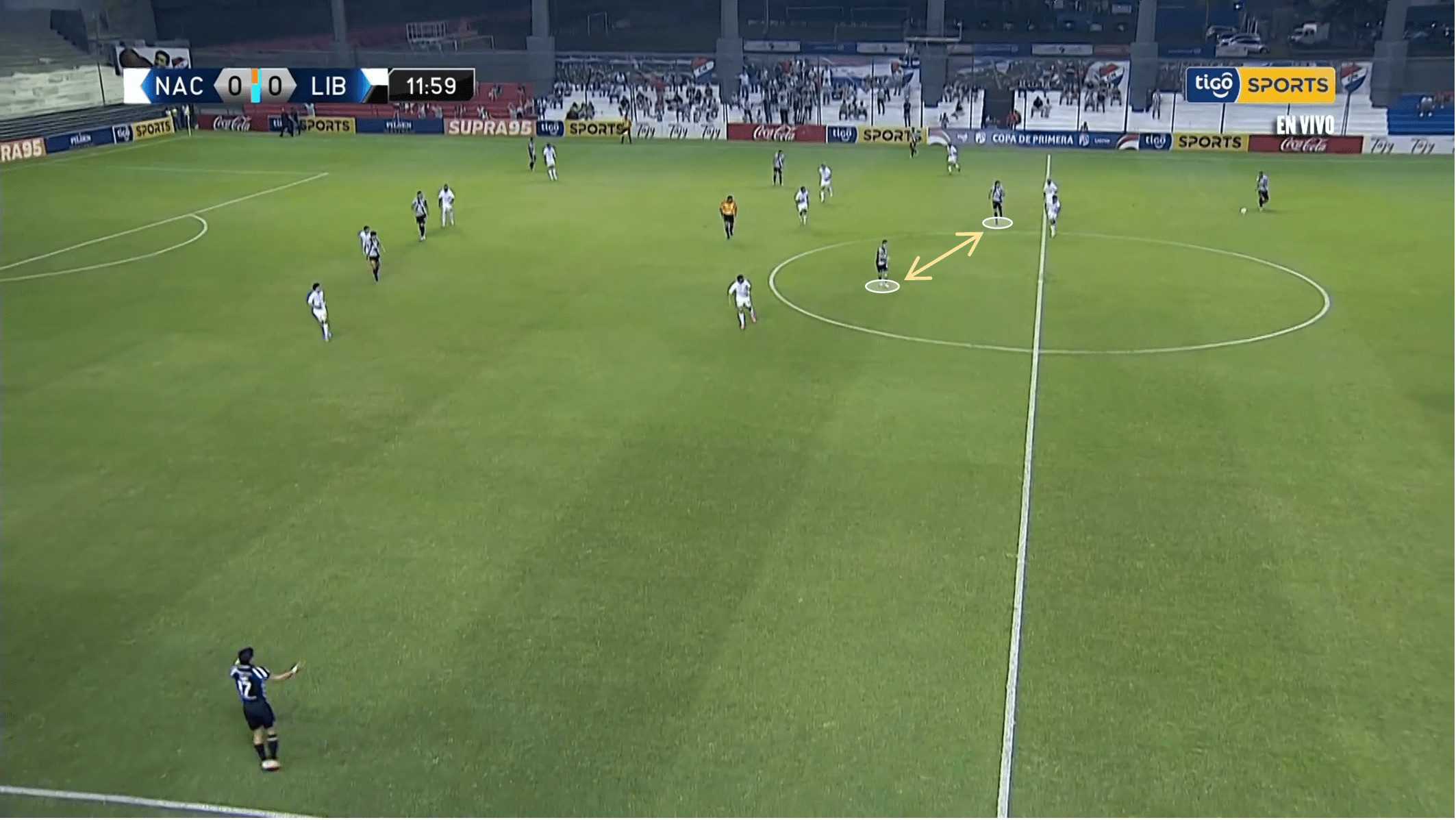
Still, on Libertad’s first offensive phase, we also observed a three-man build-up, where Campuzano enters between the middle of the centre-backs, and the full-backs extend their deepness in the field.
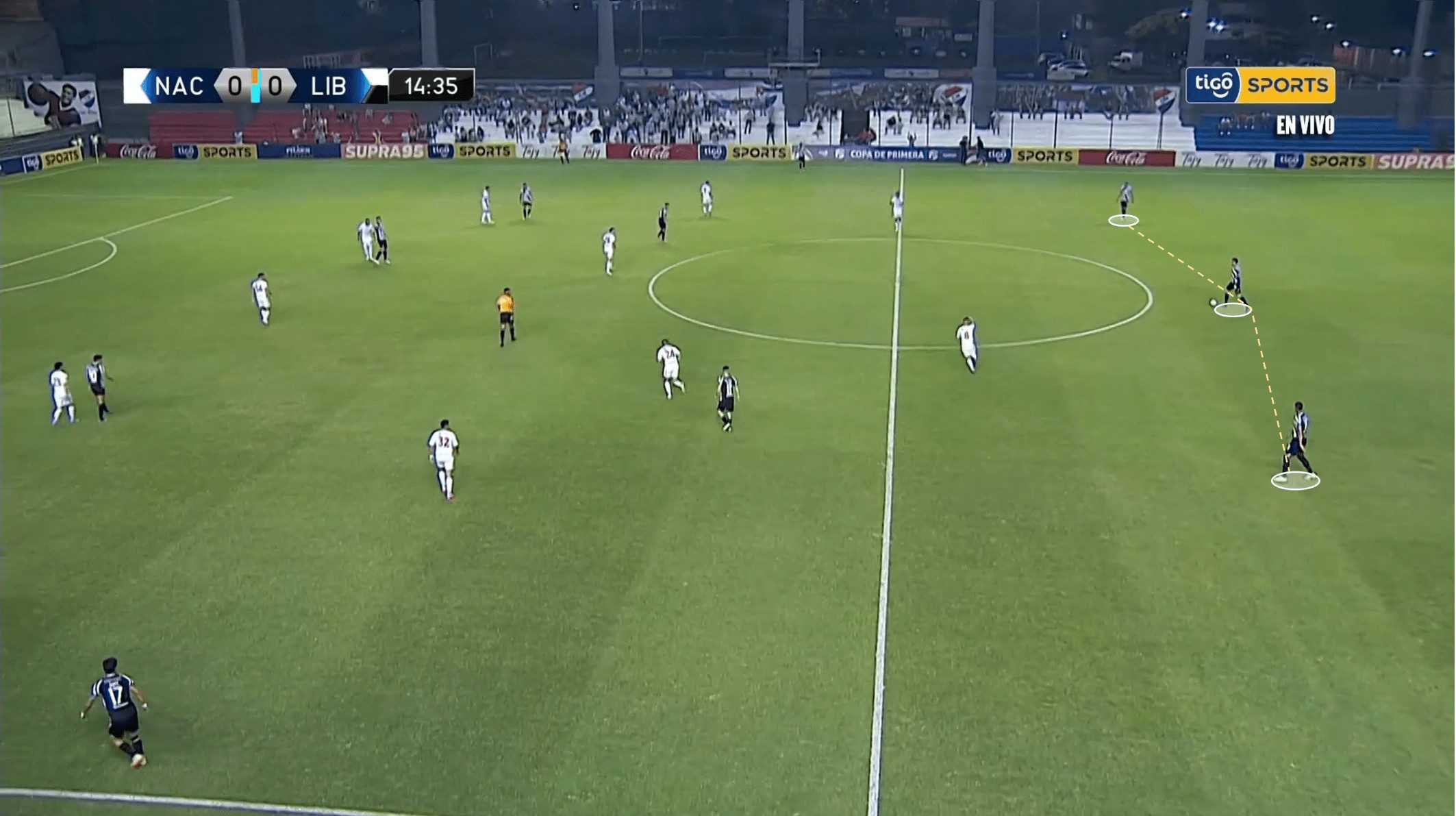
Another alternative for their offensive strategy which can be used if the opposition has their elements concentrated in the middle, making an interior pass more difficult to make.
With this, they prioritise the flanks and their exterior game, where both wingers and full-backs have a significant and substantial impact.
Finally, the direct game can also be a strong weapon for Galeano’s men, especially when you have a strong aerial presence like Cardozo on the roster.
The wingers and the midfielders also have an important role in this strategy, especially by battling and winning the second ball at that particular zone of the pitch.
At 40 years old, the Paraguayan legend already has 22 goals and not only is Libertad’s top goalscorer but also the player with the most goals in the Paraguayan league, an exceptional achievement for a player at his age.
He’s very experienced and intelligent while attacking, making his technical (shooting and passing) and physical attributes his biggest strengths.
Cardozo is Libertad’s main reference inside the box and doesn’t need much space and time to score.
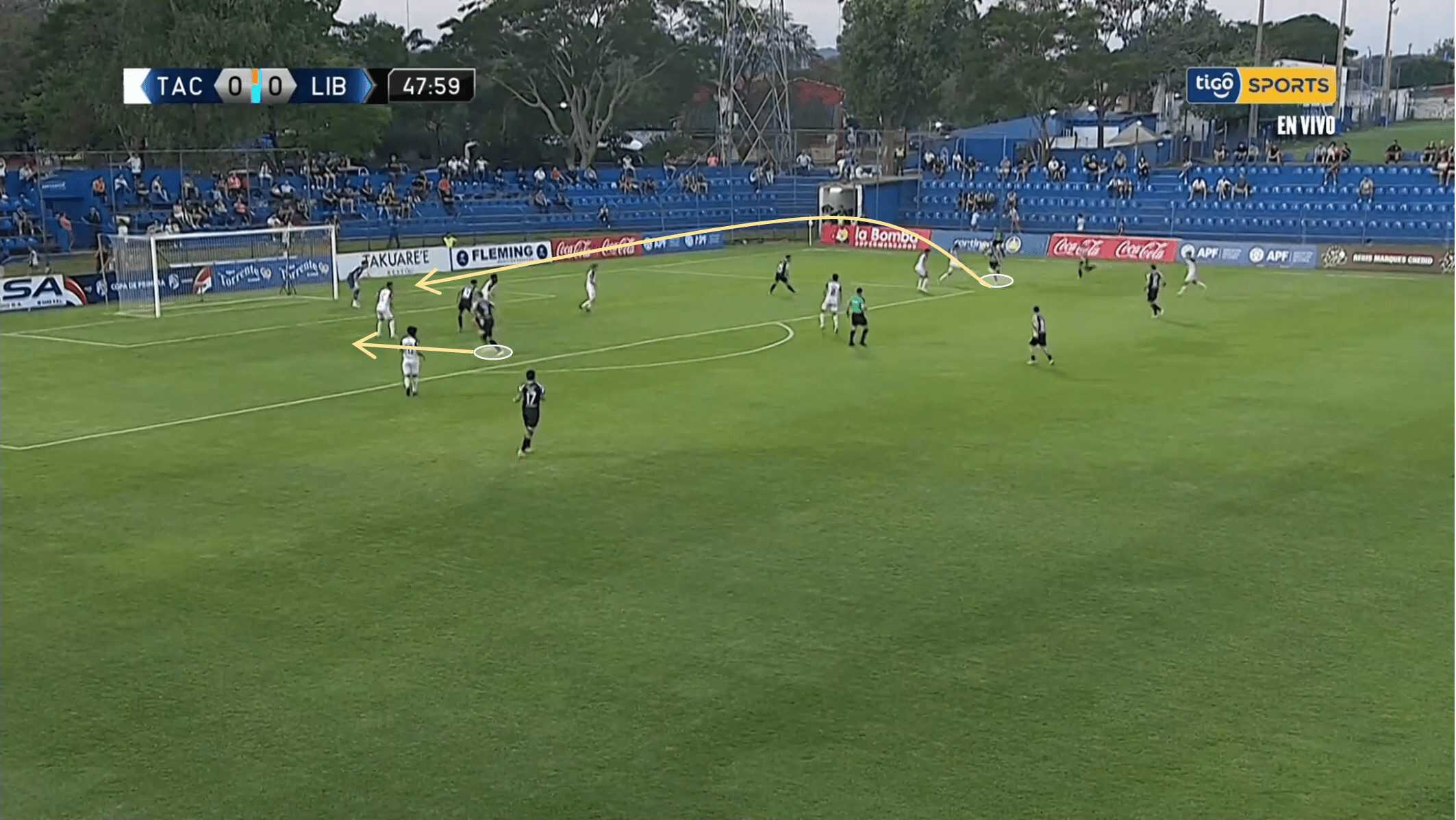
One of the most common plays is described in these two images, where the flank takes a cross with Cardozo as the primary target.
Also, an essential note for Cardozo’s off-the-ball movement, which is decisive for his success in these kinds of plays.
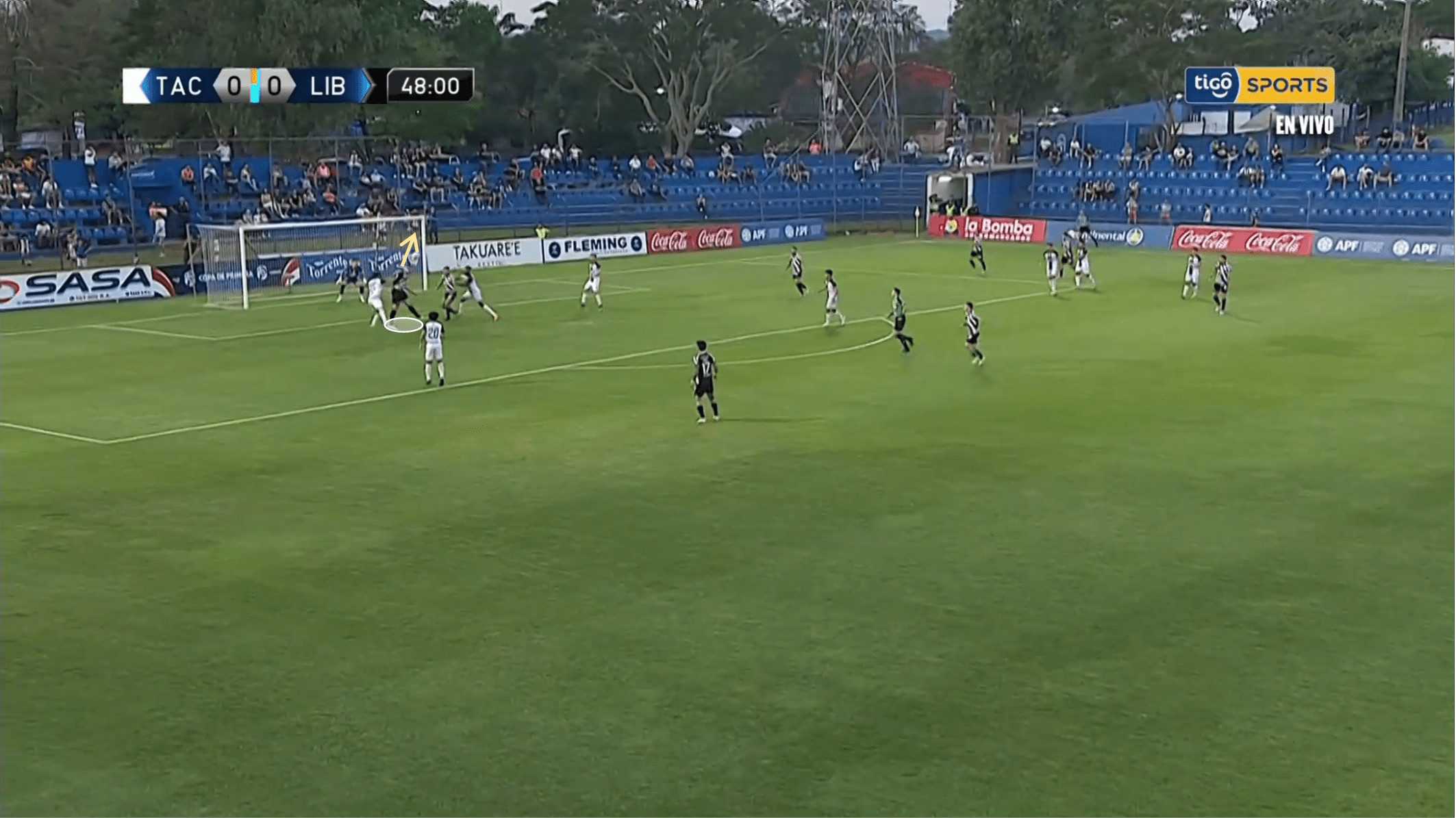
Indeed, during the cross, top strikers like him tend to give more attention to their positioning than the cross itself and in the first image, we can see Cardozo looking at his front, taking his eyes off the ball.
Ariel Galeano Defensive Approach
As we mentioned, this Paraguayan side has the best defence in the championship, having conceded 26 goals in a total of 41 games, resulting in an average of 0.6 goals conceded per game.
Their offensive strategy is directly related to their defensive success due to their ability to have the ball most of the time.
According to Wyscout, Club Libertad have an average of 53,74% ball possession and the most negligible defensive exposure in the league by conceding, on average, only eight shots, which verifies their on-possession dominance.
As we said, the general model can have some oscillations concerning its format, yet, generally, Libertad defend like an attack in a 4-3-3.
They are an intense team in the loss-of-possession moment, especially when discussing the midfielders and defenders.
Although it’s not always possible, this Paraguayan side also intends to shorten the space between the defensive and midfield lines.
The centre-backs play a crucial role in this by constantly alerting the attackers to their behaviour.
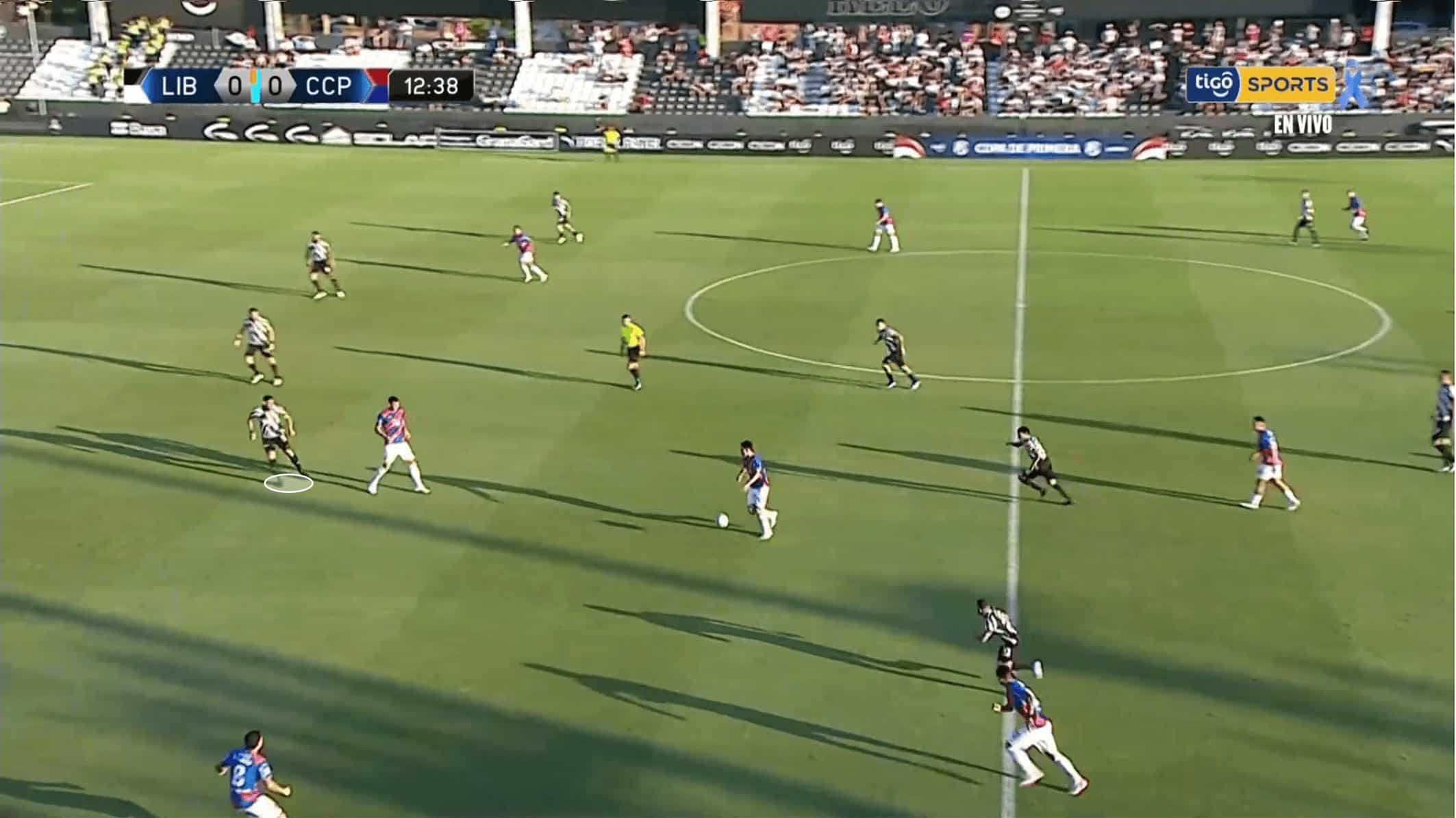
We also found a fascinating defensive detail from the full-back.
When the winger comes from the wing and explores the gap behind the midfielders, the pivot becomes a 1v2 situation.
Keeping this in mind, the full-back acts as a defensive inverted full-back and closes inside, blocking such a solution.
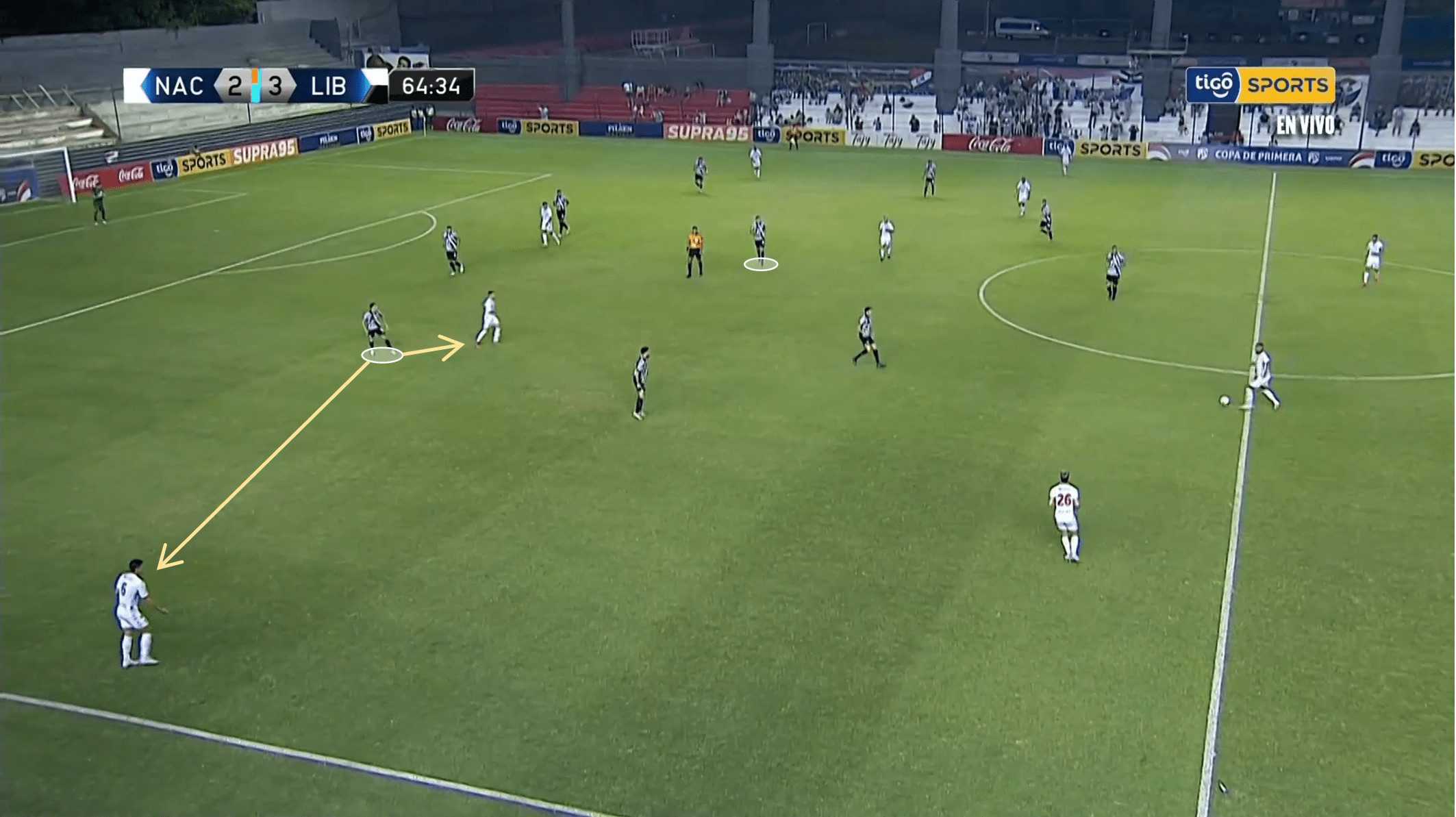
This technique is effective most of the time, yet it has a critical requirement attached to it: cohesion between the different sectors must be present in the defensive process.
Continuing with the example above, it only makes sense for the full-back to continue marking the player inside if the Libertad winger is defensively assured of the width, or to be more specific, he is aware of the opposition’s full-back positioning.
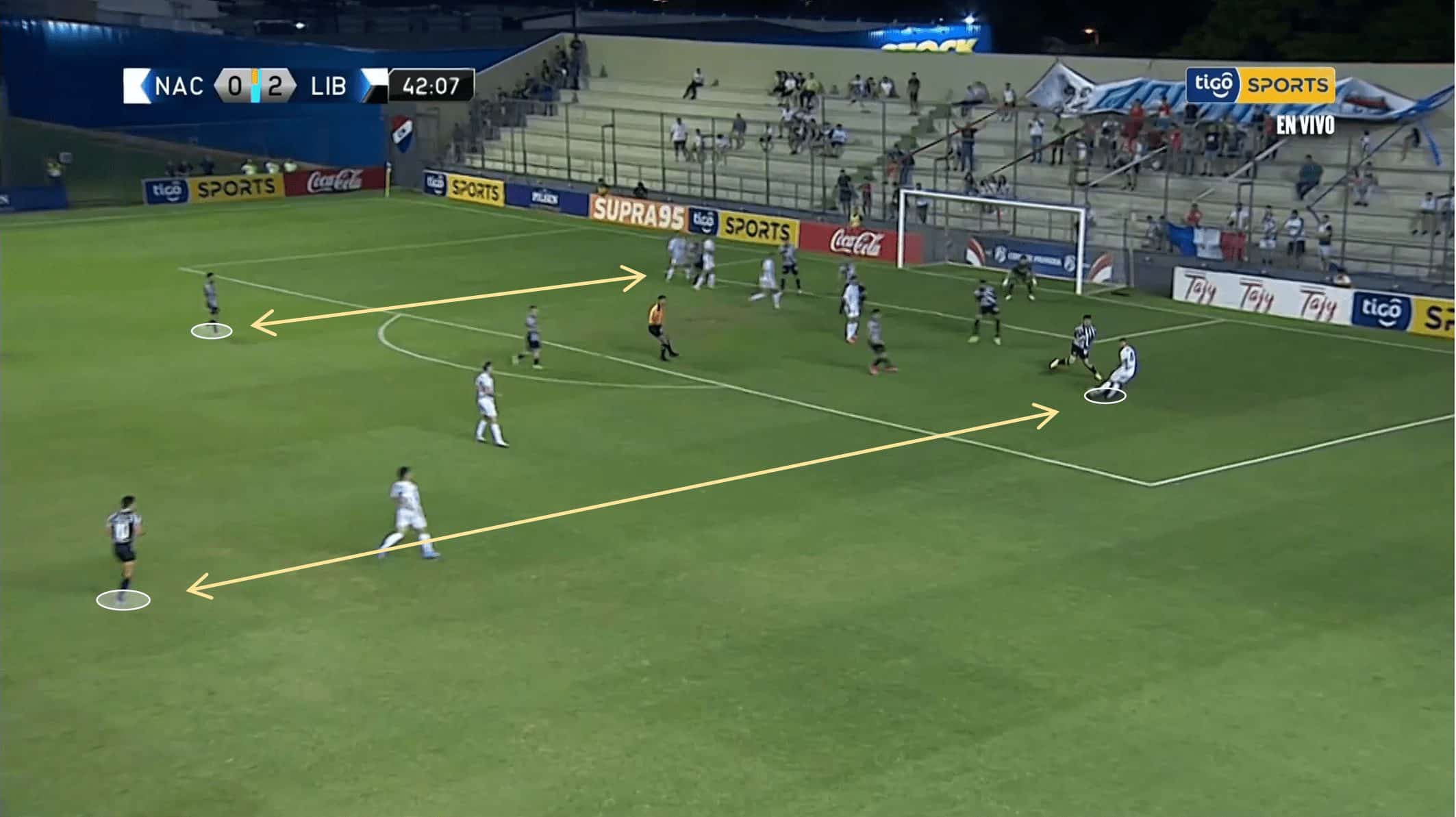
This takes us to one of the Libertad’s defensive flaws: sometimes, the wingers take too long to descend and have difficulty keeping up with the opposition’s attack, especially in transitions.
This is transversal to teams whose attackers have a high offensive preponderance, and the rest of the team ends up compensating by making an extra effort while defending.
However, this additional commitment strategy isn’t entirely trustworthy and at a higher competitive level, it can be fatal.
 Such off-the-ball consistency is also due to their aggressiveness and intention in the aerial game, especially when discussing defensive crosses or set pieces inside Libertad’s box.
On average, they won more than half of every duel disputed, which again is significantly higher than its opposition.
Regarding their pressing, Libertad isn’t a very intense and high-block team, seizing a PPDA (Passes Per Defensive Action) of 10,19 in all competitions in 2023.
Their pressing intensity varies throughout the game, peaking in the first minutes of the match and decreasing thereafter.
This relates to what we previously discussed regarding the front three direct goal contributions and defensive disregard.
Moreover, we also think the attackers’ age can play a relevant role due to the physical exigence and demand for a successful high-pressing strategy.
Indeed, the average age of the most used attackers is 35.6 years, which brings experience to the squad but also lacks in situations that demand high physical levels.
Conclusion
Club Libertad from Asunción, the capital of Paraguay, is on the verge of bringing home their fifth Clausura title since the competition adopted this format.
Under Galeano, the team feels comfortable working the ball from the back, with the wingers’ interior positioning as this model’s main highlight.
In this scout report, we also run over the importance of Campuzano’s intelligence and tactical know-how in Libertad’s offensive processes.
Although they play with a single pivot, we described some situations where the midfielder could drop down to have numeric superiority in such an important zone.
Some similarities with Diniz’s Fluminense were also found, especially in overloading concepts, which attract the pressing to a specific zone, leaving a whole sector free, in this case, the corridors.
Defensively, we went through some reasons for their defensive success, such as the aggressiveness and intensity on winning duels and the second balls in particular.
An interesting detail concerning the positioning of the full-back was also mentioned.
Finally, we discussed a defensive inconsistency related to the disaggregation of the most offensive line with the rest of the team.

