


Chesterfield F.C. have endured a rather tumultuous recent history. Since winning the EFL Trophy in 2012, the club went on to win League Two for a record fourth time in 2013/14. However, after three seasons in English football’s third tier, The Spireites suffered two consecutive relegations, which saw them drop out of the football league in 2018.
The club failed to bounce back instantly, and the club narrowly avoided relegation again in 2019/20, finishing just two points above the relegation zone. However, the season came to an end after 38 games due to the pandemic. Although their fortunes have started to turn around, in every season since then, the club have reached the National League playoffs.
In February 2022, Paul Cook returned to Chesterfield, having previously guided the team to that aforementioned record-breaking League Two title back in 2014. During the little time he had in the 2021/22 campaign, Cook guided the team to a seventh-place finish in the league, sneaking into the playoffs by a single point. However, it wasn’t meant to be, as the team from Derbyshire lost to Solihull Moors in the semi-final.
Last season saw the club get off to an impressive start; however, as we know, Wrexham and Notts County charged well ahead, engaging in a remarkable title battle that saw both teams pick up over 100 points. Cook guided his team to third place, which again saw them into the playoffs.
This time, they advanced to the final, where Notts County were waiting, having fallen short in the race for the title. With the scoreline 1-1 after 90 minutes and 2-2 after extra time, it went to penalties. The shootout ended in heartbreak for the Spireites, with victory belonging to the Magpies on this occasion. Chesterfield remained in the National League for another season.
However, the 2023/24 campaign has gotten off to a promising start. Chesterfield are currently top of the league by five points and scoring goals for fun, having notched up 32 already. There are issues at the other end of the pitch as they have conceded 21 goals, double that of third-place Solihull Moors.
With plenty of loanees from Premier League clubs and former EFL Championship players, the level of talent in the National League has never been higher. Safe to say, Chesterfield are flying, and in this tactical analysis, we will look at the tactics Paul Cook is implementing in his second spell at the helm. We will dissect why they can create so many goalscoring opportunities and look into why they struggle to keep clean sheets.
Preferred formations

We can see from the graphic above that Paul Cook has mostly sent Chesterfield out in a 4-2-3-1 formation this season. This system plays to the player’s strengths as it allows them to utilise the wide areas in the attacking phase, where the skills and speed of Colclough are an excellent outlet.
Chesterfield likes to dominate possession, averaging 58.78% per 90 this season. This is mainly accomplished by the double pivot in defensive midfield, whose primary role is to win back possession and distribute the ball efficiently. They provide passing options for the defenders, creating a secure platform from which the team can build its attacks.
This formation is also effective for pressing high up the pitch, something which Cook likes his time to do. The lone striker serves as a focal point for launching quick counterattacks to link up with teammates, often bringing the wide players into play as they make inverted runs into the opposition penalty area.
Positional rotations of the forwards
Chesterfield’s attacking play mostly revolves around strategically facilitating attacking rotations. Their attacking players are given the freedom to rotate throughout the game freely. These rotations often drag the opposing defenders out of their positions, as they have to adapt to the changing positions of the attacking players, leading to gaps or spaces opening up in the defensive lines.
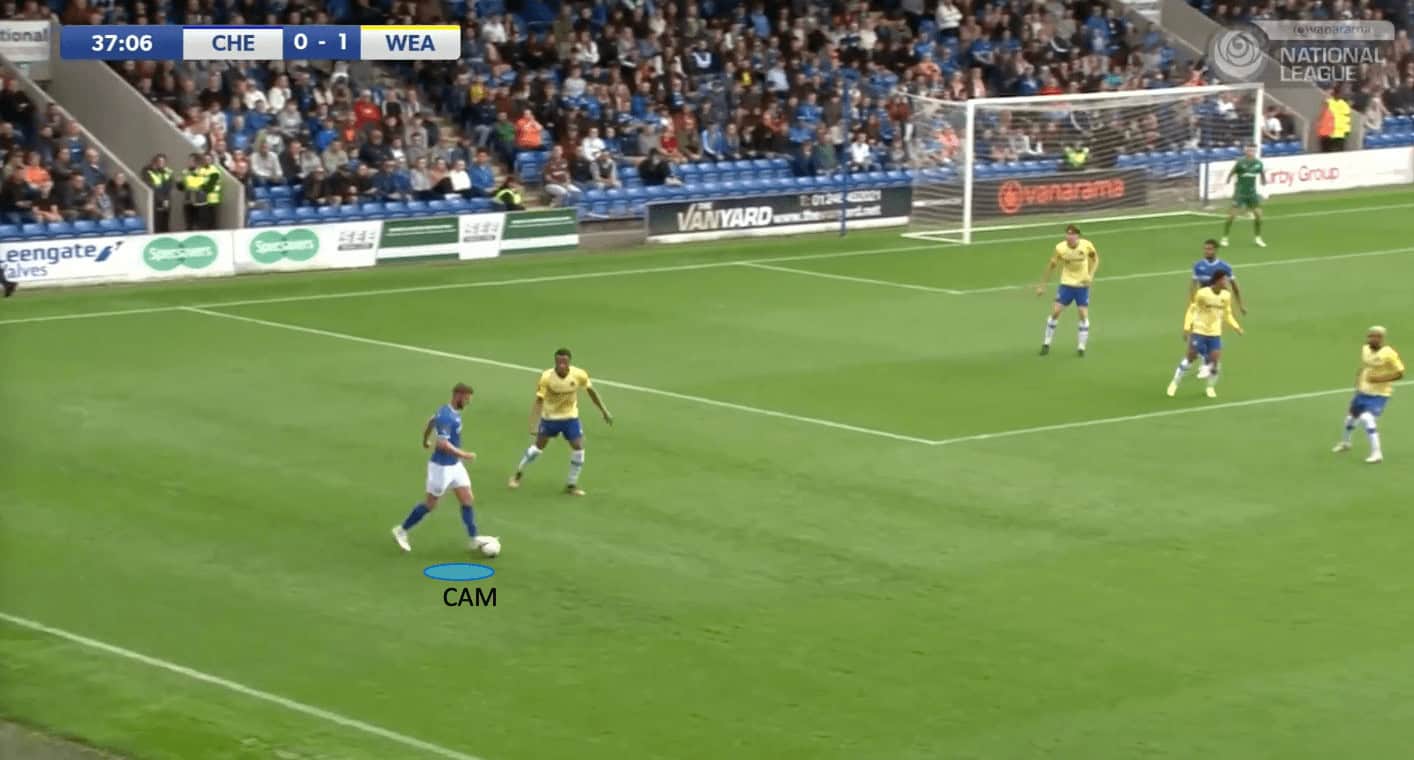

While the attacking players move and interchange positions, the defensive midfielders can maintain their positions and act as playmakers looking to distribute the ball effectively.
We can see in the example above how Michael Jacobs, the CAM, has drifted out to the left wing. As a result, the left winger James Berry-McNally has moved infield to make a compact front four consisting of the two wingers, the centre forward and the left back, who has made an underlapping run.
The front four of Chesterfield can cause chaos with their off-the-ball movement. As the images show, it forces the opposition to defend deeper in their own half. The full-backs’ advanced positioning, whether overlapping or underlapping, pins them back and drags more players out of their defensive shape.
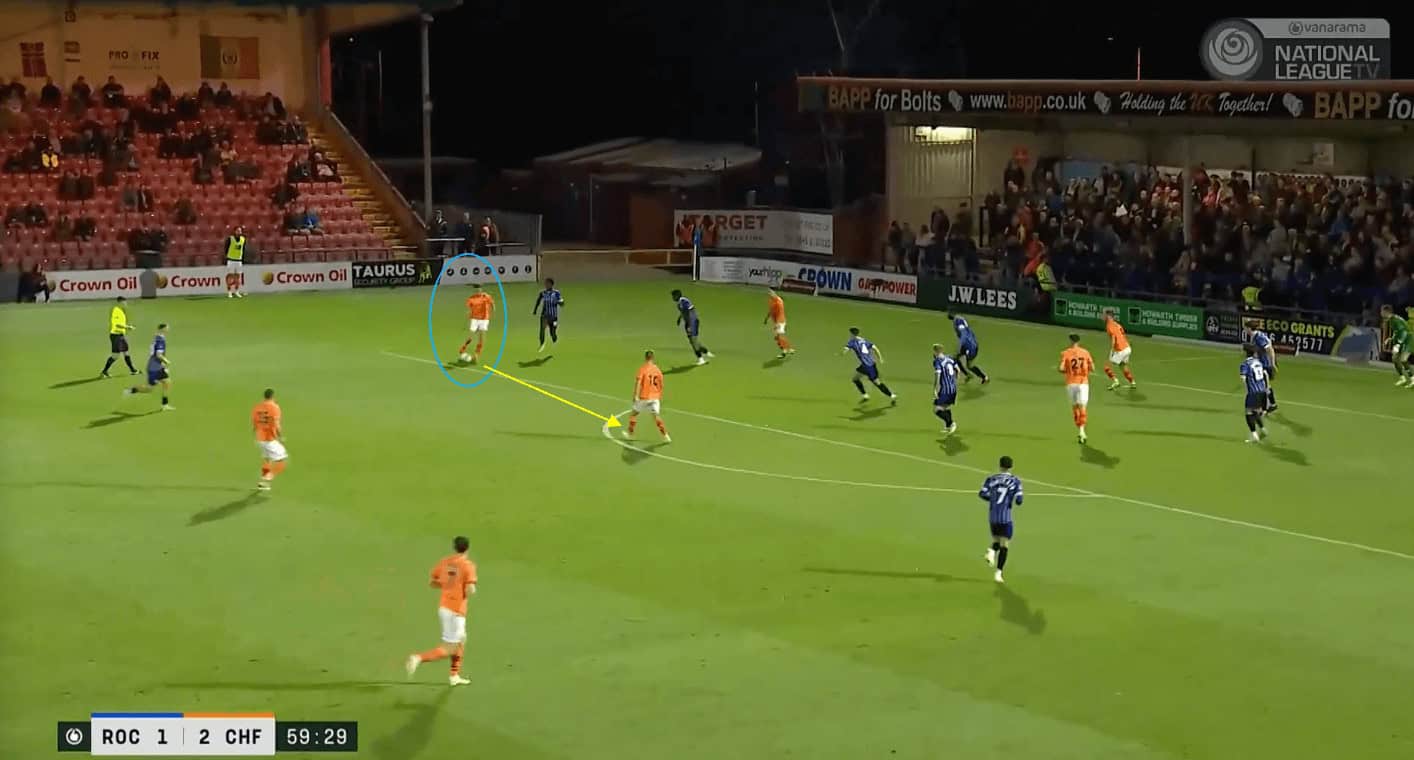
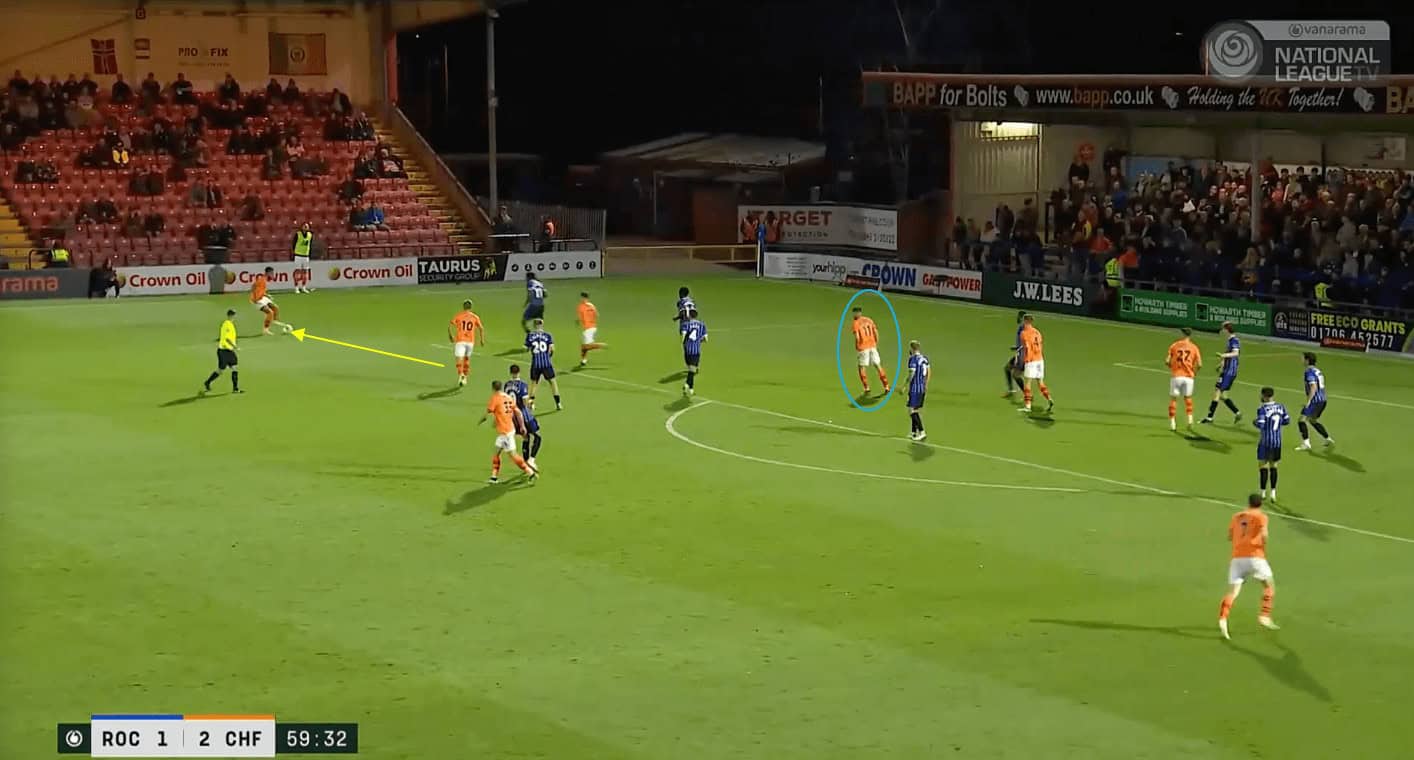
Another example can be seen here. Colclough plays the ball to Jacobs, who lays the ball off to Freckleton. Meanwhile, Ryan Colclough has made his way into the penalty area and found himself a pocket of space to wait for the cross.
The Chesterfield number 11 is their primary attacking outlet so far this season. When building an attack, the midfielders will spray the ball out to Colclough, who will look to progress the play as much as possible.
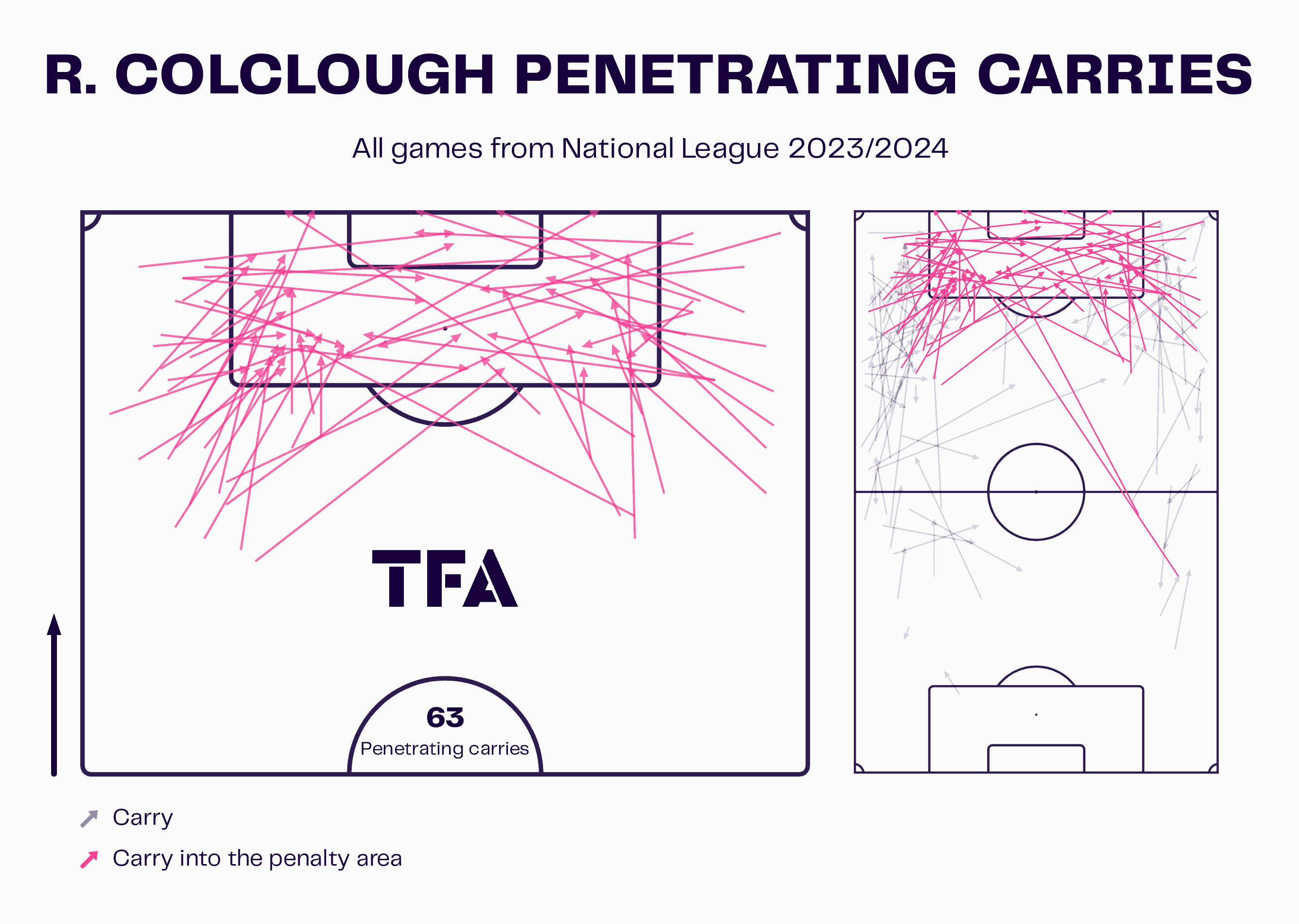
Colclough averages 9.49 dribbles per 90 with a success rate of 63.1%, which shows how he likes to carry the ball forward. The 28-year-old, who can play on either wing or as a number ten, isolates his opponent in the wide area and then beats his man and carries the ball into the box. We can see from the data viz that he has made 63 carries into the area so far this season. He is a nightmare for defenders with the ball at his feet.

Additionally, we can see from this data visual how the centre forwards are involved in the positional rotations. Will Grigg is primarily the starting forward, with Quigley making appearances from the bench. The touch maps indicate that both forwards move into the channels as well as drop deeper to pick up possession.
Smart set pieces
We cannot talk about Chesterfield’s attacking prowess without mentioning their set pieces. The Spireites have scored 13 goals from set pieces than they have from open play this season, so what makes them so good from dead-ball situations?
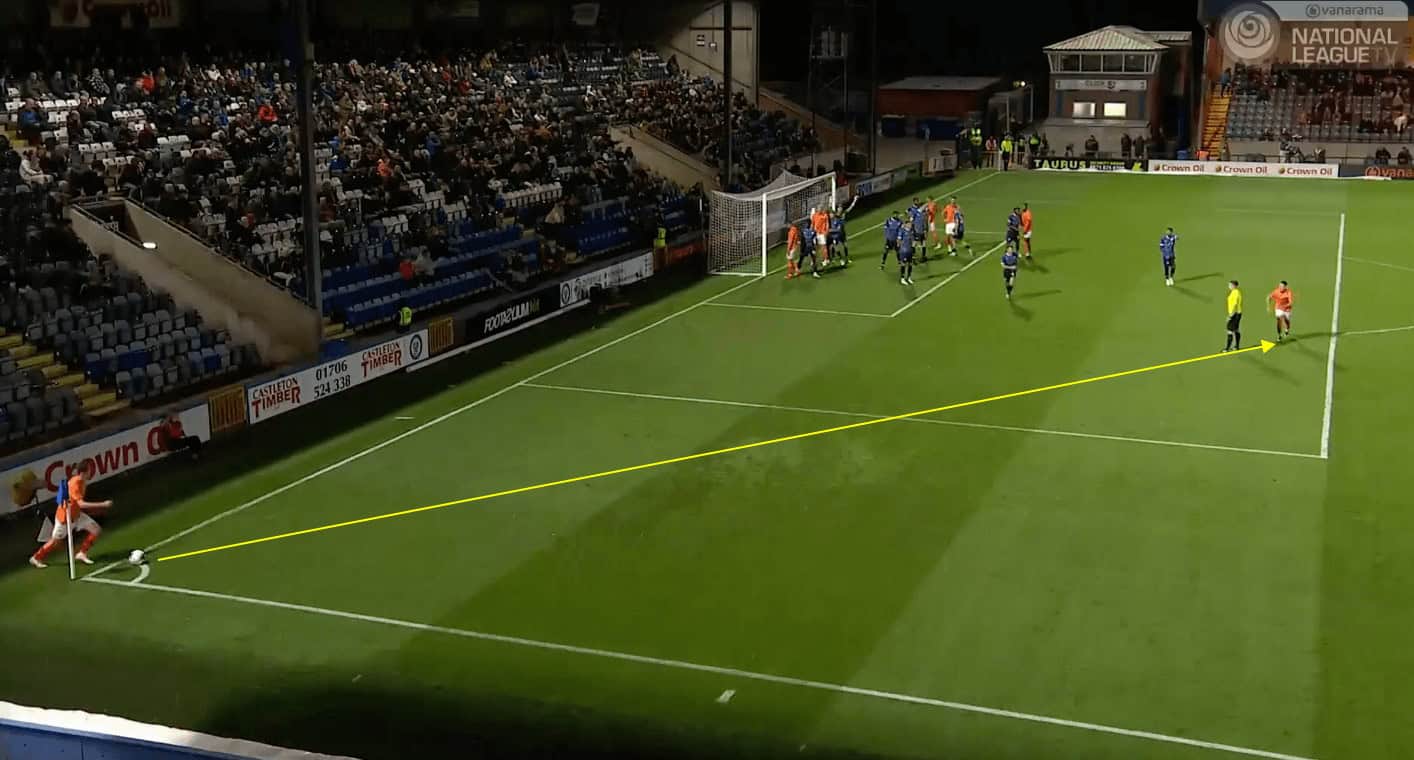
A great example can be seen here: with a player unmarked, it offers the opportunity for a short corner. Mandeville plays the ball to his teammate and then moves to a more optimal crossing position.
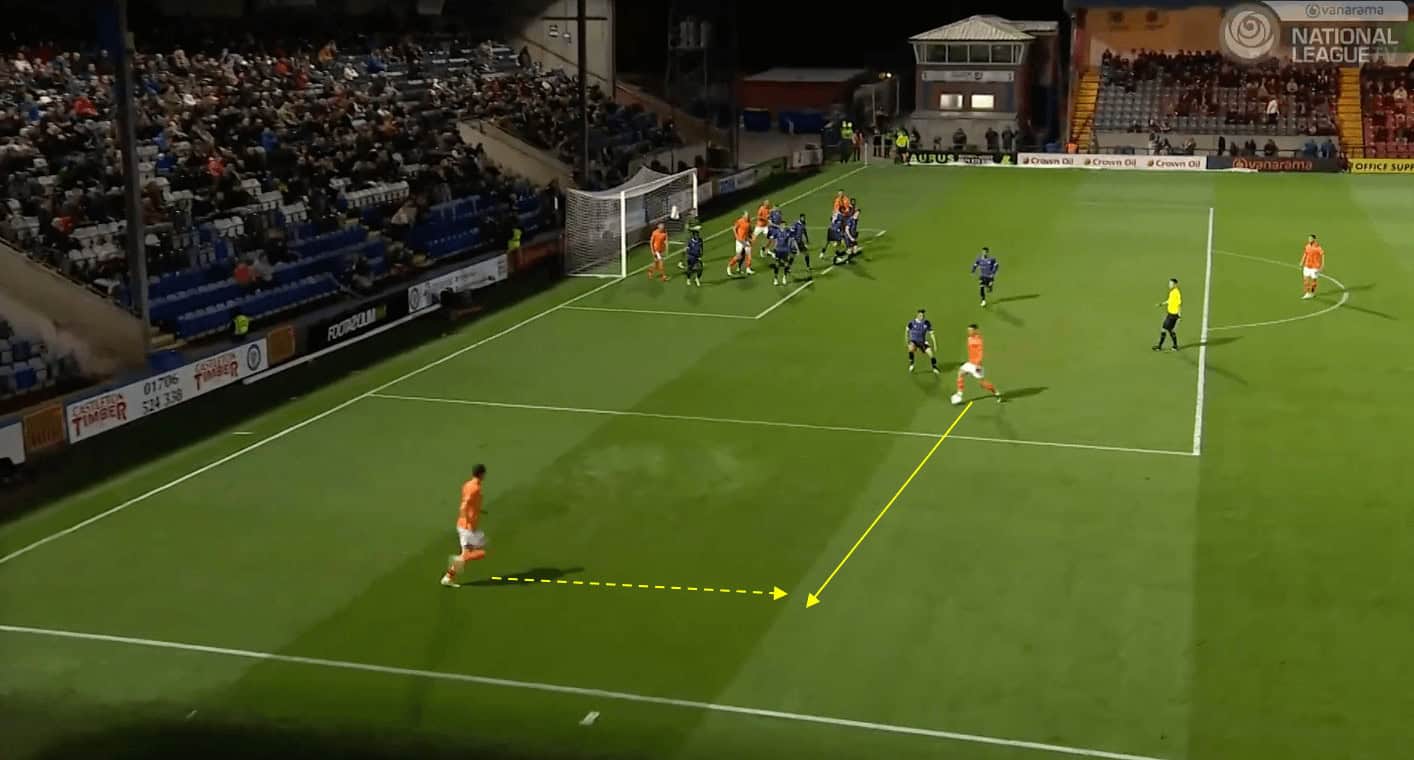
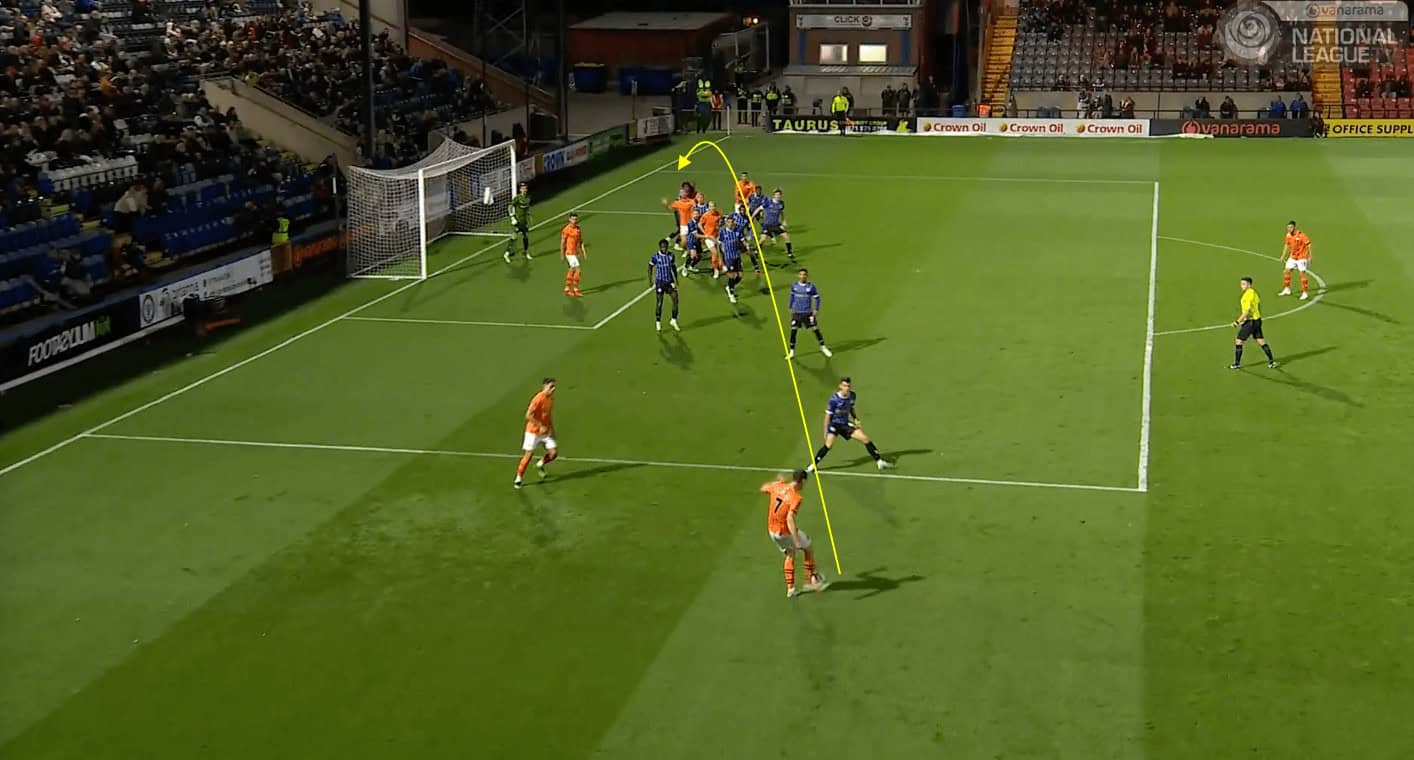
Upon receiving the ball back, he whips in a first-time cross with his left foot. The players in the area have moved towards the edge of the six-yard box. Some Rochdale players have abandoned their instructed positions altogether, leaving space for the unmarked Tom Naylor to rise highest and nod the ball home.
This is another way of creating space. When the ball is played short, the defenders begin to leave their structure, looking to close down the cross or anticipating the ball being played to the player at the edge of the area.
Utilising short corners changes the angle from which the ball is delivered into the box. This alteration makes it challenging for defenders to anticipate the flight of the ball and adjust their positioning accordingly. As we can see, it also provides multiple options for the corner taker, such as short passes to a player outside the area or in-swinging deliveries to the six-yard area. This, in turn, forces defenders to alter their positioning and can lead to space becoming available in an otherwise crowded area.
Pressing high
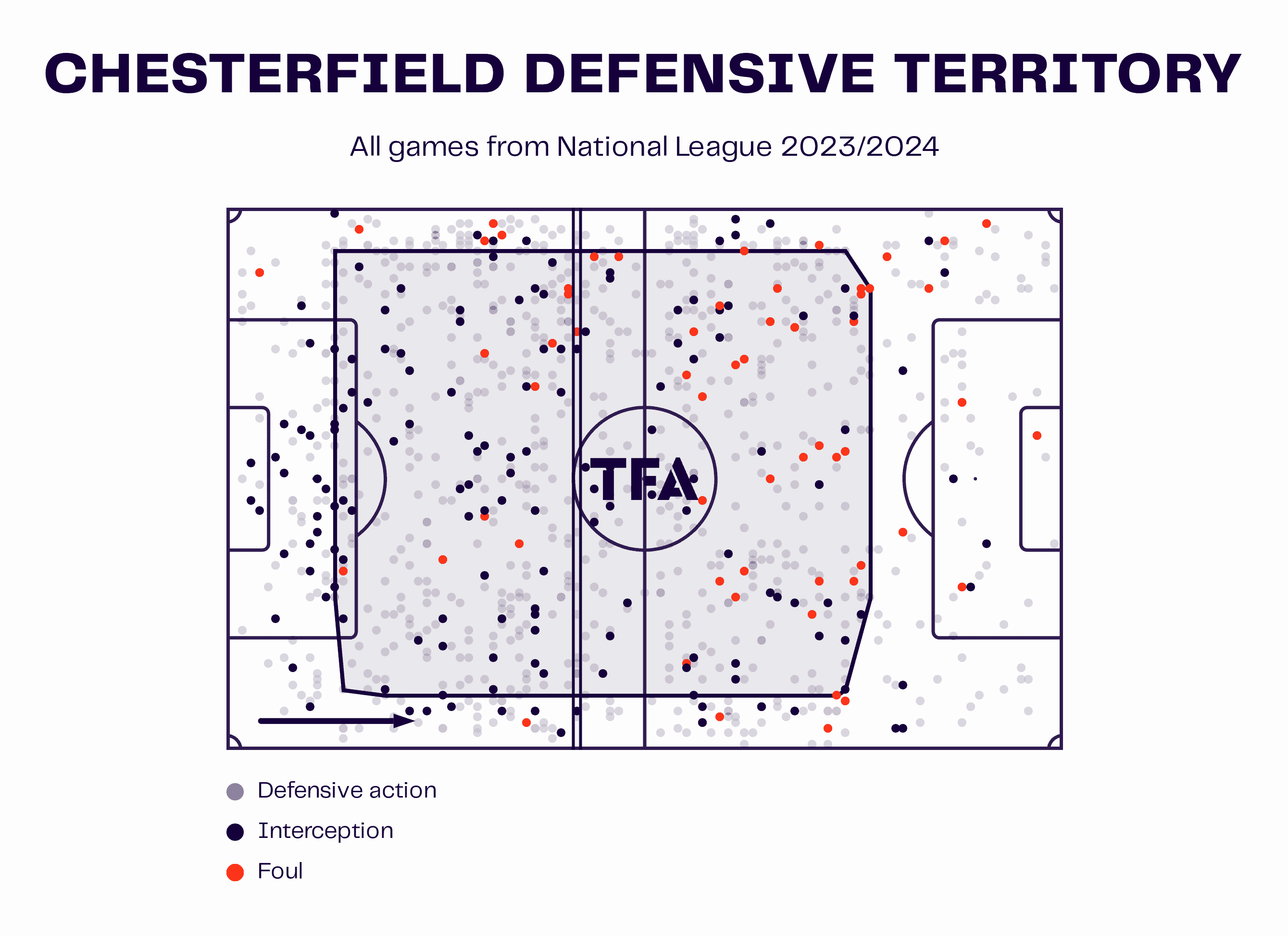
The critical element to Chesterfield’s play in the defensive phase is their high press. Paul Cook likes his side to attempt to regain possession as soon as they have lost it. This allows them to ensure that the opponent cannot create any attacking momentum and means they can keep their lethal attacking players high up the pitch.
The data visual shows us the Spireites’ defensive territory for the current season. We can observe their defensive actions take place over a vast area. Plenty of interceptions are occurring in the opposition half, indicating the attacking players move to cut off passing lanes to increase their chances of turning over possession.
Moreover, the defensive line is high, which indicates that Chesterfield will look to pin their opponents back into their own half. This facilitates the high press as it means the midfielders can close down opponents with the knowledge they are not leaving too much space between themselves and the defensive line. Additionally, the centre-backs are on hand to recycle possession and allow the full-backs to push forward to join the attack.
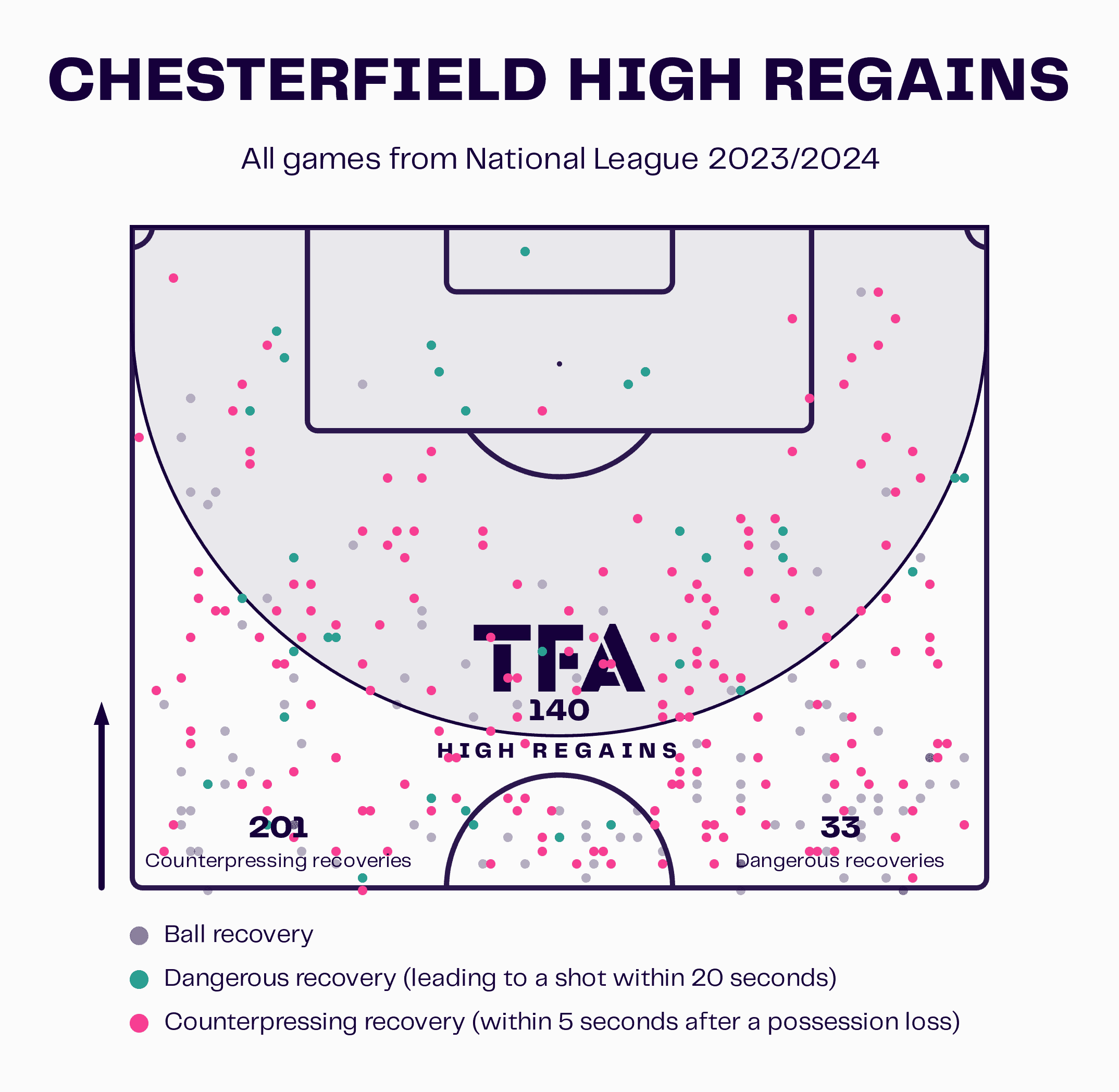
Further to the above, we can fully understand the intensity of Chesterfield’s counterpress from this data visual. With a PPDA of 8.74, we can infer that the team do not continuously press throughout the game; it is more so when they have lost possession high up the pitch to disrupt the opposition’s counterattack.
We can see that the team have made 201 counterpressing recoveries so far this season. 140 of them have taken place in the attacking third, and 33 have led to a shot within 20 seconds of Paul Cook’s team recovering possession.
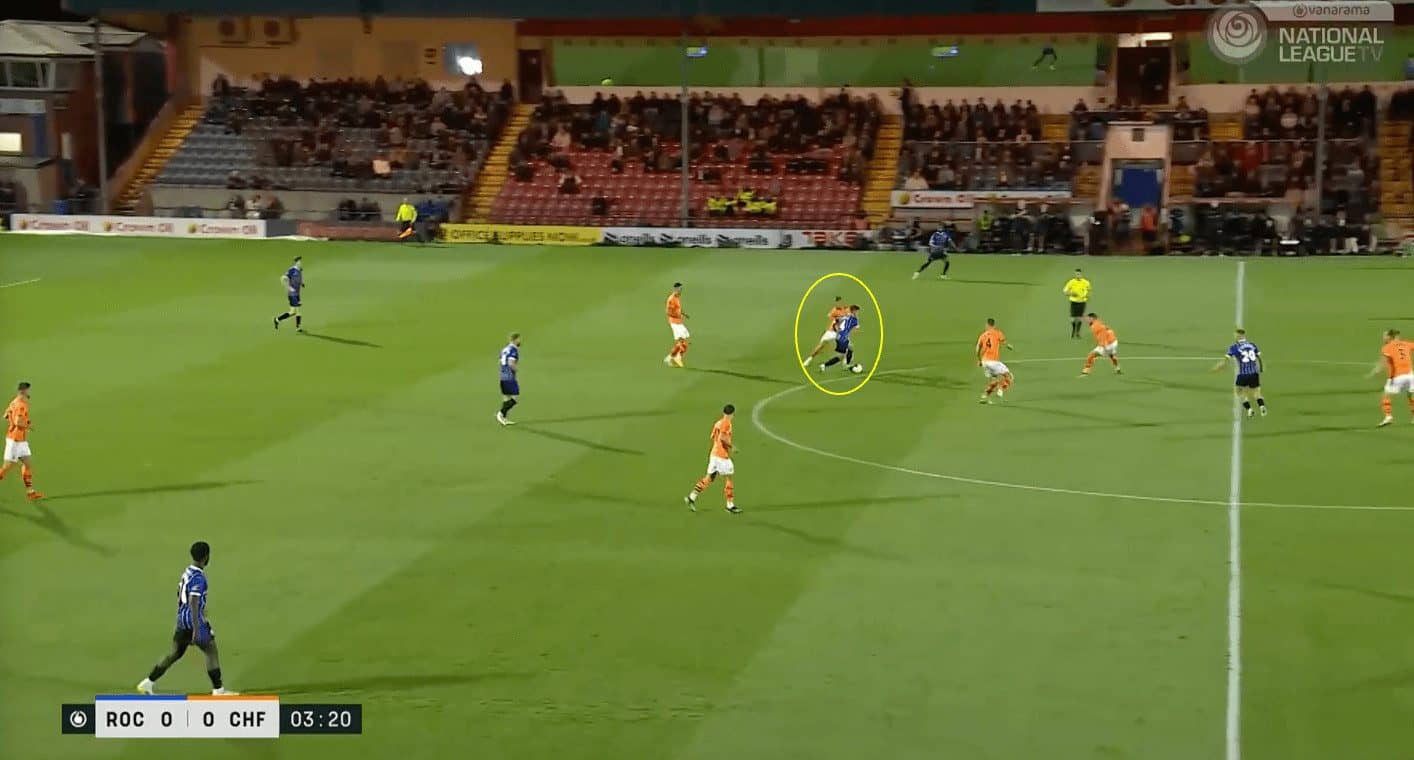
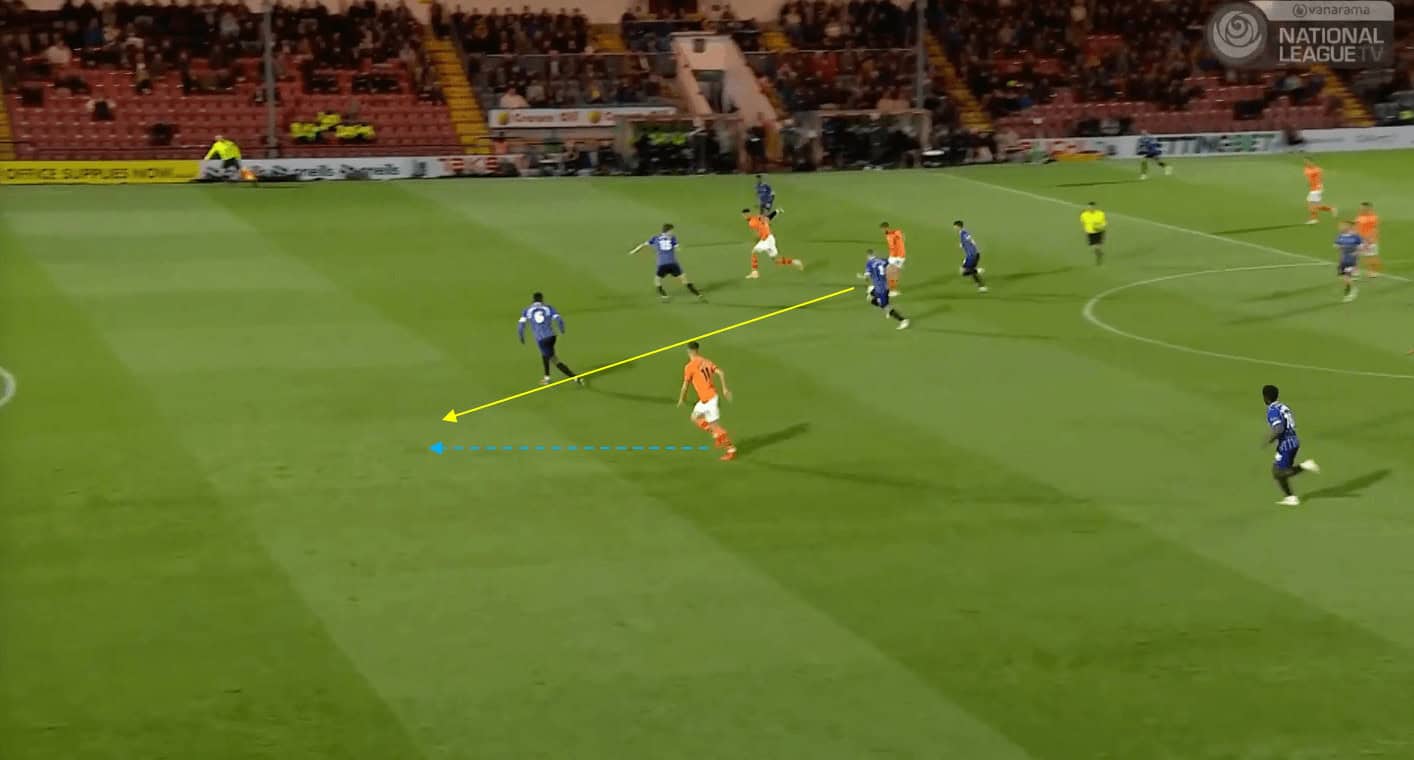
This is an excellent example of the Chesterfield counterpress’s efficiency, especially early on in games. After losing possession, they initiate a press in the midfield area and subsequently force a turnover. Upon regaining possession, they don’t hang about – their first thought is to exploit the fact that the opposition is caught out of the defensive structure.
On this occasion, a wonderfully weighted pass is played into the path of Ryan Colclough, who is able to go through 1v1 with the goalkeeper—a goalscoring opportunity created purely from a successful press that prevents the opposition from counterattacking themselves.
Gaps in central areas
Chesterfield’s 4-2-3-1 system takes the shape of a 4-4-2 when in the defensive phase. This allows for more effective pressing and containment of the opponent. With a block of four in midfield, cutting off the passing lanes to the opposition midfielders and wide players is easier.
In theory, the 4-4-2 shape enhances the team’s ability to maintain a compact defensive block, making it challenging for the opposition to find space between the lines. This compactness limits the opponent’s ability to create through balls or play intricate passes in the central attacking areas.
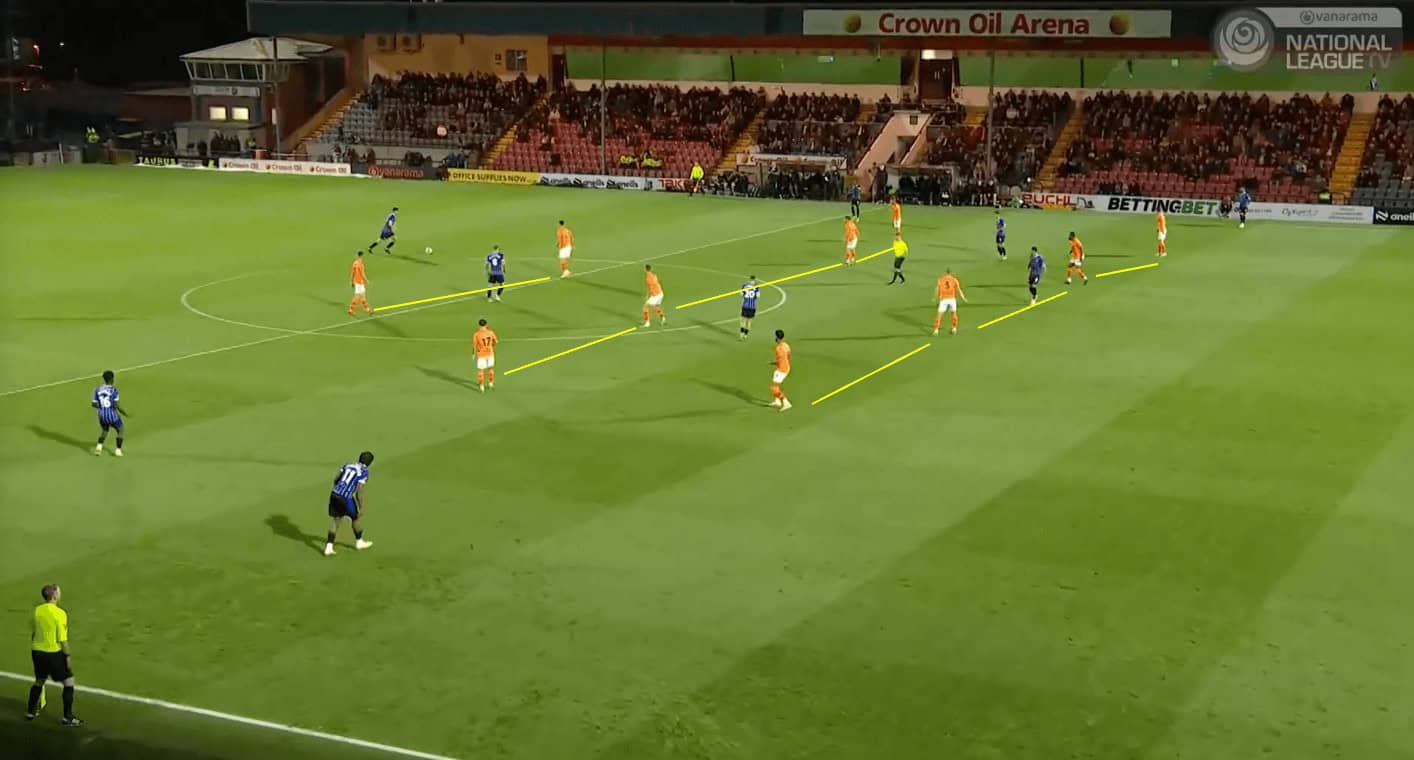
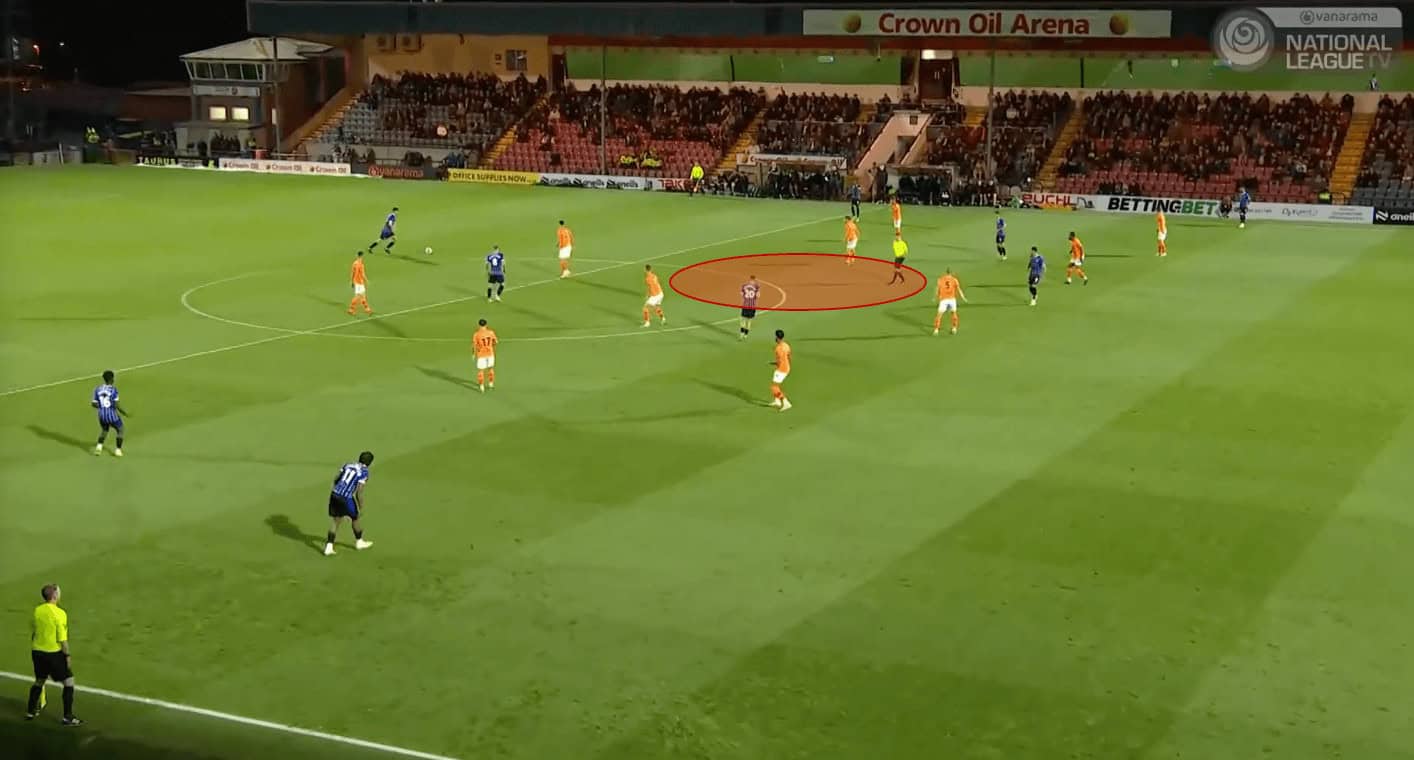
However, central areas’ space is too easy to find against Chesterfield. The first image shows us the Spirites in their 4-4-2 defensive structure. We can clearly see the space in the middle of the park that leaves a clear passing lane for the defender in possession to exploit.
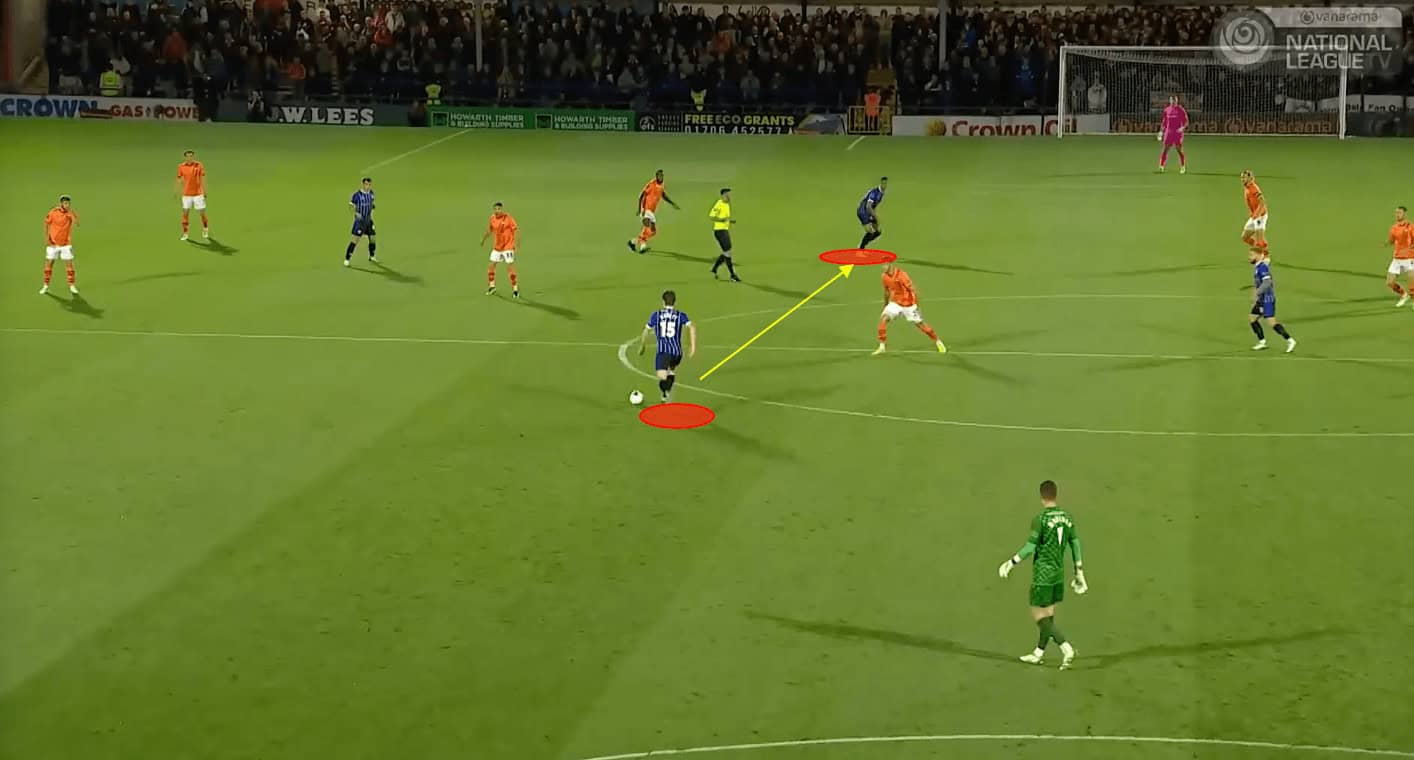
This angle demonstrates just how much space appears in front of the defender. We can see that Kairo Mitchell is able to keep himself onside whilst Nevett threads an accurate pass through to him.
Due to the space Mitchell has, he can allow the ball to run beyond him and immediately go 1v1 with the goalkeeper. On this occasion, Mitchell cooly slots the ball into the back of the net. Given Mitchell’s goal threat, there are questions as to why the two central defenders are so far apart.
Chaotic pressing
We have previously discussed how Paul Cook asks his team to engage in an intense counterpress when possible. However, the Chesterfield press can be highly effective and is a huge aspect of why they are the league’s top scorers. It is also the main reason why they struggle to keep clean sheets.
The forward players are often the first to initiate a counterpress; they aim to close down the opposition quickly to limit their attacking options. What typically follows is the two defensive midfielders engaging in the press in order to cut off passing lanes. Coupled with the fact that the full-backs often stay high up the pitch to act as a passing outlet should possession be recovered, it can leave some considerable gaps in the middle of the pitch. This is another example of how the central areas are difficult for Chesterfield to defend successfully.
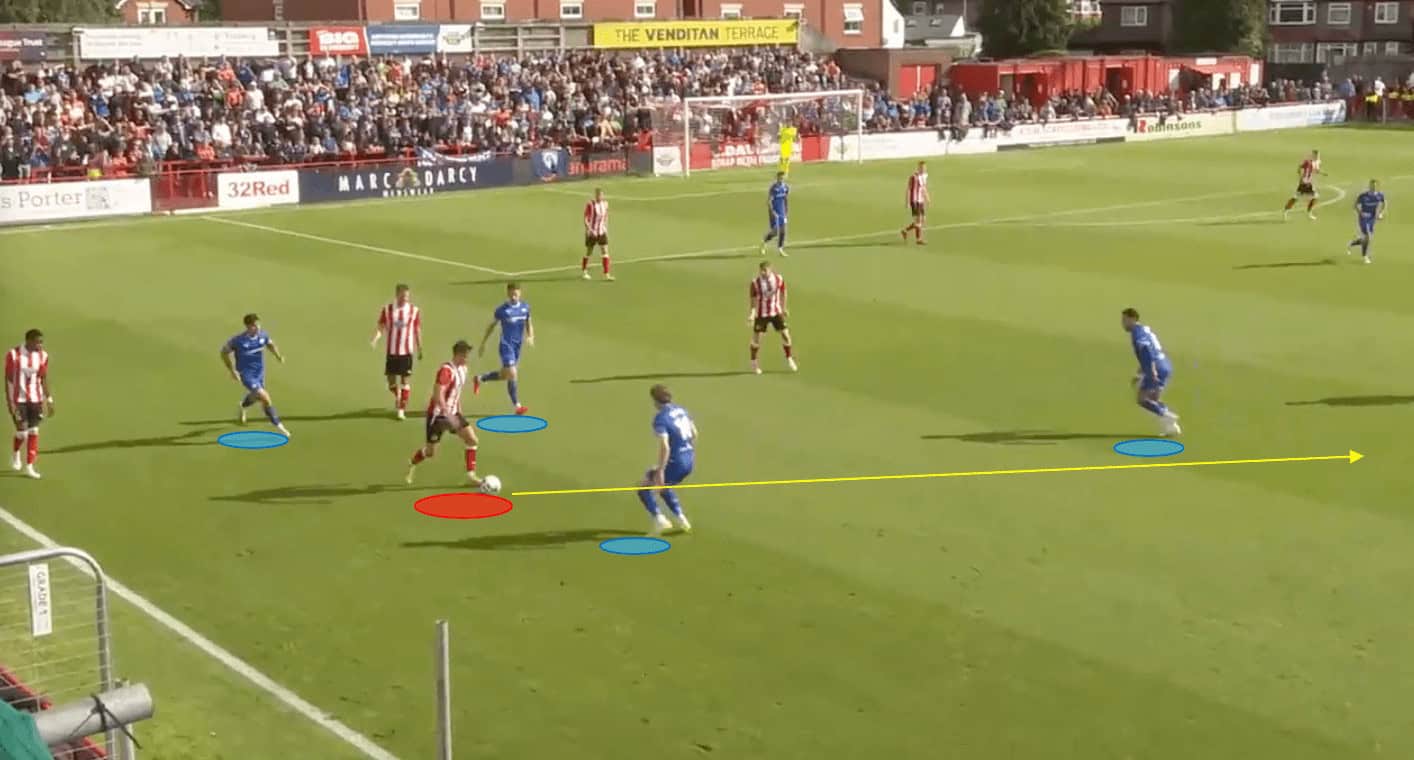
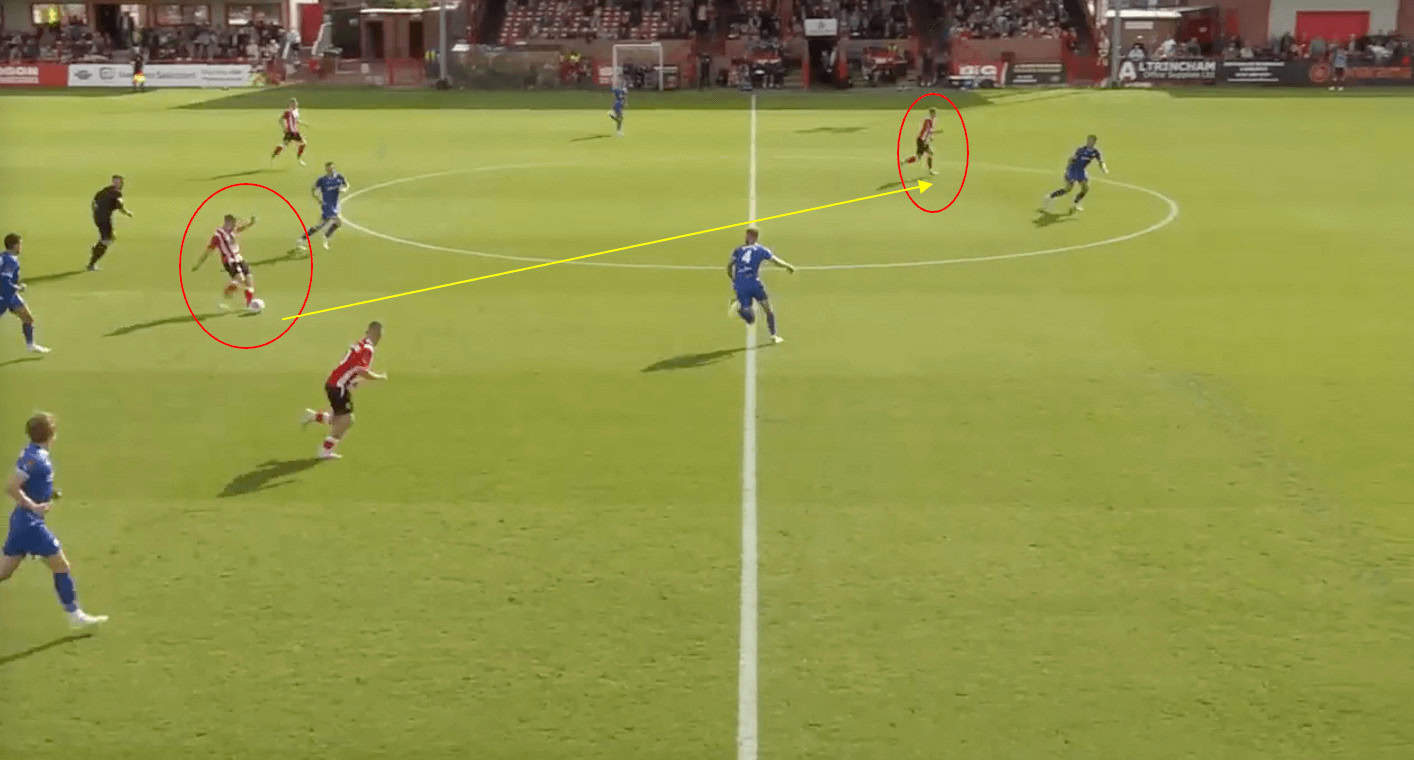
In this example, we can see Altrincham have successfully bypassed the Chesterfield counterpress. The first image shows four players in blue looking to press. However, they are nowhere near close enough to their opponent, so it becomes relatively straightforward to play through them.
Due to the chaotic pressing from the midfielders, there is a considerable amount of space for Altrincham to progress the ball quickly. Furthermore, as we have already ascertained, the full-backs are higher up the pitch, which means the two central defenders are exposed. Two passes is all it takes for the opposition to break into the Chesterfield half. In this scenario, two more passes follow before the ball finds its way into the net.

The data visual shows that on loan, Everton goalkeeper Harry Tyrer has conceded 2.31 goals more than we would expect so far this season. As we have seen, the team’s defensive structure can be easy to break through, leaving the young ‘keeper vulnerable.
Chesterfield currently rely on their prolific forward line to bail them out of trouble. Potentially, this could cause issues later in the season, should they pick up injuries to the attackers or play against a team with a resolute defence. The Spirites will most likely need to tighten up defensively if they are to win the title this season.
Conclusion
Overall, it has been an excellent start to the season for Paul Cook and Chesterfield. They are scoring goals for fun and flying high at the top of the table. However, as this analysis has shown, some defensive issues may need to be addressed sooner rather than later. Time will tell if the Spireites are good enough to win promotion back to the football league, but for now, they are indeed the team to beat in English football’s fifth tier.

