Total Football Analysis
Once.Sport
  • Football Analysis
    • Data Analysis
    • Formations
      • 2-2-4 Formation
      • 2-3-5 Formation
      • 3-1-4-2 Formation
      • 3-2-2-3 Formation
      • 3-2-4-1 Formation
      • 3-1-6 Formation
      • 3-3-4 Formation
      • 3-4-1-2 Formation
      • 3-4-2-1 Formation
      • 3-4-3 Formation
      • 3-5-1-1 Formation
      • 3-5-2 Formation
      • 4-1-4-1 Formation
      • 4-2-2-2 Formation
      • 4-2-3-1 Formation
      • 4-2-4 Formation
      • 4-3-1-2 Formation
      • 4-3-3 Formation
      • 4-4-2 Formation
      • 4-5-1 Formation
      • 5-3-2 Formation
      • 5-4-1 Formation
      • 6-3-1 Formation
    • Head Coach Analysis
    • Match Analysis
    • Player Analysis
    • Recruitment Analysis
    • Set Piece Analysis
    • Tactical Theory
    • Tactical Preview
    • Team Analysis
    • Training Analysis
    • Tactical Analysis
    • Scouting Report
  • Competition
    • ALL Competitions
    • English Premier League
    • Champions League
    • La Liga
    • Bundesliga
    • Serie A
    • Ligue 1
    • Eredivisie
    • EFL Championship
    • FIFA World Cup 2022
    • WEURO 2022
    • Women’s Super League
    • NWSL
    • Belgian First Division A
    • A-League
    • Liga Profesional de Argentina
    • Austrian Bundesliga
    • Campeonato Brasileiro Série A
    • DFB Pokal
    • 1. HNL
    • Danish Superliga
    • EFL League One
    • EFL League Two
    • FA Cup
    • EFL Cup
    • Indian Super League
    • K-League
    • J1 League
    • Liga MX
    • Copa América 2021
    • Copa del Rey
    • MLS
    • Eliteserien
    • Euro 2020
    • Primeira Liga
    • Scottish Premiership
    • Allsvenskan
    • Europa League
    • UEFA Nations League
    • Liga AUF Uruguaya
  • Coaches
    • All Coaches
    • Alfred Schreuder
    • Ange Postecoglou
    • Antonio Conte
    • Arne Slot
    • Bo Svensson
    • Brendan Rodgers
    • Bruno Lage
    • Carlo Ancelotti
    • Christophe Galtier
    • Claude Puel
    • Claudio Ranieri
    • David Moyes
    • Dean Smith
    • Diego Simeone
    • Domenico Tedesco
    • Frank Lampard
    • Eddie Howe
    • Edin Terzić
    • Emma Hayes
    • Erik ten Hag
    • Ernesto Valverde
    • Gennaro Gattuso
    • Gerardo Seoane
    • Gian Piero Gasperini
    • Giovanni van Bronckhorst
    • Graham Potter
    • Igor Tudor
    • Imanol Alguacil
    • Jesse Marsch
    • Jonas Eidevall
    • Jorge Sampaoli
    • José Bordalás
    • José Mourinho
    • Julen Lopetegui
    • Julian Nagelsmann
    • Julien Stéphan
    • Jürgen Klopp
    • Luciano Spalletti
    • Lucien Favre
    • Manuel Pellegrini
    • Marcelo Bielsa
    • Marco Rose
    • Marco Silva
    • Massimiliano Allegri
    • Mauricio Pochettino
    • Maurizio Sarri
    • Mikel Arteta
    • Niko Kovač
    • Nuno Espírito Santo
    • Oliver Glasner
    • Patrick Vieira
    • Paulo Fonseca
    • Pep Guardiola
    • Peter Bosz
    • Rafa Benítez
    • Ralf Rangnick
    • Ralph Hasenhüttl
    • Roger Schmidt
    • Roy Hodgson
    • Sean Dyche
    • Sérgio Conceição
    • Simone Inzaghi
    • Sonia Bompastor
    • Stefano Pioli
    • Steffen Baumgart
    • Steven Gerrard
    • Thiago Motta
    • Thomas Frank
    • Thomas Tuchel
    • Unai Emery
    • Vincenzo Italiano
    • Xavi
  • Teams
    • ALL Teams
    • AC Milan
    • Ajax Amsterdam
    • Arsenal
    • AS Monaco FC
    • Atalanta
    • Atlético Madrid
    • FC Barcelona
    • FC Bayern Munich
    • Borussia Dortmund
    • Celtic FC
    • Chelsea FC
    • Everton F.C.
    • Inter Milan
    • Juventus F.C.
    • Leeds United F.C.
    • Liverpool FC
    • Manchester City
    • Manchester United FC
    • Paris Saint-Germain
    • Rangers FC
    • RB Leipzig
    • Real Madrid CF
    • Tottenham Hotspur
    • West Ham United
  • Players
    • ALL Players
    • Alisson Becker
    • Bukayo Saka
    • Erling Haaland
    • Harry Kane
    • Jack Grealish
    • John Stones
    • Julián Alvarez
    • Kalvin Phillips
    • Kevin De Bruyne
    • Kyle Walker
    • Kylian Mbappé
    • Lamine Yamal
    • Lionel Messi
    • Luis Díaz
    • Mohamed Salah
    • Phil Foden
    • Virgil Van Dijk
  • Contact
  • Write For TFA
No Result
View All Result
No Result
View All Result
Total Football Analysis
No Result
View All Result
Home Analysis

UEFA Champions League 2023/24: Union Berlin’s resolute defending in the underdog role – tactical analysis

Luis Kircher by Luis Kircher
September 22, 2023
in Analysis, Champions League, Match Analysis, Real Madrid CF, Union Berlin
0
UEFA Champions League 2023/24: Real Madrid vs. Union Berlin - tactical analysis tactics

In football, where the pitch often becomes a theatre of dreams, there are moments that defy expectations, ignite passions, and etch their names into the annals of history. The UEFA Champions League, the grandest stage of them all, is a theatre where such moments are born, and the clash between Real Madrid and Union Berlin on the first matchday of the 2023/24 campaign in Group C was no exception.

On one side stood the formidable giants of European football, Real Madrid, a club that had secured the coveted UCL trophy an astounding 14 times, a record that continues to inspire awe and reverence. On the other side was Union Berlin, a club making their debut in the UEFA Champions League, carrying with them the dreams of an entire city and the unyielding spirit of the underdog.

The stage was set, and the odds were overwhelmingly stacked against Union Berlin. They were about to face the mighty Real Madrid, a club steeped in tradition, adorned with a galaxy of stars, and boasting a history that would make any football aficionado bow in respect. However, in football, as in life, the underdog often carries a special magic, a determination that transcends mere statistics. The clash promised drama, suspense, and perhaps an upset that would reverberate through the footballing world.

And when the final whistle blew, it was not just the scoreline that captured the imagination but the tale of resilience and dreams that unfolded over the 90 minutes, as we will see in this tactical analysis. Real Madrid, the juggernaut, could only secure victory deep into added time, courtesy of a stunning goal from their new signing, the rising star Jude Bellingham.

Join us as we delve into the riveting analysis of this historical encounter, where giants met underdogs and where the beautiful unpredictability of football once again took centre stage in the UEFA Champions League.

Line Ups

As the curtains rose on this eagerly anticipated clash between European heavyweight Real Madrid and UEFA Champions League debutants Union Berlin, the lineups revealed a stark contrast in quality and squad depth, setting the stage for a potentially gripping encounter.

Carlo Ancelotti‘s Real Madrid took to the field with a formidable 4-1-2-1-2 formation, a testament to the club’s wealth of talent. Kepa Arrizabalaga assumed his duties between the posts, guarding the fortress with intent.

In defence, Real Madrid fielded an impressive backline featuring Lucas Vázquez, Antonio Rüdiger, Nacho Fernández, and David Alaba. The midfield, a quintessential blend of youth and experience, showcased Eduardo Camavinga, Luka Modrić, Aurélien Tchouaméni, and Jude Bellingham, hinting at their commitment to controlling the game’s tempo.

Upfront, Los Blancos deployed a dynamic duo, Joselu and Rodrygo Goes, ready to unlock Union Berlin’s defences. Ancelotti’s intentions were clear – establish dominance early on to secure a commanding lead, allowing for tactical flexibility as they looked ahead to the Madrid Derbi against Atletico de Madrid.

Real Madrid: Kepa – Vazquez, Rüdiger, Nacho (73. Fran Garcia), Alaba – Tchouameni (66. Fede Valverde), Modric (81. Diaz), Camavinga (66. Kroos), Bellingham – Joselu, Rodrygo.

UEFA Champions League 2023/24: Real Madrid vs. Union Berlin - tactical analysis tactics

Union Berlin chose a pragmatic 3-5-2 formation, adapting to their underdog status and focusing on defensive solidity. Frederik Rönnow stood between the Union Berlin posts, ready for the daunting task.

The defensive trio comprised Leonardo Bonucci, Danilho Doekhi, and Diogo Leite, with their primary mission to thwart Real Madrid’s attacking prowess. The midfield, featuring Josip Juranovic, Alex Kral, Robin Gosens, Sofiane Laidouni, and Lucas Tousart, ensured a compact and resilient formation.

In the attack, Union Berlin placed their faith in Kevin Behrens and Marius Becker, two forwards looking to exploit any potential weaknesses in Real Madrid’s rearguard. While a 3-5-2 formation morphed into a 5-4-1 in most phases of the match, Union Berlin’s strategy was clear – stay deep and stubborn, especially in the first half, hoping to counter the Galacticos’ might with defensive resilience.

Union Berlin: Rönnow – Bonucci (80. Jaeckel), Doekhi, Diogo Leite – Juranovic, Kral, Gosens, Laidouni (66. Aaronson), Tousart (83. Kemlein) – K. Behrens (66. Volland), Becker (80. Fofana).

Union Berlin’s Low Block

Union Berlin, under the astute guidance of manager Urs Fischer, entered the UEFA Champions League stage with a reputation for extracting maximum efficiency from their limited resources. Their tactical acumen was fully displayed, particularly in their low-block defensive setup against the mighty Real Madrid.

Fischer’s tactics centers on pragmatism and efficiency. In the previous Bundesliga season, Union Berlin overperformed, scoring 16 goals more than expected and gaining a remarkable 20 points beyond expectations. These statistics underscored the team’s ability to make the most of their opportunities, a trait that they brought to their European adventure.

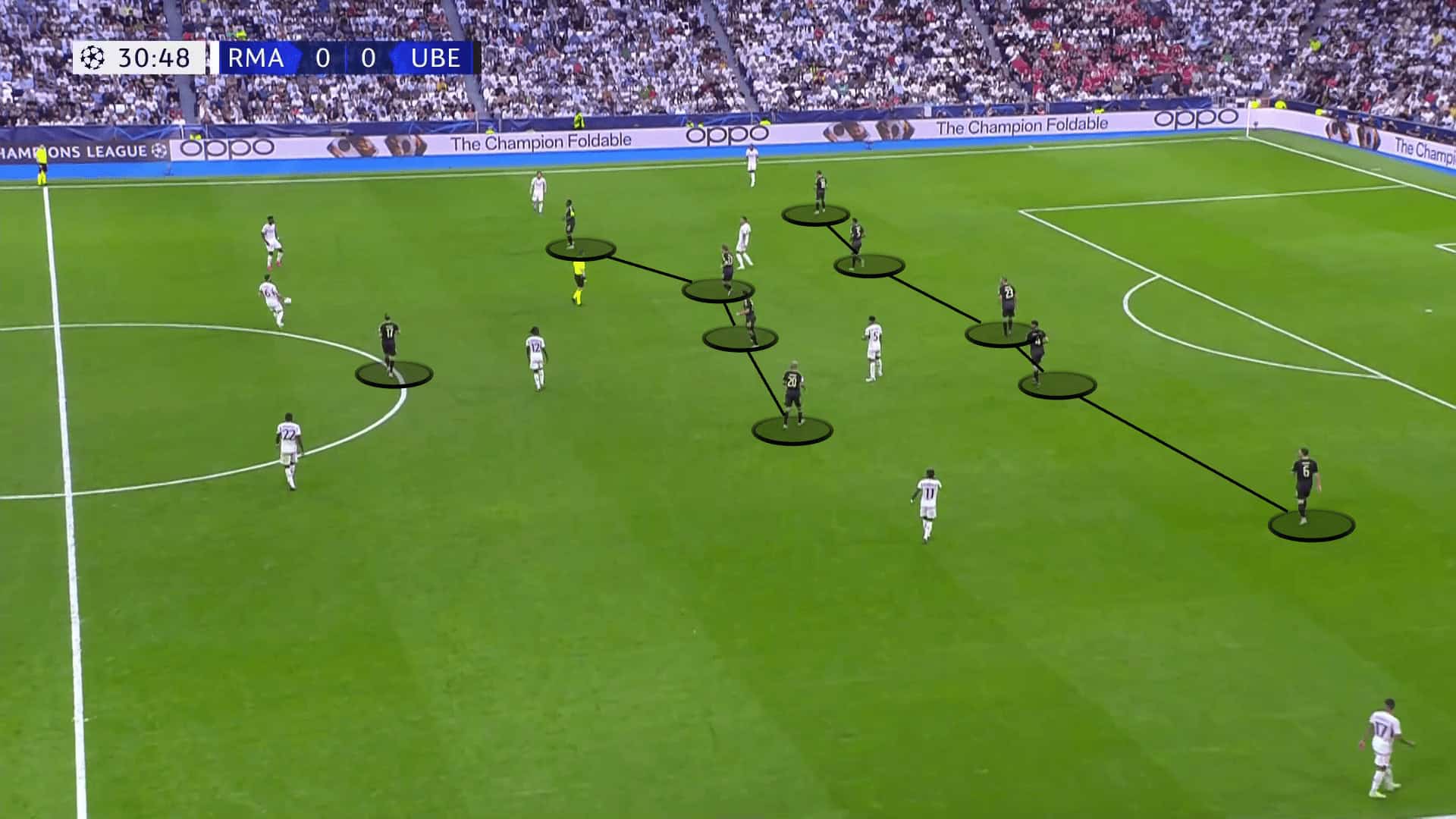
Also, in the match against Real Madrid, Union Berlin’s defensive strategy was built around a well-executed low block. This tactic involved the team falling back into a compact defensive shape, ceding possession to their opponents and relying on their resilience and organization to stifle attacking threats. Key to this was their remarkable PPDA (Passes Allowed Per Defensive Action) of 25.13, indicating their inclination to let the opposition come to them.
UEFA Champions League 2023/24: Real Madrid vs. Union Berlin - tactical analysis tactics

One of the hallmarks of Union Berlin’s low block was their incredibly low challenge intensity, clocking in at just 3.6. This number signifies the limited number of defensive duels they actively sought out. Instead, they preferred to maintain their shape, pressuring selectively and forcing their opponents into less threatening areas of the pitch.

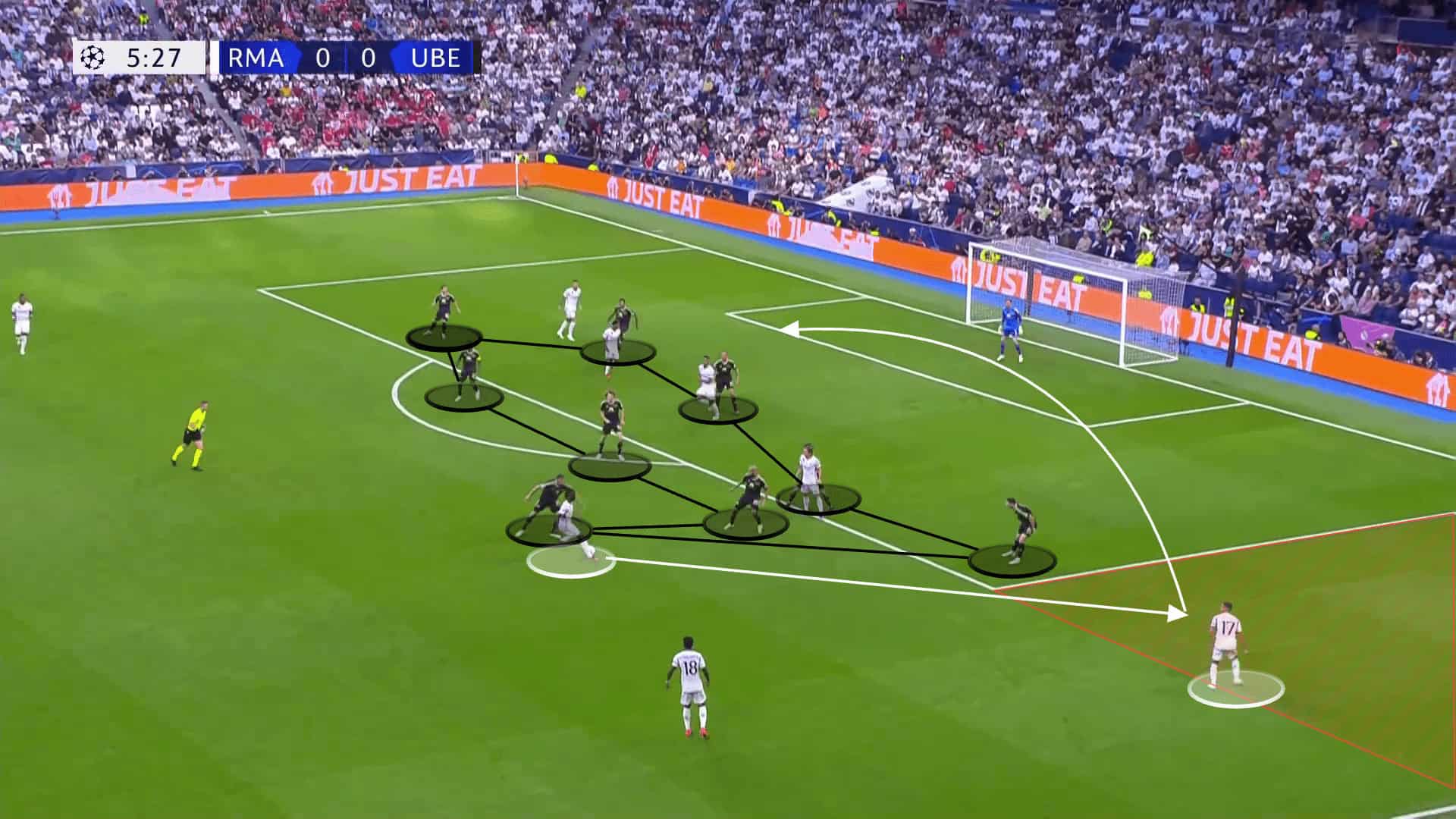
Union Berlin’s success in executing this low block stemmed from their defensive cohesion and patience. They moved as a unit, creating a compact and impenetrable barrier that opponents found hard to breach. This defensive shape forced Real Madrid into wide areas, limiting their penetration through the centre and effectively neutralizing their attacking threats.
UEFA Champions League 2023/24: Real Madrid vs. Union Berlin - tactical analysis tactics

However, Union Berlin’s defensive performance left much to be desired. They often relied on sheer numbers rather than strategic positioning to defend. Witnessing nine Union Berlin players crowded inside their penalty area was a frequent sight, yet there was often a Real Madrid player left unmarked.

Attacking Transitions

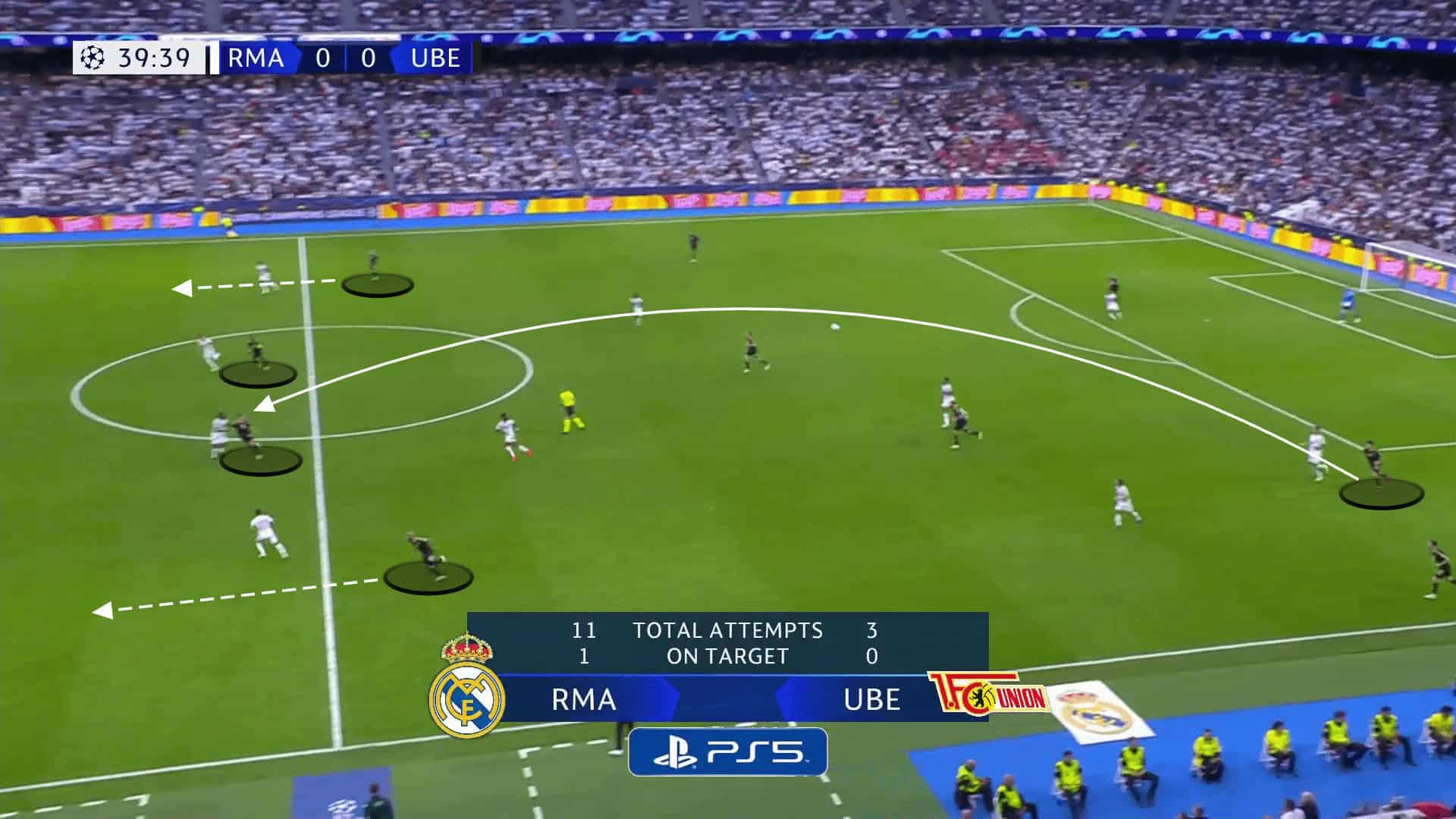
Union Berlin’s low block acted as a defensive shield and a launching pad for quick transitions. When they won back possession, they sought to exploit any potential openings left by their opponents. While their primary focus was defence, they were well-organized and prepared to break forward when the opportunity arose. When in possession, Union Berlin frequently employed long balls to create 2v2 situations, aiming to win duels and deliver crosses into the box.
UEFA Champions League 2023/24: Real Madrid vs. Union Berlin - tactical analysis tactics

They ensured that two players were consistently positioned out wide, ready to receive the ball and provide width. In contrast, two others made runs into the penalty area to capitalize on scoring opportunities.
UEFA Champions League 2023/24: Real Madrid vs. Union Berlin - tactical analysis tactics

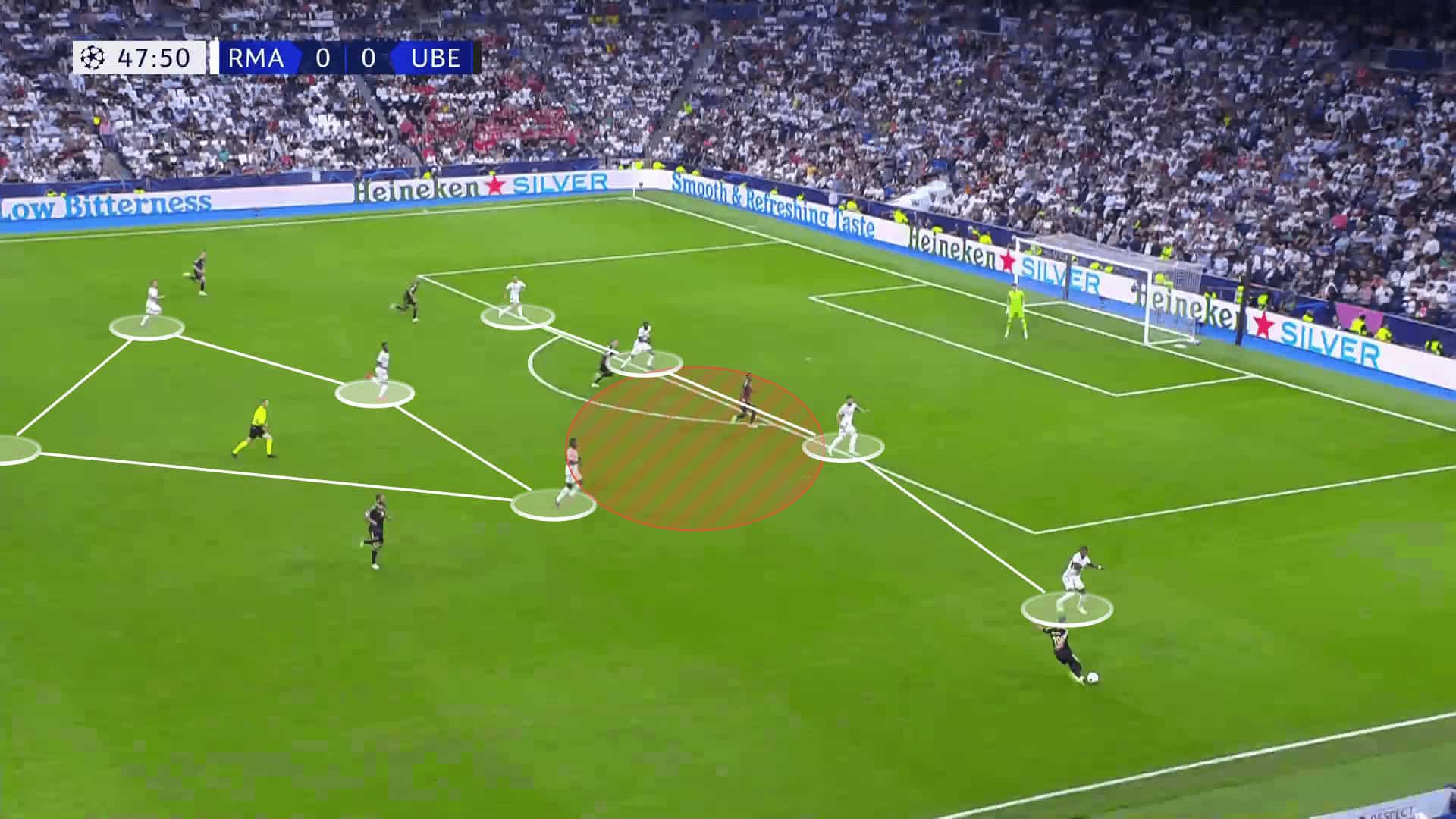
Real Madrid’s box defending was subpar, often leaving opposing players unmarked in precarious positions. However, Union Berlin struggled to capitalize on these situations due to their limited technical proficiency when delivering key passes to finish off plays.

Real Madrid’s tactical change

In the second half, Ancelotti implemented a tactical adjustment by instructing his full-backs to drop deeper, effectively luring the opposition’s wing-backs out of position. This strategic shift aimed to create more space and invite other Real Madrid players to push forward and exploit the newfound gaps. Consequently, it compelled the defensive block of Union Berlin to retreat.
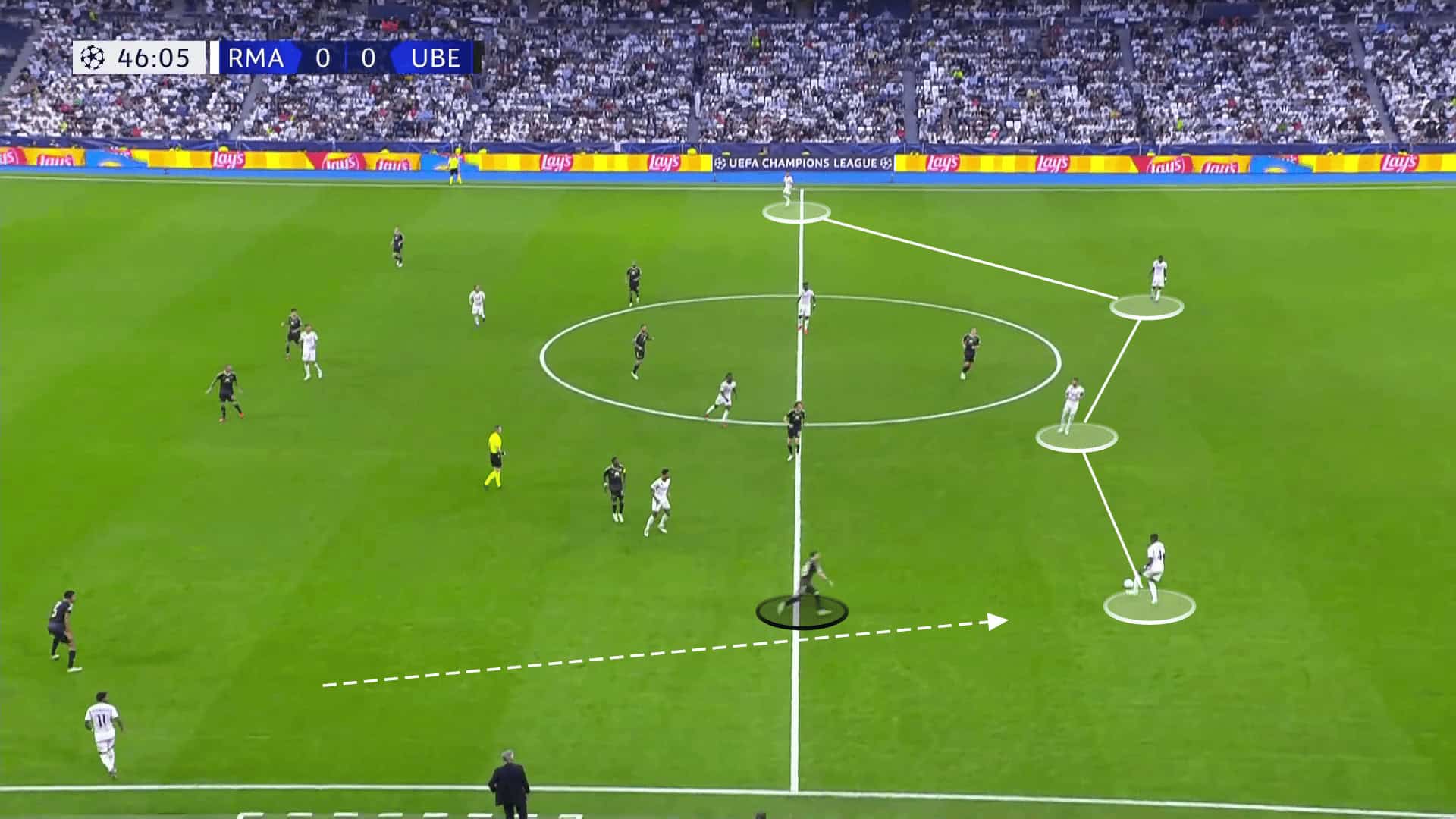
UEFA Champions League 2023/24: Real Madrid vs. Union Berlin - tactical analysis tactics

Throughout the second half, Real Madrid consistently threatened the spaces between the centre-backs and the wing-backs, playing with greater tempo and intensity. This adjustment resulted in numerous opportunities for Real Madrid early in the second period. By compelling Union Berlin’s defenders to provide support on the flanks, it left the central defensive area exposed, allowing Joselu to engage in several aerial duels and attempt headers on goal.
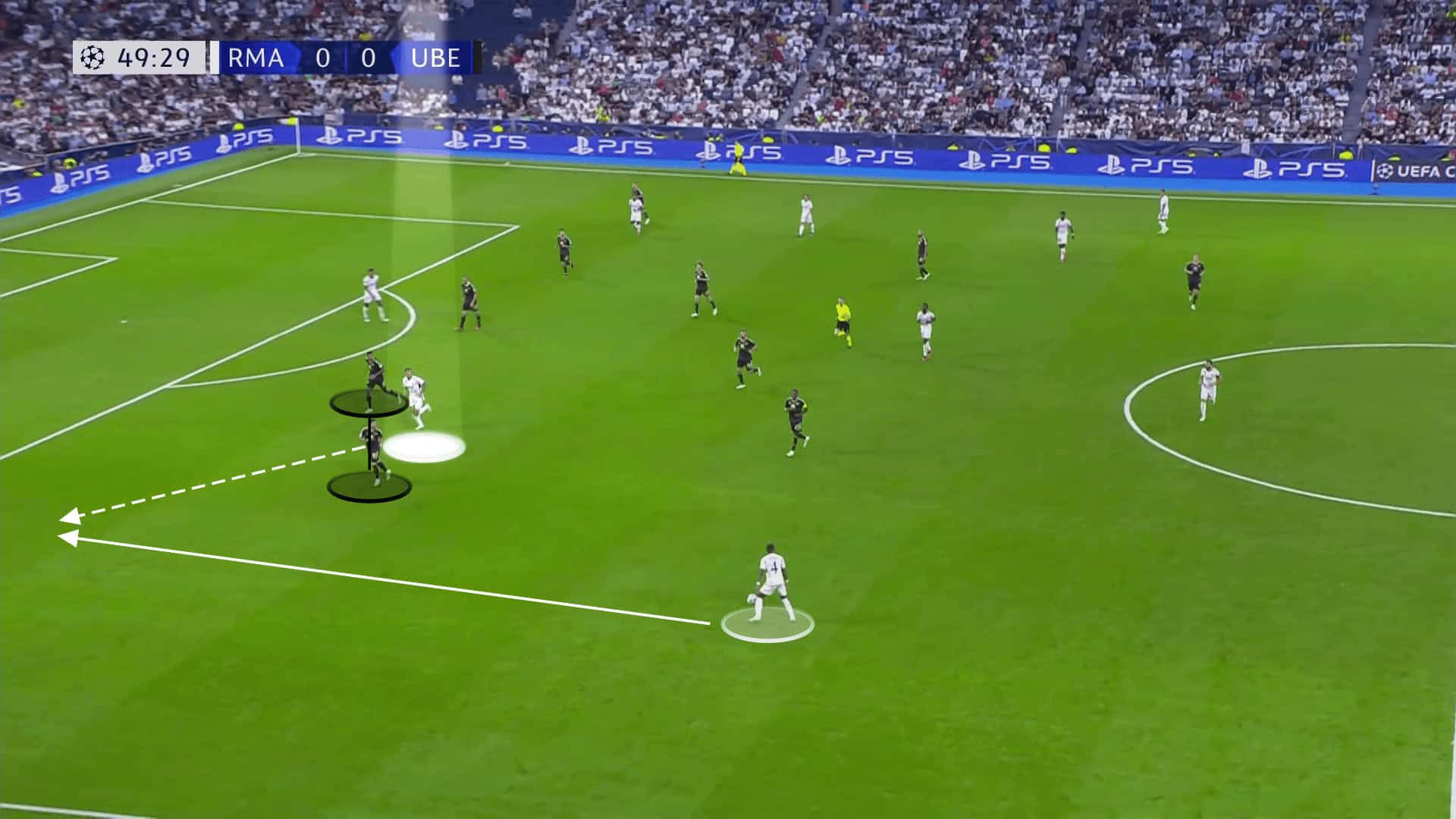
UEFA Champions League 2023/24: Real Madrid vs. Union Berlin - tactical analysis tactics

However, Real Madrid did make a significant tactical error in the final 15 minutes of the match. They positioned all their attackers extremely high up the pitch, with no one operating between the lines. As a result, they were forced to try and secure victory through a set piece rather than utilizing a more balanced approach in the late stages of the game.

Conclusion

As shown in this match analysis, Union Berlin demonstrated their renowned ability to defend resolutely, adopting a low block and inviting Real Madrid to break them down. However, it must be noted that their defensive approach was not without its flaws. Rather than relying on meticulous positioning, Union Berlin often resorted to amassing numbers in their penalty area, which occasionally left Real Madrid players unmarked.

On the flip side, Real Madrid displayed glimpses of tactical astuteness in the second half when they adjusted their approach. Ancelotti’s decision to drop the full-backs deeper drew Union Berlin’s wing-backs out of position, creating vital spaces for Real Madrid’s attackers to exploit. These tactical changes led to an increase in opportunities for the Spanish giants, especially during the early stages of the second half.

Yet, as the game reached its climax, both teams found it challenging to capitalize on the errors committed by their opponents. It was fitting that the match’s decisive moment occurred after a set-piece situation, highlighting both sides’ difficulty in breaking the deadlock during open play.

Previous Post

La Liga 2023/24: How Atlético Madrid will aim to deal with Real Madrid’s Jude Belingham – tactical preview

Next Post

Individual errors and structural issues: Manchester United’s UEFA Champions League loss to FC Bayern – tactical analysis

Next Post
Individual errors and structural issues: Manchester United’s UEFA Champions League loss to FC Bayern – tactical analysis

Individual errors and structural issues: Manchester United's UEFA Champions League loss to FC Bayern – tactical analysis

  • About Total Football Analysis
  • Contact Total Football Analysis
  • Write For Total Football Analysis
  • Advertise
  • Privacy Policy
  • Cancellation / Refund Policy
  • Resources
  • Terms Of Service

© 2026 Total Football Analysis

No Result
View All Result
  • Football Analysis
    • Data Analysis
    • Formations
      • 2-2-4 Formation
      • 2-3-5 Formation
      • 3-1-4-2 Formation
      • 3-2-2-3 Formation
      • 3-2-4-1 Formation
      • 3-1-6 Formation
      • 3-3-4 Formation
      • 3-4-1-2 Formation
      • 3-4-2-1 Formation
      • 3-4-3 Formation
      • 3-5-1-1 Formation
      • 3-5-2 Formation
      • 4-1-4-1 Formation
      • 4-2-2-2 Formation
      • 4-2-3-1 Formation
      • 4-2-4 Formation
      • 4-3-1-2 Formation
      • 4-3-3 Formation
      • 4-4-2 Formation
      • 4-5-1 Formation
      • 5-3-2 Formation
      • 5-4-1 Formation
      • 6-3-1 Formation
    • Head Coach Analysis
    • Match Analysis
    • Player Analysis
    • Recruitment Analysis
    • Set Piece Analysis
    • Tactical Theory
    • Tactical Preview
    • Team Analysis
    • Training Analysis
    • Tactical Analysis
    • Scouting Report
  • Competition
    • ALL Competitions
    • English Premier League
    • Champions League
    • La Liga
    • Bundesliga
    • Serie A
    • Ligue 1
    • Eredivisie
    • EFL Championship
    • FIFA World Cup 2022
    • WEURO 2022
    • Women’s Super League
    • NWSL
    • Belgian First Division A
    • A-League
    • Liga Profesional de Argentina
    • Austrian Bundesliga
    • Campeonato Brasileiro Série A
    • DFB Pokal
    • 1. HNL
    • Danish Superliga
    • EFL League One
    • EFL League Two
    • FA Cup
    • EFL Cup
    • Indian Super League
    • K-League
    • J1 League
    • Liga MX
    • Copa América 2021
    • Copa del Rey
    • MLS
    • Eliteserien
    • Euro 2020
    • Primeira Liga
    • Scottish Premiership
    • Allsvenskan
    • Europa League
    • UEFA Nations League
    • Liga AUF Uruguaya
  • Coaches
    • All Coaches
    • Alfred Schreuder
    • Ange Postecoglou
    • Antonio Conte
    • Arne Slot
    • Bo Svensson
    • Brendan Rodgers
    • Bruno Lage
    • Carlo Ancelotti
    • Christophe Galtier
    • Claude Puel
    • Claudio Ranieri
    • David Moyes
    • Dean Smith
    • Diego Simeone
    • Domenico Tedesco
    • Frank Lampard
    • Eddie Howe
    • Edin Terzić
    • Emma Hayes
    • Erik ten Hag
    • Ernesto Valverde
    • Gennaro Gattuso
    • Gerardo Seoane
    • Gian Piero Gasperini
    • Giovanni van Bronckhorst
    • Graham Potter
    • Igor Tudor
    • Imanol Alguacil
    • Jesse Marsch
    • Jonas Eidevall
    • Jorge Sampaoli
    • José Bordalás
    • José Mourinho
    • Julen Lopetegui
    • Julian Nagelsmann
    • Julien Stéphan
    • Jürgen Klopp
    • Luciano Spalletti
    • Lucien Favre
    • Manuel Pellegrini
    • Marcelo Bielsa
    • Marco Rose
    • Marco Silva
    • Massimiliano Allegri
    • Mauricio Pochettino
    • Maurizio Sarri
    • Mikel Arteta
    • Niko Kovač
    • Nuno Espírito Santo
    • Oliver Glasner
    • Patrick Vieira
    • Paulo Fonseca
    • Pep Guardiola
    • Peter Bosz
    • Rafa Benítez
    • Ralf Rangnick
    • Ralph Hasenhüttl
    • Roger Schmidt
    • Roy Hodgson
    • Sean Dyche
    • Sérgio Conceição
    • Simone Inzaghi
    • Sonia Bompastor
    • Stefano Pioli
    • Steffen Baumgart
    • Steven Gerrard
    • Thiago Motta
    • Thomas Frank
    • Thomas Tuchel
    • Unai Emery
    • Vincenzo Italiano
    • Xavi
  • Teams
    • ALL Teams
    • AC Milan
    • Ajax Amsterdam
    • Arsenal
    • AS Monaco FC
    • Atalanta
    • Atlético Madrid
    • FC Barcelona
    • FC Bayern Munich
    • Borussia Dortmund
    • Celtic FC
    • Chelsea FC
    • Everton F.C.
    • Inter Milan
    • Juventus F.C.
    • Leeds United F.C.
    • Liverpool FC
    • Manchester City
    • Manchester United FC
    • Paris Saint-Germain
    • Rangers FC
    • RB Leipzig
    • Real Madrid CF
    • Tottenham Hotspur
    • West Ham United
  • Players
    • ALL Players
    • Alisson Becker
    • Bukayo Saka
    • Erling Haaland
    • Harry Kane
    • Jack Grealish
    • John Stones
    • Julián Alvarez
    • Kalvin Phillips
    • Kevin De Bruyne
    • Kyle Walker
    • Kylian Mbappé
    • Lamine Yamal
    • Lionel Messi
    • Luis Díaz
    • Mohamed Salah
    • Phil Foden
    • Virgil Van Dijk
  • Contact
  • Write For TFA
  • Login

© 2026 Total Football Analysis