


Malmö FF are looking to bounce back into the UEFA Champions League and to the top of the Allsvenskan after a disappointing 2022 campaign where they finished in seventh. They are currently stood in second place in the league after 18 games of the season already played. Ex-Leeds and Brentford central defender Pontus Jansson is the current captain and will be looking to help guide Malmö back to European football.
After 120+ corner kicks, Malmö have displayed positive signs of a team with some strategy for set plays. However, with only three goals scored on these occasions, there is definitely room for improvement. Their intentions are good, but that hasn’t always translated to clear results from corner kicks.
In this tactical analysis, we will look into the tactics behind Malmö’s corner routines, with an in-depth analysis of how their strategy of using a ‘train’ has been promising. This set-piece analysis will examine why this method has the potential to be effective and how Malmö can improve on solid foundations.
Malmö’s Corner Evolution
Since the start of the season, Malmö have utilised several different starting strategies from corner kicks whilst trying to find an efficient method. In the opening games of the season, Malmö attempted to begin with a deep starting position at the back post, intending to float crosses inside the back half of the six-yard box. Malmö have struggled with consistent deliveries into the box, so perhaps in order to reduce the reliance on the corner taker’s accuracy, they aimed to float balls into the box, where attackers have more time to react to the flight of the ball before attacking it.
With floated crosses, the balls have to be crossed into areas away from where the goalkeeper can claim the ball, which usually involves the ball being aimed at regions at the back post and further away from the goal. The example below shows the attacking group starting at the back edge of the six-yard box, where the defensive players cannot see both the ball and the player simultaneously. As the ball is about to be crossed in, once the defenders look over their shoulders to track the ball, the attackers can make their run into the six-yard box and gain separation from their markers.

With the defenders being able to stay tight to their markers, it can be challenging for attackers to lose them, even if defenders turn away from the marker. To avoid this, Malmö have utilised blindside screens to create that extra separation. The image below shows the blind side screen, where the screen comes from behind the defender’s back.
With the element of surprise, a defender cannot evade the screen when it comes from behind, thus ensuring that the screen will be effective. The free attacker can then attack the box from deep and attempt to win the aerial duel.
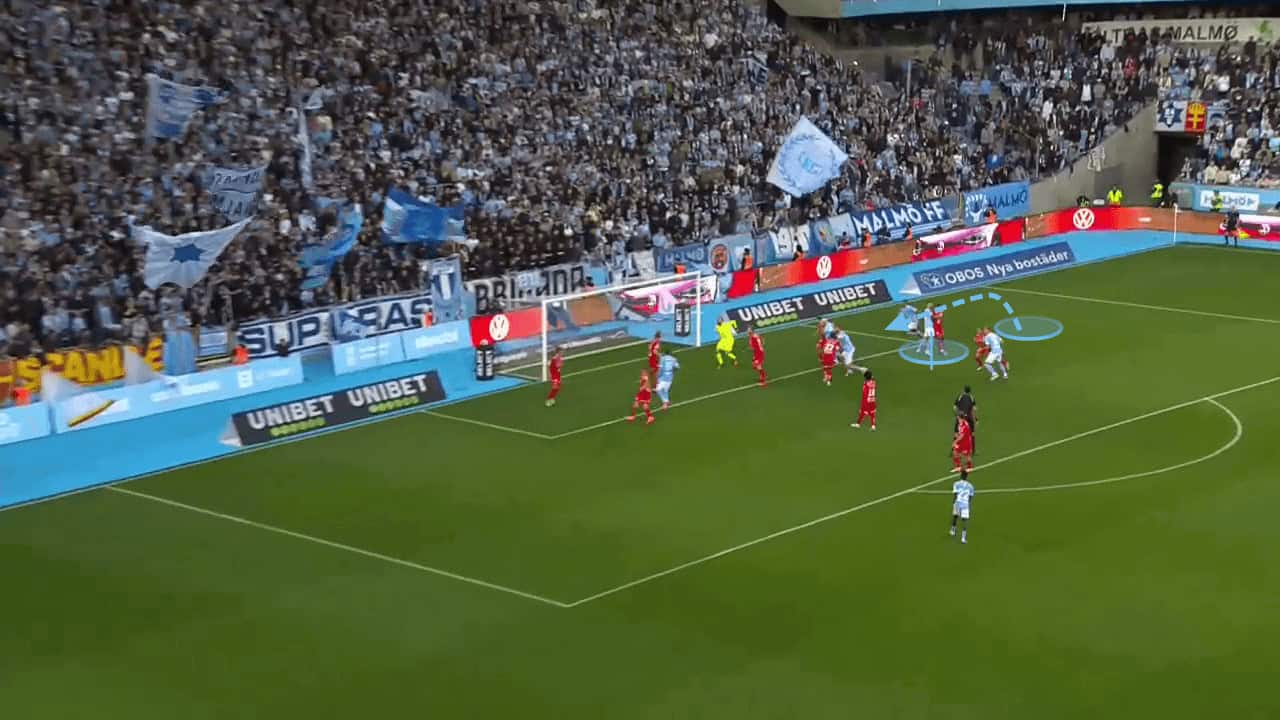
This particular method had struggled to be effective most of the time due to several factors. Firstly, the floated ball often could be claimed by the goalkeeper, as it was placed too close to the goal, while there was also no one present to disrupt the keeper during the claims.
Furthermore, Malmö have struggled to create that separation for the attackers at the back post through a lack of teamwork in their actions. Although the above example displayed the use of a screen, this was used less often than it should’ve. On most occasions, each attacker was left in an isolated 1v1 situation with their marker, but the close starting position to the goal meant that it was hard for any attacker to get away from their marker, with no space available to attack. As a result, defenders found it simpler to stay tight to an attacker, even with the attacker out of sight, and win the aerial duels.
The ‘Train’ Method
In the more recent fixtures, Malmö’s corner routine evolved. In an effort to build upon their older strategies, Malmö attempted to create additional space for the individual attackers by grouping up the attacking unit more tightly, making it impossible for the defenders to mark players tightly.
This was achieved by creating a ‘train’ where each attacker was tight to a teammate’s back, so defenders couldn’t remain goalside while staying tight. Had a defender attempted to keep tight but on one side of the attacker, it would allow the attacker to attack the opposite side, where their marker would have to run around the ‘train’ to recover their position, which would give the attacker enough time and space to attack the ball unopposed.

One alternate method of creating additional space for attackers had been to move the starting positions of each attacker further away from the goal. Forcing a player away from the goal can increase the space between a tight marker and the goal, making it easier for an attacker to lose their marker whilst getting into the box. Each player can lose their marker and dart away into the open area when the space is there.
Without that space, attackers who lose their markers have nowhere to escape to and can then be easily caught again by their marker unless the movement is made in the last possible second, where the attacker instantly attacks the ball after stepping away from their marker.
In the example below, the defending unit decides to protect the space at the cost of giving each attacker plenty of space. In doing so, the attackers all have lots of space to run into, where their momentum can give them a massive advantage in the aerial duel over the static defenders.
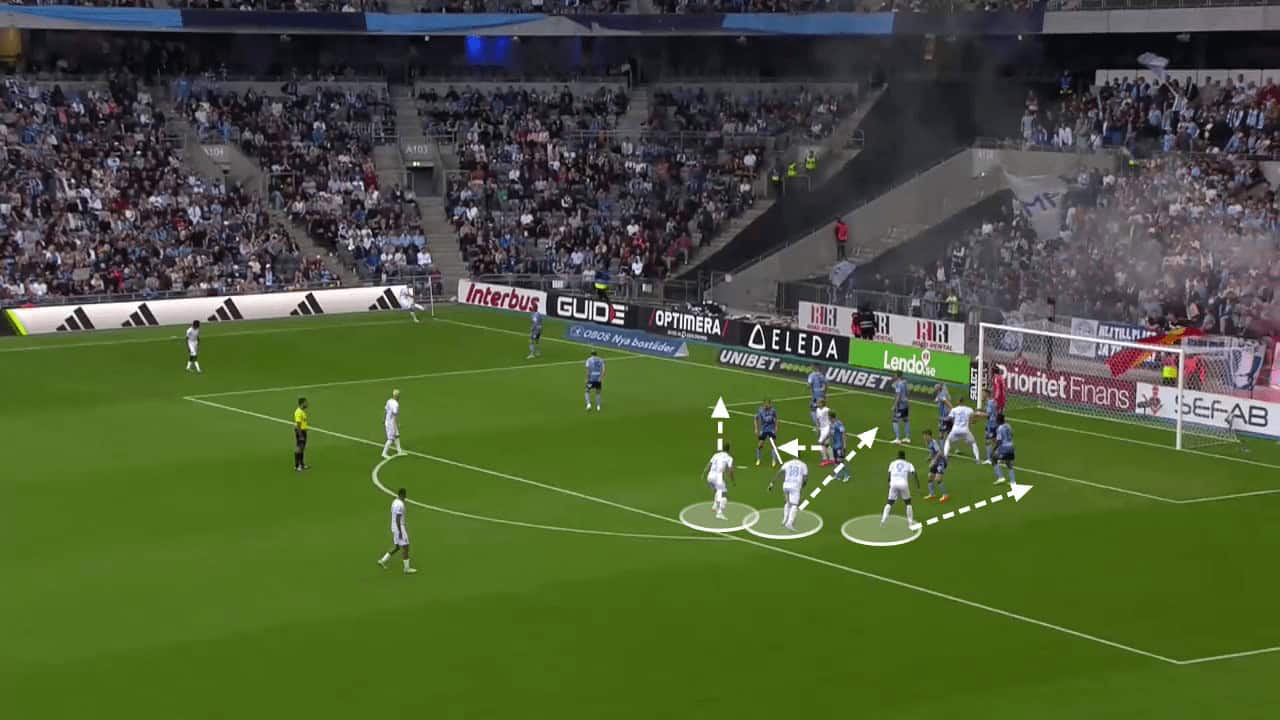
Another way in which Malmö have been able to create space around the six-yard box has been through the use of screens on zonal markers. It can be easier to perform screens on zonal defenders, as their position won’t change during the build-up to a corner. So it can be made in the last seconds before a corner is taken, giving them minimal time to recover back into position.
Using screens on static markers also means it is harder for them to evade the screen, as they may not expect to be blocked off and caught off guard.
The example below shows three Malmö attackers using screens on the zonal markers, which means that the six-yard line is unguarded and can be attacked unopposed if an attacker can break through into that open space.
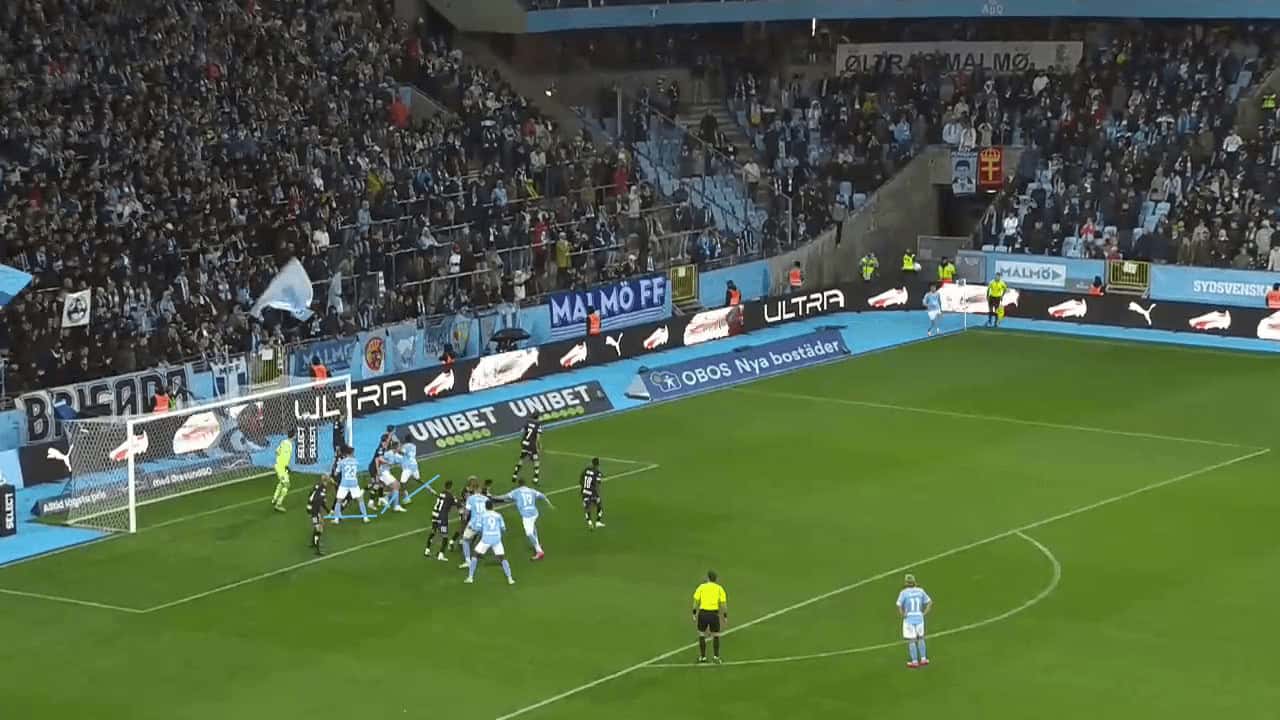
Malmö have also used screens on man markers to give individual attackers the time and space to attack balls in the aerial duel unopposed. When the number of runners from deep has been more significant than the number of man markers, Malmö have used a spare attacker to perform a screen, giving an alternate attacker the opportunity to have a clear run-up at the ball.
The issue has been with the corner taker being unable to deliver the ball close enough to the free attacker’s path, so even though he is unmarked, the ball never reaches him.
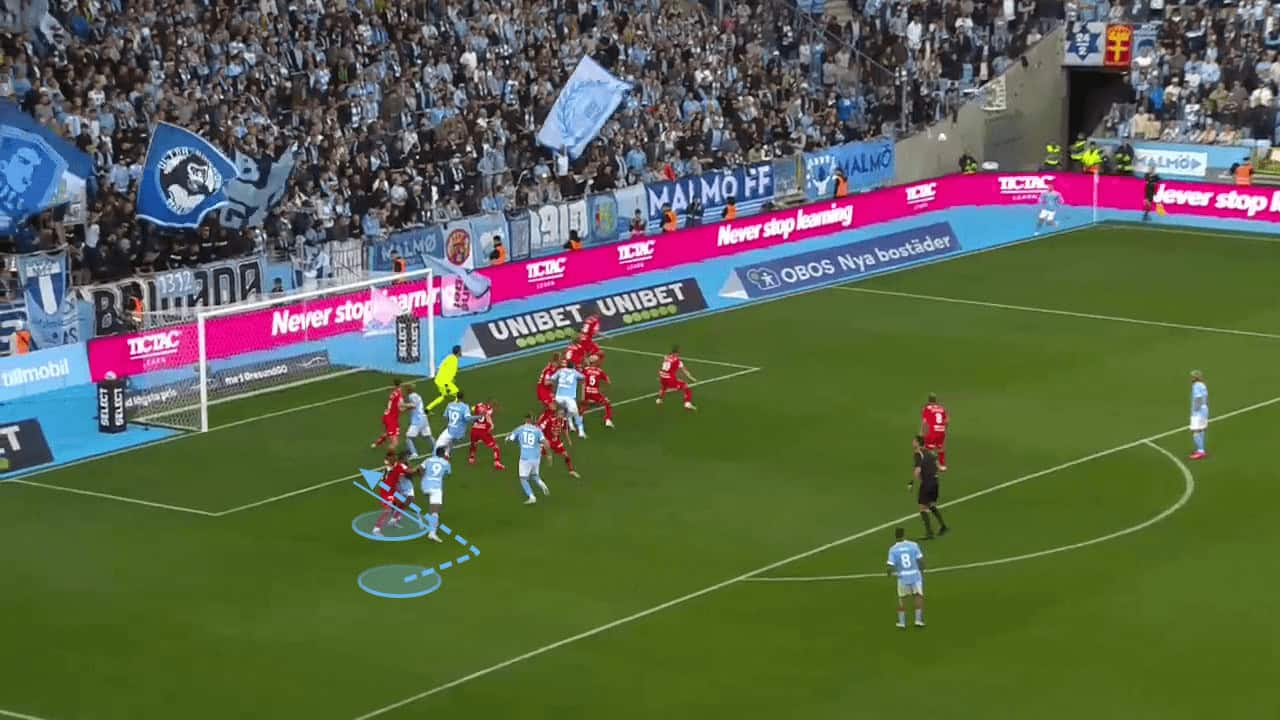
Problems with timing
Whilst Malmö have used many positive ideas when attacking corners, the lack of attention to detail has caused them to be inefficient from these corners. Adjusting to the ‘train’ has been particularly ineffective regarding how many times a Malmö attacker made the first contact with the ball.
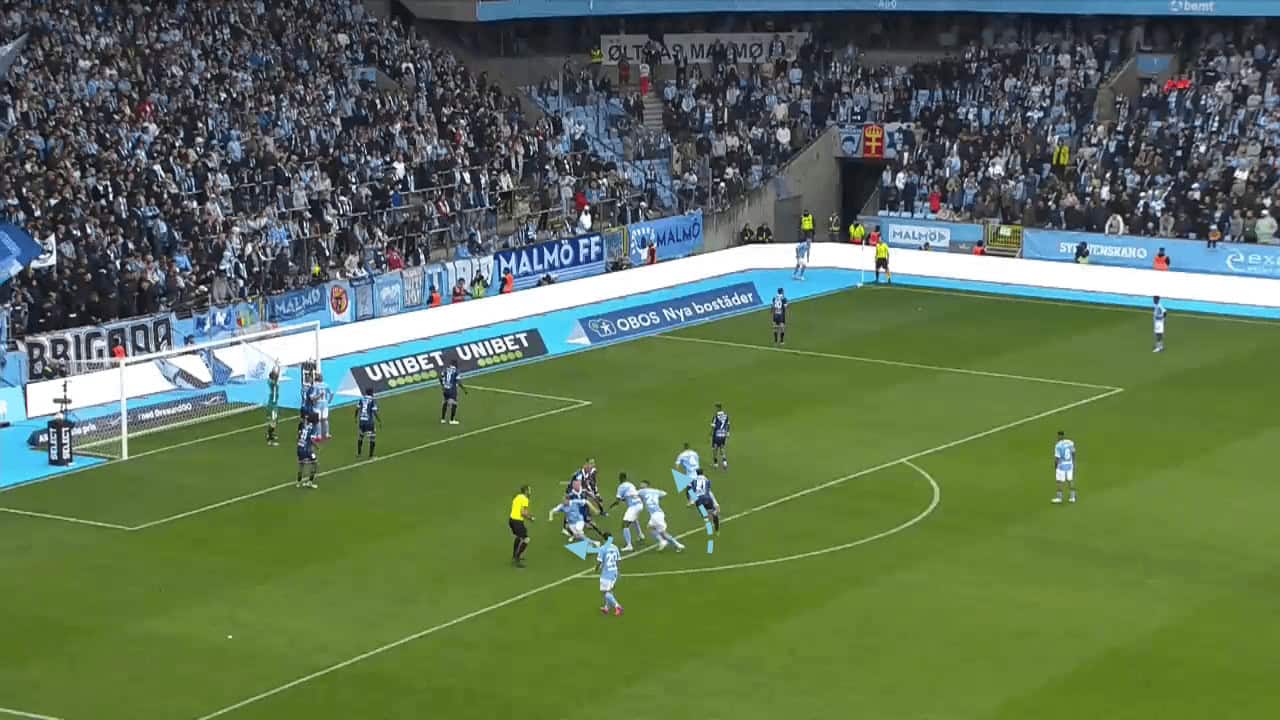
One of the issues has been with the timing of when to make the initial movements. As shown in the image below, we can see that two attackers have already begun their sprint towards the six-yard box, whilst the other two attackers are standing still. The corner-taker hasn’t even started his run-up at this point.
Waiting until the latest moment before making the run can be highly effective, as the defending players will have the least time to recover their position and get goalside of their marker. Making this run too early creates many problems.
Firstly, the two attackers who split and attack the six-yard box too early cannot time their run at the ball. As they enter the target area too early, they have to wait for the ball and lose all the momentum they gain from sprinting from a deeper position. Furthermore, while waiting for the ball to arrive, defenders have time to recover their position and mark them again.
The early movement also means that the two attackers who waited are sitting ducks. The two man-markers can track the runs easily, as there isn’t much interruption, and they can get tight. The whole concept behind the ‘train’ becomes ineffective when the timing of the split isn’t right.
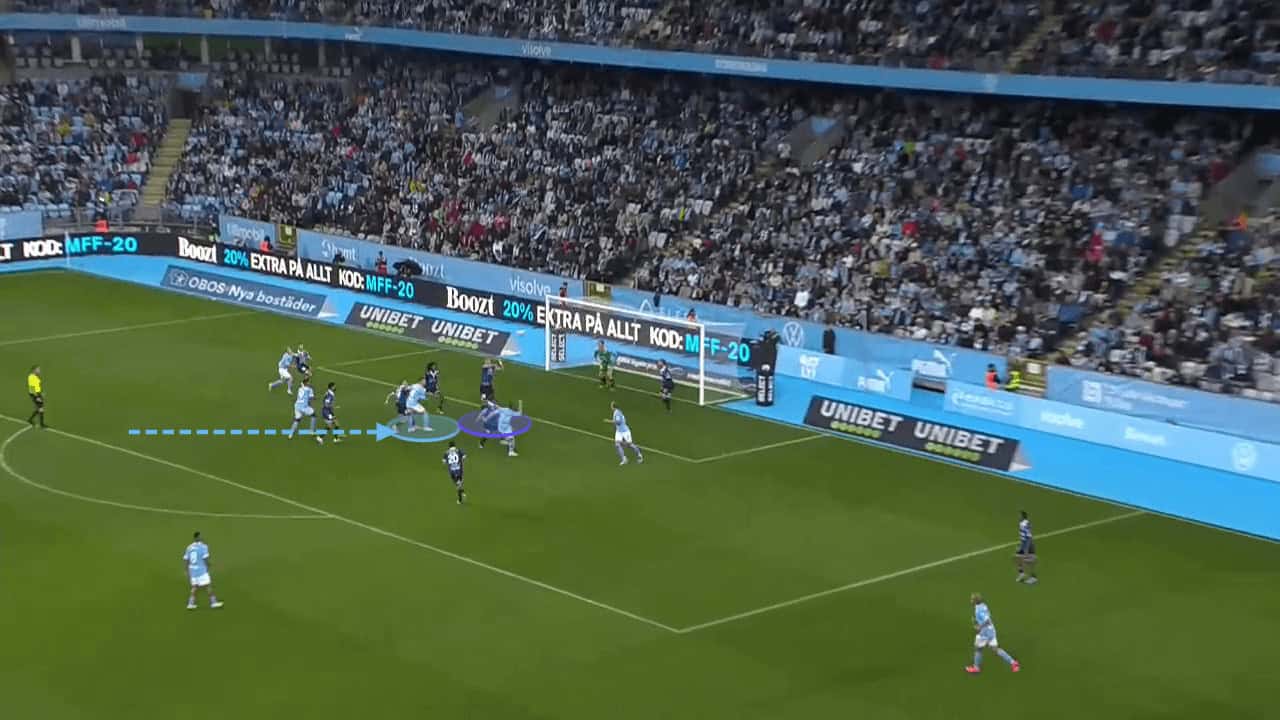
Malmö have consistently had issues with this method. In the case below, the late timing of the split of all attackers has meant that the attacker closest to the ball cannot get there in time. As we can see, the defender is already in the air heading the ball away from danger, whilst the attacker is still attempting to move into the path of the ball.
Malmö have shown that they struggle with the timings, being both too late and too early on different occasions. If they can practice the timings, they can become a team that is difficult to stop from corners, especially with one effective method like this one.
Summary
Malmö FF have been slowly piecing together the puzzle regarding their corner routine. Creating screens, both on zonal markers and man markers, using ‘trains’, and altering the starting positions of the attacking unit has given Malmö slight advantages in a lot of corner attempts.
However, the lack of consistency in all of these actions above has meant that Malmö cannot take full advantage of the great things they have attempted. With defending teams cramming their own box during corners, it is necessary for Malmö to have planned movements and coordinated attacks rather than having each attacker fend for themselves apart from the occasional screen.
The lack of coordination means that Malmö FF cannot consistently create good opportunities. Many times, a delivery is well placed towards the six-yard box, but the lack of screens means each attacker can be easily tracked. When the space for an attacker is made, the ball usually fails to be aimed toward that individual, making them irrelevant. At the same time, attackers also fail to attempt to make any decoy runs or selfless movements to take advantage of second balls.
These don’t all have to be performed simultaneously, but with Malmö’s reluctance to coordinate moves or have variety in their routines, their positive intentions don’t always translate onto the pitch. The poor timing in their movements has also proven to hinder their output from corners massively.

