Total Football Analysis
Once.Sport
  • Football Analysis
    • Data Analysis
    • Formations
      • 2-2-4 Formation
      • 2-3-5 Formation
      • 3-1-4-2 Formation
      • 3-2-2-3 Formation
      • 3-2-4-1 Formation
      • 3-1-6 Formation
      • 3-3-4 Formation
      • 3-4-1-2 Formation
      • 3-4-2-1 Formation
      • 3-4-3 Formation
      • 3-5-1-1 Formation
      • 3-5-2 Formation
      • 4-1-4-1 Formation
      • 4-2-2-2 Formation
      • 4-2-3-1 Formation
      • 4-2-4 Formation
      • 4-3-1-2 Formation
      • 4-3-3 Formation
      • 4-4-2 Formation
      • 4-5-1 Formation
      • 5-3-2 Formation
      • 5-4-1 Formation
      • 6-3-1 Formation
    • Head Coach Analysis
    • Match Analysis
    • Player Analysis
    • Recruitment Analysis
    • Set Piece Analysis
    • Tactical Theory
    • Tactical Preview
    • Team Analysis
    • Training Analysis
    • Tactical Analysis
    • Scouting Report
  • Competition
    • ALL Competitions
    • English Premier League
    • Champions League
    • La Liga
    • Bundesliga
    • Serie A
    • Ligue 1
    • Eredivisie
    • EFL Championship
    • FIFA World Cup 2022
    • WEURO 2022
    • Women’s Super League
    • NWSL
    • Belgian First Division A
    • A-League
    • Liga Profesional de Argentina
    • Austrian Bundesliga
    • Campeonato Brasileiro Série A
    • DFB Pokal
    • 1. HNL
    • Danish Superliga
    • EFL League One
    • EFL League Two
    • FA Cup
    • EFL Cup
    • Indian Super League
    • K-League
    • J1 League
    • Liga MX
    • Copa América 2021
    • Copa del Rey
    • MLS
    • Eliteserien
    • Euro 2020
    • Primeira Liga
    • Scottish Premiership
    • Allsvenskan
    • Europa League
    • UEFA Nations League
    • Liga AUF Uruguaya
  • Coaches
    • All Coaches
    • Alfred Schreuder
    • Ange Postecoglou
    • Antonio Conte
    • Arne Slot
    • Bo Svensson
    • Brendan Rodgers
    • Bruno Lage
    • Carlo Ancelotti
    • Christophe Galtier
    • Claude Puel
    • Claudio Ranieri
    • David Moyes
    • Dean Smith
    • Diego Simeone
    • Domenico Tedesco
    • Frank Lampard
    • Eddie Howe
    • Edin Terzić
    • Emma Hayes
    • Erik ten Hag
    • Ernesto Valverde
    • Gennaro Gattuso
    • Gerardo Seoane
    • Gian Piero Gasperini
    • Giovanni van Bronckhorst
    • Graham Potter
    • Igor Tudor
    • Imanol Alguacil
    • Jesse Marsch
    • Jonas Eidevall
    • Jorge Sampaoli
    • José Bordalás
    • José Mourinho
    • Julen Lopetegui
    • Julian Nagelsmann
    • Julien Stéphan
    • Jürgen Klopp
    • Luciano Spalletti
    • Lucien Favre
    • Manuel Pellegrini
    • Marcelo Bielsa
    • Marco Rose
    • Marco Silva
    • Massimiliano Allegri
    • Mauricio Pochettino
    • Maurizio Sarri
    • Mikel Arteta
    • Niko Kovač
    • Nuno Espírito Santo
    • Oliver Glasner
    • Patrick Vieira
    • Paulo Fonseca
    • Pep Guardiola
    • Peter Bosz
    • Rafa Benítez
    • Ralf Rangnick
    • Ralph Hasenhüttl
    • Roger Schmidt
    • Roy Hodgson
    • Sean Dyche
    • Sérgio Conceição
    • Simone Inzaghi
    • Sonia Bompastor
    • Stefano Pioli
    • Steffen Baumgart
    • Steven Gerrard
    • Thiago Motta
    • Thomas Frank
    • Thomas Tuchel
    • Unai Emery
    • Vincenzo Italiano
    • Xavi
  • Teams
    • ALL Teams
    • AC Milan
    • Ajax Amsterdam
    • Arsenal
    • AS Monaco FC
    • Atalanta
    • Atlético Madrid
    • FC Barcelona
    • FC Bayern Munich
    • Borussia Dortmund
    • Celtic FC
    • Chelsea FC
    • Everton F.C.
    • Inter Milan
    • Juventus F.C.
    • Leeds United F.C.
    • Liverpool FC
    • Manchester City
    • Manchester United FC
    • Paris Saint-Germain
    • Rangers FC
    • RB Leipzig
    • Real Madrid CF
    • Tottenham Hotspur
    • West Ham United
  • Players
    • ALL Players
    • Alisson Becker
    • Bukayo Saka
    • Erling Haaland
    • Harry Kane
    • Jack Grealish
    • John Stones
    • Julián Alvarez
    • Kalvin Phillips
    • Kevin De Bruyne
    • Kyle Walker
    • Kylian Mbappé
    • Lamine Yamal
    • Lionel Messi
    • Luis Díaz
    • Mohamed Salah
    • Phil Foden
    • Virgil Van Dijk
  • Contact
  • Write For TFA
No Result
View All Result
No Result
View All Result
Total Football Analysis
No Result
View All Result
Home Analysis

FIFA Women’s World Cup 2023: How Sweden are obliterating opponents with corners – set-piece analysis

Marcel Seifeddine by Marcel Seifeddine
August 2, 2023
in Analysis, FIFA Women's World Cup 2023, Set Piece Analysis
0
FIFA Women's World Cup 2023: How Sweden are dismantling sides with corners - set-piece analysis

Credit: BBC Sport

Sweden have begun the Women’s World Cup in a dominant fashion in their opening two fixtures, with a 2-1 victory over South Africa, including a late winner from a corner kick. The side, led by Peter Gerhardsson from the sidelines, has adapted their corner routine to make the most of Arsenal‘s Amanda Illestedt. In the second fixture, Sweden demolished Italy 5-0, with three near-identical goals coming from Jonna Anderson’s inswinging corners, where Illestedt managed to score a brace and is currently the joint-second top scorer. AC Milan‘s Kosovare Asllani has taken the inswinging corners from the left-hand side. However, no one can match Anderson’s technique and consistency regarding dead-ball deliveries, meaning they are likelier to score from the right.

In this tactical analysis, we will look into the tactics behind Sweden’s corner routines, with an in-depth analysis of how their strategy of floating the ball inside the six-yard box has been successful. This set-piece analysis will examine why this method has been effective and how opposition teams can adjust defensively against it in the latter stages of the World Cup.

Sweden’s Inevitable Routine

Sweden’s source of goal from corners has arrived through their intent to crowd the six-yard box, from where any flick on towards goal is likely to result in a goal, with the goalkeeper having no time to react to the shots. From corners, Illestedt is the primary target, who starts off inside the goal or by the post before attempting to ghost into the green target area pictured below.

Barcelona‘s Fridolina Rolfo attacks the near-side of the six-yard box to ensure that no one can clear it should the corner be under it. We can then see an attacker move towards the goalkeeper whilst two attackers begin in the six-yard box to crowd it and disperse to prepare for any flicks or rebounds.

FIFA Women's World Cup 2023: How Sweden are dismantling sides with corners - set-piece analysis
Credit: BBC Sport


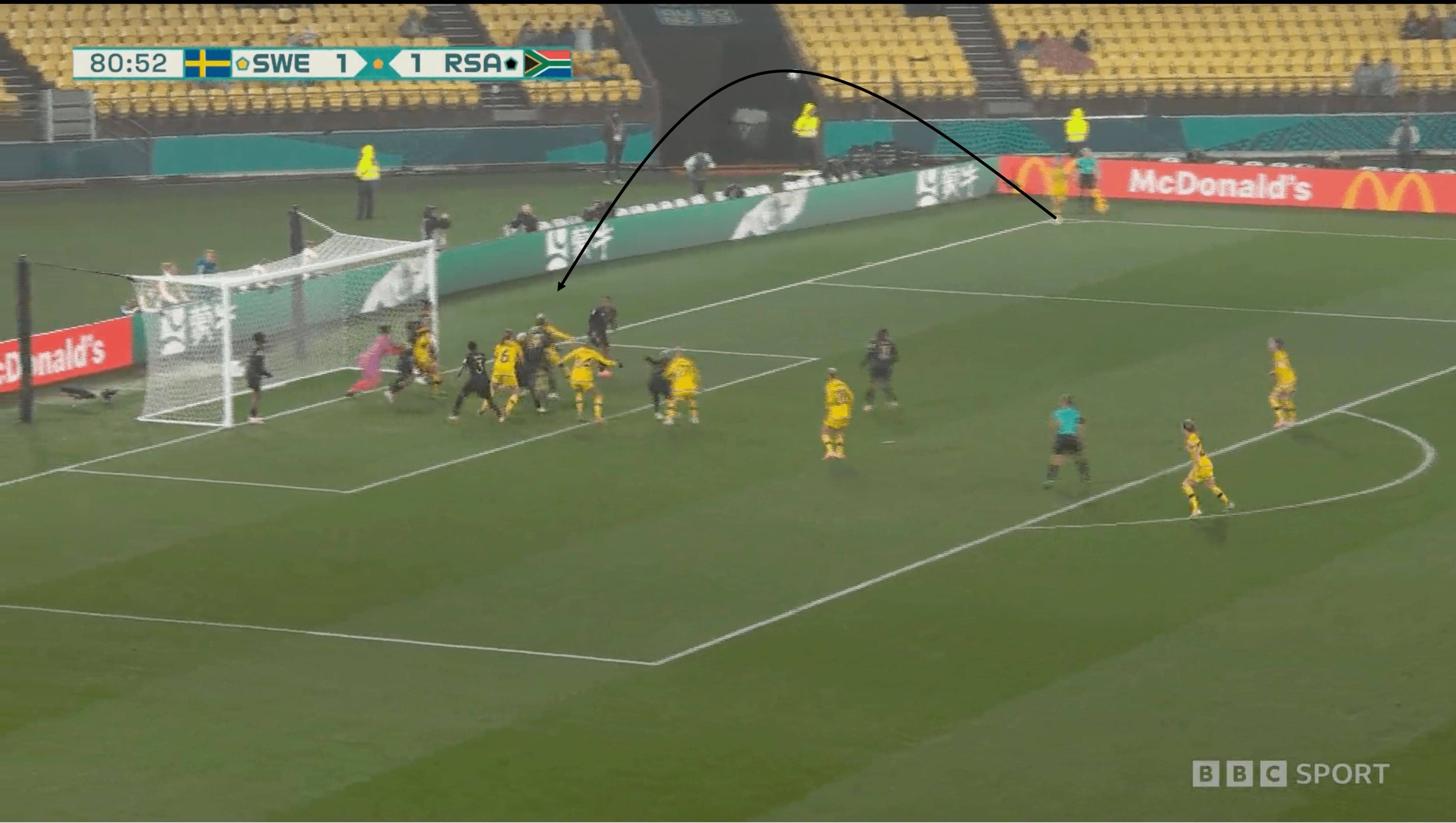
The common understanding is that Sweden have used inswinging corners most of the time. However, the unique part of Sweden’s corner game which has been underappreciated is their use of floated corners into the near side of the six-yard box.

While the ball is still inswinging, what separates Sweden from the other sides is the fact that the ball hangs in the air when it is crossed in. Jonna Anderson has regularly displayed her ability to float crosses in by not following through in her swing for the delivery.

As she makes contact with the ball, her foot does not fully swing forward, as we see with most other corners. Instead, she applies backspin to the ball, meaning there is less power than with a usual corner, and the ball can float through the air for a more extended period.

Anderson’s ability to make the ball hang in the air, even when applying minimal power to the cross, means that she can make the ball travel short distances but stay in the air with her wedge-like leg swing of a golfer.

Floated crosses aren’t anything new regarding corner-taking. However, the difference is in the placement of the delivery. As floated crosses hang in the air, it gives goalkeepers added time to step off their lines and claim the ball.

As a result, these types of corners are almost exclusively attempted towards the back side of the six-yard box or the penalty spot, where the ball can float over everyone’s heads and be too far for the goalkeeper to claim.

However, Sweden have been aiming these deliveries into the six-yard box, almost at the goalkeeper, where it seems like it should be easy to claim or punch, no matter how big or small the goalkeeper may be.
FIFA Women's World Cup 2023: How Sweden are dismantling sides with corners - set-piece analysis
Credit: BBC Sport

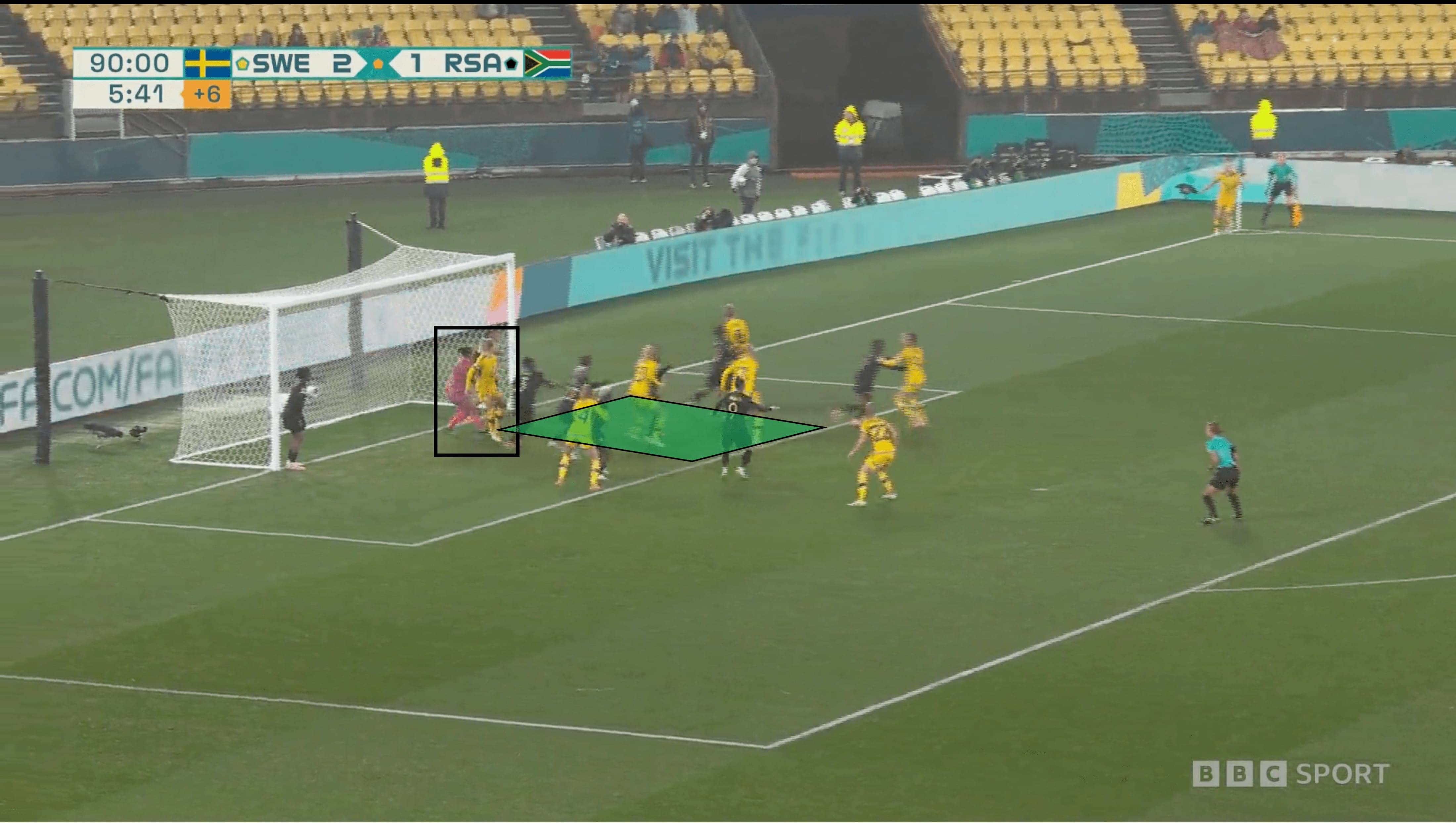
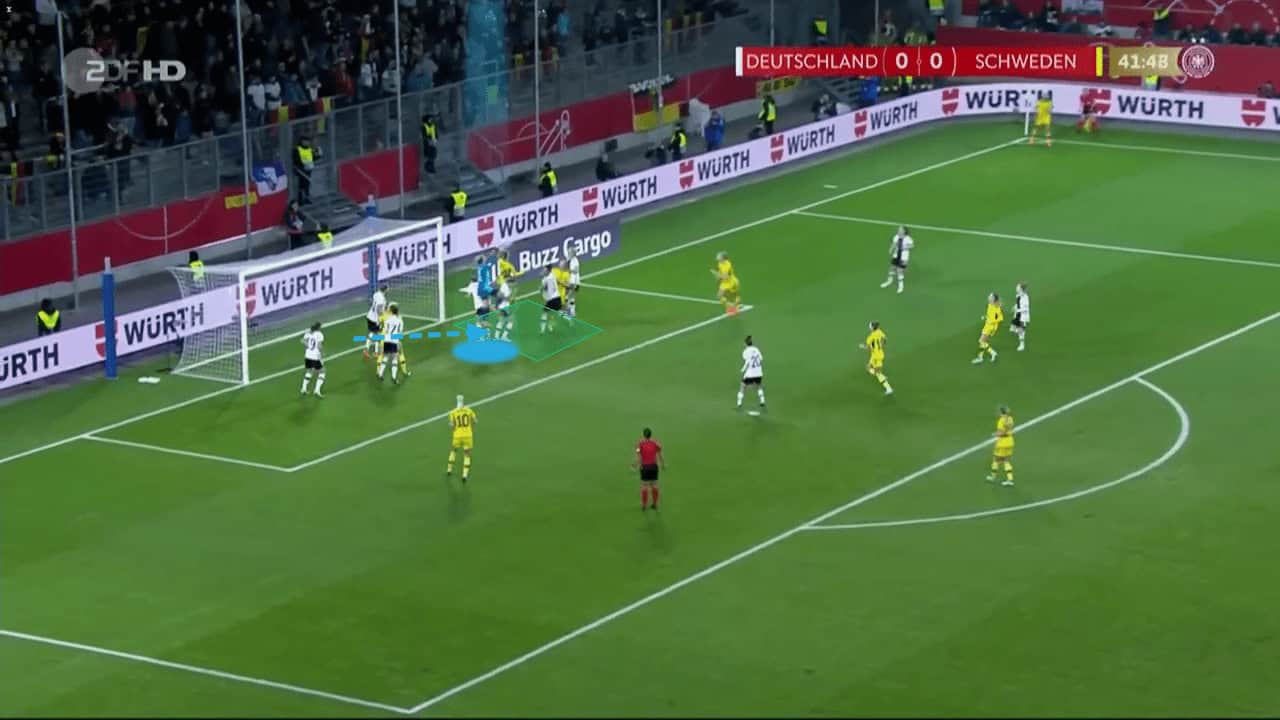
In order to prevent the goalkeeper from being able to affect this type of delivery, Sweden have had to plant a player on the opposition goalkeeper every time. The image below shows the goalkeeper’s path being blocked, which means they are rooted to the spot, and unable to impact the corner coming in.

The green area highlighted is the rough area where these types of corners have been aimed at. The ball floating in the air means that even if the delivery isn’t accurate, attackers have the time to adjust their position and still have the time to attack the ball.
FIFA Women's World Cup 2023: How Sweden are dismantling sides with corners - set-piece analysis
Credit: BBC Sport

The final key component of Sweden’s successful method has come through the use of intelligent movement. When Anderson hangs a ball in the air, it seems time slows down, and each attacker has all the time in the world to make their moves.

Each attacker can benefit from Anderson’s delivery, as they have the added time to make their decisions and then execute them with a higher success rate.

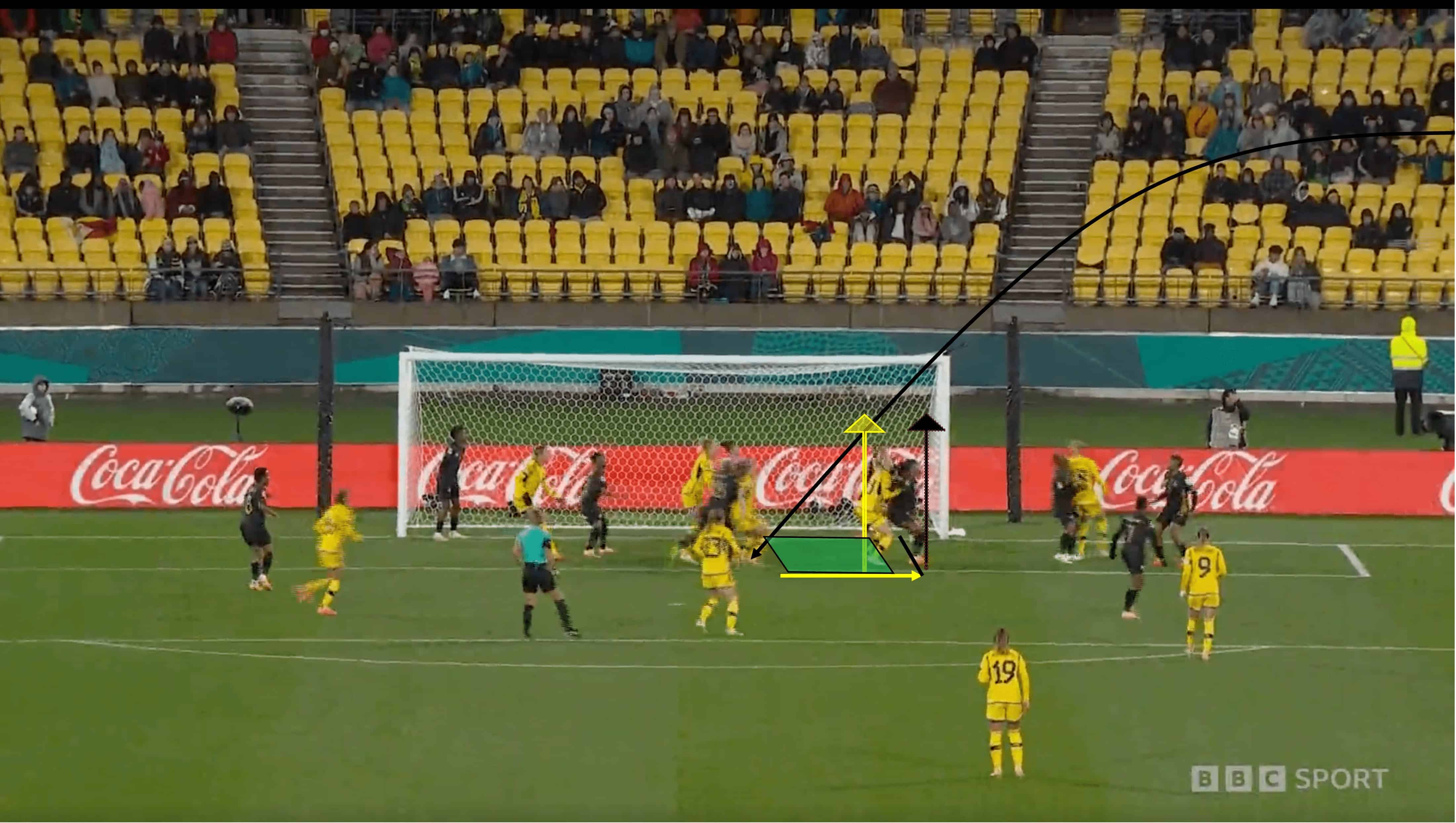
The target player, Illestedt, has time to move directly behind her marker. From that position, she is able to edge forwards slowly toward the corner taker, forcing her marker to move in the same direction, further away from the target area. Although these movements can seem minimal and sometimes are barely visible, they make a massive difference, especially inside the six-yard box.

In the image below, we can see the average jump height (yellow and black arrows) a player can reach from a standing position as well as the arc of the ball. At the front side of the target area (green box), we can see that if a player jumps, they would be able to meet the ball mid-air.

However, the black arrow shows that from the defender’s position, even a perfectly timed jump wouldn’t be springy enough to intercept the cross, thus taking that defender out of the equation for that particular set play.
FIFA Women's World Cup 2023: How Sweden are dismantling sides with corners - set-piece analysis
Credit: BBC Sport

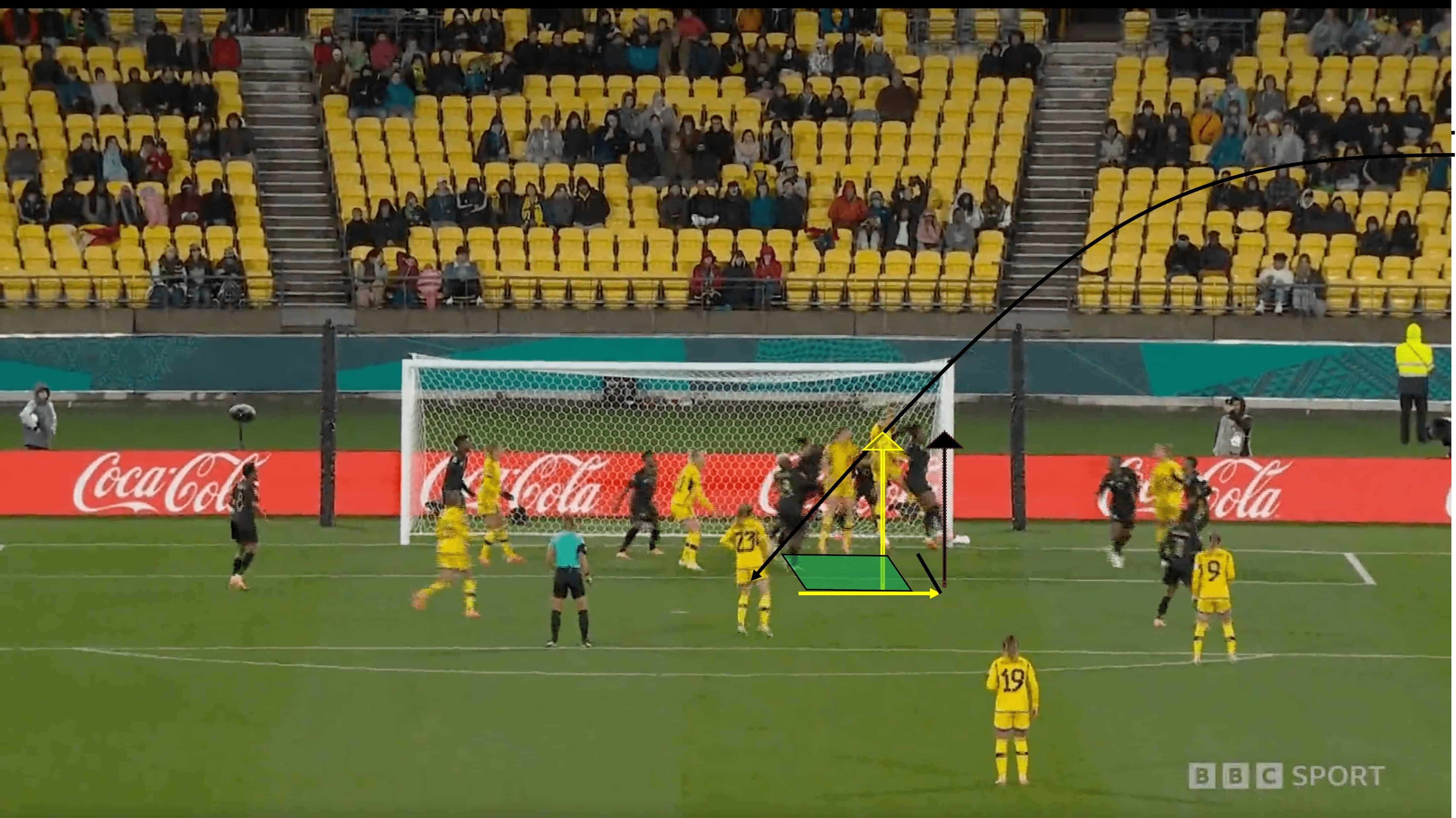
We can then see this in action, with the attacker being able to meet the ball at her peak jump height, whilst the defender has also attempted to clear the cross but was unable to meet it. This has been Sweden’s key to achieving success from these corners.

The ability to quickly shift defenders out of the way, making the aerial duel easier for the attackers, whilst Illestedt’s superior ability in the air, has helped Sweden win those 50/50 duels.
FIFA Women's World Cup 2023: How Sweden are dismantling sides with corners - set-piece analysis
Credit: BBC Sport


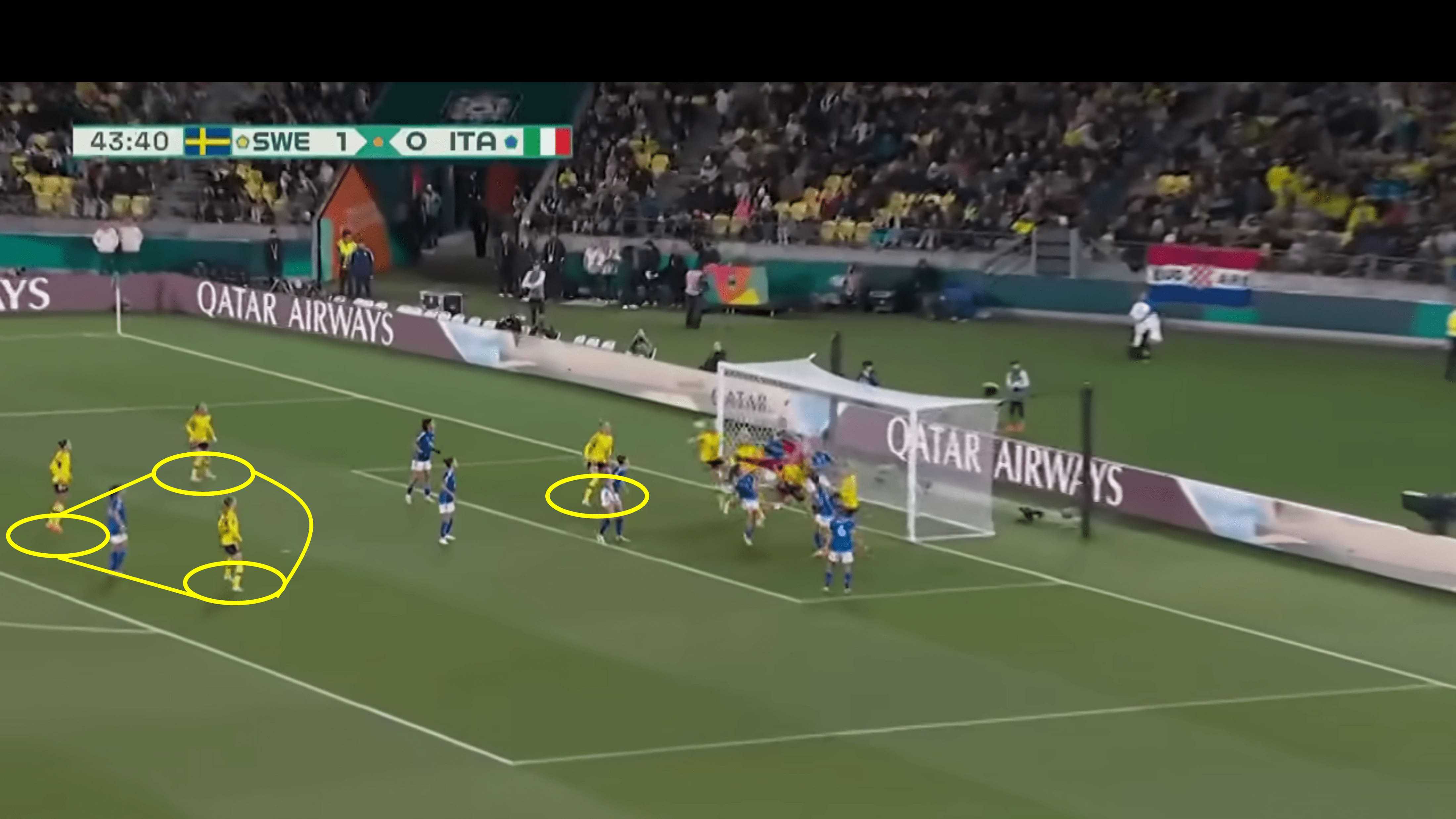
While Sweden have looked threatening from corners, they have only really used 2-3 players who actually attack the ball. This leaves a large number of spare players who aren’t distracted by attempting to attack the ball.

Instead, these players have been positioned intelligently to cut out potential counterattacks and help the team sustain pressure by keeping the ball alive and active inside the box, even if the defenders dealt with the initial cross.

We can see below Sweden leave one attacker at the back post to attack rebounds or if the ball completely bypasses everyone else inside the six-yard box. The remaining three attackers are spread wider than the defensive players around the box in order to contain them.

If an opposition player does receive the ball, there are attackers ready to press the ball from both left and right to make sure the ball doesn’t leave the final third.
FIFA Women's World Cup 2023: How Sweden are dismantling sides with corners - set-piece analysis
Credit: ITV Sport

Opposition’s Mistakes

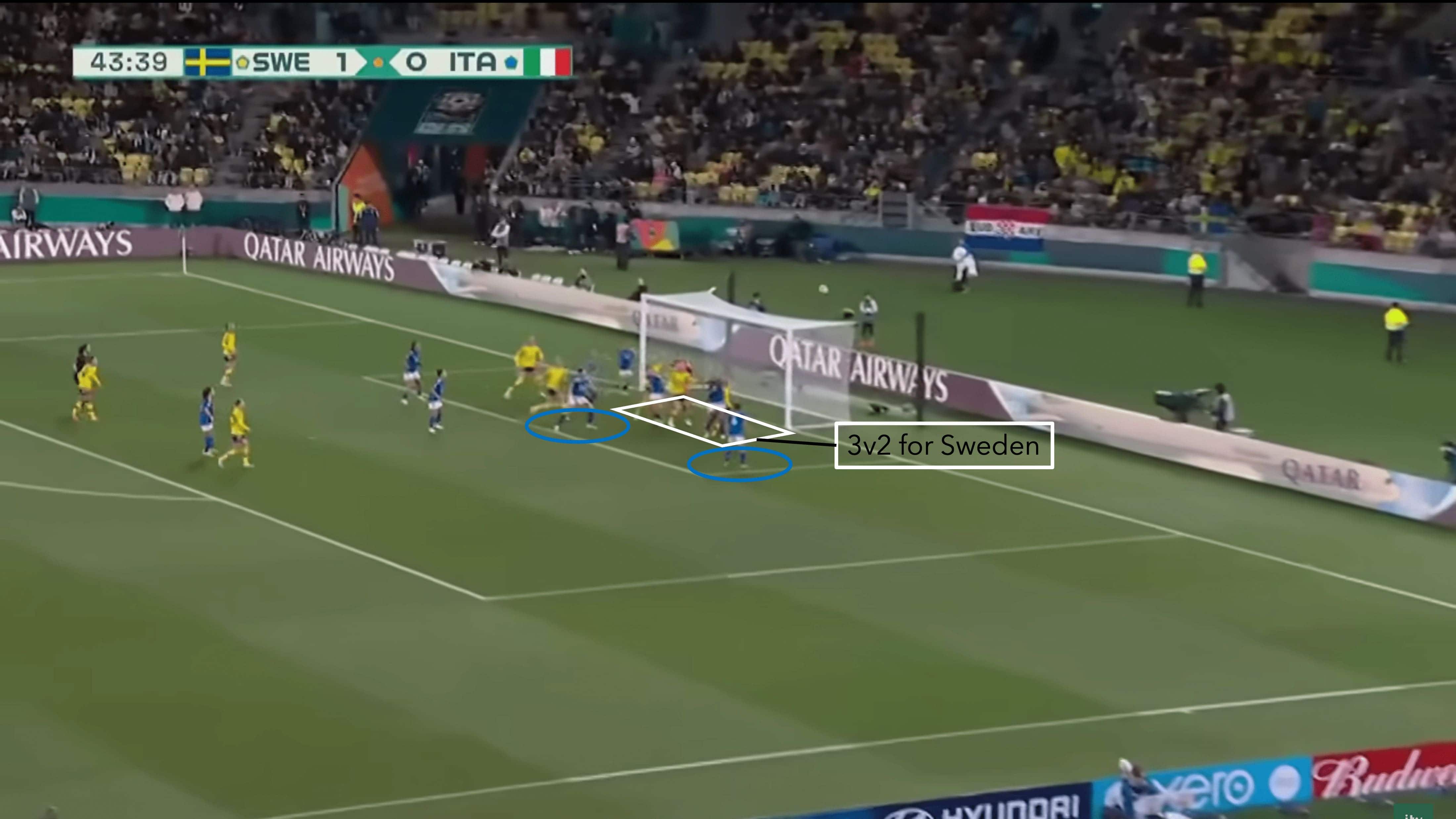
While Sweden have been doing exceptionally well to score so many goals from set pieces, life has been made easy for them by defensive issues from opposition teams. With Sweden having so many corners, defending teams sometimes struggle with concentration, leading to these defensive mishaps.

In the example below, two Italian defenders are rooted to their spot as the cross comes in, leaving a 3v2 for Sweden against Italy’s defenders inside the immediate area around the goalkeeper. This leaves at least one Swedish attacker free to attack the ball without interruption. The inability of defensive markers to stay with the attacker means that the goalkeeper cannot move past the blocker and is definitely rooted to the line.
FIFA Women's World Cup 2023: How Sweden are dismantling sides with corners - set-piece analysis
Credit: ITV Sport

The Antidote

Although Sweden have been efficient from their corners, they have been very one-dimensional, which means that teams can start to prepare against them. Until they start to alter their routines, opposing teams should be able to set up to counter that one specific method and nullify the Swedish side.

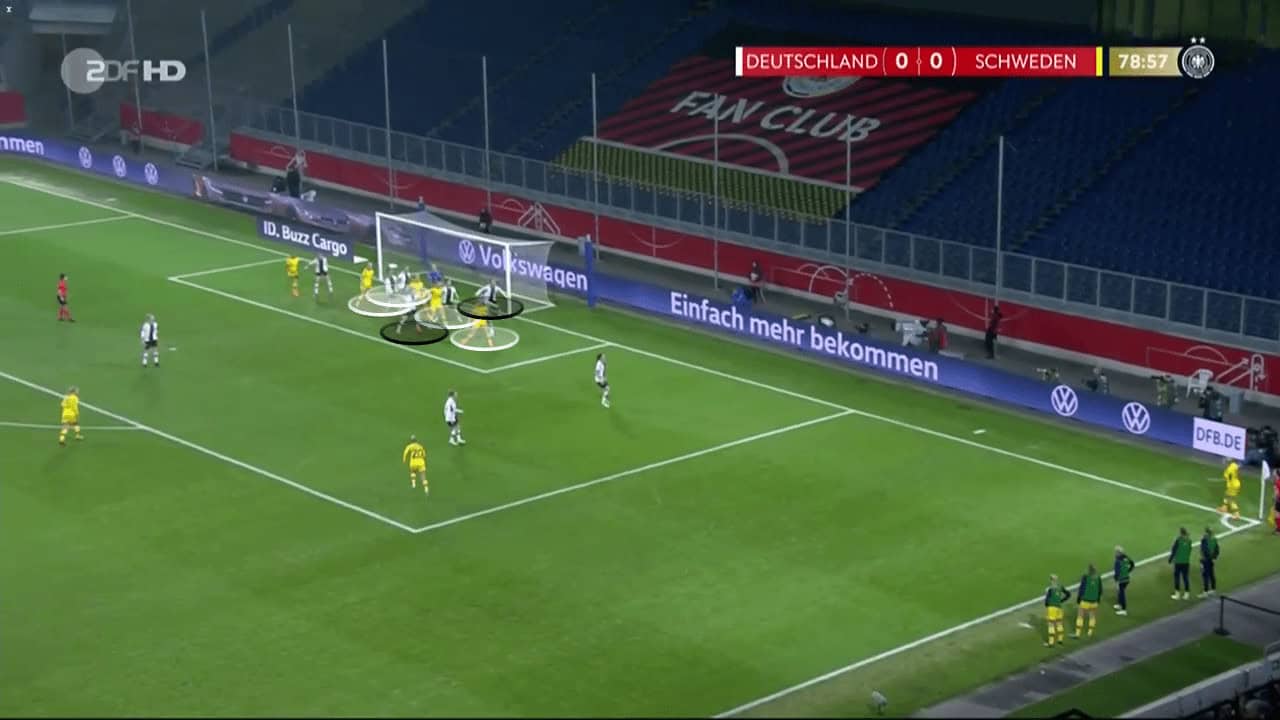
The biggest change teams can make to their defensive setups is overloading the six-yard box with defensive numbers. If teams can create numerical overloads defensively inside the six-yard box, they can start to mark attackers tightly. Tighter marking will prevent attackers from being able to attack the ball as quickly, potentially grounding them. In the instances where space is so limited, there is no risk of defenders losing their marker by being too tight.

In the image below, four defenders can man mark the four attackers around the goalkeeper, which means that none of the attackers can reach their optimal height when attacking the ball. This leaves the two spare players in black to attack the ball freely and clear it from the six-yard box.
FIFA Women's World Cup 2023: How Sweden are dismantling sides with corners - set-piece analysis

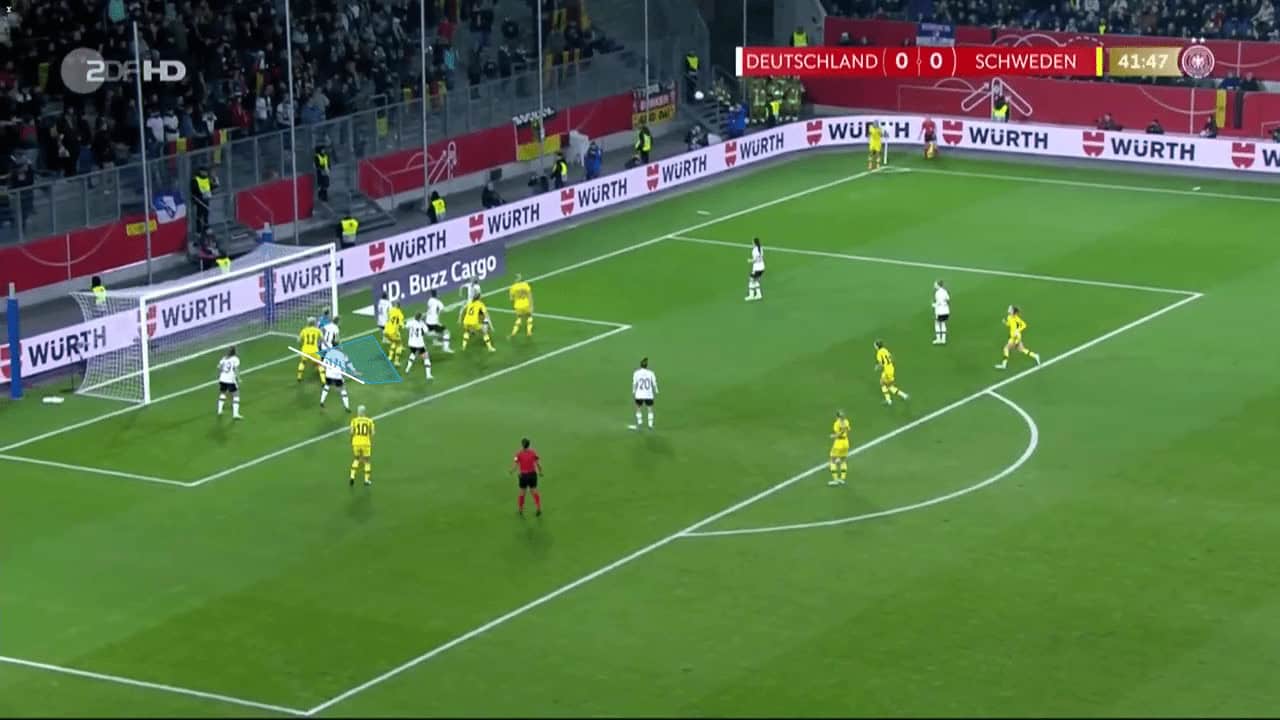
Having enough defensive numbers to man mark each attacking option also makes it harder for Sweden to root the goalkeeper to the line. We can see each defender occupied with an attacker in the image below.

As a result, the roles can be reversed, and we can see a defender making a screen on the Swedish attacker to block them from being able to mark the goalkeeper. This then allows the goalkeeper to step off her line and attack the floated cross inside the six-yard box.
FIFA Women's World Cup 2023: How Sweden are dismantling sides with corners - set-piece analysis

Because of the added reach goalkeepers have in aerial duels thanks to their arms, combined with the fact that the ball hangs in the air for an extended period when Sweden attack corners, it is definitely possible to deal with these corner deliveries.

All that needs to be done each time is to isolate the keeper so that her vision is not interfered with and she has the space to come off the line, and either claim the ball or punch it.

Until Sweden vary the speed of delivery, type of delivery, placement of delivery, or the movements inside the box, it will always be possible for the goalkeeper to singlehandedly deal with these corners, as long as she gets the help of her teammates for her to have the freedom to come off her line.

Besides one attacker attempting to block the goalkeeper, not much is being done to help Illestedt attack corners regularly, thus making it possible to defend against them.
FIFA Women's World Cup 2023: How Sweden are dismantling sides with corners - set-piece analysis

Summary

This tactical analysis has detailed the methods Sweden have used to score so many goals from a limited number of corners. At this rate, Sweden will continue to dominate from corners unless teams coming up against them in the Women’s World Cup knockout rounds begin to proactively set up and nullify Sweden’s only method from corners so far.

Previous Post

‘You need to deal with the cards you are handed’: How Australia have coped without Sam Kerr – scout report

Next Post

EPL preview download, the best set plays from the World Cup, why Lauren James is a talent and how Australia have coped without Kerr…

Next Post
TFA TODAY

EPL preview download, the best set plays from the World Cup, why Lauren James is a talent and how Australia have coped without Kerr...

  • About Total Football Analysis
  • Contact Total Football Analysis
  • Write For Total Football Analysis
  • Advertise
  • Privacy Policy
  • Cancellation / Refund Policy
  • Resources
  • Terms Of Service

© 2026 Total Football Analysis

No Result
View All Result
  • Football Analysis
    • Data Analysis
    • Formations
      • 2-2-4 Formation
      • 2-3-5 Formation
      • 3-1-4-2 Formation
      • 3-2-2-3 Formation
      • 3-2-4-1 Formation
      • 3-1-6 Formation
      • 3-3-4 Formation
      • 3-4-1-2 Formation
      • 3-4-2-1 Formation
      • 3-4-3 Formation
      • 3-5-1-1 Formation
      • 3-5-2 Formation
      • 4-1-4-1 Formation
      • 4-2-2-2 Formation
      • 4-2-3-1 Formation
      • 4-2-4 Formation
      • 4-3-1-2 Formation
      • 4-3-3 Formation
      • 4-4-2 Formation
      • 4-5-1 Formation
      • 5-3-2 Formation
      • 5-4-1 Formation
      • 6-3-1 Formation
    • Head Coach Analysis
    • Match Analysis
    • Player Analysis
    • Recruitment Analysis
    • Set Piece Analysis
    • Tactical Theory
    • Tactical Preview
    • Team Analysis
    • Training Analysis
    • Tactical Analysis
    • Scouting Report
  • Competition
    • ALL Competitions
    • English Premier League
    • Champions League
    • La Liga
    • Bundesliga
    • Serie A
    • Ligue 1
    • Eredivisie
    • EFL Championship
    • FIFA World Cup 2022
    • WEURO 2022
    • Women’s Super League
    • NWSL
    • Belgian First Division A
    • A-League
    • Liga Profesional de Argentina
    • Austrian Bundesliga
    • Campeonato Brasileiro Série A
    • DFB Pokal
    • 1. HNL
    • Danish Superliga
    • EFL League One
    • EFL League Two
    • FA Cup
    • EFL Cup
    • Indian Super League
    • K-League
    • J1 League
    • Liga MX
    • Copa América 2021
    • Copa del Rey
    • MLS
    • Eliteserien
    • Euro 2020
    • Primeira Liga
    • Scottish Premiership
    • Allsvenskan
    • Europa League
    • UEFA Nations League
    • Liga AUF Uruguaya
  • Coaches
    • All Coaches
    • Alfred Schreuder
    • Ange Postecoglou
    • Antonio Conte
    • Arne Slot
    • Bo Svensson
    • Brendan Rodgers
    • Bruno Lage
    • Carlo Ancelotti
    • Christophe Galtier
    • Claude Puel
    • Claudio Ranieri
    • David Moyes
    • Dean Smith
    • Diego Simeone
    • Domenico Tedesco
    • Frank Lampard
    • Eddie Howe
    • Edin Terzić
    • Emma Hayes
    • Erik ten Hag
    • Ernesto Valverde
    • Gennaro Gattuso
    • Gerardo Seoane
    • Gian Piero Gasperini
    • Giovanni van Bronckhorst
    • Graham Potter
    • Igor Tudor
    • Imanol Alguacil
    • Jesse Marsch
    • Jonas Eidevall
    • Jorge Sampaoli
    • José Bordalás
    • José Mourinho
    • Julen Lopetegui
    • Julian Nagelsmann
    • Julien Stéphan
    • Jürgen Klopp
    • Luciano Spalletti
    • Lucien Favre
    • Manuel Pellegrini
    • Marcelo Bielsa
    • Marco Rose
    • Marco Silva
    • Massimiliano Allegri
    • Mauricio Pochettino
    • Maurizio Sarri
    • Mikel Arteta
    • Niko Kovač
    • Nuno Espírito Santo
    • Oliver Glasner
    • Patrick Vieira
    • Paulo Fonseca
    • Pep Guardiola
    • Peter Bosz
    • Rafa Benítez
    • Ralf Rangnick
    • Ralph Hasenhüttl
    • Roger Schmidt
    • Roy Hodgson
    • Sean Dyche
    • Sérgio Conceição
    • Simone Inzaghi
    • Sonia Bompastor
    • Stefano Pioli
    • Steffen Baumgart
    • Steven Gerrard
    • Thiago Motta
    • Thomas Frank
    • Thomas Tuchel
    • Unai Emery
    • Vincenzo Italiano
    • Xavi
  • Teams
    • ALL Teams
    • AC Milan
    • Ajax Amsterdam
    • Arsenal
    • AS Monaco FC
    • Atalanta
    • Atlético Madrid
    • FC Barcelona
    • FC Bayern Munich
    • Borussia Dortmund
    • Celtic FC
    • Chelsea FC
    • Everton F.C.
    • Inter Milan
    • Juventus F.C.
    • Leeds United F.C.
    • Liverpool FC
    • Manchester City
    • Manchester United FC
    • Paris Saint-Germain
    • Rangers FC
    • RB Leipzig
    • Real Madrid CF
    • Tottenham Hotspur
    • West Ham United
  • Players
    • ALL Players
    • Alisson Becker
    • Bukayo Saka
    • Erling Haaland
    • Harry Kane
    • Jack Grealish
    • John Stones
    • Julián Alvarez
    • Kalvin Phillips
    • Kevin De Bruyne
    • Kyle Walker
    • Kylian Mbappé
    • Lamine Yamal
    • Lionel Messi
    • Luis Díaz
    • Mohamed Salah
    • Phil Foden
    • Virgil Van Dijk
  • Contact
  • Write For TFA
  • Login

© 2026 Total Football Analysis