


Nigeria women’s national football team have qualified for the World Cup for the ninth time. They have always been present in this competition and never missed an edition. This already shows that Nigeria are among the best teams in Africa and that they have the experience needed for such tournaments. In fact, Nigeria’s best result in this competition was reaching the quarter-finals in the 1999 edition and holding the seventh position. In the latest edition of 2019, they were also able to qualify from the group stage phase and reach the Round of 16 after qualifying as one of the four best third-placed teams in a group containing the hosts France, Norway and South Korea.
After reaching the semi-finals of the Africa Cup of Nations in 2022, Nigeria qualified for the 2023 FIFA Women’s World Cup and will be playing in group B which includes the hosts Australia, the Republic of Ireland and Canada. On paper, this looks like a very complicated group for Nigeria since Australia are already a very good team apart from the fact that they will be playing at home. Canada have also been one of the best teams in the world over the last few years, winning the Summer Olympics in 2020 against some of the toughest teams such as Sweden and the USWNT can only confirm that Canada is never an easy team to face.
Nevertheless, Nigeria are capable of creating surprises such as they did in previous editions, and they have the mentality and the experience needed to do so, knowing that the team is actually a very balanced one and includes numerous talents, which would make head coach Randy Waldrum’s mission a bit more realistic. Coaching the team since 2020 has allowed him to get familiar with the players, adapt his philosophy to Nigerian players’ characteristics and try to find the most suitable tactics for this African team. And we will discover together in this tactical analysis scout report how would the team line up during this tournament. The analysis will also aim at identifying the team’s strengths and weaknesses from a defensive and an attacking perspective.
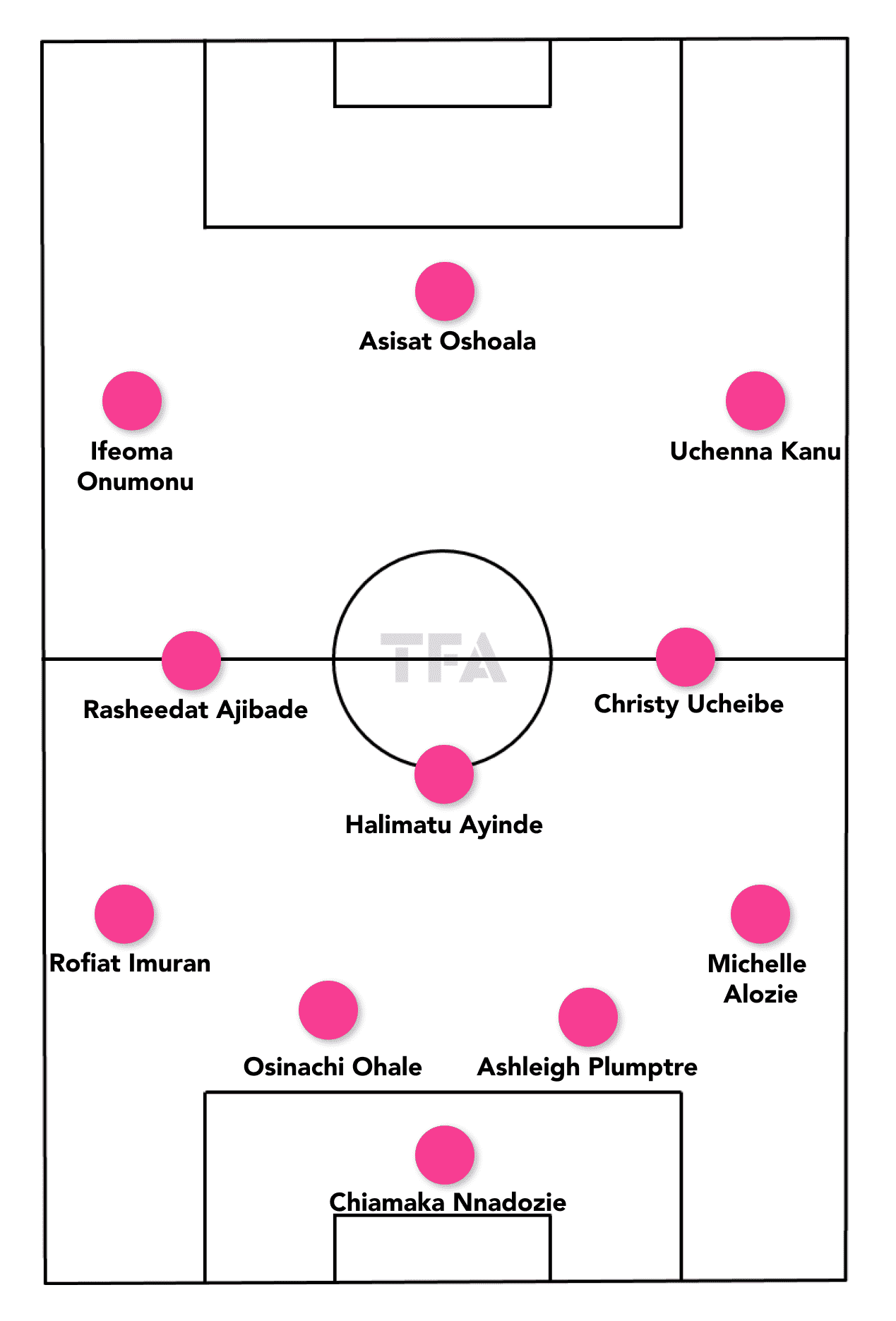
Predicted Starting XI
Nigeria will most likely be using the 4-3-3 formations since it suits the players’ characteristics more, knowing that Waldrum has been using this specific formation in a regular way during the last few seasons. A change to the 4-2-3-1 could occur as well since Waldrum often switches to this formation using Toni Payne as an advanced playmaker and both Christy Ucheibe and Jennifer Echegini or Halimatu Ayinde as central midfielders.
If they decide to rely mainly on the 4-3-3 formation, the Super Falcons will opt for Paris FC’s Chiamaka Nnadozie as a goalkeeper, with Yewande Balogun and Tochukwu Oluehi as backup options. The defence will most probably feature Houston Dash’s Michelle Alozie as a right-back, Leicester City’s Ashleigh Plumptre and Deportivo Alavés’ Osinachi Ohale as centre-backs and Reims’ Rofiat Imuran as a left-back. This defence is capable of guaranteeing some very useful compactness at the back, knowing that all four defenders have European/International experience and have got what is needed to resist attacks from teams like Canada and Australia.
The midfield will be formed by Rosengård’s Halimatu Ayinde as a defensive midfielder linking between defence and midfield and having the more defensive duties in the middle of the park while both Benfica’s Christy Ucheibe and Atlético Madrid’s Rasheedat Ajibade will be the central midfielders having some more playmaking roles. This organisation combines defensive and attacking midfielders since both Ayinde and Ucheibe are used to applying defensive instructions rather than attacking ones.
However, the addition of a creative midfielder like Ajibade would help the team in being more dangerous in transitions and in having an additional attacking player when the team is in possession. If given considerable liberty in attack by Waldrum, Ajibade’s impact on the team’s attacking performance will be very useful as it can surprise opponents too. Moreover, Toni Payne represents the “joker” player of the team since she has already been used in different positions and can play in midfield, on the wings or as a full-back as well.
For the attacking plan, Waldrum would surely rely on Barcelona’s star, Asisat Oshoala, as a striker, accompanied by both Gotham FC’s Ifeoma Onumonu on the left wing and Racing Louisville’s Uchenna Kanu on the right wing. This would be Nigeria’s most powerful attacking line-up since these players are actually in their best form, knowing that players like Esther Okoronkwo, Desire Oparanozie and Gift Monday can be subbed on at any moment and are capable of making the difference when given some playing time.
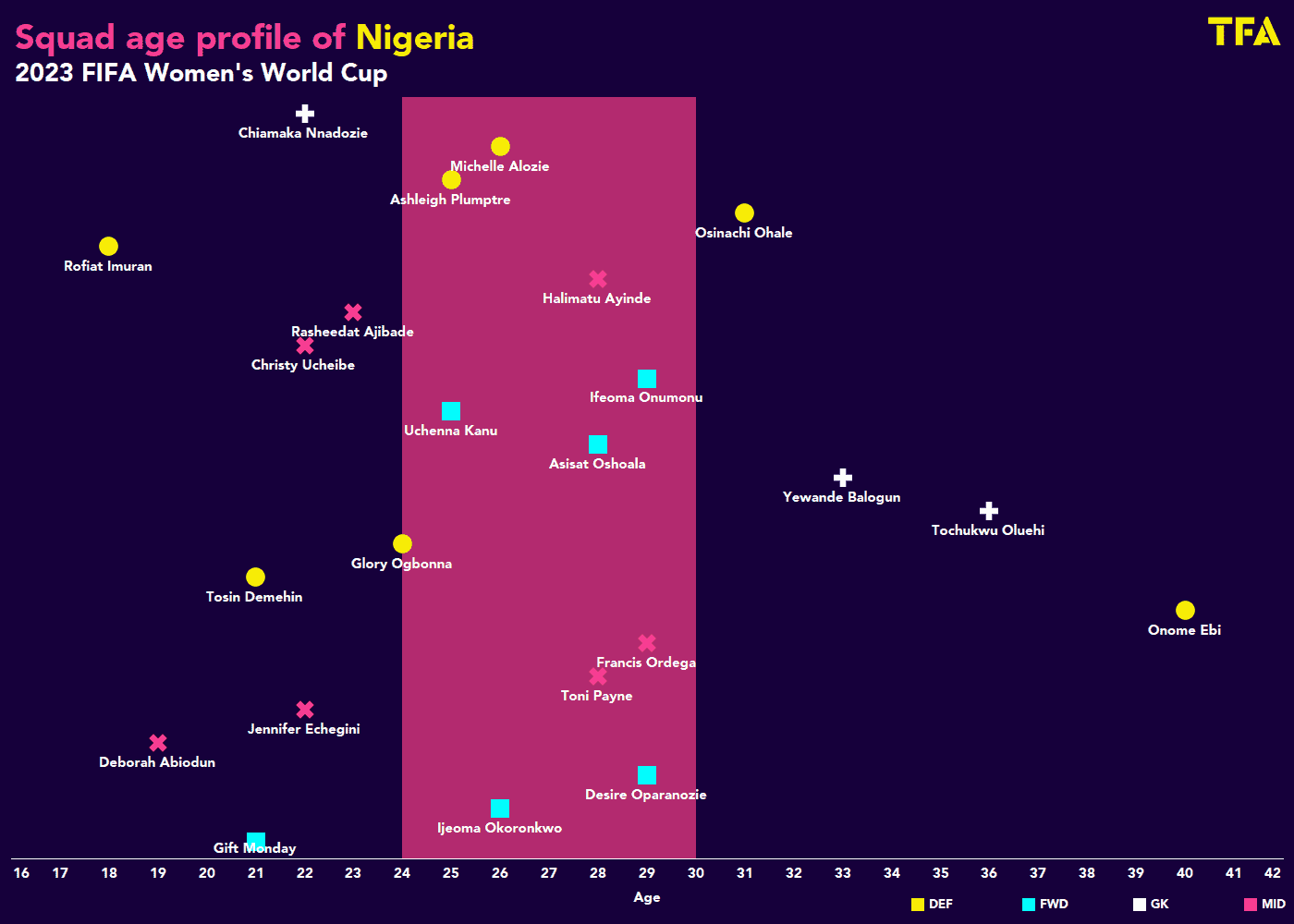
Nigeria’s squad is among the best squads in terms of age averages in this Women’s World Cup. This statement is made mainly because the team includes very few players past their peak or in their 30s. This would guarantee more dynamism and fewer injuries for the team. As the graphic shows, nine players are actually under 24 and 10 players are at their peak (between 24 and 30).
Attacking Phase
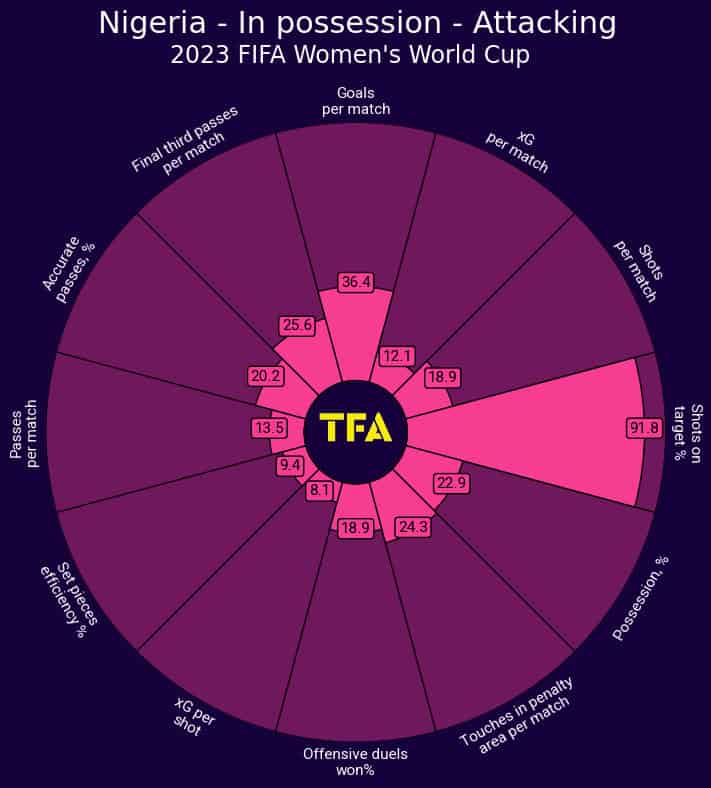
It is fair to say that Nigeria have got one of the most dangerous attacking trios of this Women’s World Cup. Yet, they will need to exploit this in their favour by being decisive in front of goal and by working as a team to create the most possible number of opportunities for this trio. The graphic above shows that Nigeria are extremely dangerous in terms of shots on target. However, they will need to improve their offensive duels won, set-piece efficiency, final third passes and passing accuracy in that area if they want to be crucial in attack and be able to score against organised defences like Canada’s and the Republic of Ireland, mainly.
Nigeria are capable of causing issues for any defence including that of the USWNT as they did during the latest friendly match between the two. However, what is needed is consistency and the ability to alternate the attacking ideas more often in order to confuse defences.
The following example shows Kanu’s goal action which was initiated by Ogbonna’s assist — long pass over the back of Kanu’s marker. The latter’s excellent pace helped her in getting past her direct marker before shooting the ball with great technique and ease.
This highlights the fact that Kanu and Onumonu can switch sides whenever needed without losing their efficiency since both players are used to playing in both positions. Also, Onumonu played as a striker a lot and can switch roles with Oshoala as well. Such in-game changes can be very fruitful, especially in attack, as they help Nigeria find alternative solutions and may push opposing defences to lose their references and organisation.
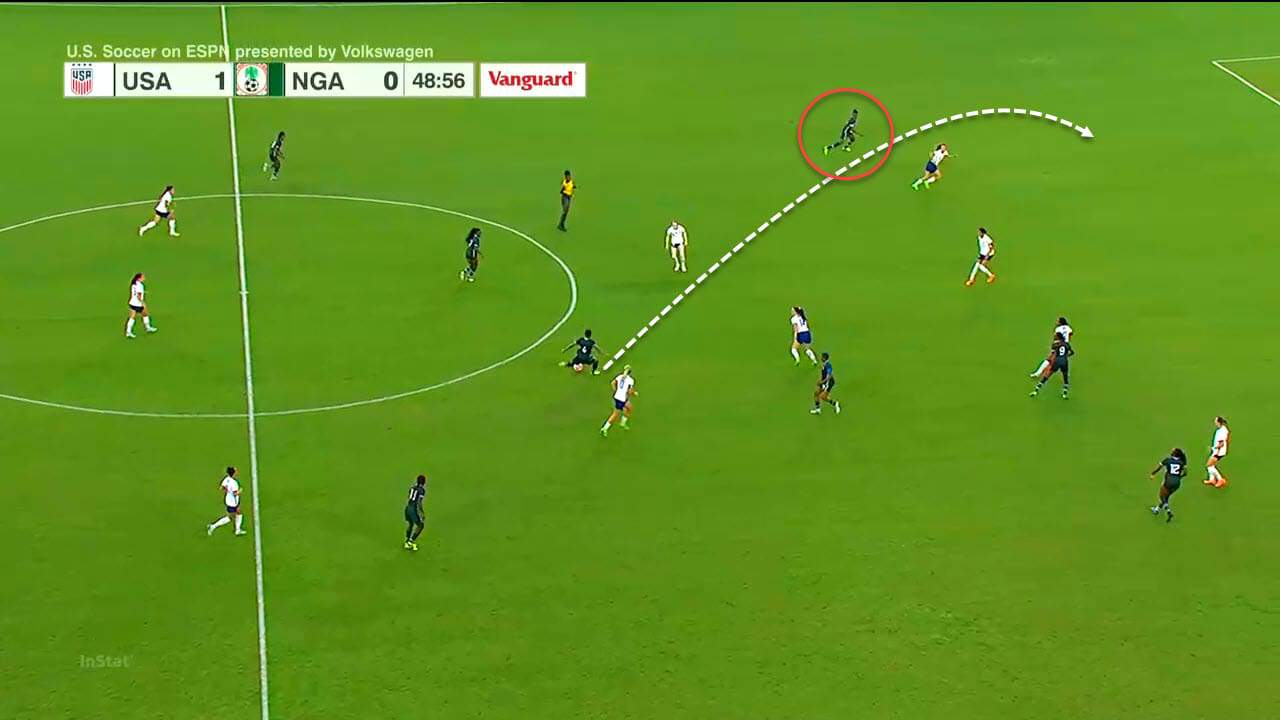
Another key element in Nigeria’s attacking plans is the support of midfielders and mainly the attacking impact of a player like Ajibade. If used as a midfielder during the tournament, she will have the possibility to be even more impactful since her movements will be less predictable when advancing. She always tries to ask for the ball in key areas and she is always dangerous when having the ball. Penetrations like the one shown below while asking for the ball and running behind a defender can always be fruitful for the team especially when her teammates see her and serve her at adequate timing just like in this action.
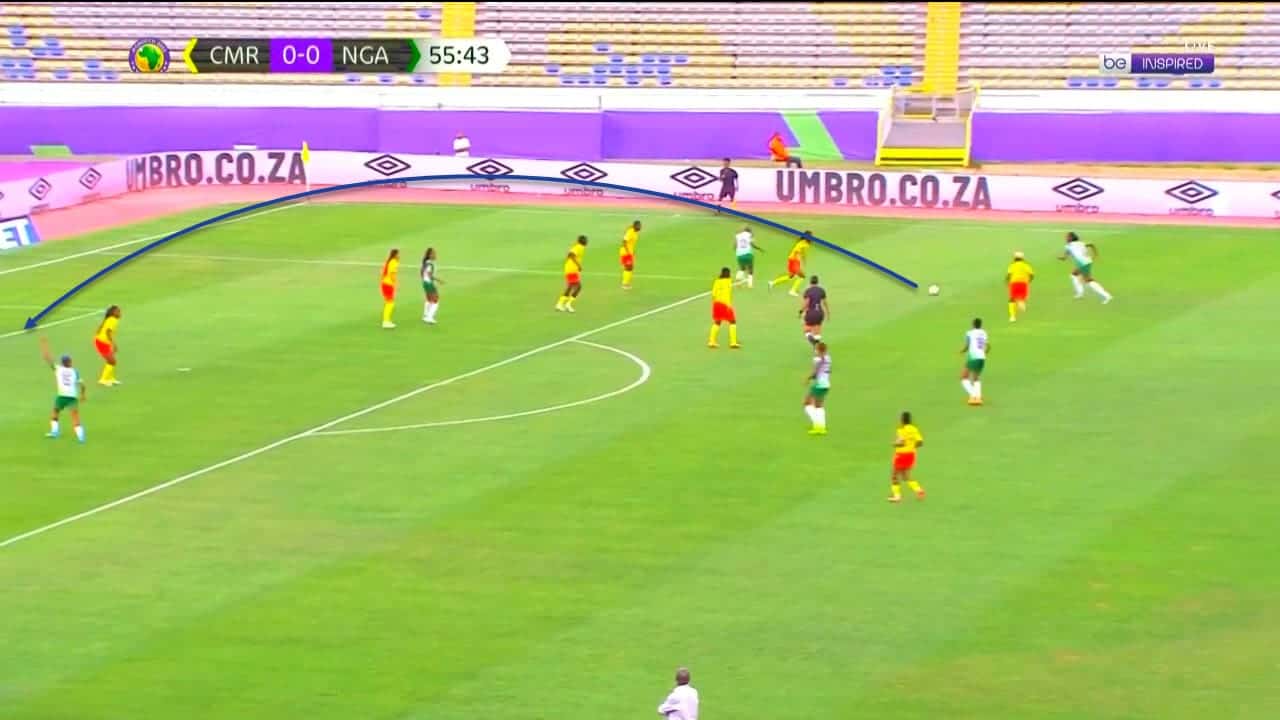
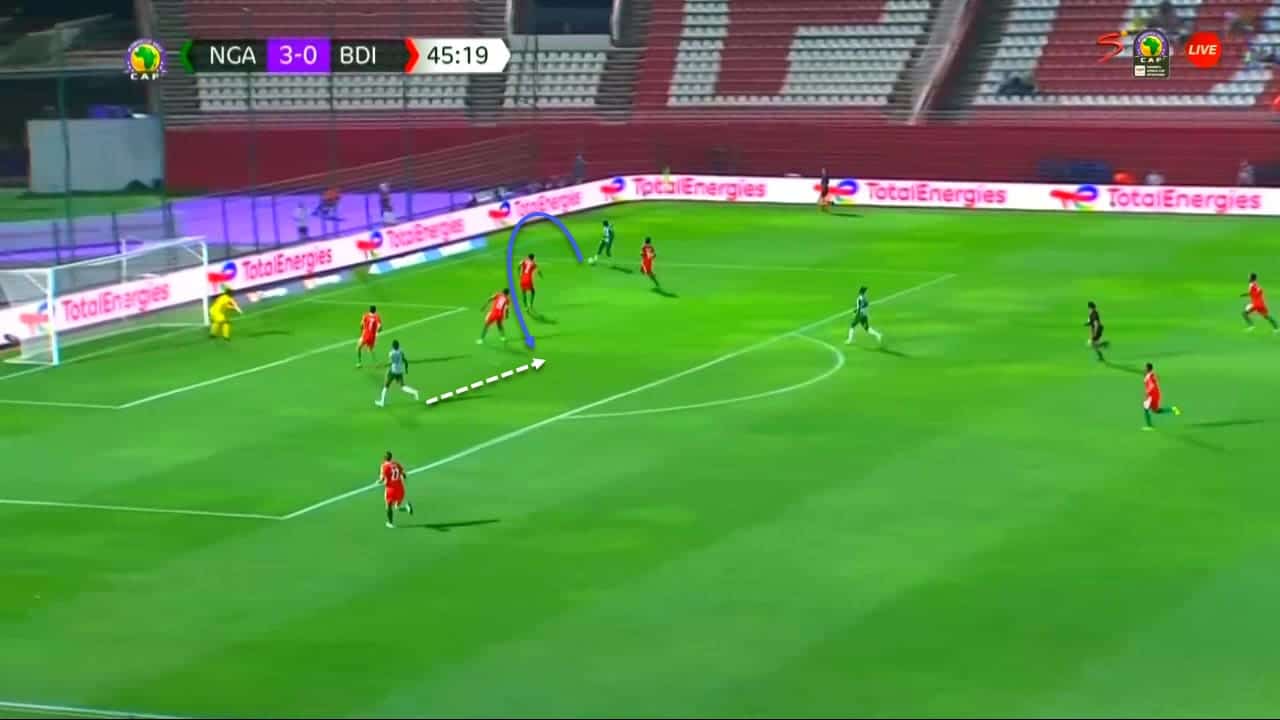
It should be said that Nigeria have been relying a lot on crosses from the wings during the latest African Cup of Nations. And with players with excellent ability in the air like Oshoala, Kanu and Onumonu, relying on these crosses during the World Cup can always be a source of danger and goals. Nevertheless, alternation is necessary and the reliance on penetrations from the wings or through passes towards Oshoala at the back of defence would generate excellent results. Plus, changing the type of crossing itself can be efficient as early crosses surprise defences, for instance, and don’t give them enough time to react. The following example highlights this variation of crosses and shows a cross that invited Kanu to lean towards her right in order to get the ball and finish with an excellent half-volley.
Defensive Phase
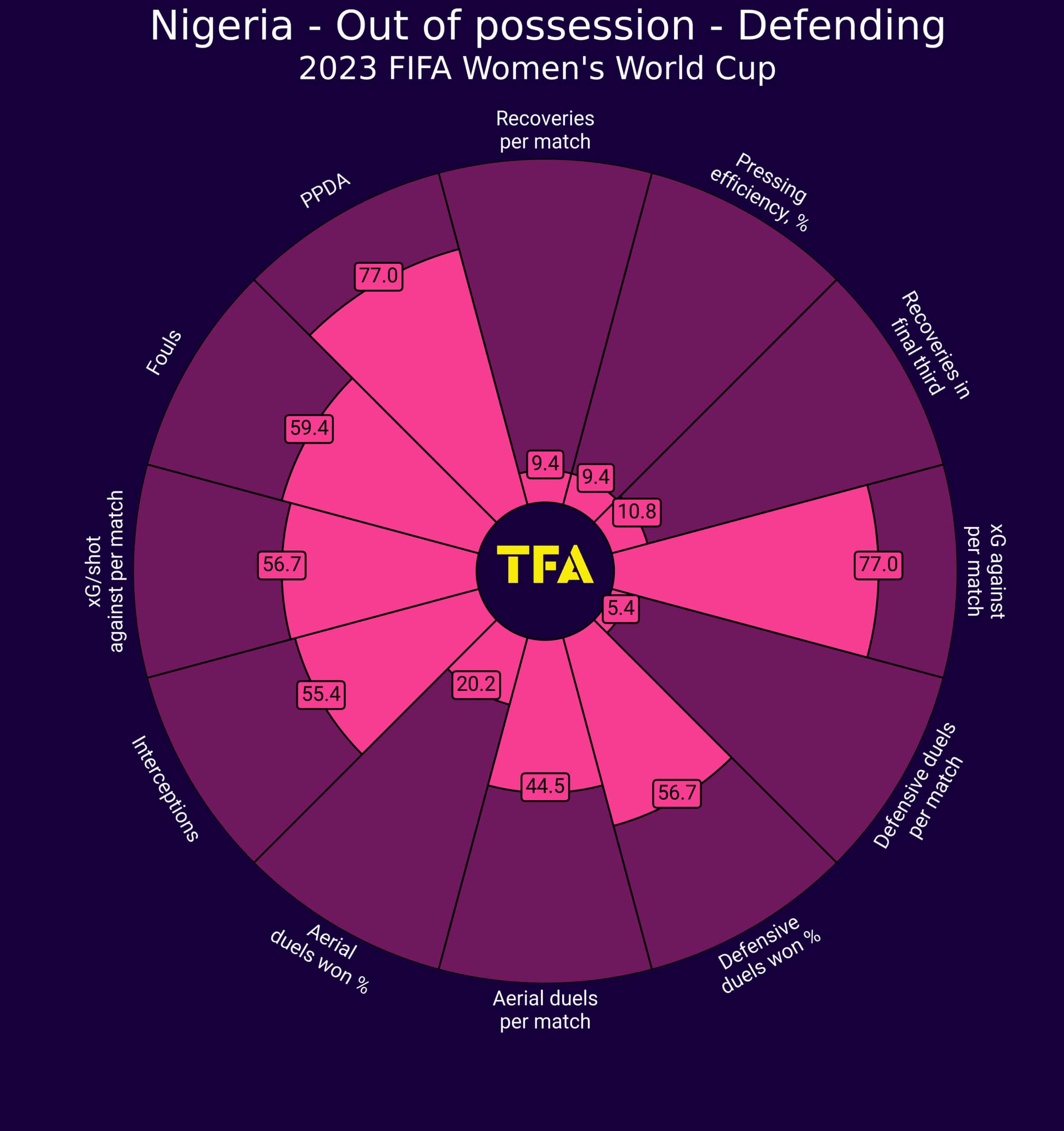
From a defensive perspective, we can argue that Nigeria have quite a high PPDA, indicating a less intense press, and are able to win a fair amount of defensive duels per match as they have an average rate of interceptions per game too. Some of the statistics are a bit worrying for Nigeria since they are poor in aerial duels, they commit a lot of fouls and they have a high xG against per 90. Nigeria need to address their defensive issues prior to the start of the tournament because this is the aspect where the team struggle the most, especially against teams with excellent attacking players such as Canada or Australia.
Stopping players like Chelsea‘s Sam Kerr, former PSG and current OL Reign’s Jordyn Huitema or Christine Sinclair will not be an easy task for Nigeria’s defence since they often lack concentration and fail to mark players properly in key moments despite having the physical abilities to disturb such players. The following example shows an individual mistake made by Oluwatosin Demehin following a cross from the right wing. Instead of clearing the ball away, Demehin failed to shoot the ball towards the correct destination and scored an own goal instead. Such individual errors can be fatal for Nigeria during the World Cup and the players will need to be attentive enough to not fall into the trap of committing such unnecessary mistakes.
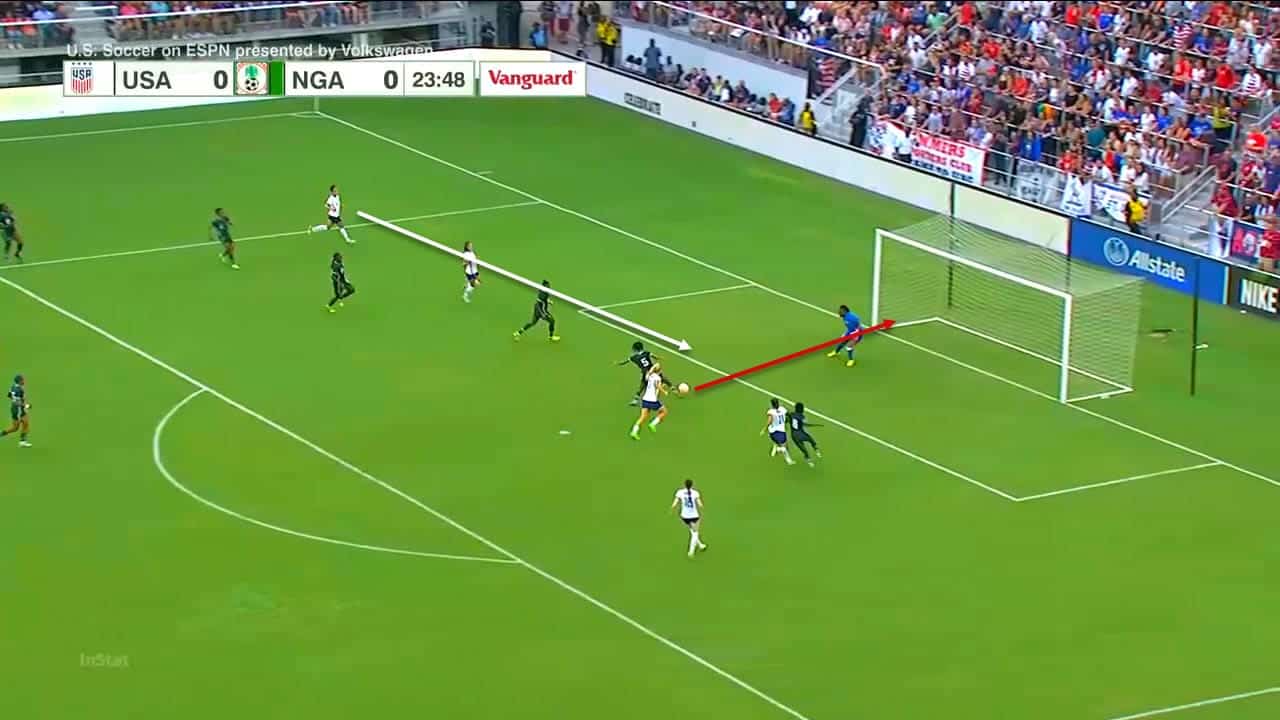
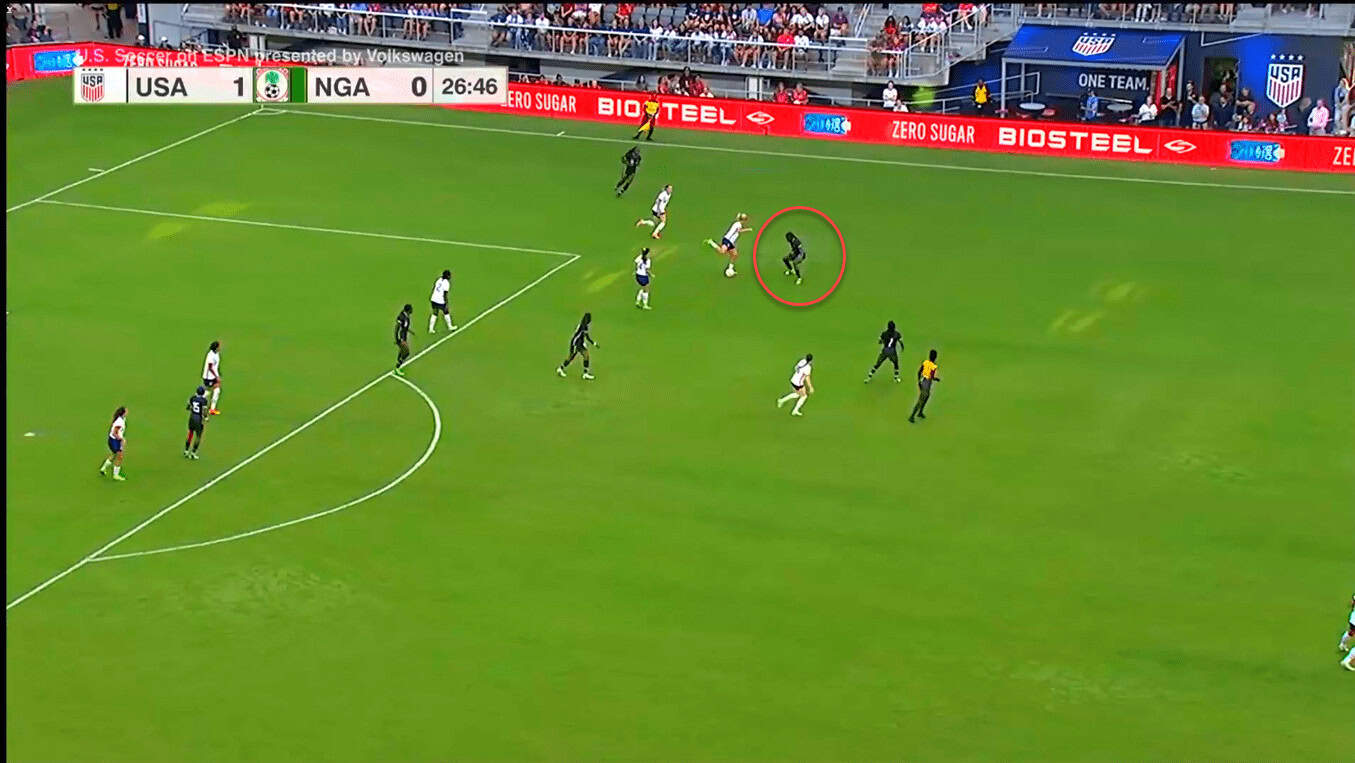
Moreover, the defensive phase doesn’t only concern defenders but midfielders and forwards too. Therefore, midfielders need to cover for the defence and close passing lines more often to avoid uncovering the defensive line. Therefore, midfielders’ mistakes are as crucial as defenders’ and might lead to conceding goals. This example of a USWNT goal against Nigeria shows exactly how fatal a midfield error can be. Just a bad and complicated controlling attempt from a Nigerian player was transformed into an assist for the USWNT. Attention needs to be maintained throughout the match to not give away such wrong passes to opponents during the group stage. Working on concentration and committing the lowest possible number of individual errors will be key for Waldrum’s side.
Transitions
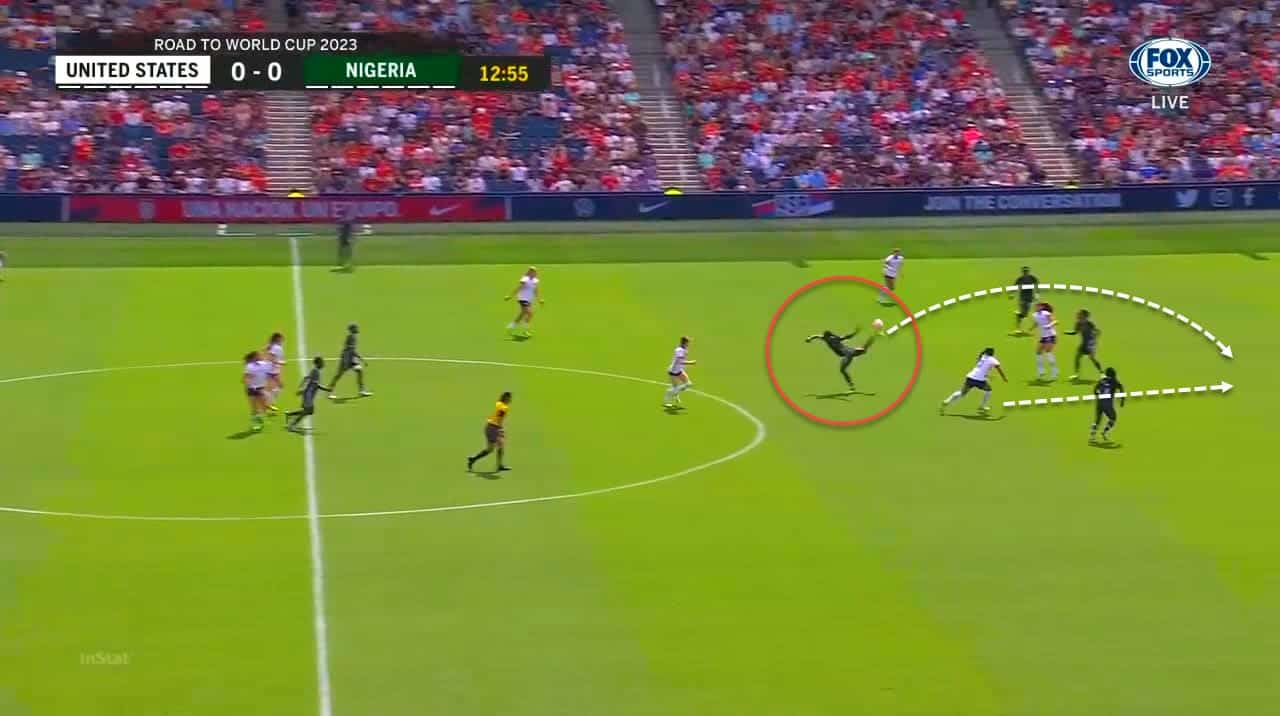
In terms of transitions, Nigeria proved on several occasions that they are fast enough in going from defence to attack and they have the pacy players needed to excel in this regard. Combining key passing and quick attacking penetrations will certainly be a successful combination for the team if executed successfully.
In fact, Nigeria always tend to initiate their attack through the full-backs before looking for movement from the striker to provide her with a through pass, for instance. This method usually proves successful for the team since both full-backs are good passers and don’t lose the ball easily while wingers and the striker always initiate their runs while asking for the ball when the full-backs receive the ball.
On certain occasions, however, it would be more adequate to go through the middle instead of the flanks in order to alternate their transitions and avoid being an open book to opponents.
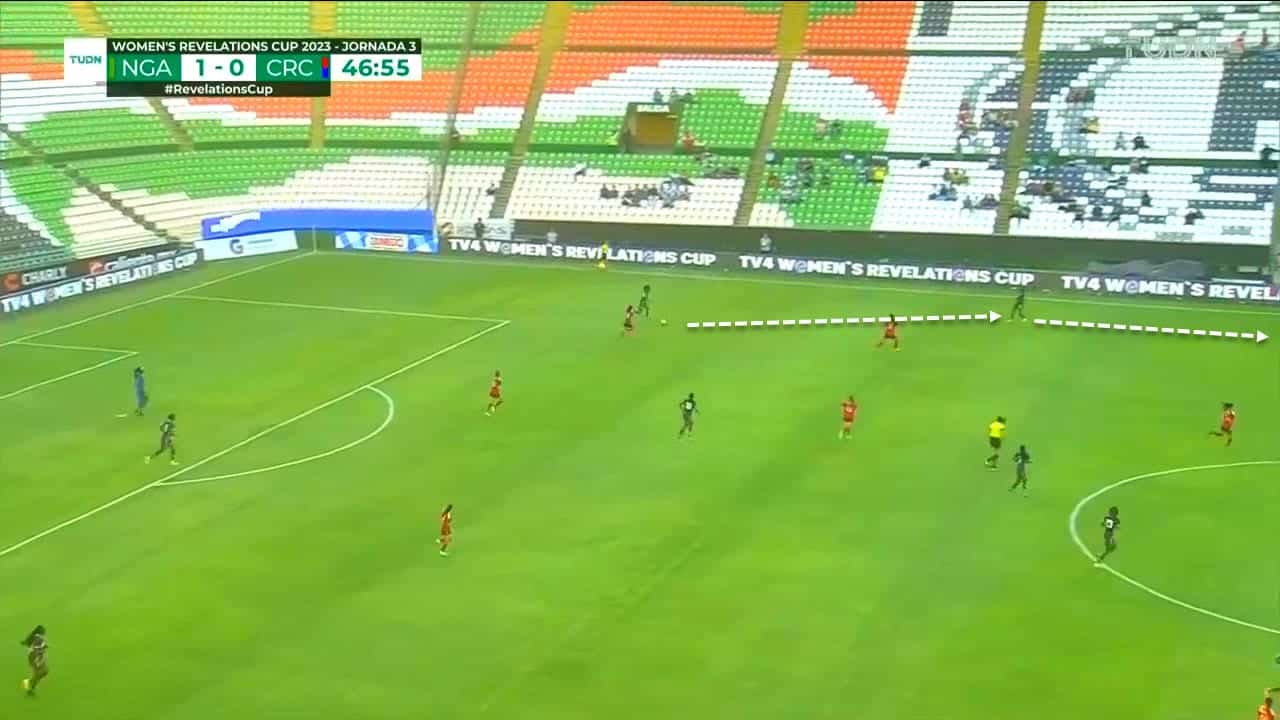
In terms of defensive transitions, and especially when losing the ball in their opponent’s final third, Nigeria often close down opponents who intercept the ball in a direct way and try to prevent them from launching a quick counterattack, just like in the example below. However, when opponents succeed in passing the ball and avoiding this disturbance, the team risks having less players in defence and conceding dangerous counterattacks. And that’s why Nigeria will have to be very attentive to such defensive transitions and be careful not to be in numerical inferiority.
Defenders
In terms of defenders, Nigeria doesn’t really have a plethora of powerful options like in attack for instance. Yet, they still have some good elements who will have to do their best to avoid conceding goals during the tournament. Plumptre and Ohale will need to be very attentive and will have to keep on improving their chemistry in order to not leave gaps between each other while working as a team with both Alozie and Imuran by covering for each other and communicating whenever needed.
The alternative options include the veteran Onome Ebi despite the fact that she is past her peak, Demehin and Ogbonna who are a little bit inferior to Ohale and Plumptre in terms of performances and abilities in one vs one situations and in defensive duels in general.
Midfielders
In midfield, Waldrum have got the choice of playing totally defensive midfielders or mixing between defensive midfielders and ones with attacking abilities. At his disposal, Ayinde and Ucheibe are among the best midfielders in Nigeria at the moment and are able to play as two central midfielders if using the 4-2-3-1 formation.
Otherwise, he can rely on these both players with Toni Payne or Rasheedat Ajibade if he would like to add an attacking player to midfield. This option would most probably work against the Republic of Ireland but probably not against Canada and Australia where it would be better to not take risks and leave gaps at the back.
Attackers
For the attacking players, Nigeria will be mainly relying on the services of their star Oshoala plus the support of both Kanu and Onumonu on the wings. This plan can be changed according to situations and Nigeria can resort to playing with both Oshoala and Onumonu as strikers while Kanu and Payne or Ajibade become the two wingers, and Ayinde/Ucheibe remain as midfielders in a 4-2-2-2 formation.
Waldrum has got some back-up forwards too who can sub the front-three whenever needed yet with not exactly the same finishing abilities. We are talking about Oparanozie, Okoronkwo and Monday.
Key Player
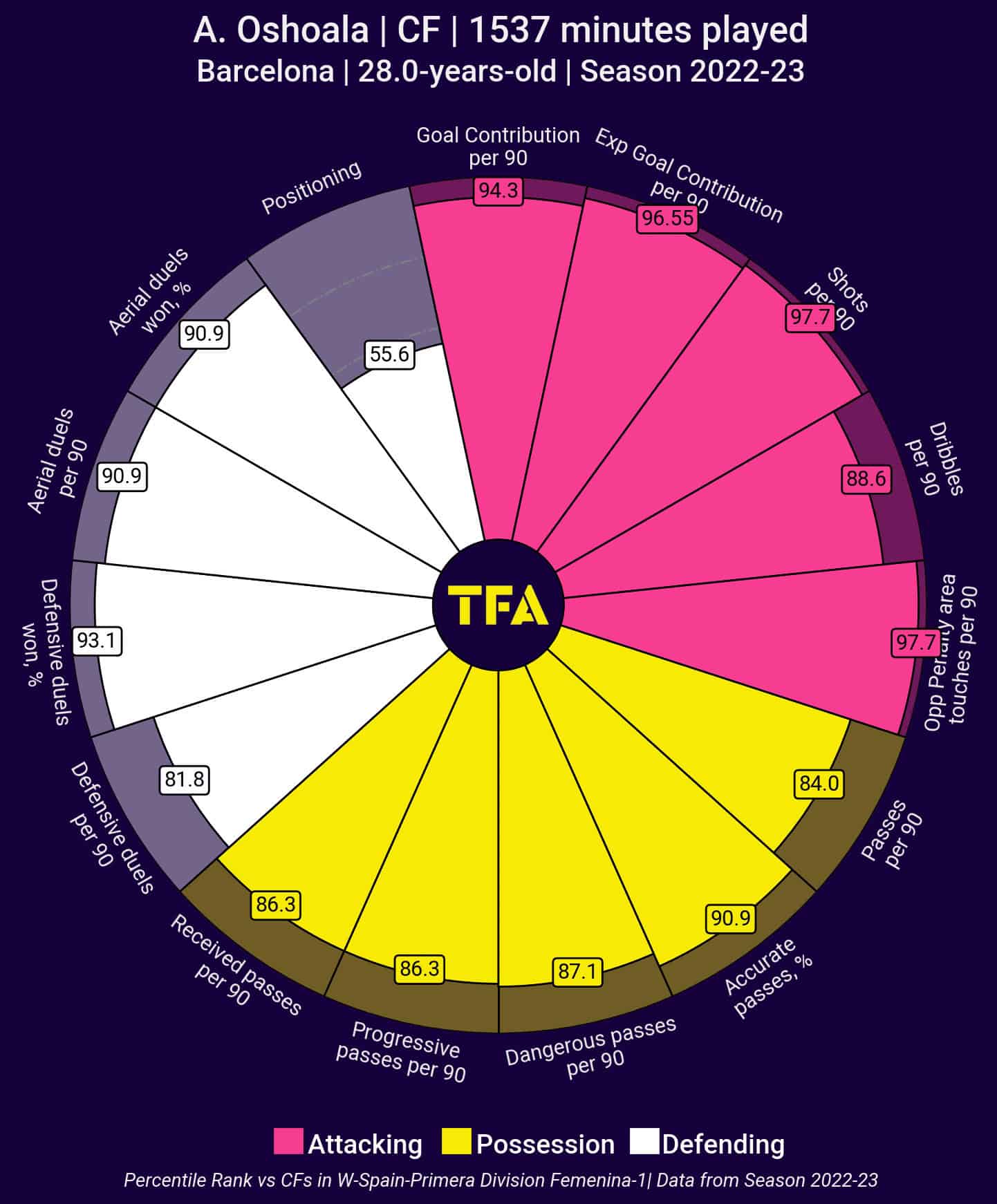
As the graphic below highlights, Oshoala is actually one of the best strikers in the world and not only in Europe, in terms of finishing skills, pace and tactical awareness. She won almost everything at Barcelona including the UEFA Women’s Champions League and will be helping Nigeria in reaching the knockout phase during this Women’s World Cup, knowing that the Nigerians’ hopes will be attached to Oshoala’s performances and her ability to punish opponents.
She has got some fairly excellent goal contribution rates per match and is equally outstanding in shots on target, accurate and dangerous passing, dribbling and also in aerial duels. She will have to confirm these excellent statistics during this tournament and her mission will consist of being able to convert crosses into goals, penetrate inside the box and finish actions with success, get away from marking and aim at providing key passes to her teammates and especially to wingers.
Oshoala proved her worth on numerous big occasions before and has already been a winner. She also participated with the Nigerian team in various World Cup editions and scored goals too. Therefore, this time will certainly not be different and Oshoala will most likely be capable of putting her impact on each game she plays, with the desire to score in each game in order to help Nigeria qualify to the knockout stage and why not reach an advanced phase too.
Tournament Prediction
Nigeria are going to play in a relatively tough group since they will have to face the hosts Australia plus Canada who are among the best international teams at the moment. Their encounter against the Republic of Ireland will be tricky too since they are hoping to achieve an outstanding first-ever World Cup participation and Nigeria will have to give importance to this match and not underestimate their opponent if they want to get the three points.
They have got what it takes to beat the Republic of Ireland and disturb Australia. However, it will be complicated to finish first or second in such a group. Therefore, Nigeria are more likely going to finish third in this group if no surprises happen.

