


Celta Vigo, after experiencing a series of defeats under Argentinian coach Eduardo Coudet, appointed Portuguese coach Carlos Carvalhal on November 2, 2022, to rejuvenate their season in La Liga.
Carvalhal, known for his admiration of José Mourinho, previously coached for two seasons at Sporting Braga in Portugal before taking a brief stint with Al-Wahda FC in Abu Dhabi.
His appointment at Celta Vigo has resulted in improved stability for the team.
In this tactical analysis, as a team scout report, we will examine Carvalhal’s tactics with Celta Vigo and how his previous experiences, particularly in England, influenced his coaching approach.
Carlos Carvalhal Adaptability
Carlos Carvalhal has earned a reputation as a managerial nomad, thanks to his continuous travels to different football cultures and playing systems.
The Portuguese coach appreciates diversity and has developed the ability to adapt to various circumstances, which has enabled him to succeed in his managerial journeys across different countries.
During his time at Braga, Carvalhal implemented a possession-based style with mobility in the attack through a 3-4-3 formation.
Before that, he used the 5-4-1 formation with Swansea City in the 2017/18 season.
However, since joining Celta Vigo, he has switched to a classic 4-4-2 formation (used 4-4-2 in the last 14 games in La Liga, as per Wyscout) that focuses on fast attacks and quick transitions to reach the goal.
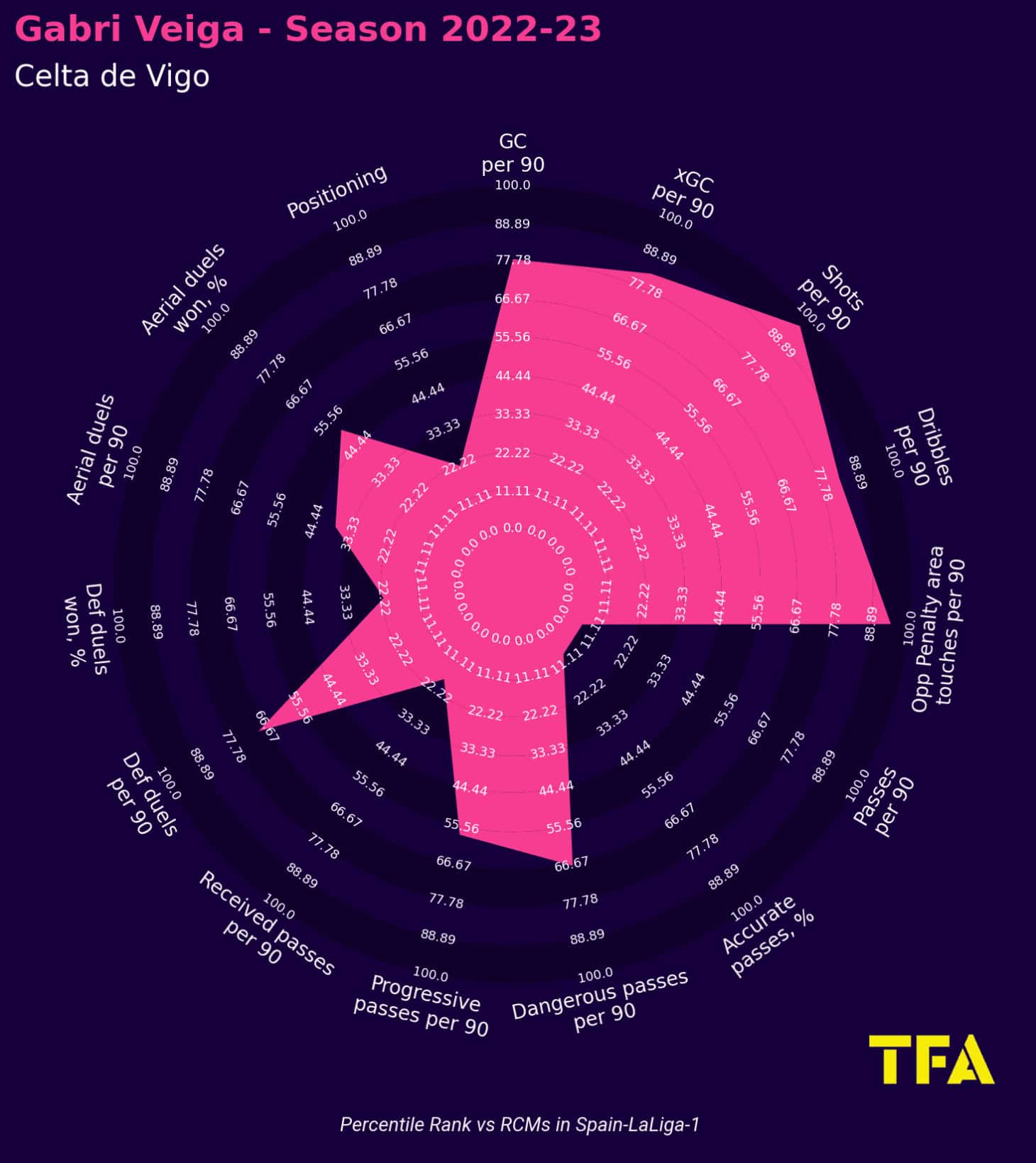
Carvalhal’s system promotes and helps young players, such as Gabri Veiga, who has emerged as a promising talent and is now being scouted by top European teams.
Classic 4-4-2 In possession
“The 4-4-2 is a formation that requires discipline and hard work from all the players on the team.
If everyone is willing to work hard and play their role, it can be a very effective system.” — Jose Mourinho.
First and foremost, in football, the 4-4-2 formation is widely recognised for its balance between defence and attack.
It is well-suited to provide width to the team’s attacking play by stretching the opposition’s defence and creating space for the forwards to operate in.
Additionally, its defensive solidity makes it an excellent choice for counter-attacking football.
Its simplicity is another advantage, as it is a straightforward and easy-to-understand formation, making it easier for players to execute their roles effectively.
During the deeper build-up, Celta Vigo, with Carvalhal, focuses on direct play, often with long balls from the goalkeeper directed at a specific zone in an area where they take advantage of their physical strikers’ aerial ability and create positional superiority to win second balls after the layoff.
Moreover, Celta Vigo also builds up through the fullbacks, who have better quality and can progress under high pressure.
However, the team generally prefers a vertical approach to reach the farthest point on the pitch with the least number of passes.
Celta Vigo typically build with a 4-2 base, with a significant focus on the initial positioning of the wide midfielders (RM and LM).
The team aims to empty the space statically and then exploit it dynamically to gain a superior position.
In a game against Villarreal, Celta Vigo was building up through their right-back Kevin Vázquez.
This was usually done directly (as shown by the white line) or through a third-man combination (as indicated by the yellow lines).
At the same time, Luca De La Torre’s initial static positioning was effective in pulling Villarreal’s left-back, Alberto Moreno, inside, which created space for the striker to drop off and receive, dragging his marker deeper and opening up gaps.
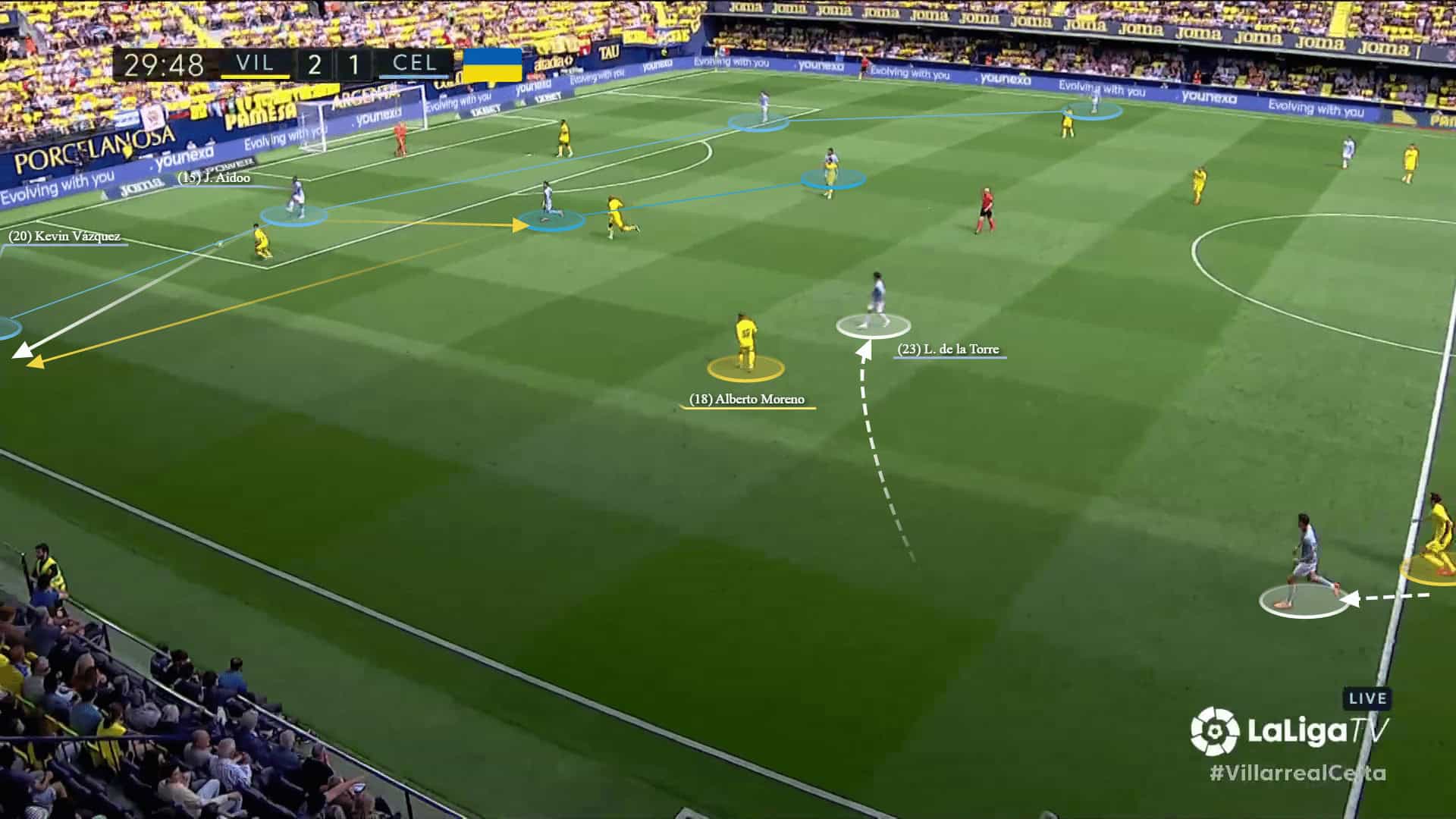
Once the ball was played to the right-back, De La Torre moved vertically toward the space that was generated in the backline while gaining the dynamic advantage over his marker.
Larsen dragged Pau Torres deeper.
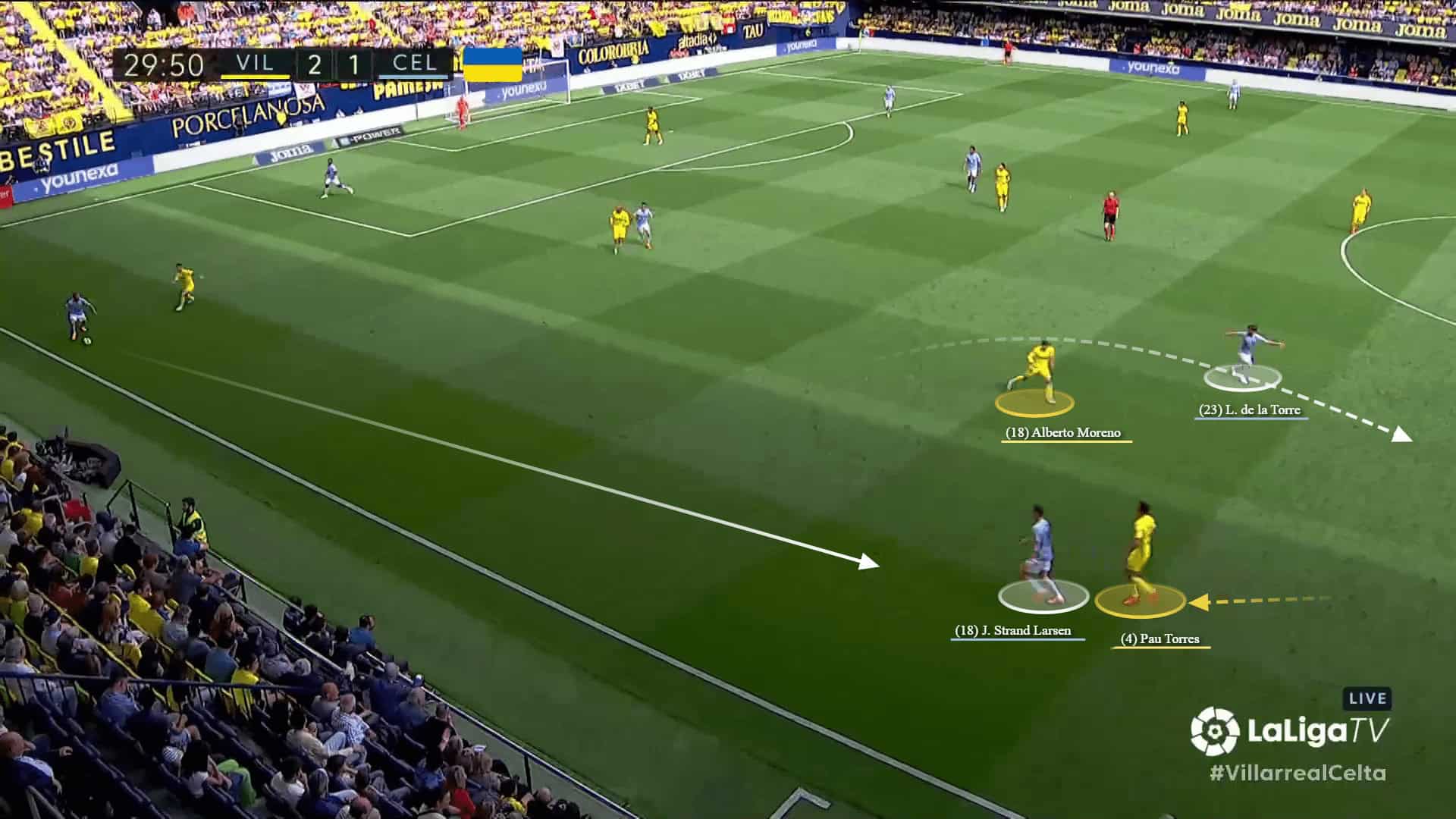
These counter-movements are often repeated to manipulate the opposition’s backline.
After circulating the ball to the other side, Celta Vigo also searched for penetration through their left-back Javi Galán, with the winger starting a vertical run from a deeper point to exploit the space generated by Haris Seferović, who drops and drags the centre-back.
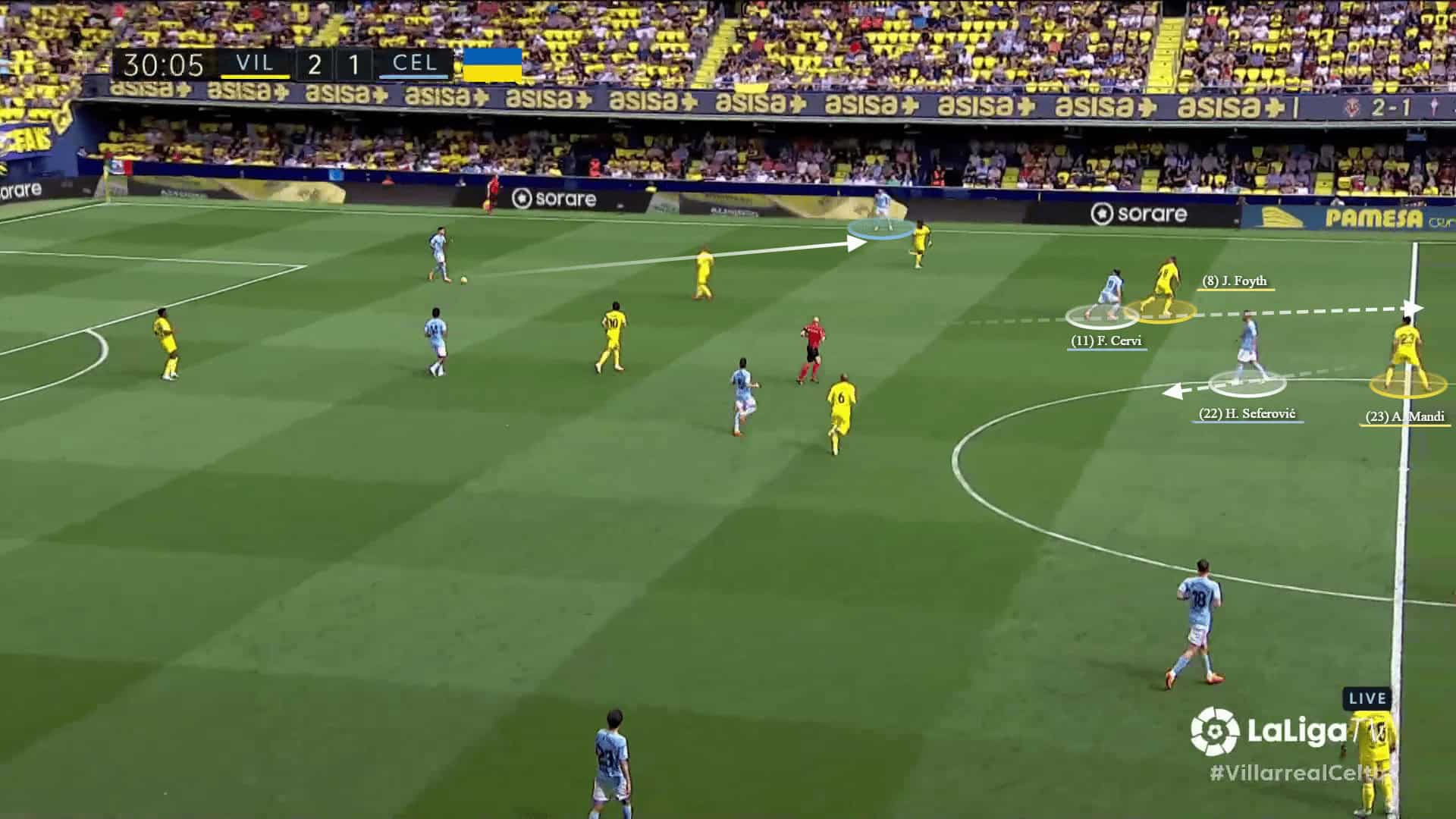
Cervi then received a through long ball into the space from the fullback, but Villarreal’s goalkeeper did well to sweep and clear the ball away.
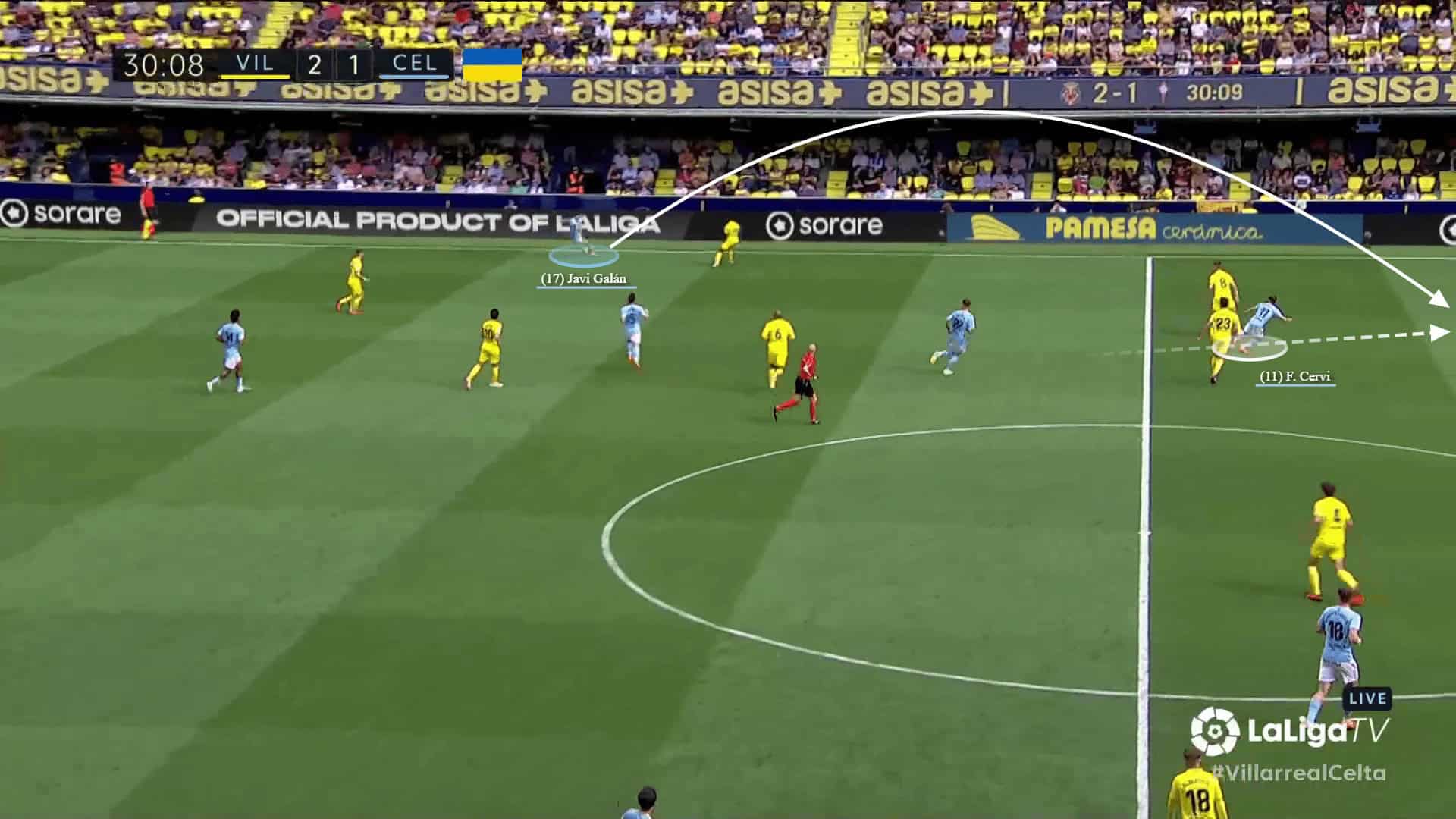
On the other hand, long balls are a crucial weapon for them to rise with some guarantees always, which is an attempt to ensure superiority to maximise winning them, such as qualitative superiority (the receiver target man over his defender aerially) and positional superiority (for potential players to receive the layoffs and win the second balls).
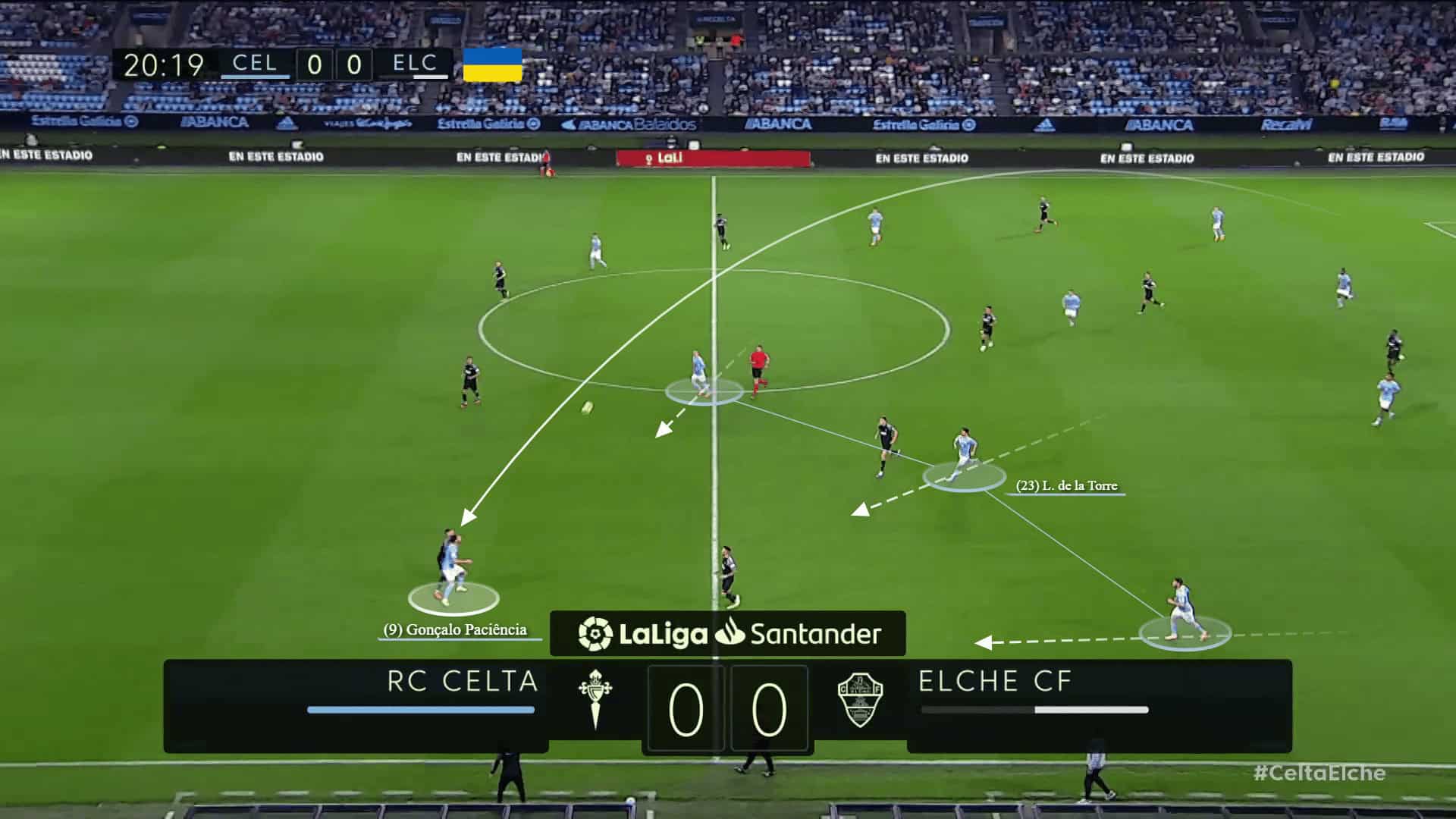
Usually, long balls are directed to the half-spaces or the flanks because they are the least crowded areas on the pitch, so here, the initial positioning of the wide midfielder is important to free up space for the attacker to receive there.
Meanwhile, others are compact by occupying the spaces in front of him, ready for any possible lay-offs or flick-ons, gaining positional superiority.
Furthermore, it is known that the player in the half-space can play 360° in a less crowded zone than the central area, which maximises the chance of making sudden, vertical and diagonal runs and minimises the chance of opposition counterattacks by using the touchline to defend in a lesser area.
In the scene below against Elche, the goalkeeper, Iván Villar, directed the ball to the left side, into the space generated, to the attacker Paciência, while three players were ready to receive the layoff in a 3-vs-2 situation.
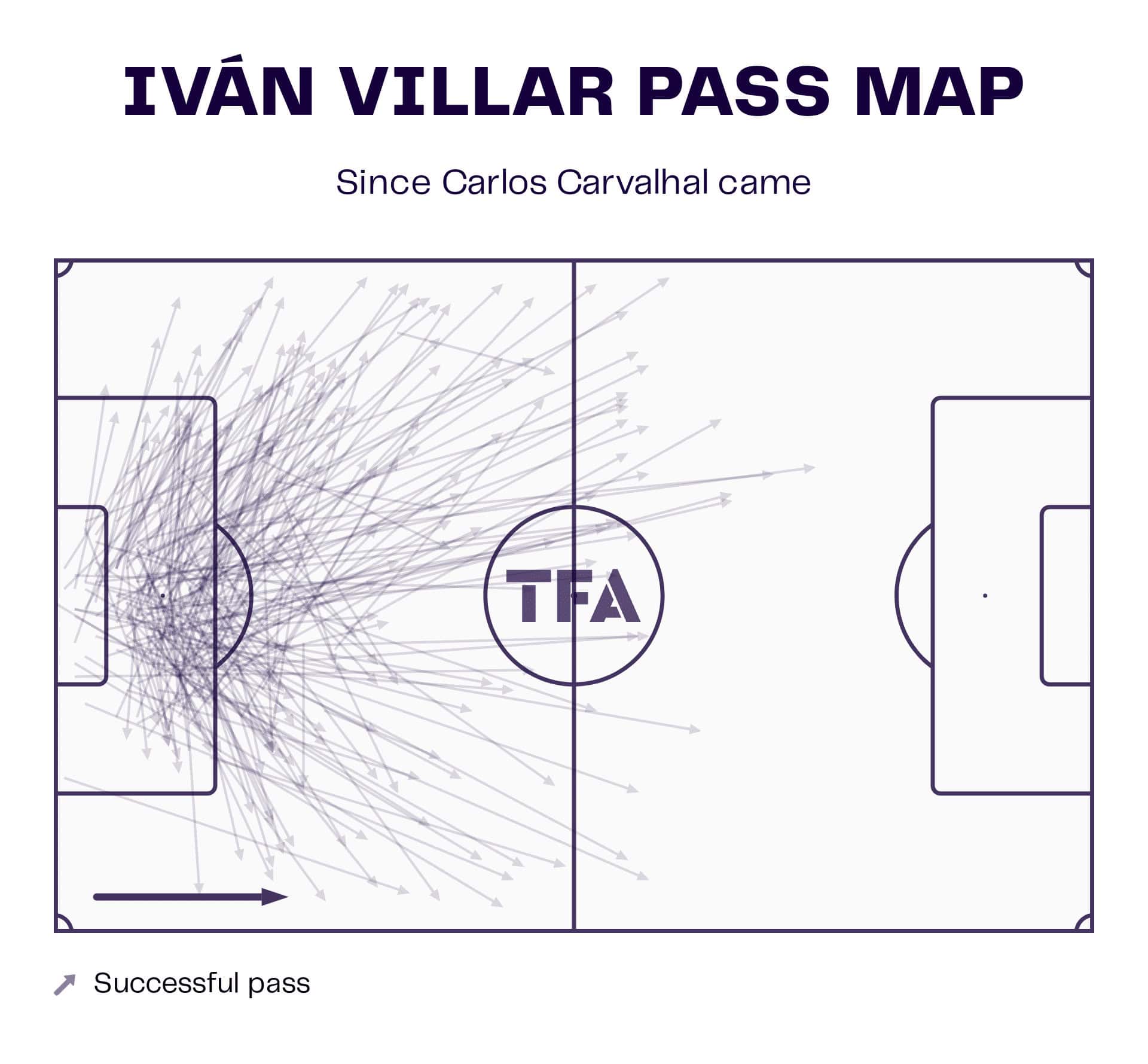
The goalkeeper Villar usually looks to play long balls there in the left half-space and flank, as shown in the graphic below.
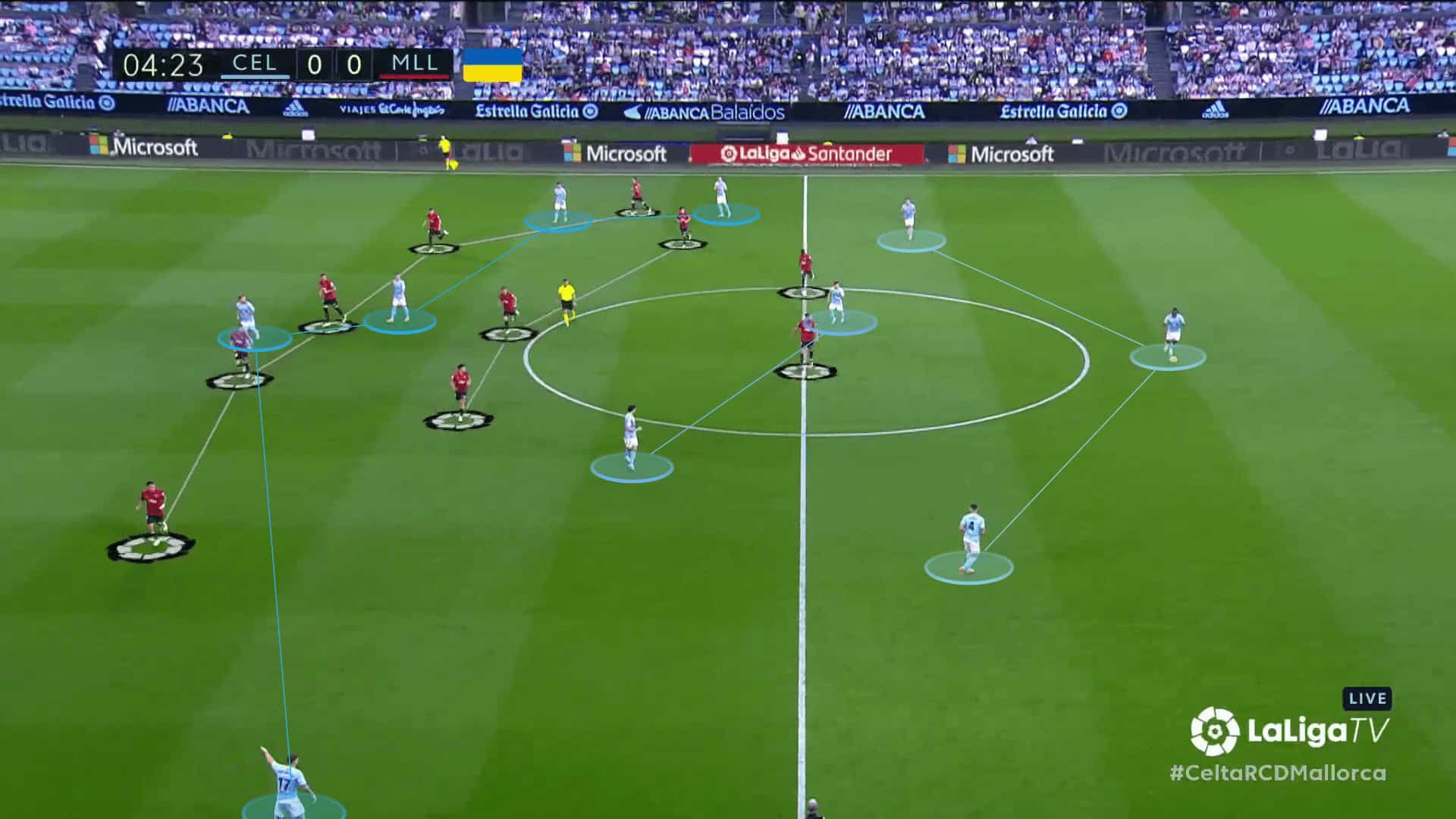
In the progression phase, Celta Vigo have mobility while stretching the field with the wide midfielders or the overlapping fullbacks, and the possession shape varies between a 2-2-6, a 3-1-6, and a 3-2-5 dynamically according to the opponent, specifically against the first line of the block.
They are trying to gain a numerical advantage, like the below 3v2, over the first line of the opposition’s block.
The 3-2-5 in-possession structure, like in the graphic below, usually gives the first line’s wide player room to progress with time and space.
Carlos Carvalhal’s ideas with Celta Vigo in the middle and final third can be outlined as being an attempt to quickly attack the space (opening spaces and exploiting them with diagonal and vertical runs) while relying on laser, through passes to reach the players into these spaces.
Celta Vigo also tries to reach higher areas on the flanks to play crosses, often cut-backs, while the attackers pin the opposition’s backline.
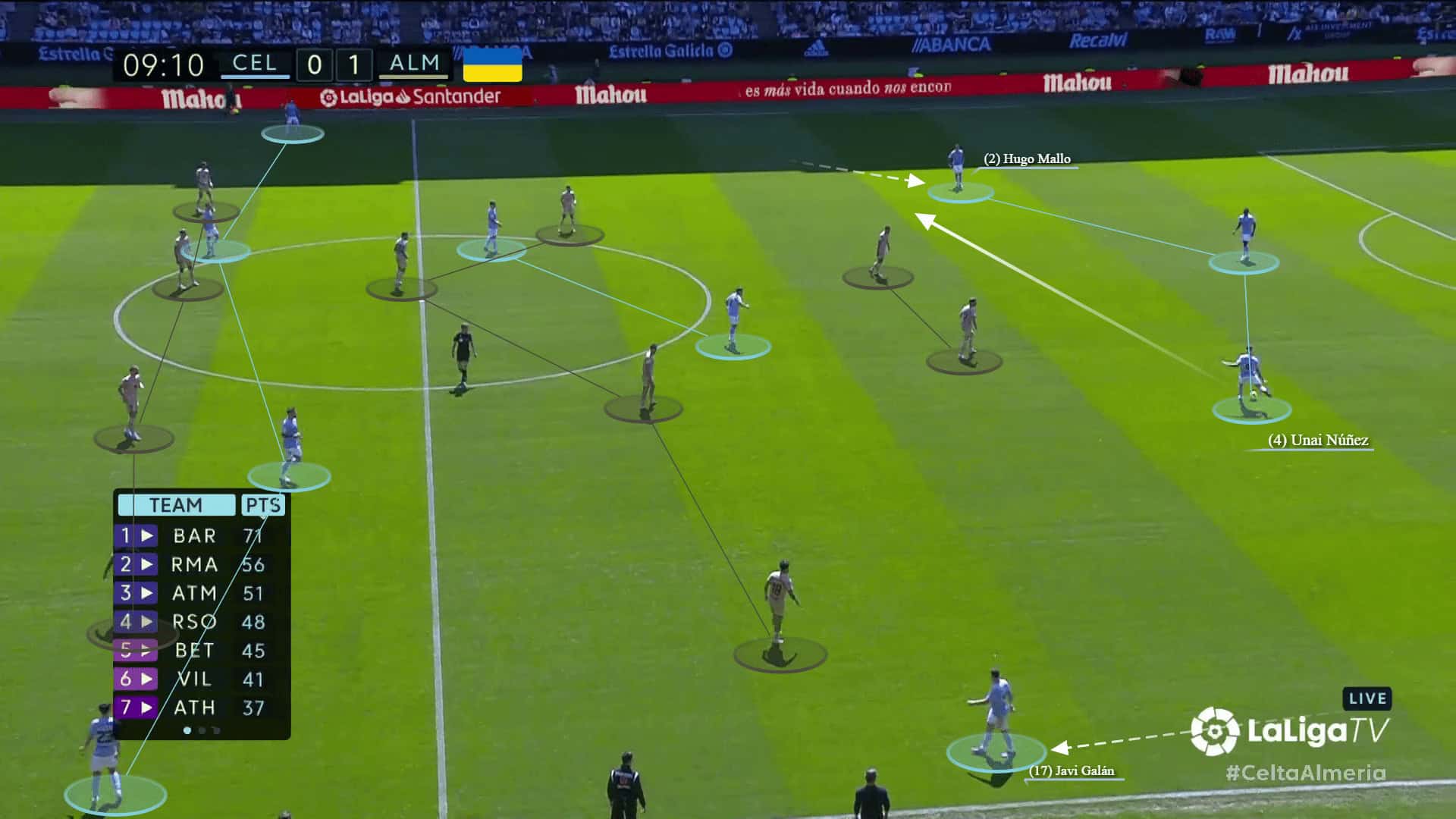
In their first goal against Almería, Celta Vigo utilised their asymmetric fullback system (with the right back inverting and the left back overlapping) to create a numerical advantage of 3v2 in the first line.
This allowed Hugo Mallo to progress forward after receiving a pass from Unai Núñez.
After Mallo progressed, he played a straight pass to the mobile striker Iago Aspas, who had dropped deep into space while Almería’s left back was busy with the right midfielder Carles Perez.
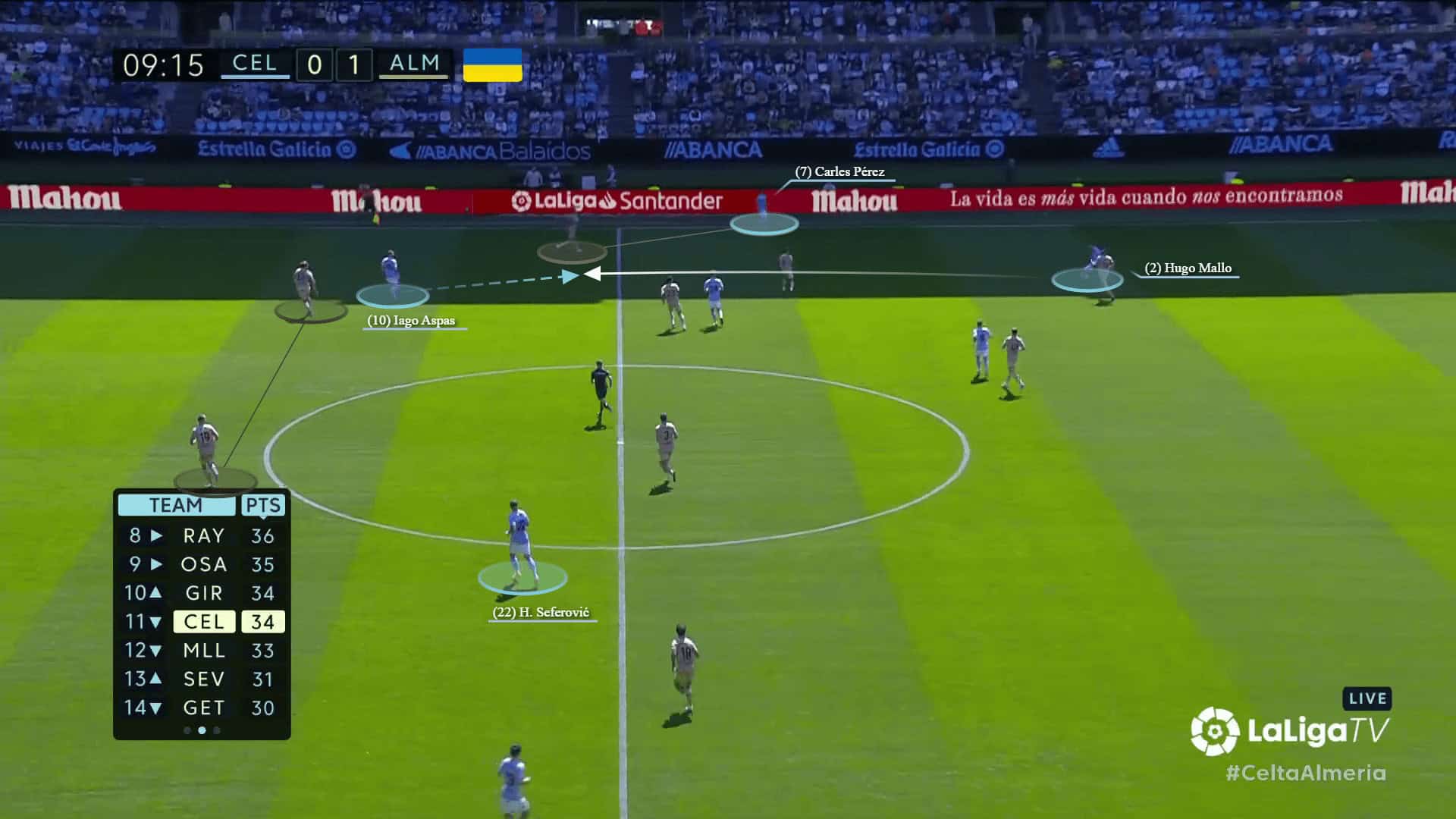
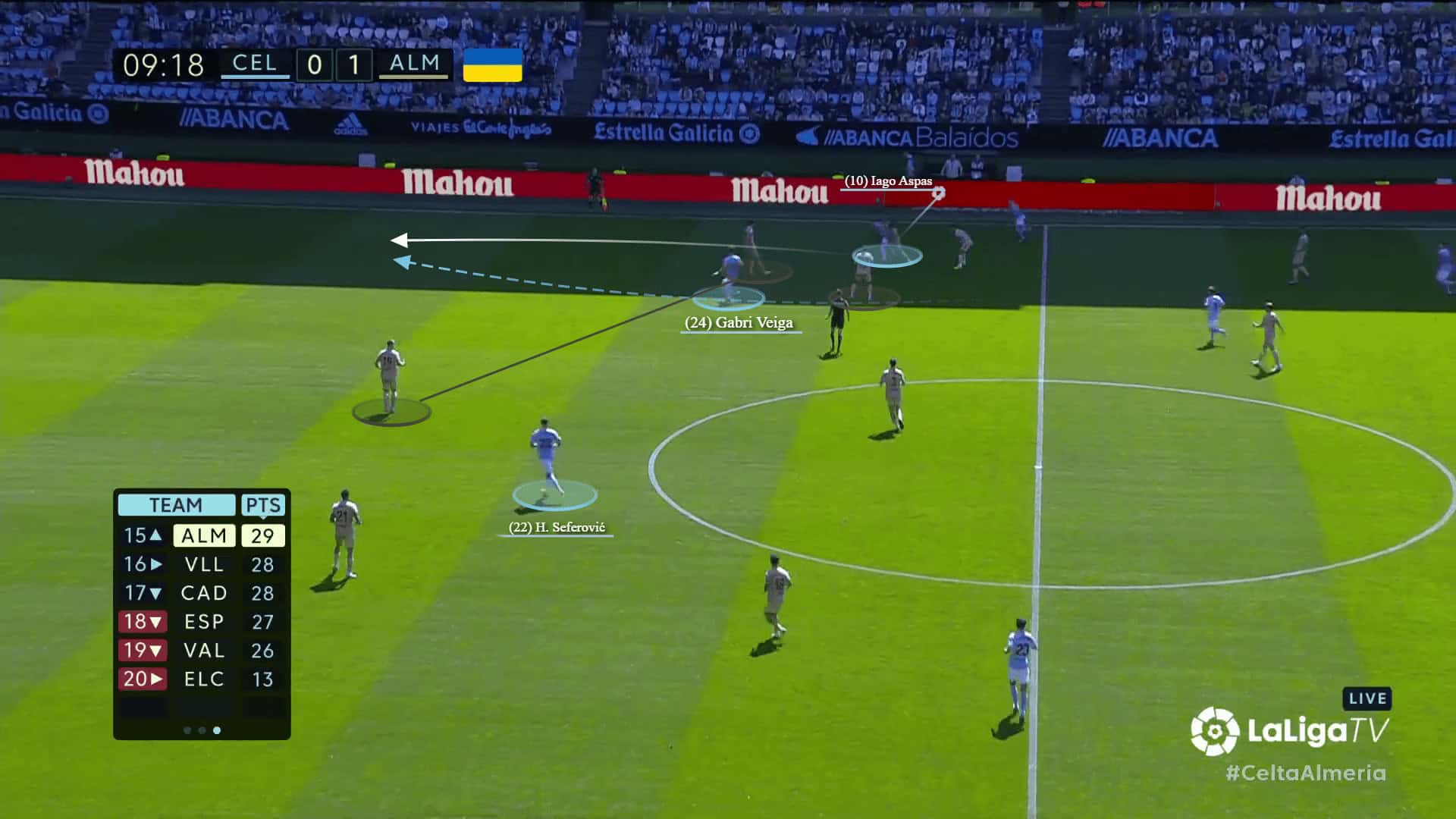
Thanks to his mobility, Aspas succeeded in turning with one fluid movement rather than laying the ball off.
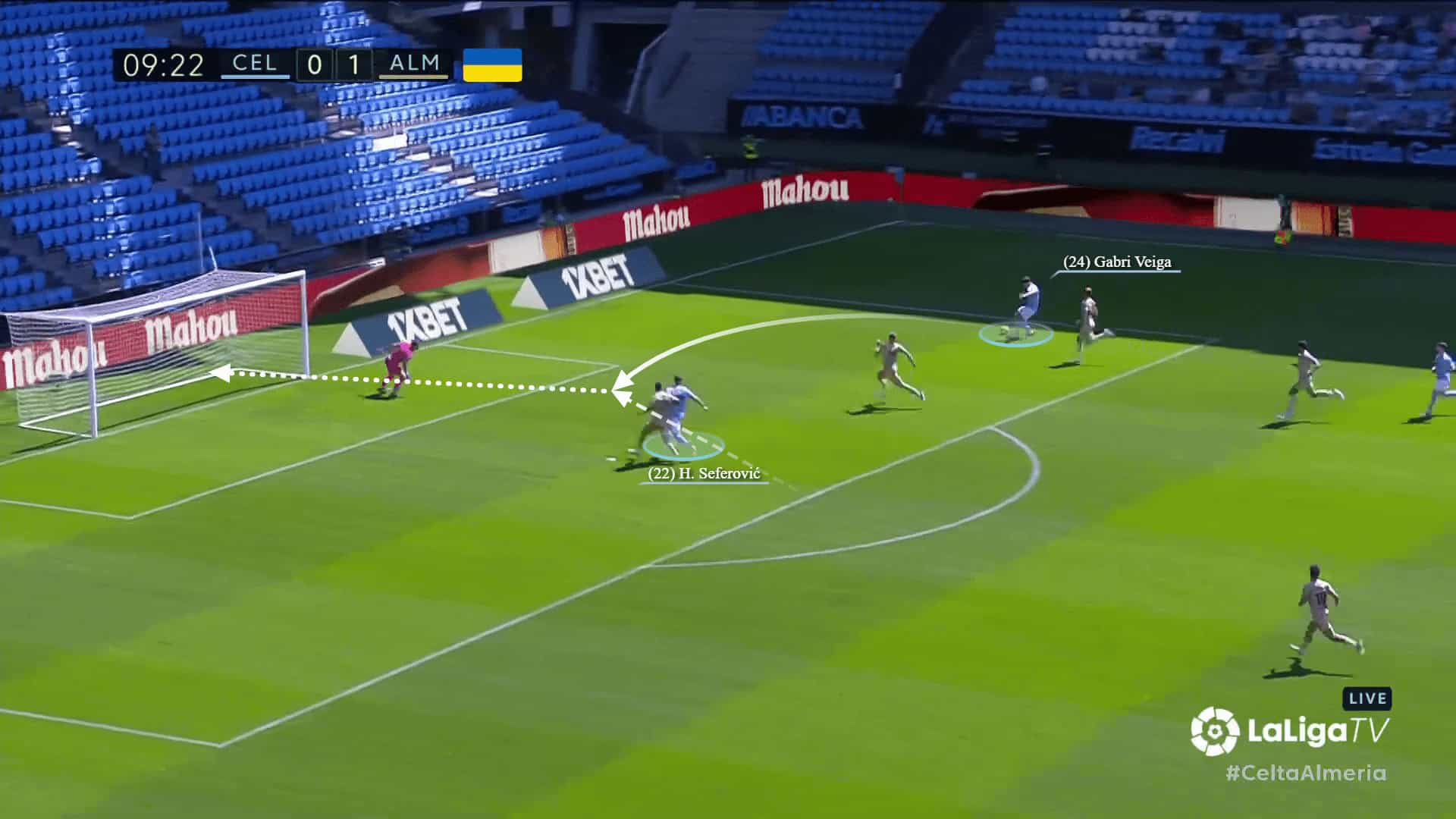
At the same time, Gabri Veiga made a vertical run into the space behind the backline, gaining dynamic superiority over his marker, while Haris Seferović drew the attention of the other centre-back.
Once Veiga reached the box, he crossed immediately to Seferović, who got in front of the opposition’s reverse fullback and scored.
Celta Vigo’s fast and direct approach was also evident in their game against Real Betis.
In this instance, Aspas received a pass without any pressure and turned quickly.
He then played a pass directly behind the defence to the forward runner, Carles Perez, while Larsen pinned the centre-backs.
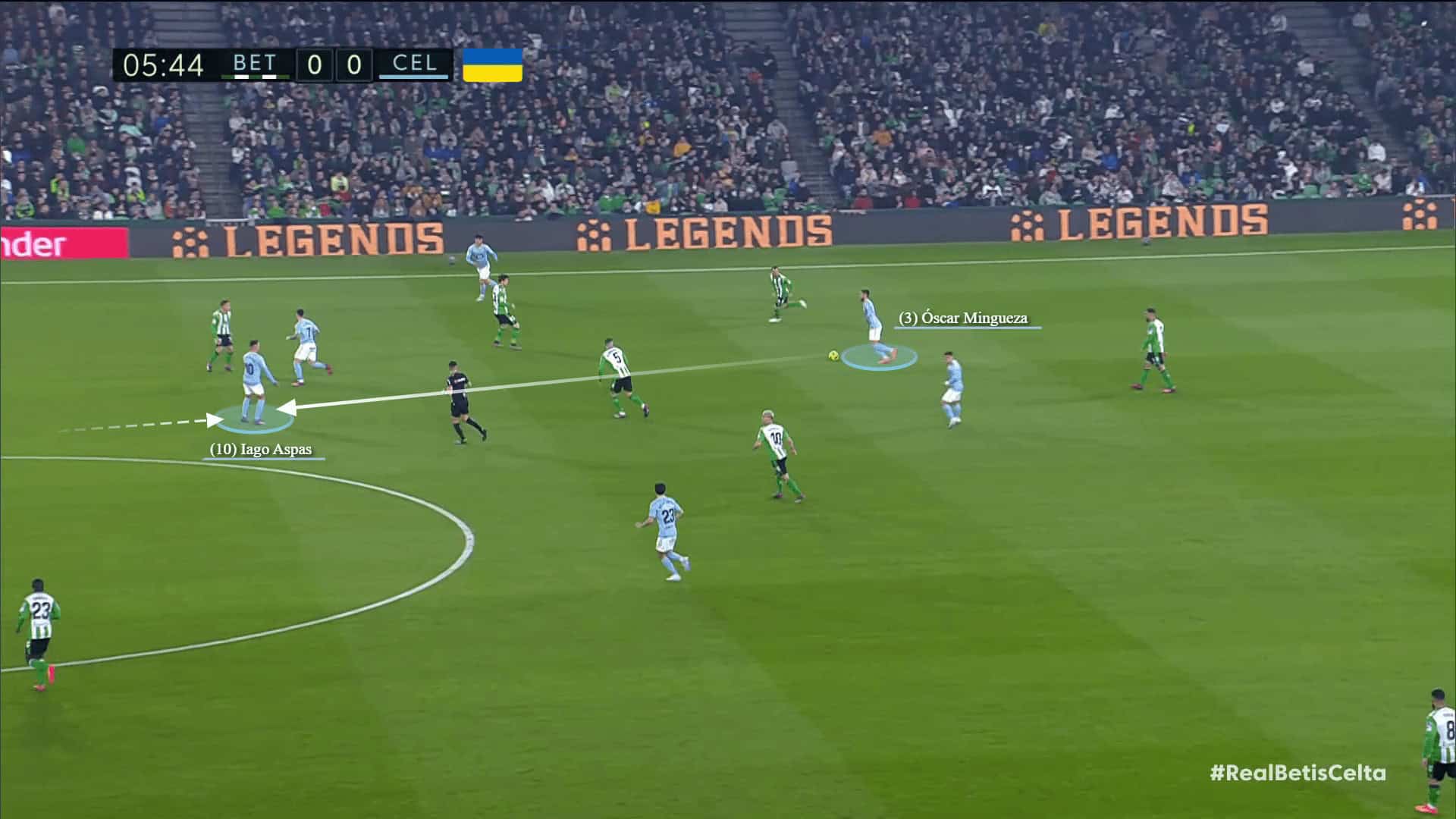
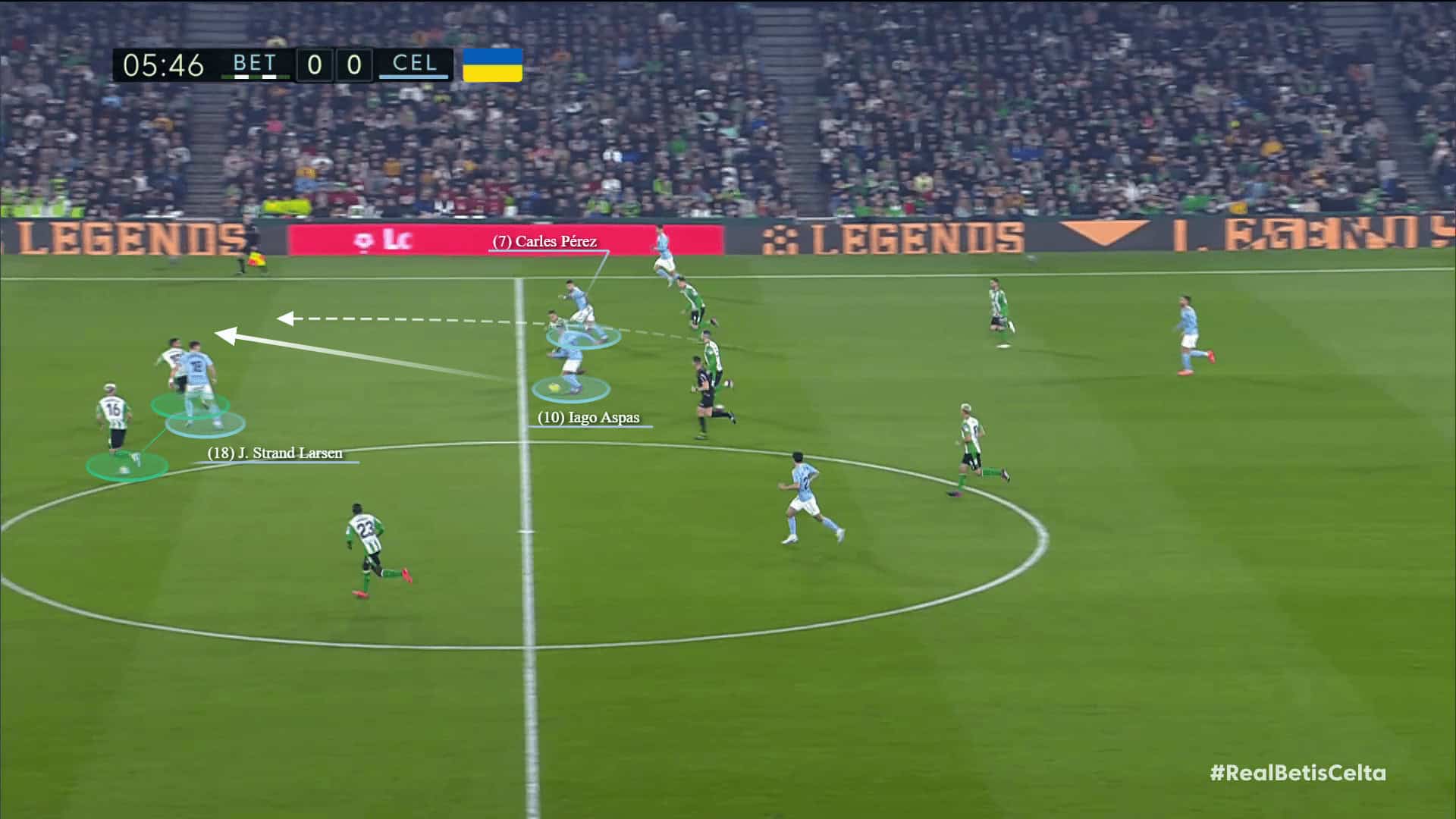
Following this, Larsen executed a clever double movement to manipulate the centre-backs and received a low cross before scoring.
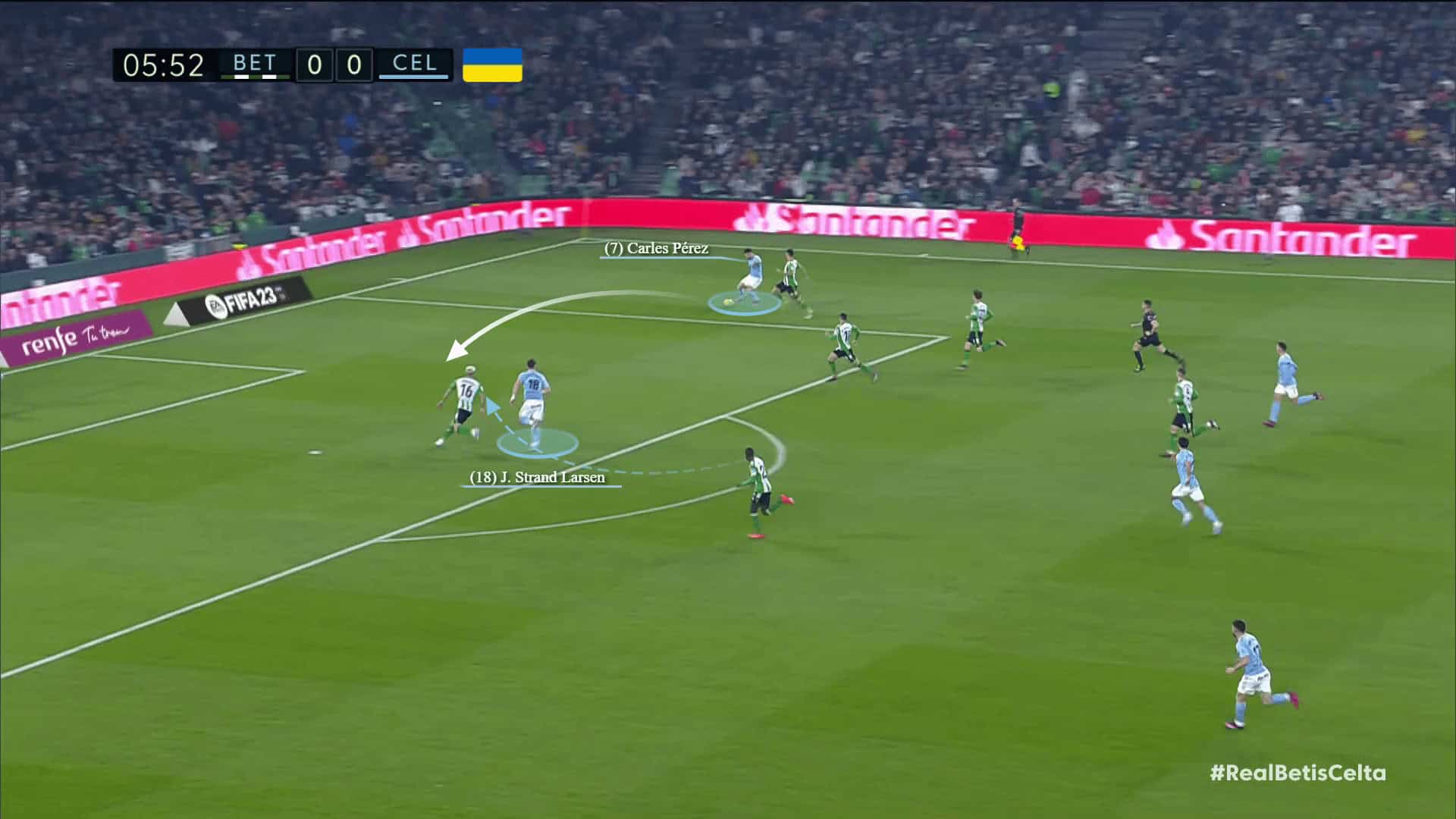
This type of quick and incisive attacking play is a common feature of Carlos Carvalhal’s tactics at Celta Vigo.
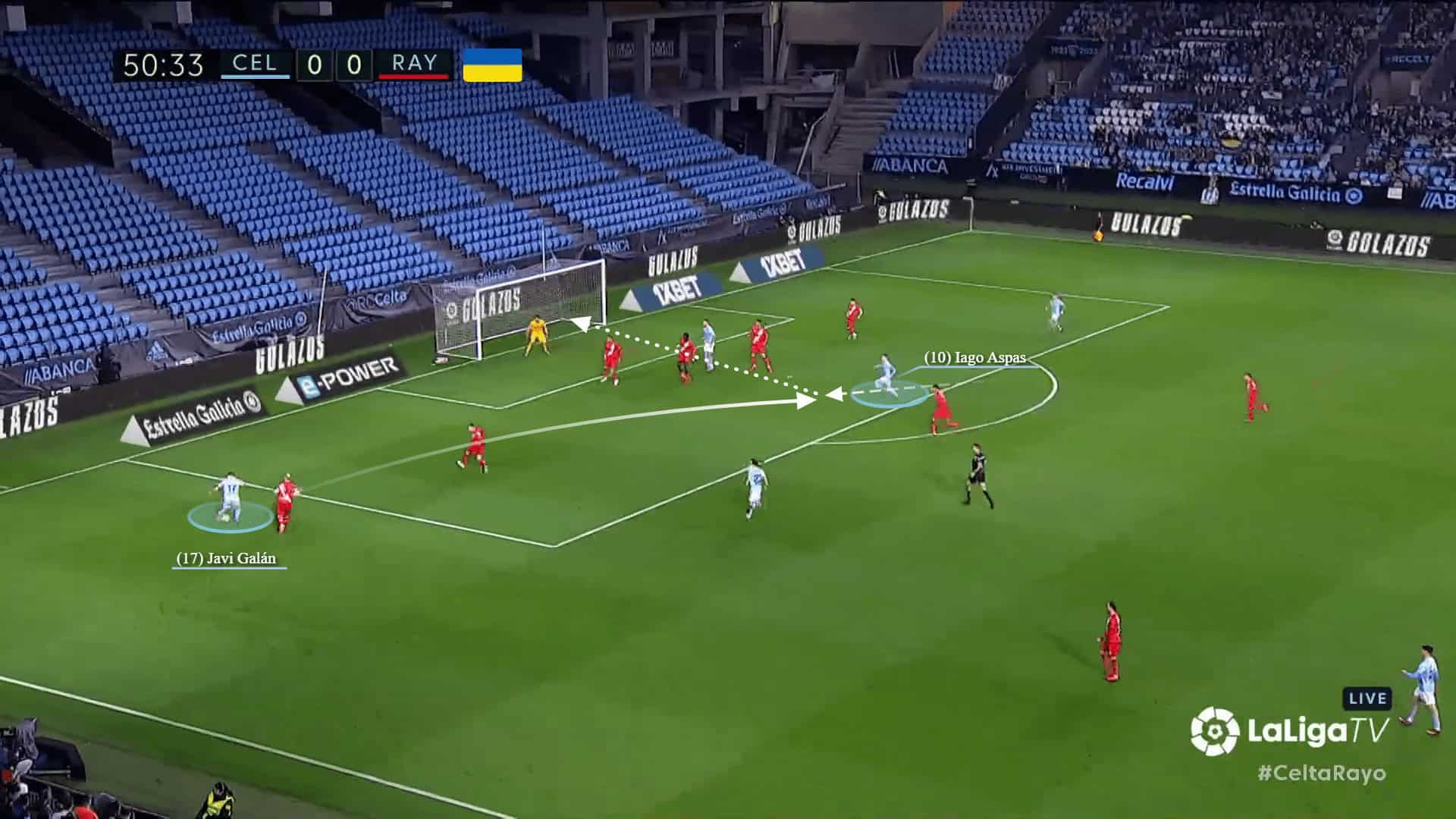
Celta Vigo frequently opt for cut-backs from the flanks rather than traditional crosses, as illustrated in the scene below.

According to FBref, at the writing time, Celta Vigo currently sit in 10th place in the La Liga standings for goals and assists.
The team’s goals, shots, and expected goals (xG) are shown below.

It can be argued that Celta Vigo still have room for improvement in their playing style, and they may not currently be the best team at implementing it.
However, with time and guidance from their coach, they have the potential to develop their style further and implement a more efficient and effective approach.
It is possible that Carlos Carvalhal, the coach, may also try to incorporate a more possession-based and positional style in the future, and perhaps seek out players who are better suited to this type of play.
Certainly, Carlos will try to repeat his era at Sporting Braga, where he came very close to Portuguese giants Porto, Benfica, and Sporting.
The Sky Blues are on their own half
Defensively, Celta Vigo typically maintains a 4-4-2 structure, with the flexibility to switch between high pressing, a medium block, or a low block occasionally.
The below visual highlights their defensive territory since Carvalhal took the reins.

However, they are not particularly strong defensively, currently sitting in 13th place in terms of goals conceded in La Liga, as per FBref, with only 19 goals more than Elche, who conceded 64.
In contrast, Barcelona, who tops the table, has only conceded 11 goals throughout the season, which is a difference of 34 goals.

When implementing high pressing, Carlos Carvalhal employs a 4-4-2/4-2-4 scheme.
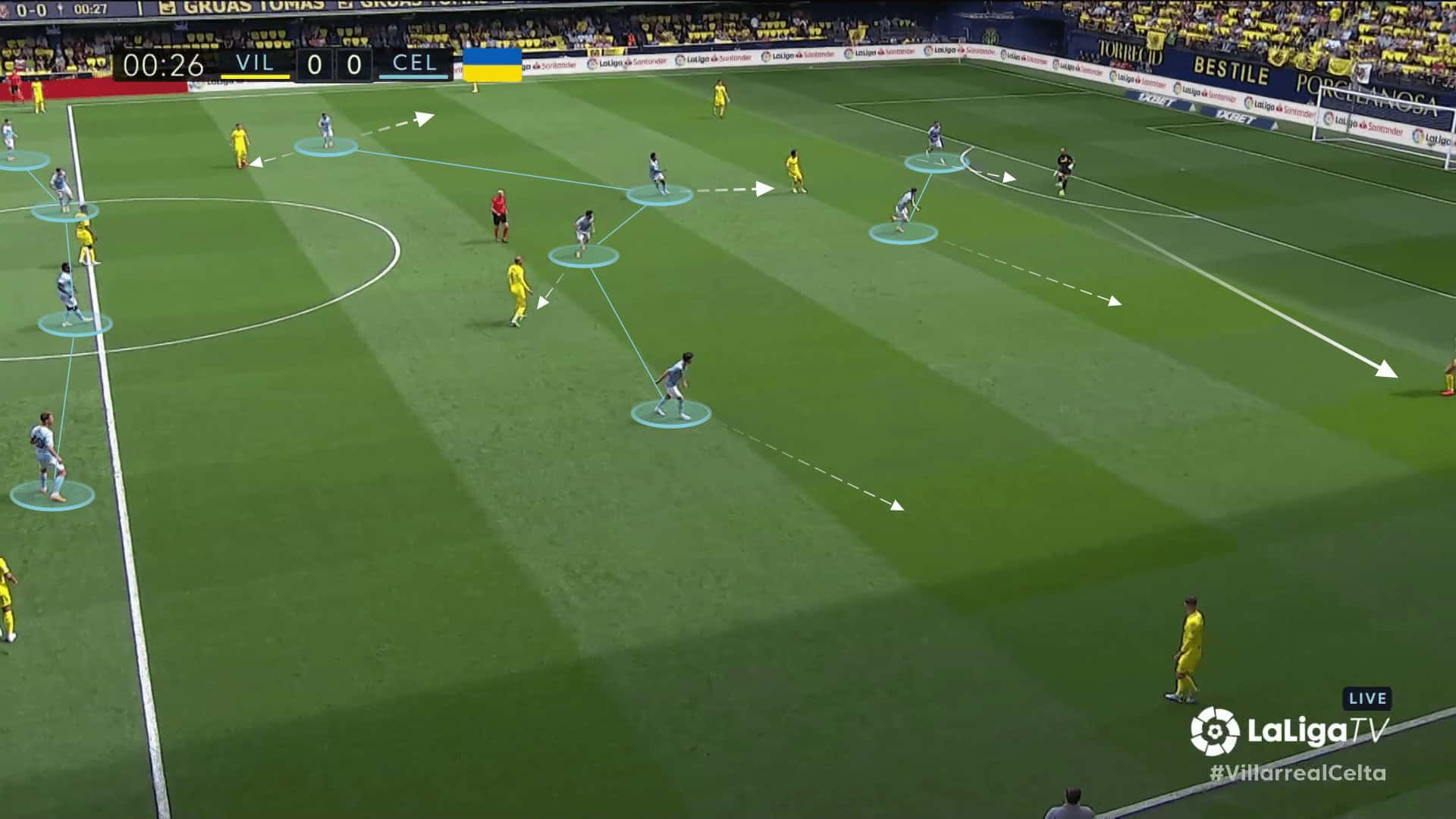
The first line always presses the opposition’s centre-backs, and the goalkeeper blocks the vertical passes, covering the depth passes’ angles and eventually forcing the ball outwards, as the wingers position themselves higher and inside to force the build-up towards the fullbacks.
By blocking the vertical passes, the central midfielders can sit in a positional press and be ready to press the opposition’s midfielders when they receive the ball.
Meanwhile, the four defenders contain the last line of the build-up.
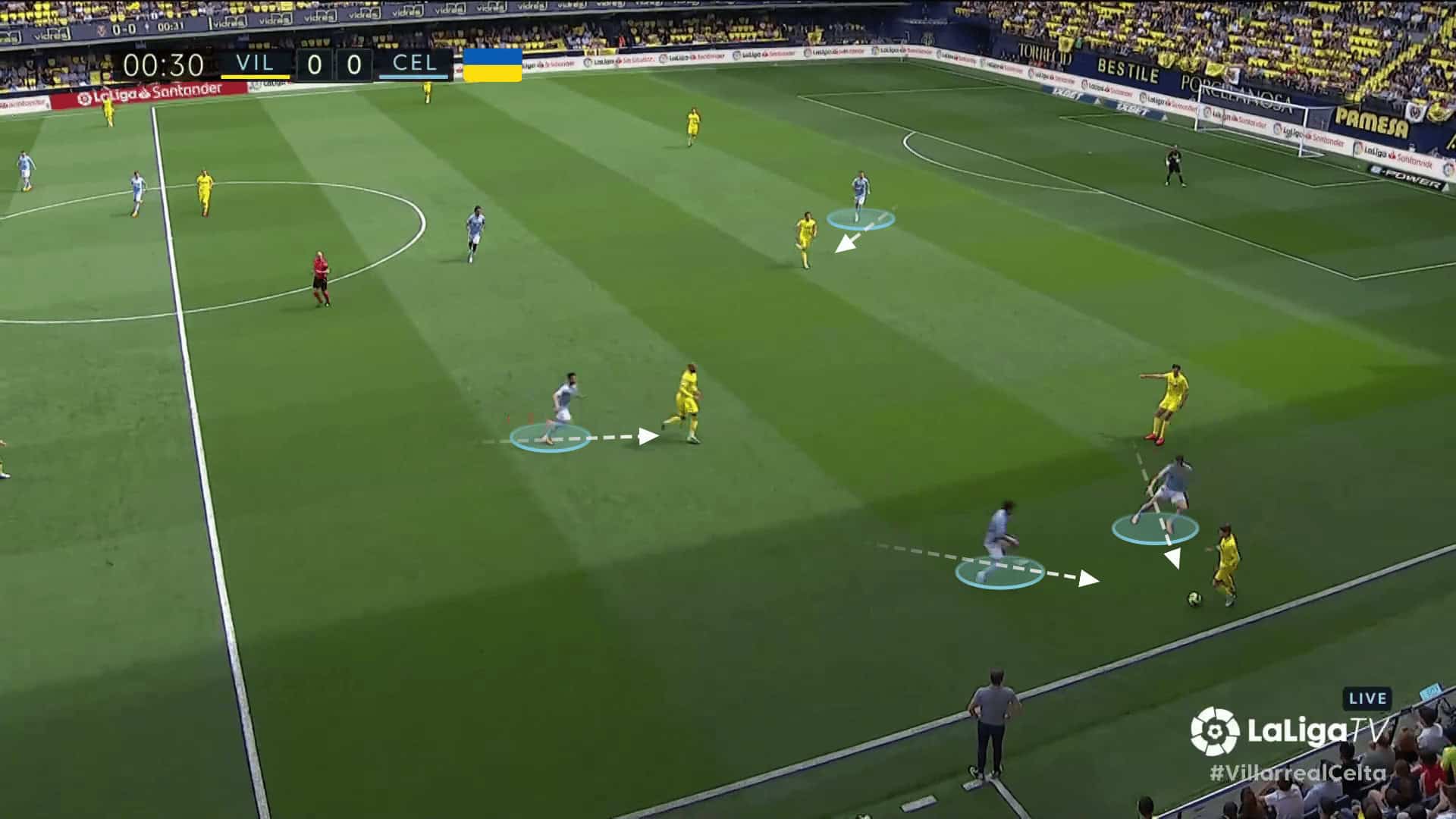
For instance, against Villarreal, they used a 4-4-2 pressing scheme and managed to force the play outwards to the fullback.
Once the fullback received the ball, Celta applied pressure and successfully pushed him to play a long ball randomly.
However, since the arrival of Carlos Carvalhal and even from the beginning of the season, Barcelona has achieved a significantly larger number compared to Celta Vigo, as the graphic below illustrates, which suggests there are some issues.

These issues in the different out-of-possession phases vary between organisational errors, individual errors, and a lack of sharpness when defending.
Here below, against Elche, while they were building earlier with 4-1 shape, the striker Gonçalo Paciência returned to mark the defensive midfielder, and the left-winger De La Torre moved higher to press the right centre-back.
This forced Celta’s left back, Javi Galá, to go out into a large space to press both players (the winger and the fullback).

He came back later to defend in the riskest point.
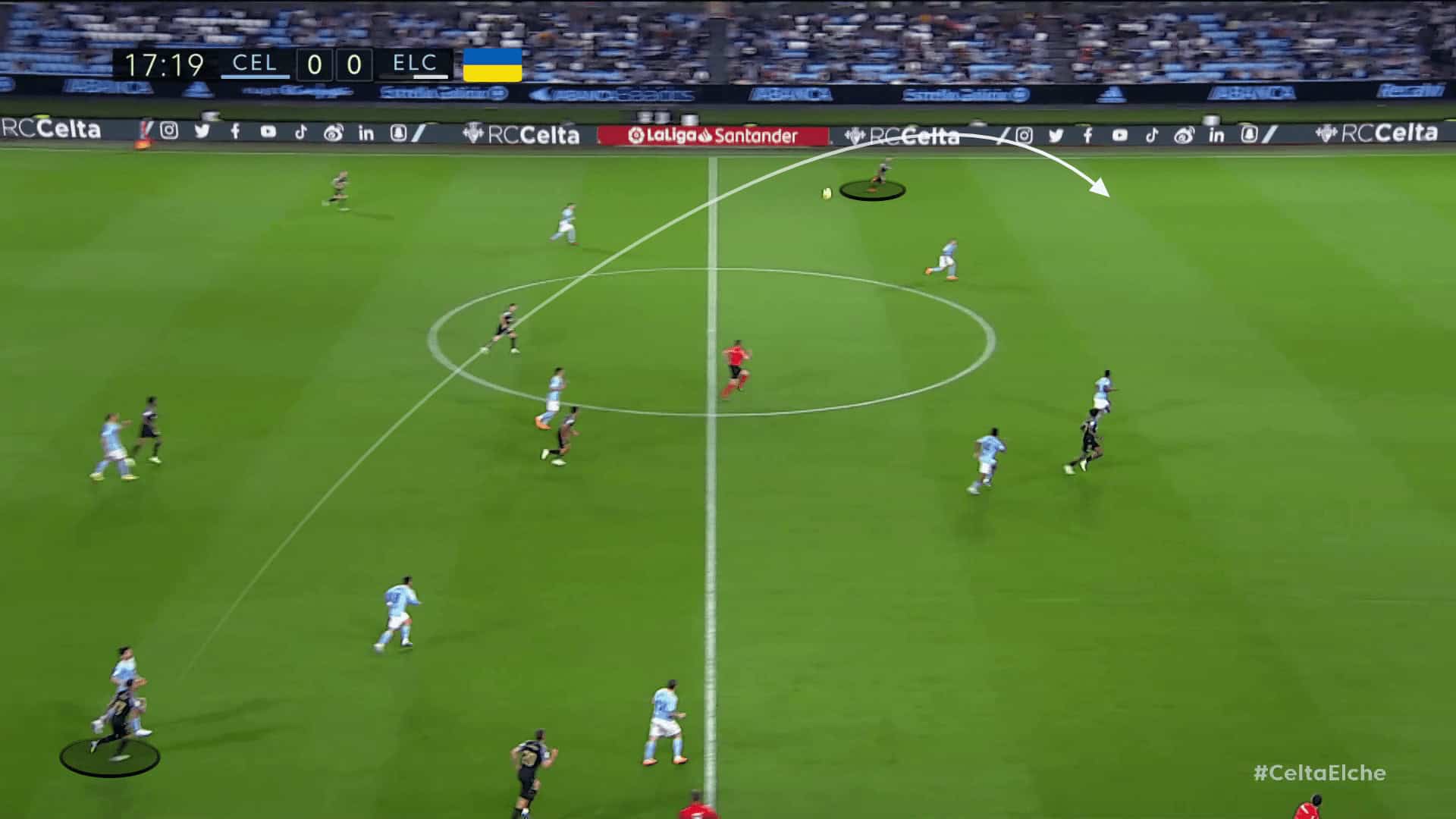
Once the ball had reached the right back, he was free and had a lot of time.
Immediately, the midfielder drifted quickly to press him, wasting extra time to ensure someone covered his space (this was a mistake in the scheme).
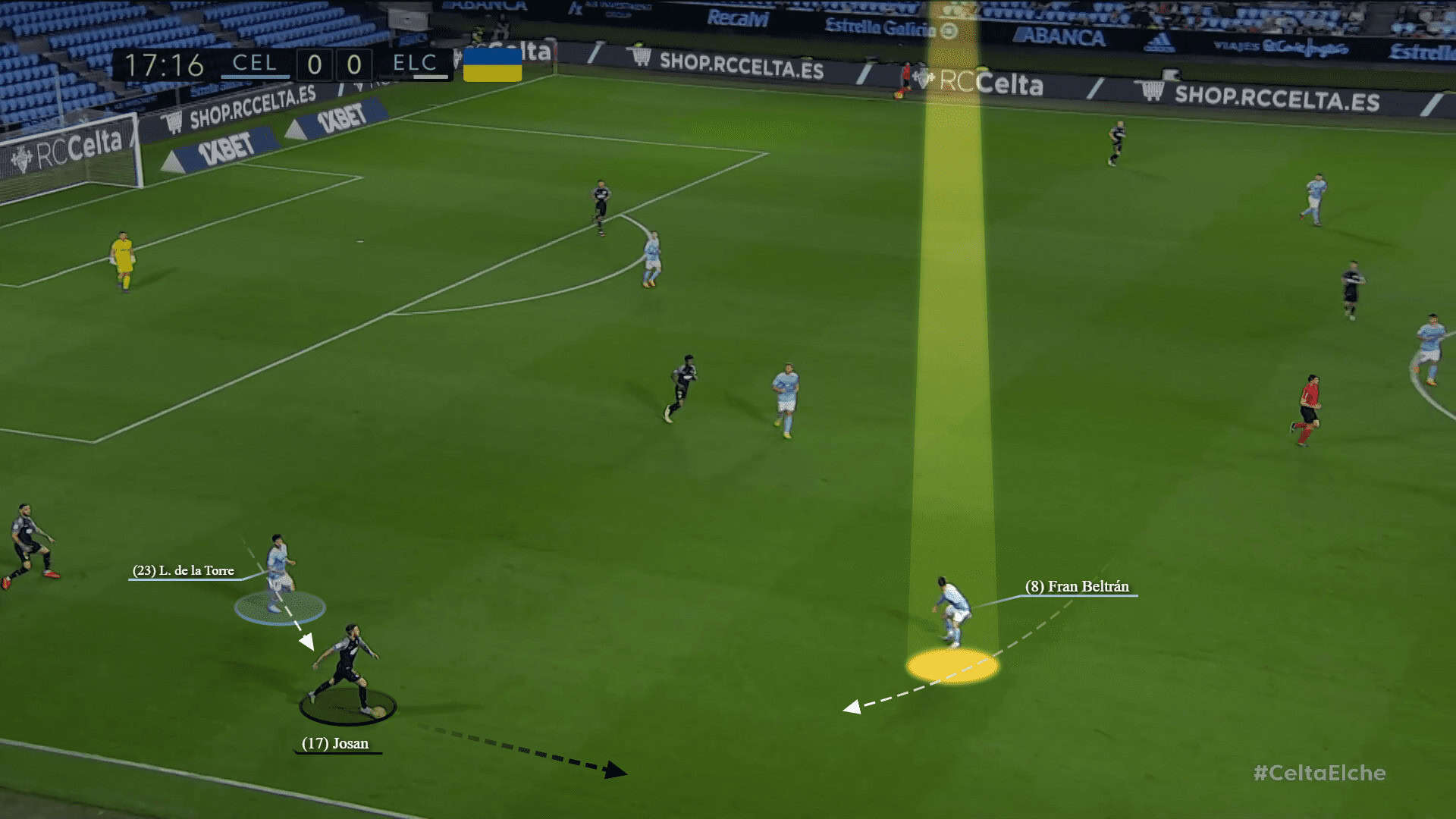
This enabled the right back to easily advance and switch the ball freely to the ball-far winger, which allowed Elche to reach the final third with ease.
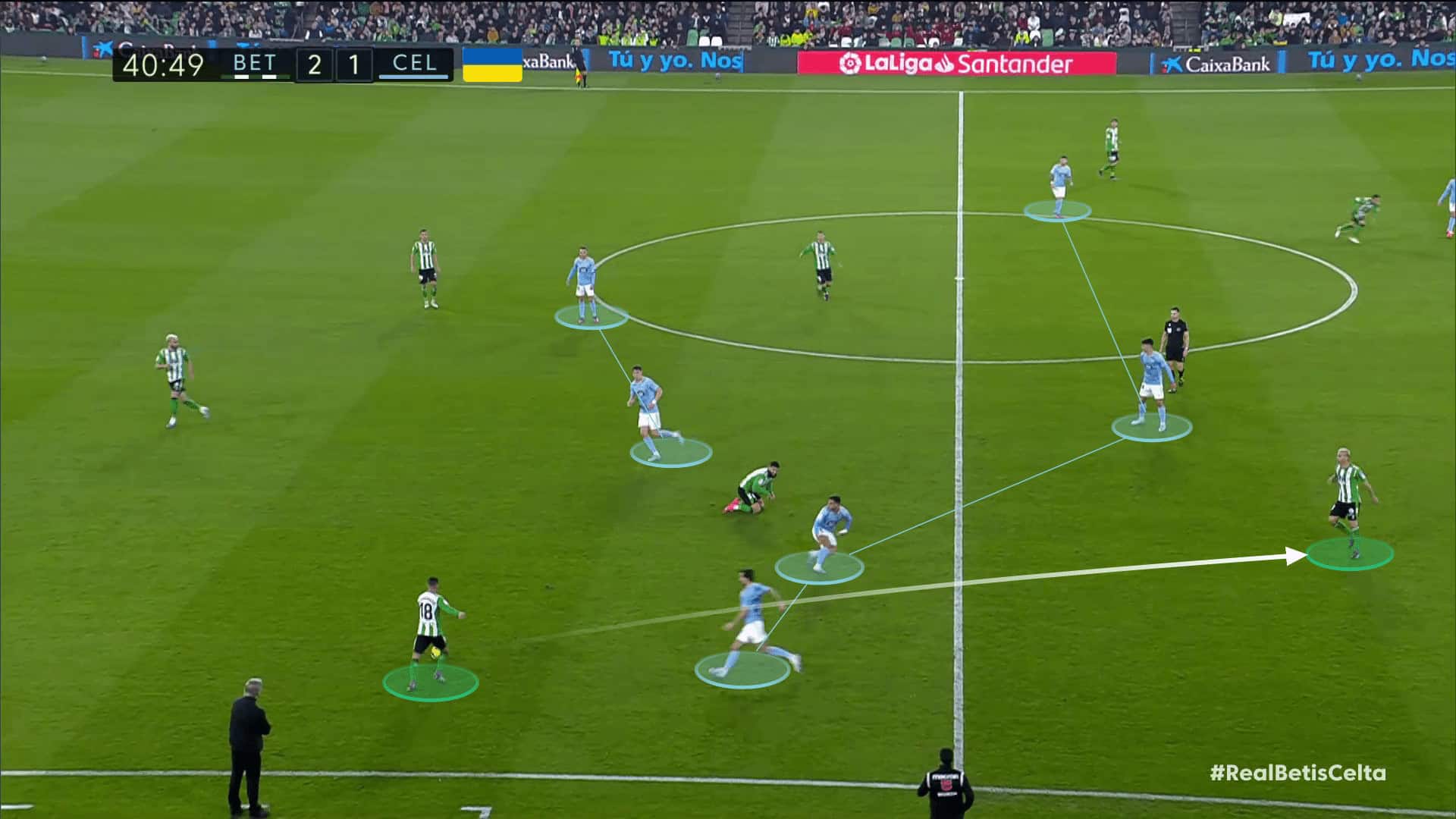
Also, against Real Betis, in their attempt to revive the press, Betis succeeded in penetrating through a gap in the defensive block of Celta Vigo, and then the midfielder who received the ball was able to progress about 15 meters without any interference and played a through pass to the overlapping left back in the blindside of the backline due to bad covering from Celta Vigo’s right winger Carles Pérez, which resulted in an extremely dangerous opportunity.
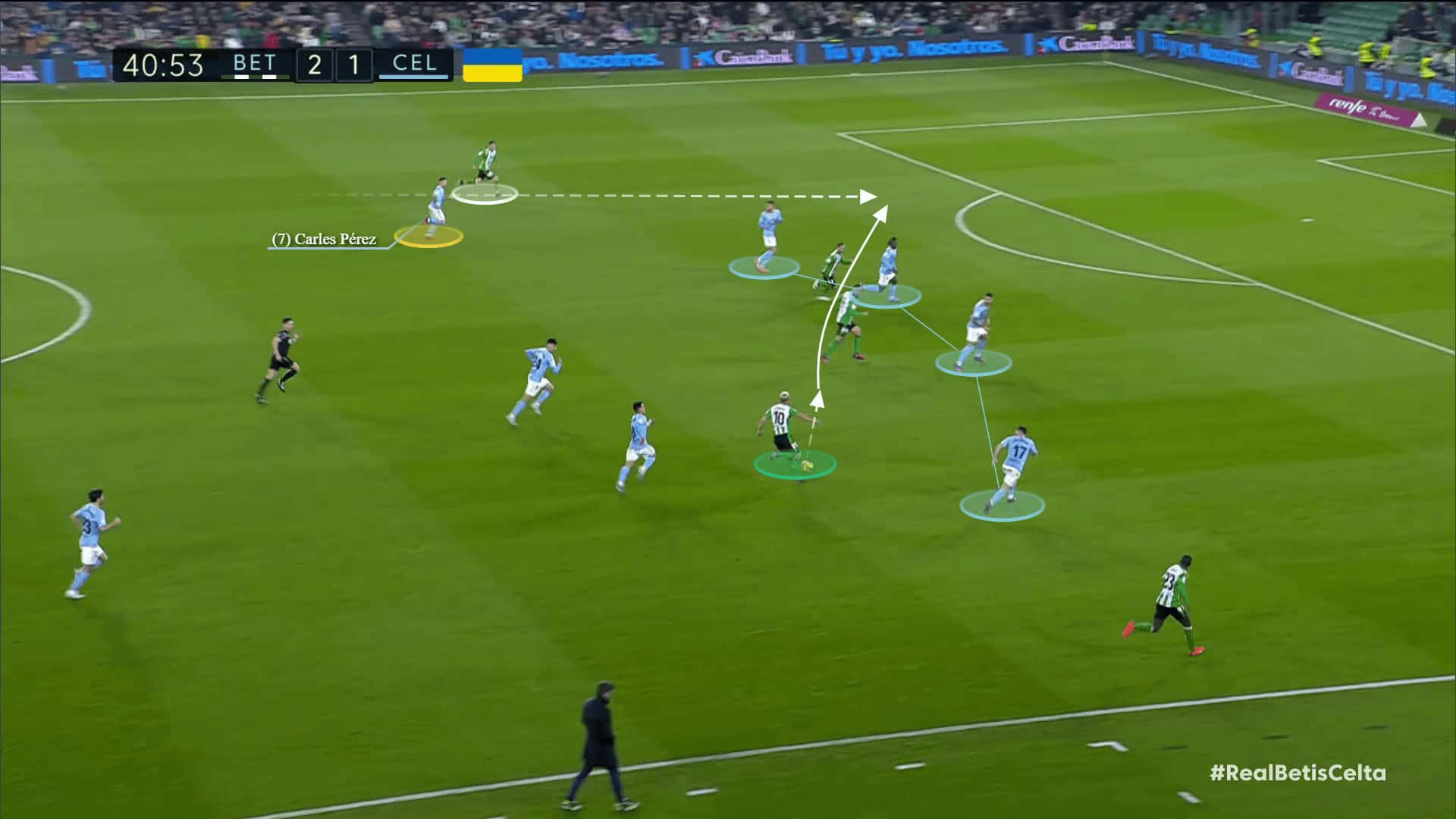
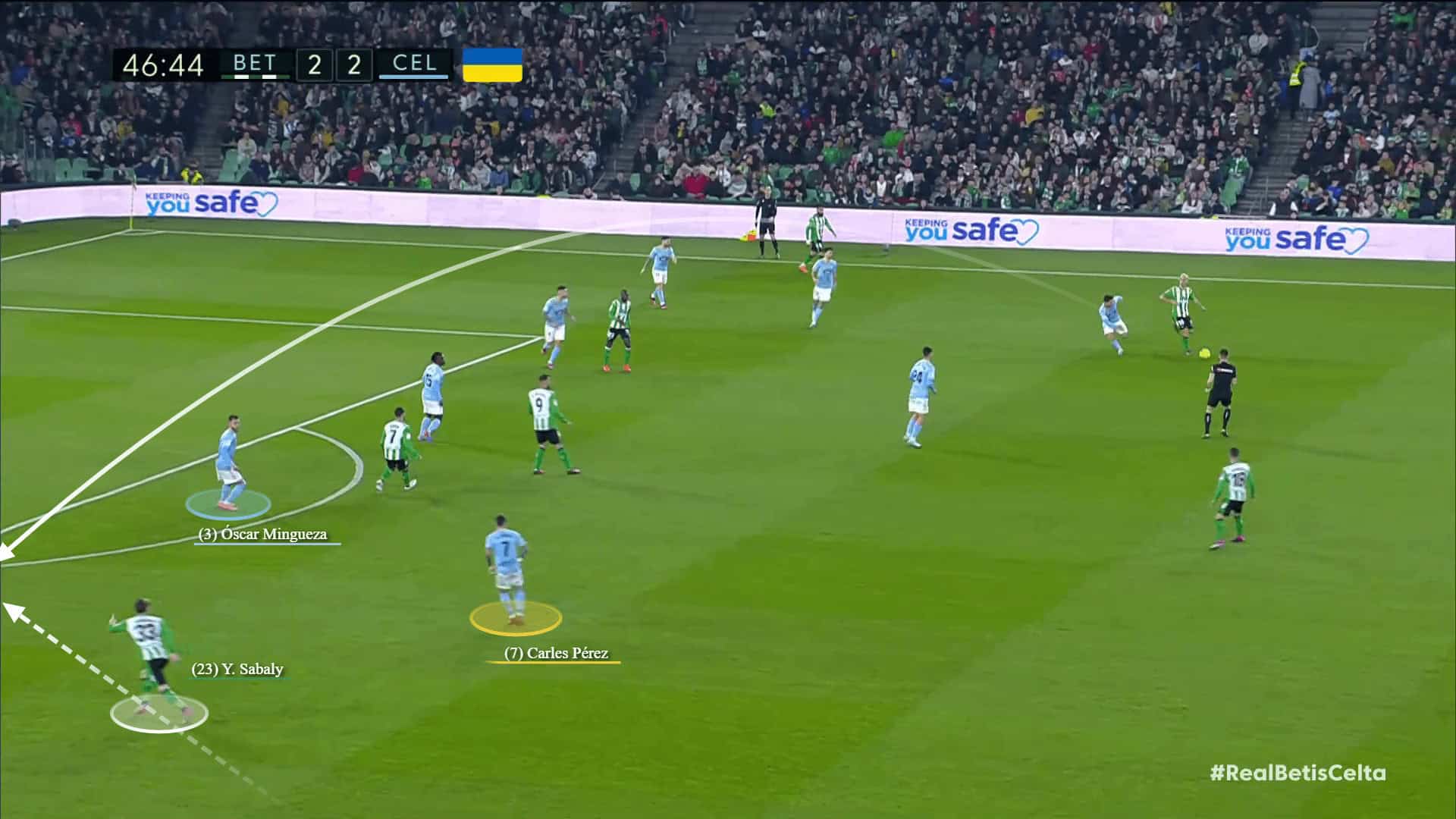
This tracking weakness was repeated again later while they were in a low block.
Below, a similar long ball is played behind on the blindside of the backline to the overlapping fullback, Juan Miranda.
Conclusion
This was a tactical analysis of Carlos Carvalhal’s approach as the new coach of Celta Vigo in La Liga, with a particular focus on his adaptability and use of the classic 4-4-2 formation, both in possession and out of possession.
Fans of Celta Vigo hope for a calm end of the season and to prepare for an optimistic season with the same coach in the 2023/24 campaign.
We will certainly keep a close eye on their development next season.

