


After a pretty quiet start to life in Group E at the FIFA World Cup 2022, Morocco and Belgium were both looking to gain crucial wins in what is seen as a very tight group. Belgium had just come out on top in a 1-0 win over Canada, although it was a game in which Canada dominated the xG, and were unlucky to somehow not even win a point. Morocco on the other hand had a point after a 0-0 draw with Croatia, in what was an uneventful game where both teams lacked the quality in the final third to create any high-quality goalscoring chances.
Morocco would have been looking to cut out the unnecessary mistakes in their own half which led to the only goalscoring chances Croatia had in the entire game, while Belgium would be looking to build on the three points by putting in a more dominant performance than the one seen against Canada.
In this tactical analysis, we will look into the tactics utilised by both Belgium and Morocco, whilst taking a deeper analysis into where the game was won and lost for both teams.
Lineups
Belgium’s lineup appears to be slightly different to when they were fortunate to beat Canada. Thorgan Hazard came in to cause a shift in formation to a 4-2-3-1, although this was only for the out-of-possession phases. Borussia Dortmund‘s Meunier and Everton‘s Onana both came into the team to add some extra physicality and potentially a set-piece threat against a side who haven’t conceded a goal under their new manager. The core of the team remained the same, while Romelu Lukaku could only get minutes off the bench following his return from injury.

On the other hand, Morocco’s team was nearly identical to the one that started in the 0-0 draw against Croatia. The only difference was in goal, where Yassine Bounou had to come out and be replaced by Munir El Kajoui, after he walked out of the tunnel, shook everyone’s hands and sang the national anthem due to reports of dizziness.
Belgium’s stale build-up
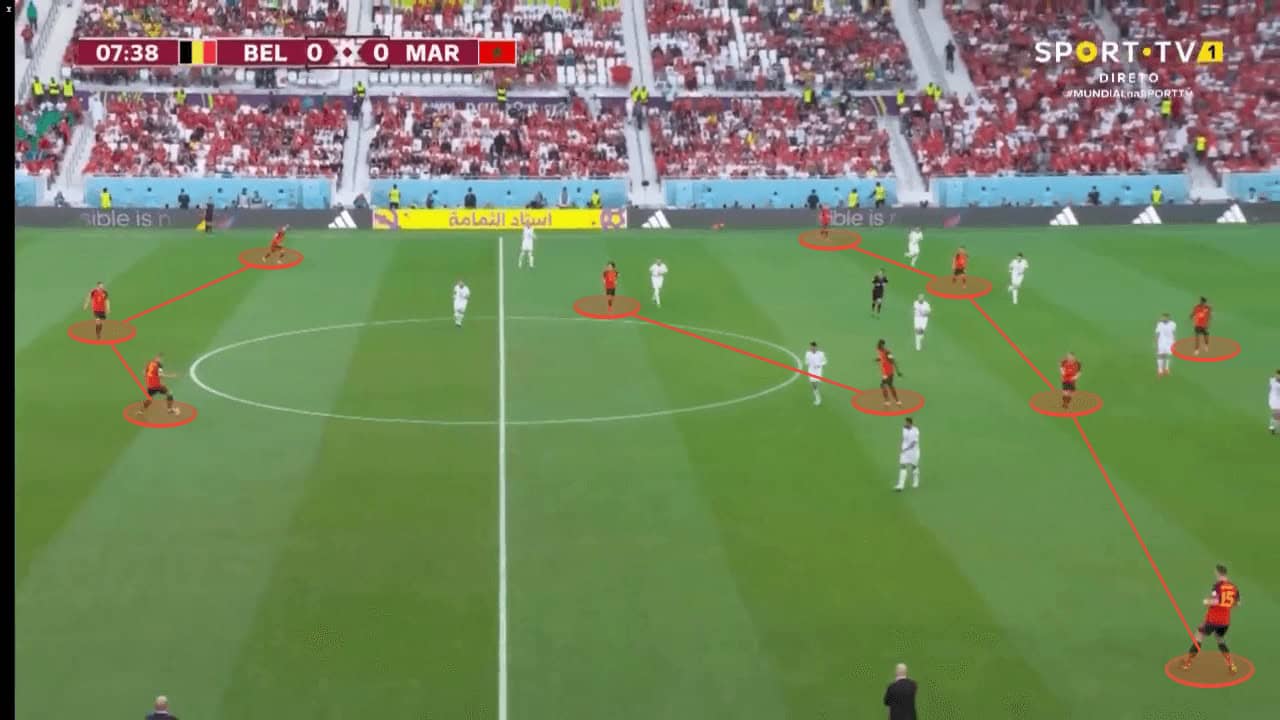
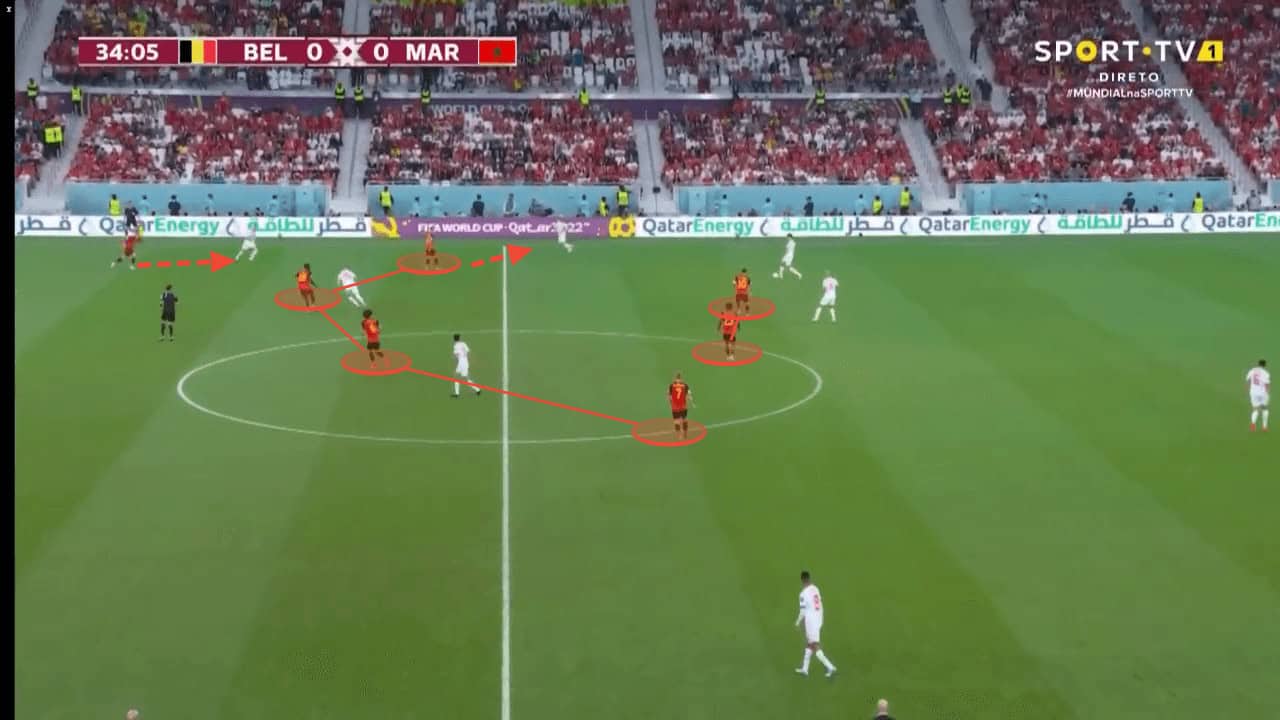
In the deeper phases of the pitch, Belgium used the 3-4-3 shape to build up play and retain the ball. Timothy Castagne would drop into the left centre-back role while Thorgan Hazard and Thomas Meunier would shift up to wing-back. Eden Hazard and Kevin De Bruyne would then become the two #10‘s, playing in the half spaces, and would drop to receive the ball between the lines.
Morocco’s off-ball shape was a 4-5-1, which resulted in Morocco’s striker chasing all three central defenders. He had no support, as the central midfielders were busy marking the Belgian double pivot while the wingers blocked the passing lane to wide players. This made it impossible for Morocco to effectively press Belgium, which resulted in Belgium having 56% possession.
When Belgium got near the opposition half, and in attacking areas, the shape slightly shifted to a 3-2-5, where the wing backs went higher and simply maintained the width for their side, aiming to pin back opposition fullbacks.
The problem with this system involved two main factors. Firstly, there was a lack of fluidity and rotations in the Belgian build-up. Players would stand in their given role and rarely combined with each other, which maybe could have been trained through during international duty. The Moroccan players could easily screen passing lanes, as the passes became predictable after the constant repetition.
Furthermore, players like Meunier in wide areas would also hinder their attacking options, as there was a lack of a 1v1 player, who could cause chaos through dribbling. Having a majority of players who all aim to create rather than score, can also become predictable to defend against, as defenders can drop off without the fear of being shouted at. A lack of progressive passing from midfield also prevented Belgium from getting into dangerous opportunities more often.
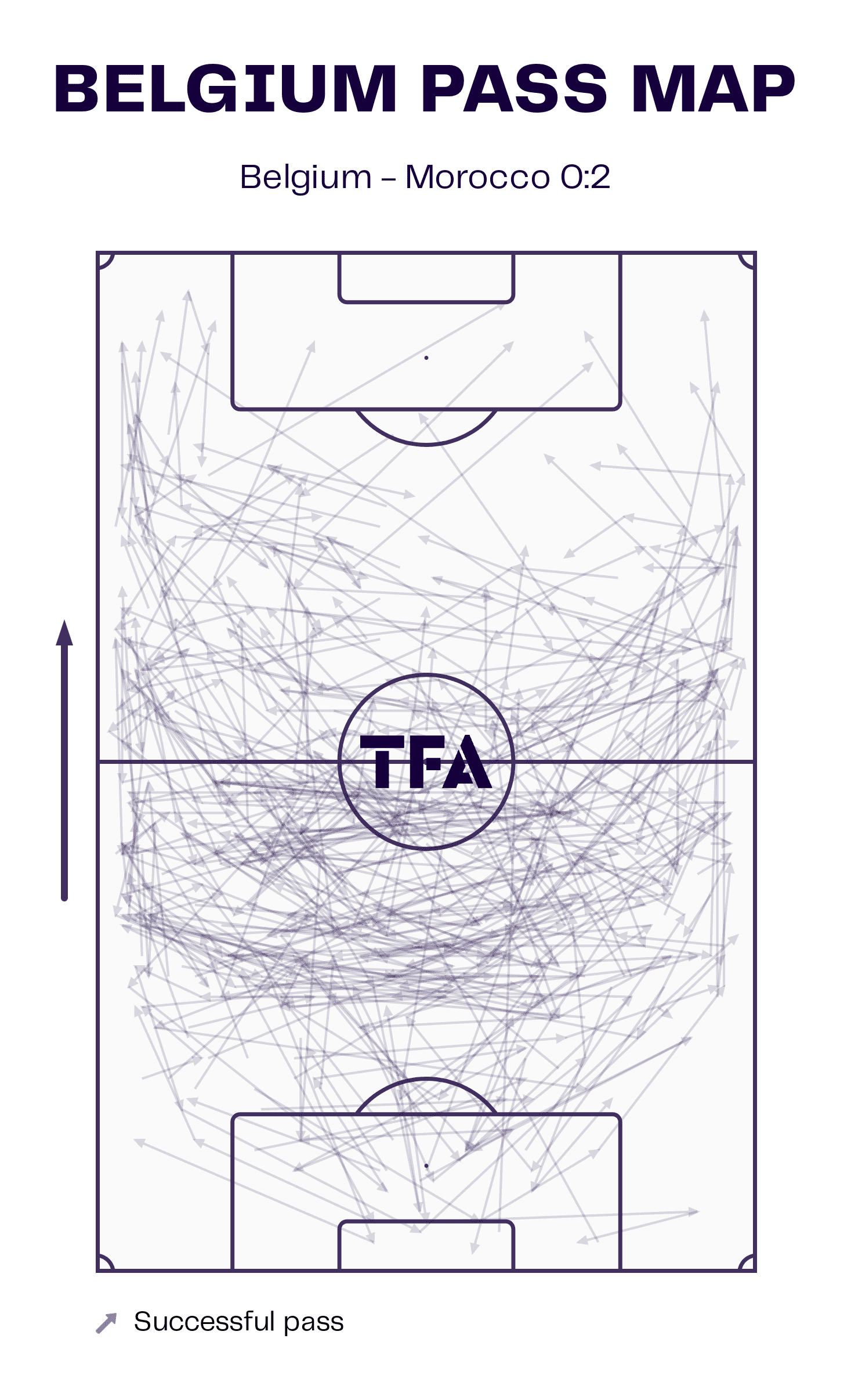
Although Belgium had such a large amount of control of the ball during that game, a majority of those passes went side to side, where the team had possession without a purpose. This pass map below clearly displays how passive Belgium were on the ball, with thick lines appearing in the defensive half going sideways.
Even after dominating the game for nearly the full 90′, Belgium only managed to play the ball into the Moroccan box five times. Toby Alderweireld attempted 103 passes, but only 18 of those went forward, past the opposition midfield line. A 17% line-breaking pass rate for a player who is under minimal pressure is poor, in comparison to the 45% mark of John Stones, although the rigid structure of the Belgians often meant that spaces were tough to find and play into.
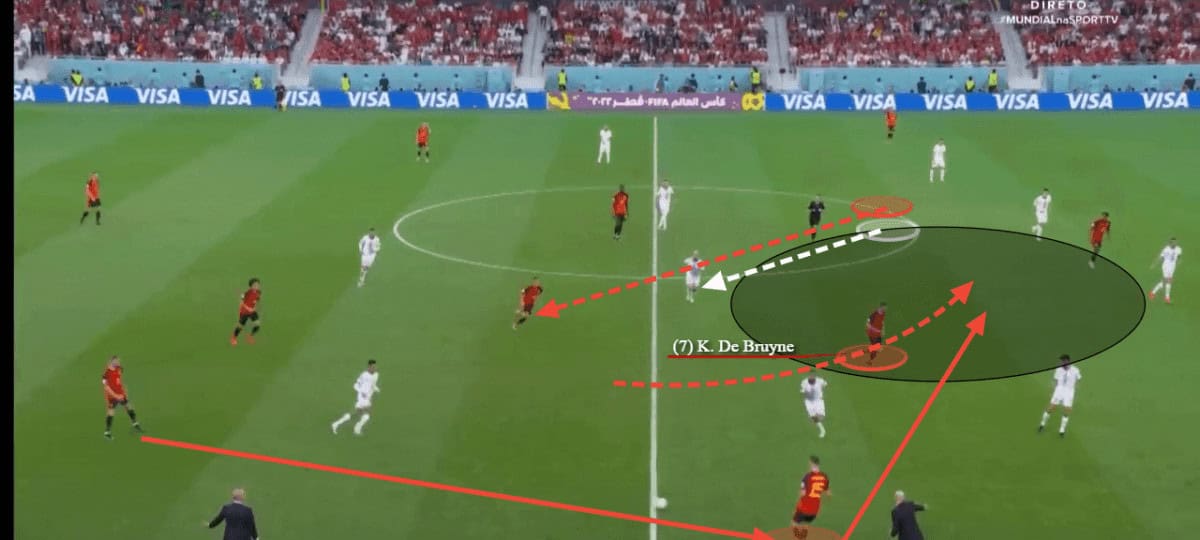
 While the Belgians’ play was often underwhelming, slow and sloppy, they did have some moments of brilliant interchanges. With the sole DM for Morocco being responsible for preventing passes from landing between the midfield and defensive lines, Roberto Martinez attempted to create space in that area through decoy runs.
In the example below, we can see Hazard making a run towards the ball, which Amrabat followed to prevent him from receiving the ball with time and space. As a result of that run, a big pocket of space appears in front of the Moroccan defence which the Man City star man can run into, and pick the ball up in an extremely dangerous area.
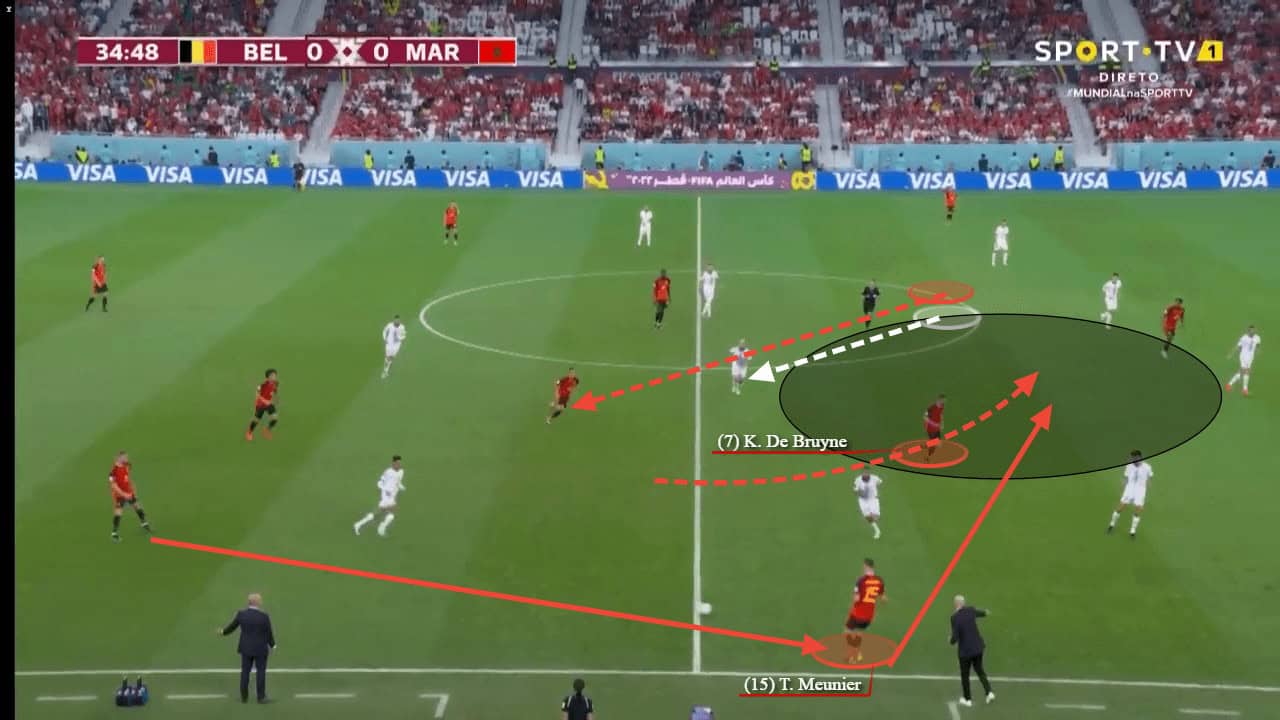
Belgium definitely got the most success through combinations between the two attacking midfielders, which allowed them to retain possession higher up the pitch, and put doubt into the other players’ minds. It was impossible for Amrabat to have the pair covered, while other players were hesitant to jump onto the free player out of de Bruyne or Hazard, and would rather stick to their position even when they couldn’t impact play.
Morocco’s threat
While Belgium had the majority of the ball, it was Morocco who created higher-quality chances. One of the main reasons which allowed Morocco to create chances was Belgium’s slow press. The Belgian squad is on the older side, and their off-ball work made that clear. Belgium were set up in a 4-4-1-1 to press Morocco, one of the front two had to split the centre backs, to force them one way, while the other should be marking the Moroccan pivot. However, the Belgian players could not keep this up for the entirety of the game.
The example below shows us clearly how, although the instructions are executed, there isn’t enough aggression or intensity which causes the press to fail. We can see deeper players being active and following their markers but the ball carrier is not being closed down. As a result, the Moroccan defender can wait, and time a lofted pass to perfection.
In the case below, Hakimi who starts from right-back makes a run from deep into the space vacated by Castagne, the Belgian left-back. Morocco have lots of technical quality amongst their squad, and so giving them time on the ball will almost definitely lead to clear-cut chances being given away as their players can execute those passes.
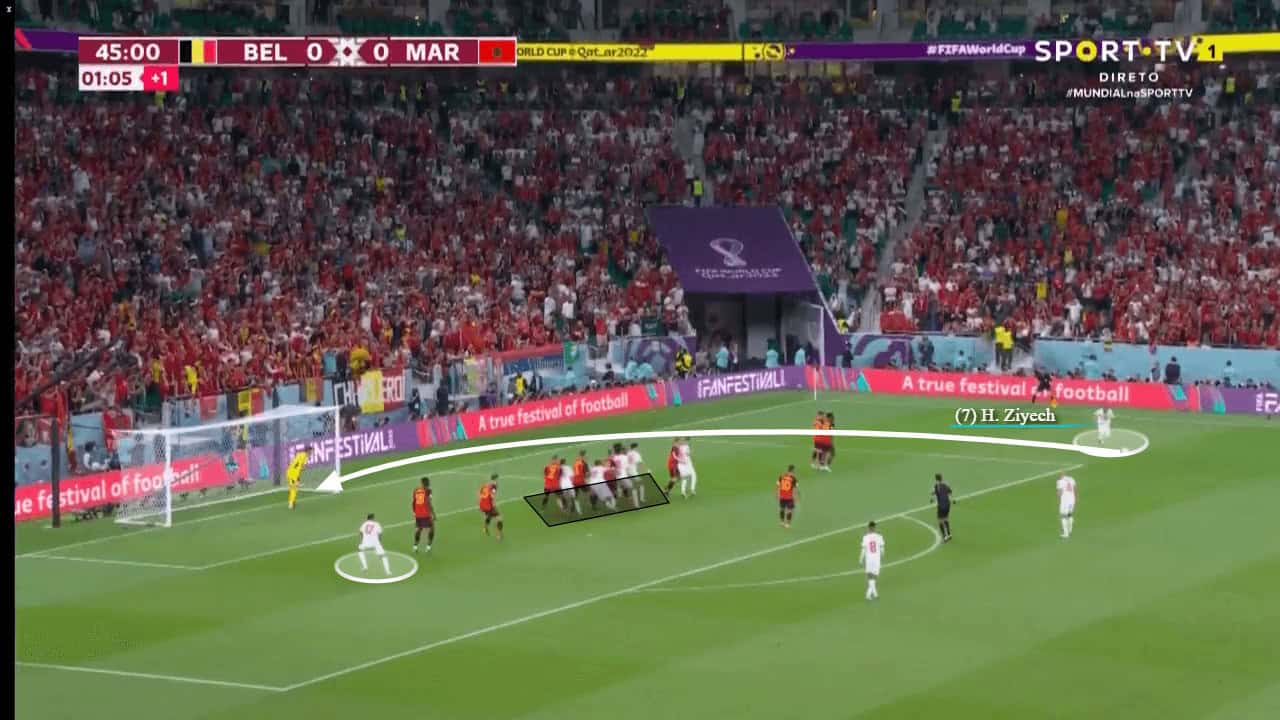
Lightning struck twice for Morocco when they scored from almost identical set-piece situations twice in a row in the game against Belgium. The wide free kicks, by the corner of the 18-yard box, caused massive issues for Belgium. Morocco chose to target the near post, whilst also keeping one player at the back post to stretch the back line. At the near post, Morocco would look for overloads by having four attackers up against three defenders.
Hakim Ziyech has excellent crossing abilities, so he could easily aim for the target areas. Having an overload means that one player is always free, to attack the ball unopposed, and from a distance of six yards, it almost always ends up in either a goal or a shot on target. In the scenario below, Romain Saiss moves slightly early, so he is offside, but the warning signs already appeared for Belgium.
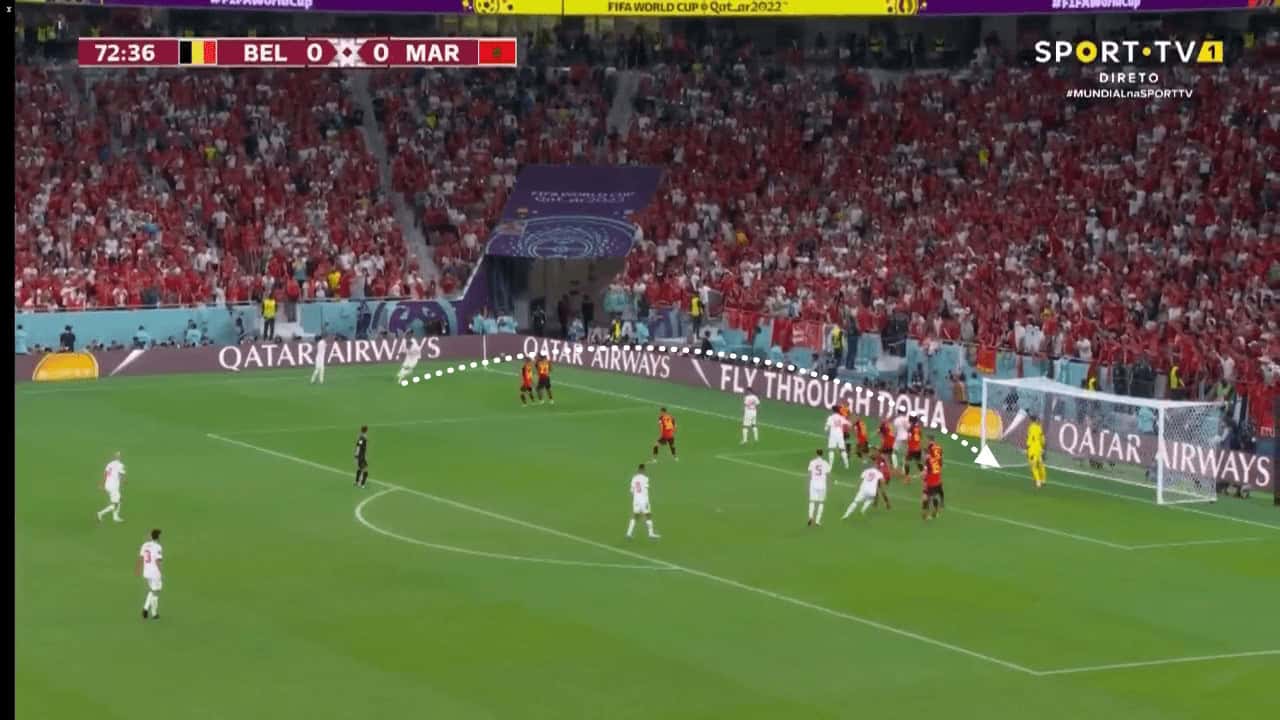
Later on in the game, from a similar position but on the other side of the pitch, Morocco gained another free kick. The angle was tighter than before, so Belgium decreased the number of target players as there was less space to aim for, so it wasn’t necessary to have as many people making the same run.
From the really wide position, a near-post cross arrives at the front post, which Romain Saiss does get a flick on for, and scores the winning goal. The Belgian defenders were caught on their heels, and so couldn’t get across in time, although it seemed like a simple enough opportunity for them to step across the goal and clear it.
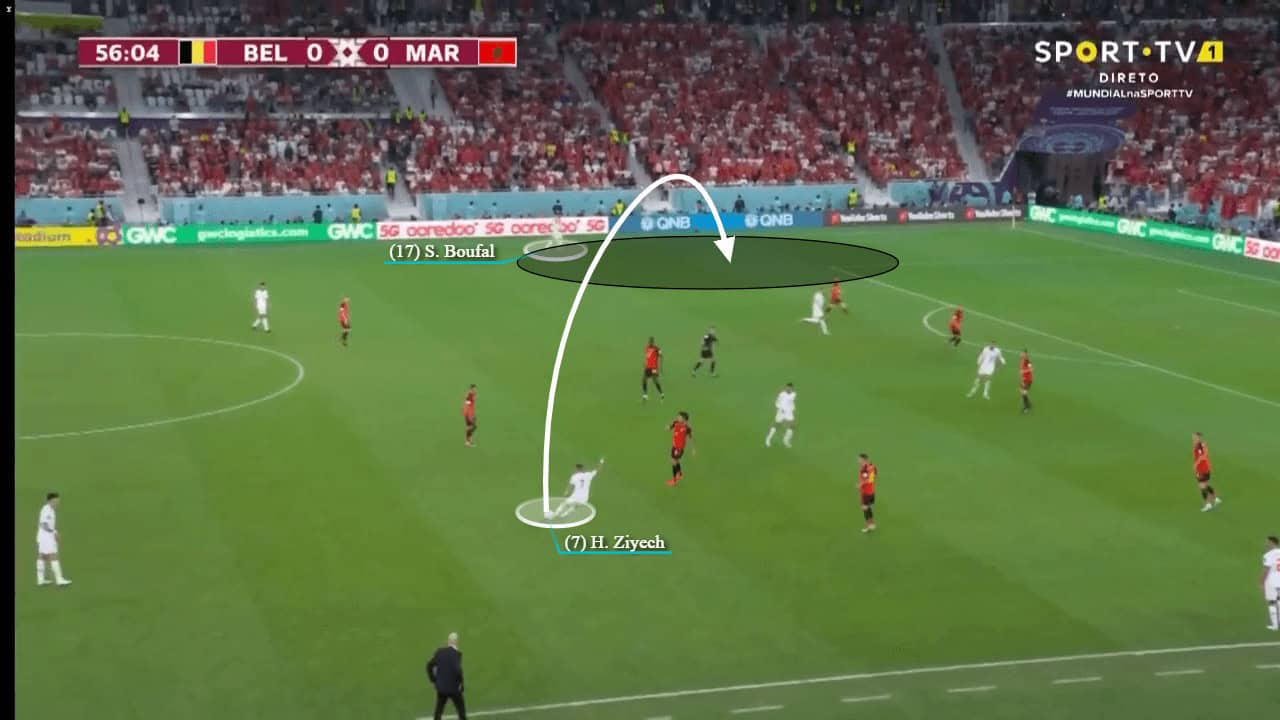
Another method of chance creation for Morocco was to make use of switches of play, to isolate their wingers in 1v1 situations. Both Boufal and Ziyech are good dribblers of the ball but lack the running power to be a consistent threat in wide areas. However, this wasn’t necessary against a slow Belgian backline. Both of these wingers made use of their excellent ball manipulation to lure defenders in, and knock it past them.
This example below shows us Ziyech switching the ball to Boufal, who is in acres of space. From there, he runs at his full-back, where he drops a shoulder to create separation for himself and take a shot on goal. Boufal lacks the ball striking to be a threat from distance, so it may be smarter in the future to bring the ball closer to the goal.
Conclusion
This tactical analysis has summarised the areas where Belgium appeared to be strong or weak, whilst also highlighting the different ways in which Morocco capitalised on those weaknesses. Both countries will be looking to win the final group game to advance to the knockouts, and while it is possible that both advance, it is unlikely for either team to advance much further than the first knockout rounds.

