


This year’s FIFA World Cup will be Senegal’s third-ever appearance in the competition, having made their first World Cup appearance in 2002 and then waited until 2018 to return to international football’s greatest stage. In 2002, Senegal made it all the way to the quarter-finals, delivering an impressive showing. They failed to make it out of the group stage in 2018 but will be hoping to achieve progression to at least the Round of 16 this year.
Senegal are in Group A at the tournament, alongside hosts Qatar, the Netherlands and Ecuador. Aliou Cissé’s side should fear none of the three teams they’re faced with in the group, as they have the quality to get a result from all of them; that’s not a guarantee, but it is a realistic aim and we should see a Senegal side full of belief in Qatar, especially if they manage to get a result in their opening game versus Louis van Gaal’s Dutch side.
The Lions of Teranga boast a promising squad for this tournament, with players who’ve achieved the highest success in club football like Édouard Mendy and Sadio Mané, along with some talents who perhaps can aim for similar levels of success in the future like Pape Gueye, Bamba Dieng, and Pape Matar Sarr; the level of talent at their disposal is thrilling.
This tactical analysis piece in the form of a team-focused scout report aims to provide a comprehensive analysis of Cissé’s side. We’ll analyse the Lions of Teranga and their tactics in possession, out of possession and in transitional phases, while also taking an in-depth look at the squad selection options Cissé has to choose from for the tournament in all areas of the pitch. Furthermore, we’ll dedicate a section of this piece to analysing Bayern Munich star Mané, who we’ve identified as Senegal’s key man for the tournament before we provide our tournament prediction for the team to cap off our scout report.
Predicted starting XI
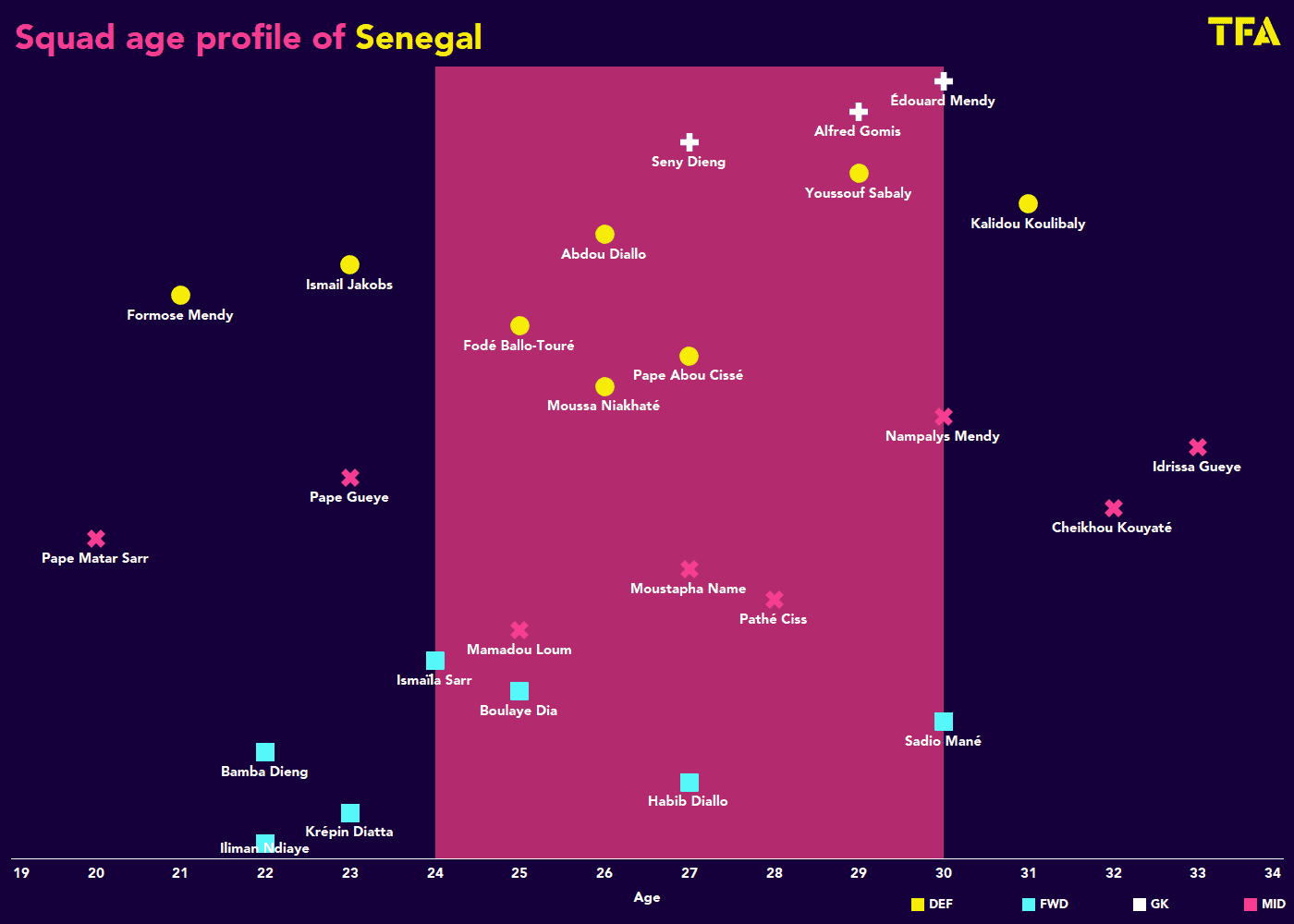
To begin our analysis, let’s take a look at our predicted 26-man squad and strongest starting XI for Senegal at the World Cup. At the time of writing, Senegal’s official 26-man squad has not been released, nor has their provisional squad been publicly released. However, in figure 1, we can see an age profile of a predicted 26-man squad that we’ve selected from the available panel of players; we don’t imagine that Cissé’s final squad will be too far off of this one.
At the time of writing, Senegal’s biggest injury issues lay in the backline, with Mané’s Bayern Munich teammate Bouna Sarr, who’d typically be Senegal’s first-choice right-back, set to miss the tournament due to a knee injury and Pape Abou Cissé currently out of action due to hip problems.
We don’t anticipate Cissé’s injury to rule him out of contention for a place at Qatar but, unfortunately for Senegal, the same can’t be said for Sarr who will not make it to the 2022 World Cup. As a result of that injury, we’ve left him out of our predicted 26-man squad. Other than Sarr, we’ve selected what we believe to be the strongest 26-man squad Senegal has to offer for this tournament.
Figure 1 shows that the vast majority (16) of this 26-man squad lies within or just on the border of the peak-age range (indicated by the pink strip on our graph). Seven of the remaining 10 players fall in the ‘youth’ age range while the remaining three players fall into the post-peak ‘experienced’ age range; those three experienced players are three current EPL players in Cheikhou Kouyaté, Kalidou Koulibaly and Idrissa Gueye, all of whom could have a significant role to play for their country in this tournament.

Figure 2 shows our predicted starting XI from this 26-man squad. Youssouf Sabaly of La Liga’s Real Betis takes Sarr’s place at right-back, completing a back-four alongside Chelsea star Koulibaly, RB Leipzig’s Abdou Diallo and AS Monaco’s Ismail Jakobs in front of Koulibaly’s Chelsea teammate Mendy.
Nampalys Mendy is a favourite of Aliou Cissé’s and as a result, we imagine that he’ll retain his place in the Lions of Teranga’s starting XI in Qatar, though Kouyaté could well displace him. We’ve put him in the deepest midfield position in our starting XI, just behind Marseille’s Pape Gueye and Everton’s Idrissa Gueye, which we believe to be a strong midfield trio that can deliver what Cissé wants from his central players.
In attack, we’ve got Mané and Ismaïla Sarr sitting on either side of Salernitana forward Boulaye Dia, who’s been in fine form in Serie A this season, scoring four goals and making two assists for his club at the time of writing.
Senegal have some excellent attacking options, and we could see some different variations of this frontline at different stages of games in the tournament. We’ll go into greater detail on all of the exciting attacking options at Cissé’s disposal later on in this scout report, however.
Attacking phase
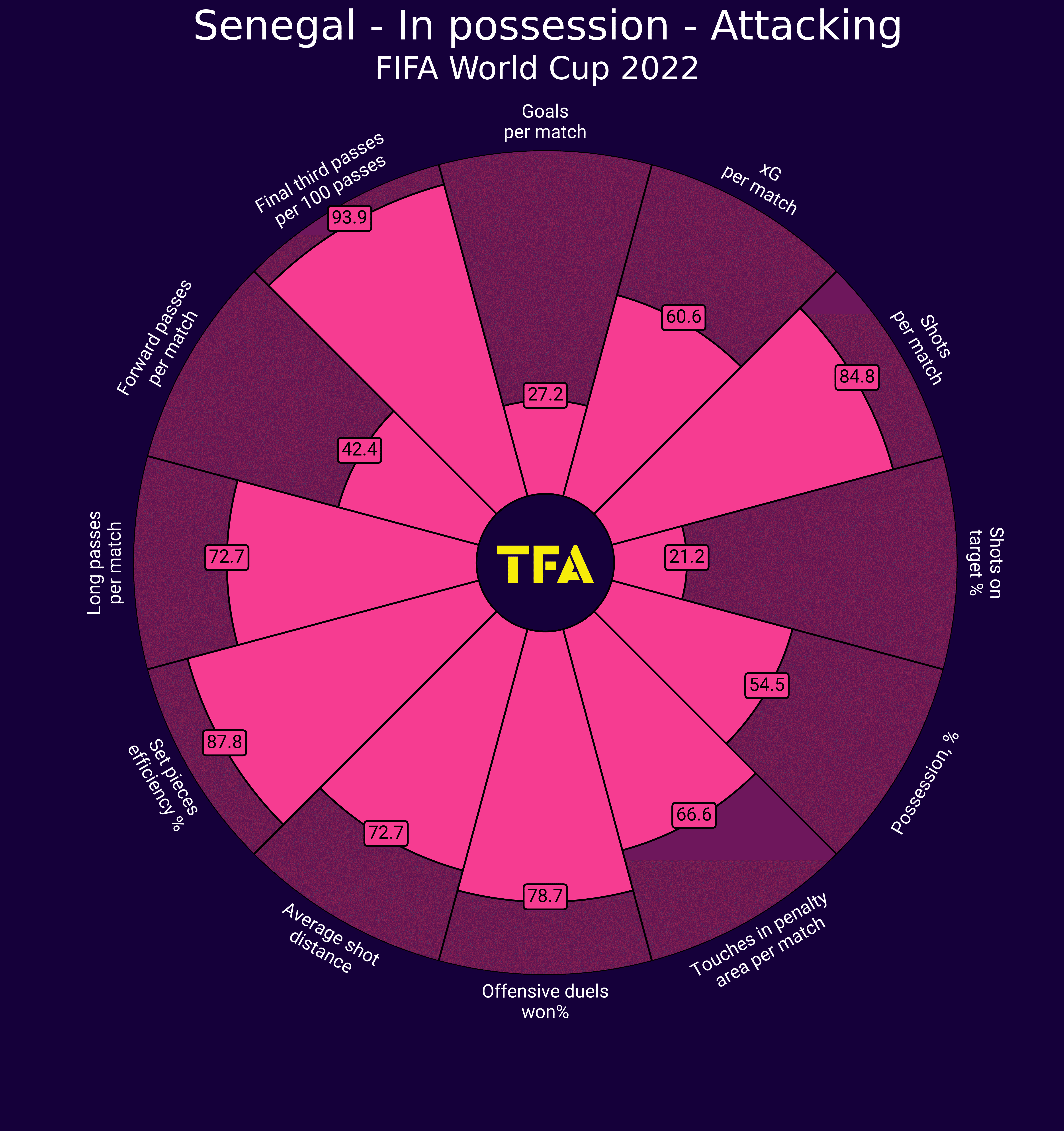
Figure 3 provides an overview of Senegal’s attacking game. The data for this radar was taken from their games over the last calendar year, and the percentile ranks shown compare them with the other 31 teams competing in Qatar this year.
Of course, it’s important to note remember that the quality of competition Senegal have faced over the last calendar year will differ from the quality they’ll mostly come up against in the World Cup, and this shouldn’t be used as a preview of what to expect from them in the World Cup or a measure of how exactly they stack up with their competition in this tournament.
However, there’s plenty to note about Senegal’s playing style with the ball from this radar. In particular, with regard to Senegal, the significant areas to note here are their high number of shots along with their relatively distant average shot distance, their high set-piece efficiency and their high number of long passes per match.
With regard to their set-piece efficiency, a lot of Senegal’s most dangerous goalscoring opportunities tend to come via set-pieces, whether their indirect free-kicks or corner kicks. They possess plenty of goalscoring threats, either aerially or otherwise from their set-pieces, and this is an important area that teams should focus on heavily when preparing to come up against the Lions of Teranga.
Senegal’s dribblers Mané and Sarr will look to take opposition players on in dangerous areas and get on the ball in congested spaces regularly, entrusting their ability with the ball to cause problems for the opposition and draw fouls from them, thus leading to set-piece opportunities for Senegal from what, for them, is a dangerous position.
Additionally, part of the reason why they are so comfortable with shooting from distance may be that they’re happy enough to just hit the target and try to force corner kicks, rather than actually scoring from their long shots, though obviously, scoring is the aim.
Shot selection is an area in which Senegal are generally quite inefficient, in general. They’re often quite wasteful with their shots and tend to shoot on sight a bit too much. It may benefit them to focus a little bit more on patience, working the ball into high-value goalscoring positions for the likes of Dia, Habib Diallo or Bamba Dieng to capitalise on with a greater chance of converting. Their shoot-on-sight tendencies are likely a big cause of their relatively low shot accuracy rate.
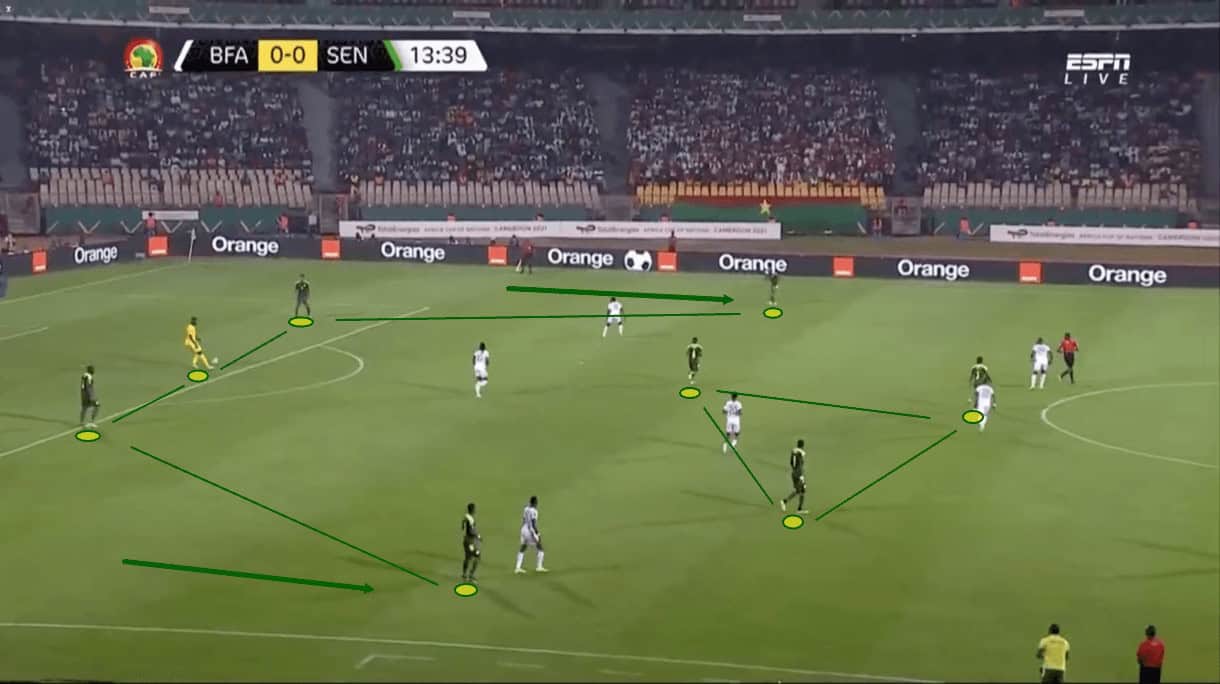
When beginning their build-up, it’s common to see Senegal as we see them in figure 4, with the centre-backs splitting slightly wide of their goalkeeper from goal-kicks and the full-backs pushing high, generally sitting on either side of their holding midfielder, just behind the other two midfielders in the 4-3-3 shape.
As play progresses upfield, it’s common to see the wingers move inside to occupy the half-spaces but at this stage, it’s common to see them stay wider and they do often receive the ball early while still positioned wide, allowing them to engage the opposition’s full-back in a 1v1 duel in space, which can suit the strengths of both Sarr and Mané.
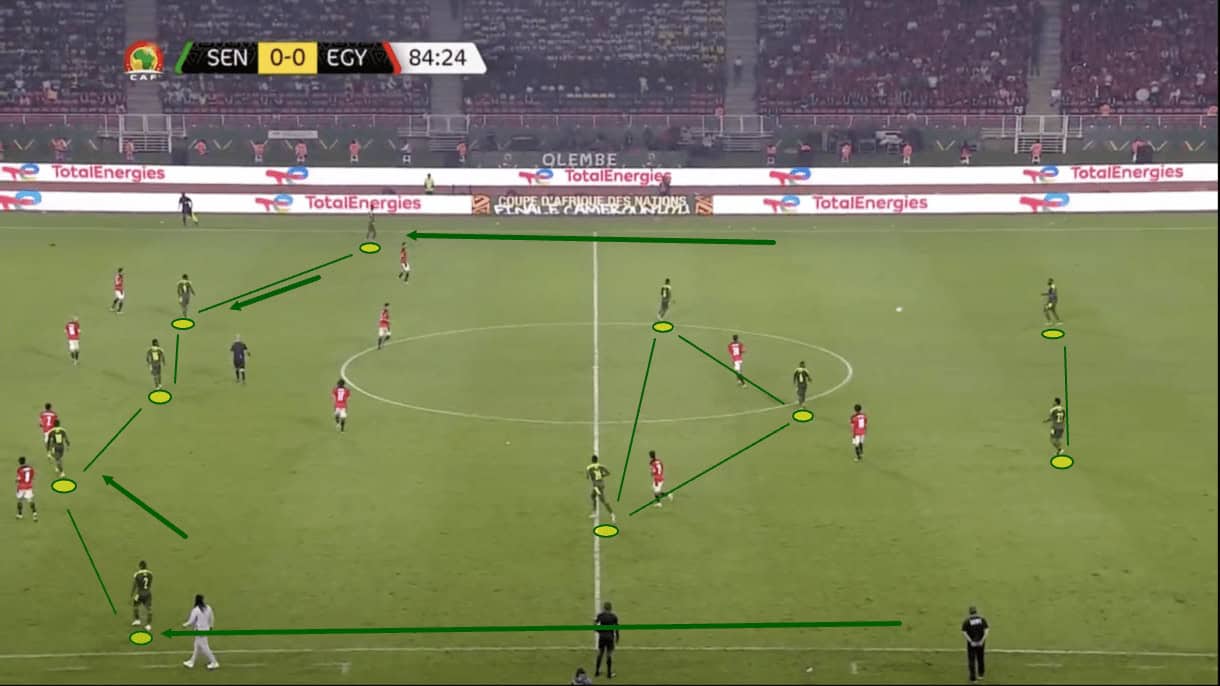
We see Senegal retain a similar shape as their possession play progresses into a slightly more advanced stage — the progression phase. However, their full-backs will be positioned far higher by now, with the wingers moving inside to the half-spaces as mentioned. We typically see Senegal utilising a 2-3-5 in-possession shape as seen above as a result of this, but it’s also very common to see their ball-far full-back drop back deeper once the ball progresses into the final third, offering some balance and extra defensive stability.
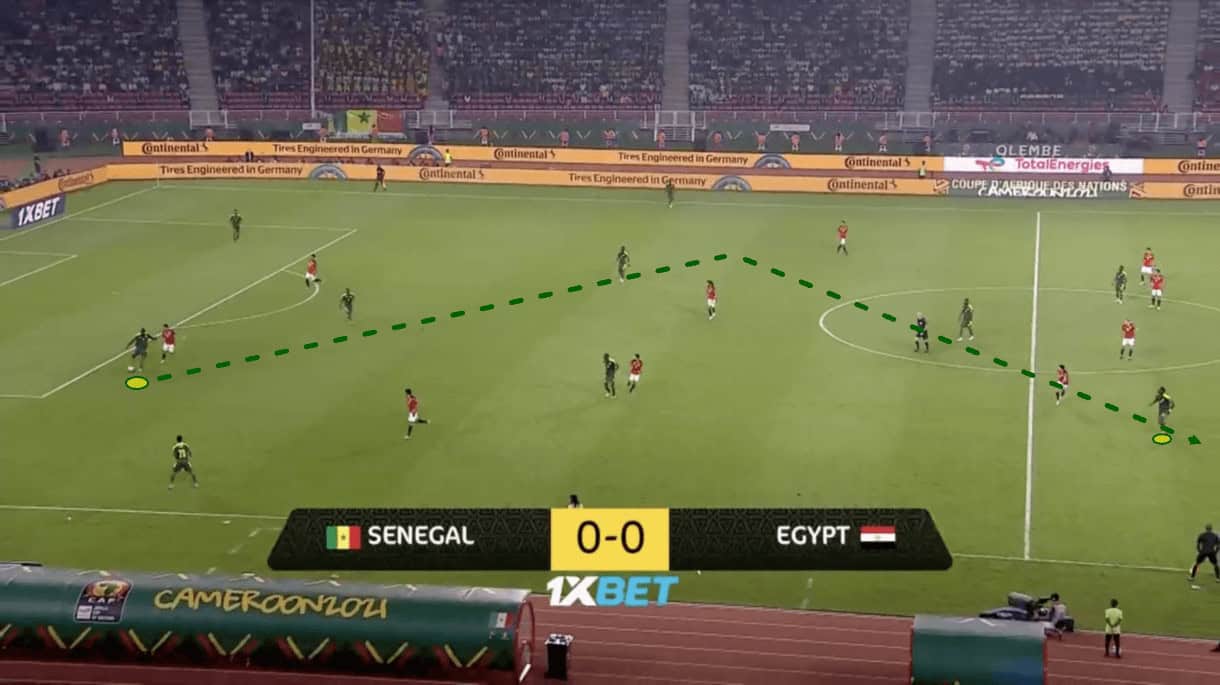
As mentioned earlier, Senegal tend to play plenty of long passes, and this is because Cissé’s centre-backs like to perform the deep-lying playmaker role in this side — especially Koulibaly.
We see an example of Koulibaly lining up a long pass over the top for the right-winger to chase down in figure 6. He’s comfortable under pressure, and he possesses impeccable vision along with technical passing quality to perform this deep-lying playmaker role behind the midfield trio.
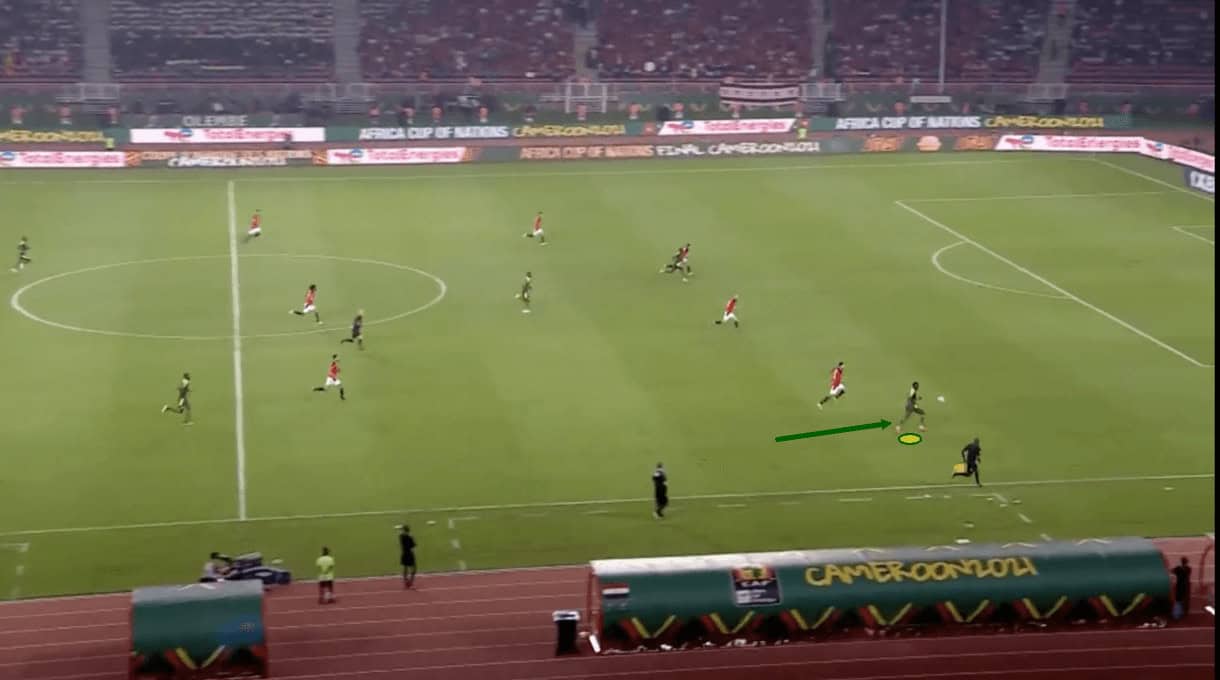
After the pass was played, Senegal’s right-winger was set up in a great position to enter the final third and make something exciting happen for his side — all a direct result of Koulibaly’s fantastic pass which created the opportunity from a position in which Senegal didn’t look at all threatening. This is the power of a quality deep-lying playmaker at centre-back, which Cissé has at his disposal.

Senegal frequently look to their centre-backs — again, mostly Koulibaly — to dictate the tempo and really control the game. Koulibaly is excellent at pulling the strings from centre-back and can perform this puppet master role masterfully, stroking the ball about and pulling off some really difficult passes in a way that makes it look easy while advancing his team into far more dangerous positions and creating difficult problems for the opposition to solve. He’s a great asset for his national team and a major problem for all opposition.
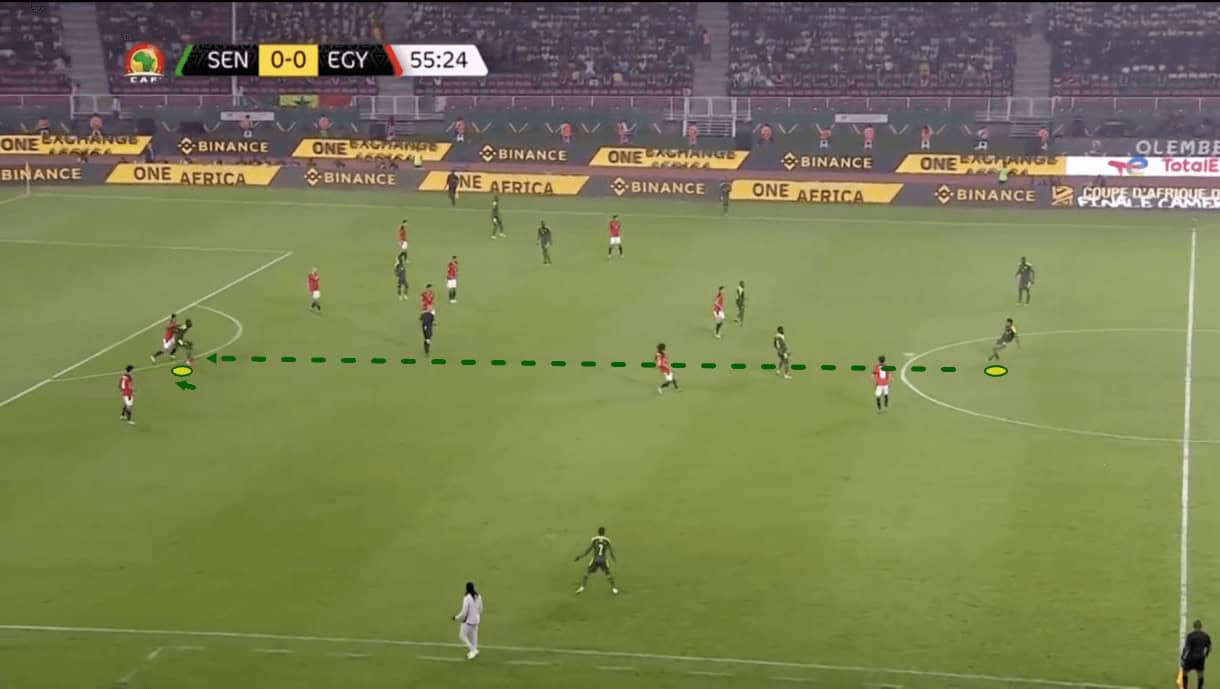
We see a couple of examples of Senegal’s tendency to switch the play from the centre-backs out to the opposite wing in figure 8. We mostly see Koulibaly performing this role from right centre-back, switching it out to the left-back who’ll be required to perform darting runs forward to aggressively exploit the space Koulibaly targets via these switches of play (the first example seen in the top two quarters of this image and the second example seen in the bottom two quarters).
This link-up between Koulibaly and Jakobs via the long switch is one to look out for at Qatar, especially as Mané will be positioned on the left wing too. So, this long switch out to the left can provide an opportunity for Senegal to quickly create an overload with Mané and the full-back on one wing, as was the case in the bottom example above. This can be extremely dangerous for Senegal’s opponents, so shutting down this tactic should be an important note in the game plan.
Of course, the left-back’s first touch is also crucial here, as we’ve seen examples of the full-back’s heavy first touch taking the ball away from him and squandering this opportunity, so that’s something Senegal need to watch out for as well; of course, this kind of play has its risks. We often see Mendy going straight to the full-backs from the build-up as well, with the opposition often leaving more space for Senegal to exploit out wide than they do centrally.
Mendy has the vision and technical quality to pull off chipped passes from the get-go out to the wing that can be very valuable for his national team in the same way as Koulibaly’s switches.
For our final point on Senegal’s in-possession play, their deep-lying players — particularly the centre-backs but also sometimes one of the midfielders should they drop deep and find space to turn and play forward, are good at breaking lines via their passing, getting the ball into the feet of their striker or wingers, with an example of this seen in figure 9.
Here, the left centre-back managed to fire the ball into the centre-forward’s feet by finding a good passing line through the centre of the pitch, demonstrating impressive vision, composure and bravery on the ball. Note how the forward sets himself well to receive and hold the defender off, allowing his teammates time to get up in support of the move.
This is a great example of how Senegal’s deep-lying playmakers, the centre-backs, are crucial to their team’s progression into the final third. They can find the wingers in dangerous pockets of space just in or on the edge of the final third via passes like this and that’s something important for Senegal’s opponents to watch out for in the World Cup.
Defensive phase
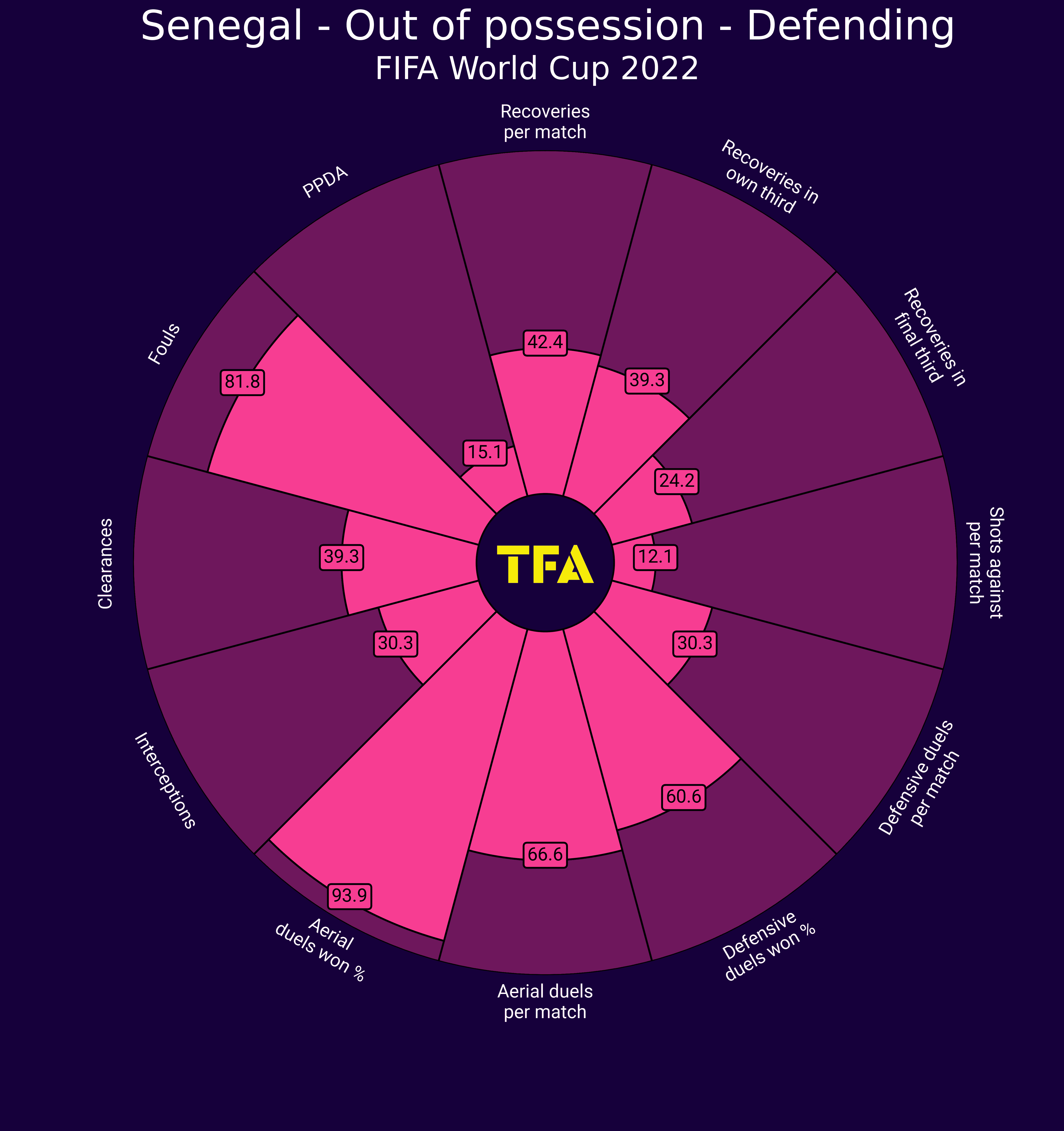
Moving on, we’ll now take a look at Senegal’s performance without the ball. Figure 10 shows us a defence-focused radar looking at some key metrics regarding Senegal’s performance over the last calendar year, with the percentile rankings comparing Senegal’s performance in these areas with the other 31 teams from this year’s World Cup.
For Senegal, the key areas to focus on here are their relatively low ranking in recoveries per match, recoveries in the final third and defensive duels per match. These low rankings are indicative of Senegal’s rather passive defensive style. They don’t press with tonnes of intensity in the high-block phase, rather preferring to remain organised and compact a bit deeper, allowing the opposition to have more of the ball in deeper areas without lots of pressure being applied on them.
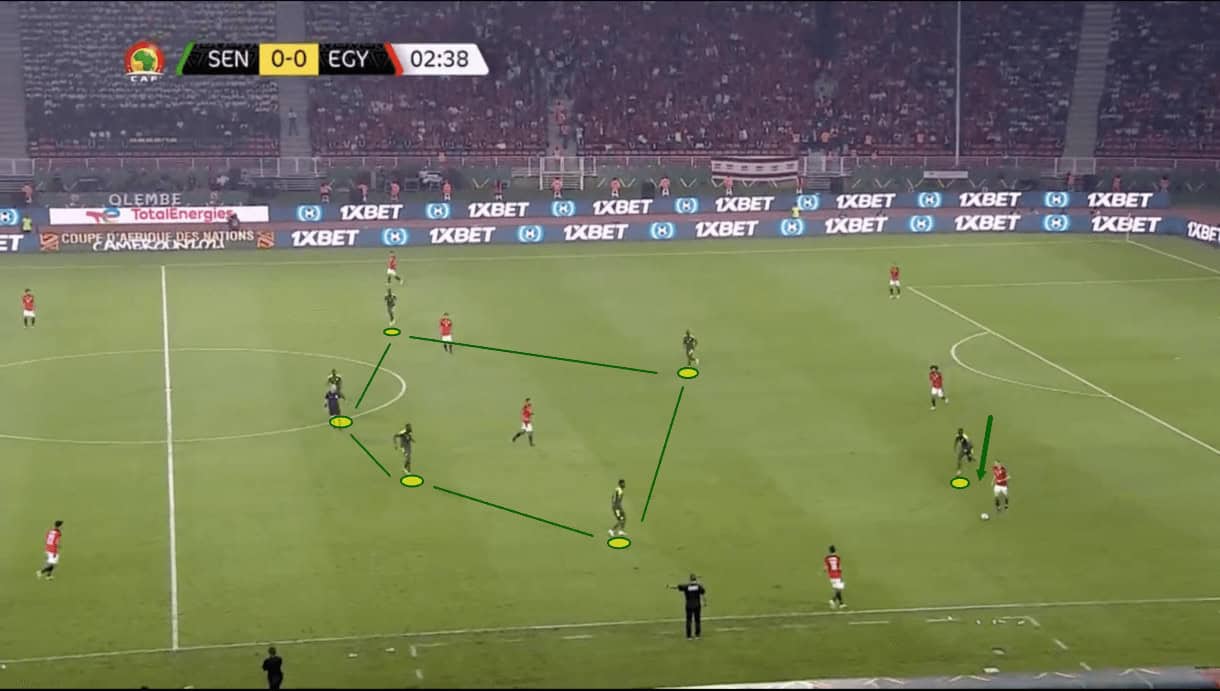
We see an example of Senegal’s high-block shape in figure 11. We can see the Lions of Teranga striker pressing with a bit of intensity but rather just trying to block the pass across the backline and force the opposition to make a move forward where most easy passing options are covered by Senegal shirts, instead forcing the opposition into a risky pass that can lead to a turnover.
While their striker sits higher, the rest of Senegal’s forward line and midfield line sit a bit deeper, not following the striker as he presses higher and instead focusing on forming a pentagon shape around the opposition’s midfielders, essentially caging those players and making them unattractive passing options. We see these players occupying valuable areas as it pertains to ball progression, so Senegal’s decision to focus on controlling this space and these players specifically makes plenty of sense.
This is a typical example of Senegal’s approach to defending in the high-block phase. They don’t press very aggressively, instead focusing on retaining central compactness around the area just in front of the halfway line to control this part of the pitch and prevent the opposition from using it. The players’ tactical intelligence, discipline, awareness and alertness are all key attributes to ensure this tactic works.
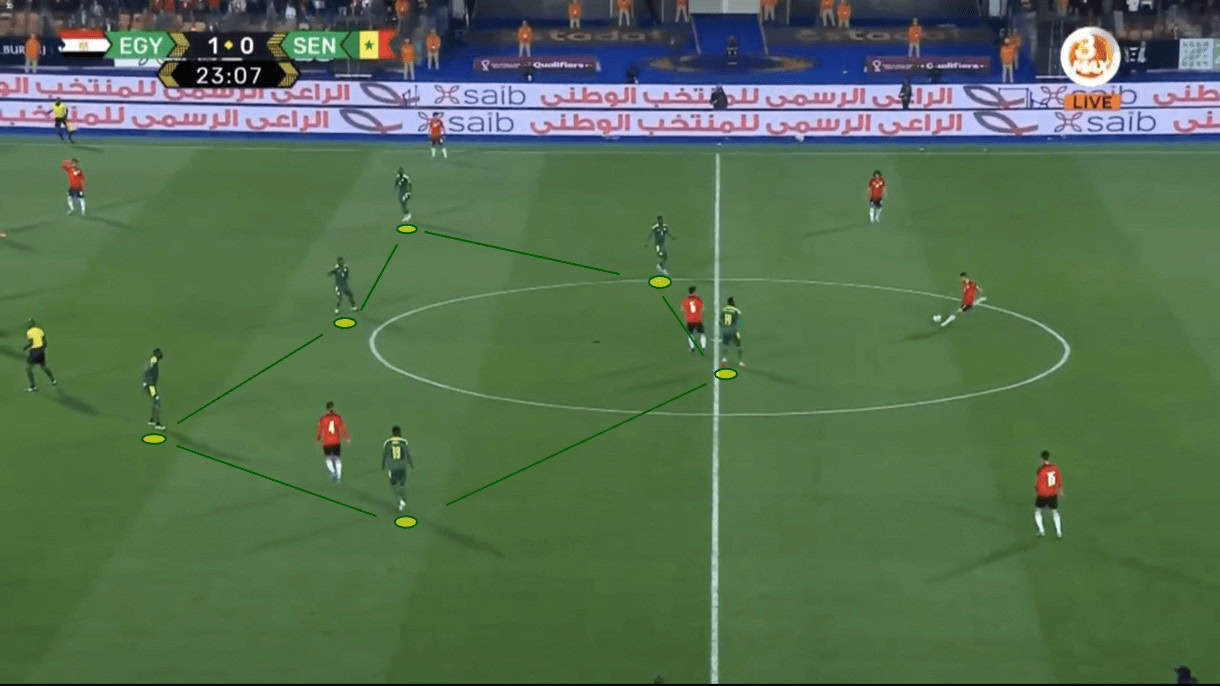
We see a similar sight with Senegal pushed into a mid-block, defending in a slightly deeper area of the pitch. Again, the striker sits highest but now forms part of the cage around the midfielders in front of the opposition’s backline.
For Senegal, the important thing here is preventing the opposition from building safely and securely through their shape via shorter passes, forcing them into longer, riskier balls by blocking off this middle part of the pitch, as they did in figures 11 and 12.
In the low block, expect to see Senegal performing similarly but with the wingers dropping deeper and wider, on either side of the midfield three, forming a 4-5-1 shape.
In the high-block/mid-block phases, with the wingers remaining quite central to control this area of the pitch, Senegal leave some space exposed on the wings that teams could look to target via long switches of play similar to the balls we see Koulibaly routinely play for Senegal — this is something Senegal’s opponents should look to target as they aim to build their attacks against Cissé’s well-organised defensive unit.
Transitions
In terms of transitions to attack, it’s common to see Senegal win the ball back in deeper areas with the opposition drawn out and committed to the attack, so traditional counterattacking play starting from a deeper position against a committed opposition with a high line is on the cards for this team.
When they manage to win the ball back in deeper areas, whether that’s from a well-timed interception/tackle (of which there aren’t tonnes — they tend to defend more passively) or a result of a successful aerial duel inside the penalty area as an opposition cross is dealt with by the centre-backs, it’s common to see Senegal quickly targeting the wings, where the likes of Sarr and Mané can be found positioned intelligently in space where they can run at the weakened defensive shape, using their pace and technical dribbling quality to create problems, either progressing to directly create a goalscoring chance themselves or drawing a foul and creating a set-piece opportunity, which Senegal generally enjoy.
So, expect to see Senegal targeting the wings quickly in transition to attack after regaining possession in deeper areas.
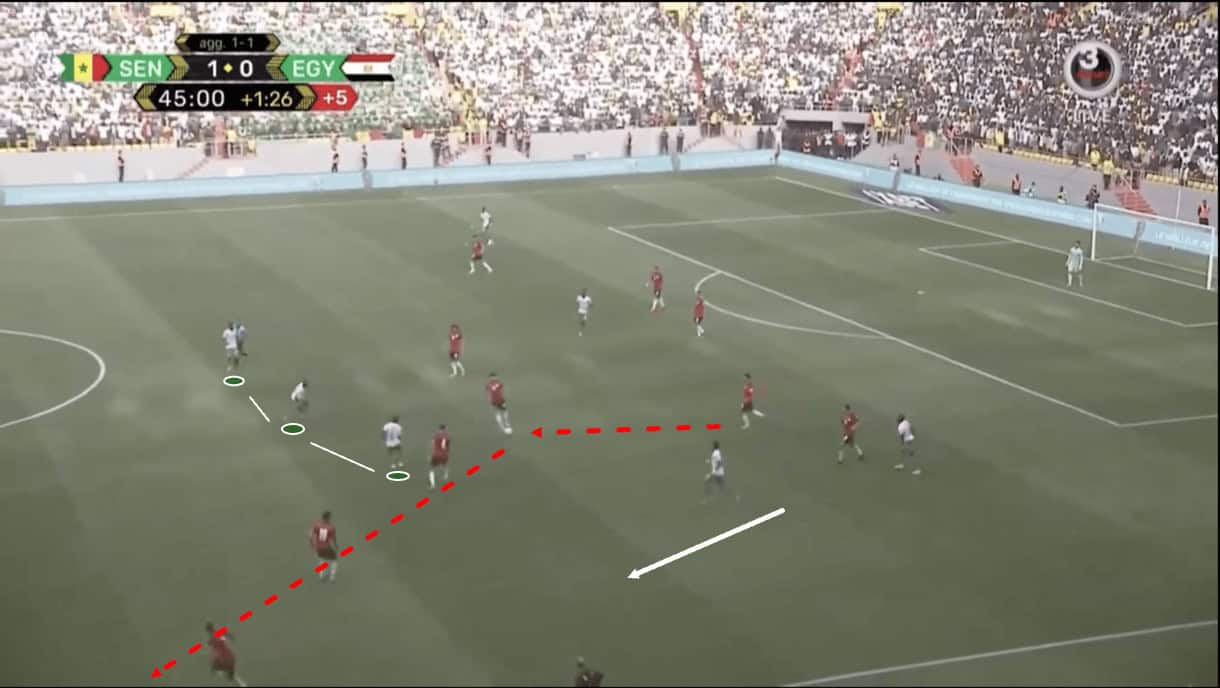
With regard to their transitions to defence, figure 13 provides an example of Senegal’s rest defence shape. As mentioned earlier, we often see both full-backs push forward in the build-up and progression phases initially but as play progresses, one full-back (typically the ball-far one) will drop back, leaving Senegal with a 3-3-4 offensive shape rather than a 2-3-5.
The key for their preparation to defend against a turnover and subsequent transition here is the tight, compact central midfield trio, who will generally be found where we see them in figure 13 in such situations. Their goal will be to cut passing lanes, stifle the opposition’s counterattack and give the attackers and full-back(s) time to track back and support the team’s defensive efforts.
At times, Senegal’s midfielders can fail to apply enough pressure to the opposition in transition, which can make life too easy for them to play past the midfield and expose their weakened backline. We see an example of this in figure 13 and this goes to show how crucial the attackers’ positioning is in the defensive phase as when the ball can be easily played into the midfield from deep, it can leave the midfielders — all of whom have great defensive quality — very exposed in this system.
Attackers
As mentioned earlier, Senegal’s attacking options are impressive. Along with Mané, who needs no introduction, Sarr, who’s enjoying a good season this term and will likely nail down the starting spot opposite many up front, and Dia — again, the Lions of Teranga’s most in-form centre-forward, they boast plenty of other exciting options.
Habib Diallo of Ligue 1 Strasbourg is another interesting centre-forward option who’s enjoyed a good season at club level so far. He’s different from Dia in that he offers far more aerially — this is where you can expect him to thrive. This could make him an attractive option for Cissé in certain games at the World Cup.
Bamba Dieng of Strasbourg’s Ligue 1 rivals Marseille can play centrally or on the wings, making him a solid versatile option. He hasn’t enjoyed as much of a good time this season under new boss Igor Tudor as he did under Jorge Sampaoli, but his quality is undeniable, and his versatility up front will be useful in the tournament setting. Dieng could provide fine backup to Mané or Dia in our predicted starting XI.
Monaco’s right-winger Krépin Diatta and Sheffield United revelation Iliman Ndiaye make up the rest of our attacking options — Ndiaye is also capable of playing as an attacking midfielder so provides an extra option there as well as the wing or at centre-forward, so the in-form goalscorer’s versatility will be valuable again.
Midfielders
In midfield, backing up our starting trio of Gueye, Gueye and Mendy, we’ve got Cheikhou Kouyaté, Pape Matar Sarr, Mamadou Loum, Moustapha Name and Pathé Ciss. Kouyaté is a solid holding midfield option who will provide great competition to the starting trio and we’d expect to see feature at some point in Qatar, perhaps even starting ahead of Mendy.
Sarr is an exciting talent who offers something different to our other midfield options. He’s a technically proficient player who’s probably most comfortable as an advanced ‘8’. He may not be the ideal profile to start in this midfield but depending on game state, he could be a very useful option to have. Unfortunately for Senegal, he hasn’t made a single appearance for Tottenham Hotspur at club level this term, which won’t help his match fitness or desire for a starting XI place.
Ciss and Loum provide good defensive midfield backup options. Off the bench, they’ll provide a lot of energy and defensive work rate whether that’s in order to retain a lead or play a ball-winning midfielder role in an attempt to get Senegal on the ball with a view to getting back into the game.
Lastly, Name is another versatile defensive midfield option who’s capable of deputising at right-back. Should right-back prove to be a problem area for Senegal with Sarr out of the tournament due to injury, Cissé may look to Name as he has in the past, so he’ll be another good option to have in the squad.
Defenders
In defence, Koulibaly and Diallo are a clear number-one duo in the centre for us, with Moussa Niakhaté and currently-injured Pape Abou Cissé providing good-quality backups should they be required. However, the quality of our starting duo is a step above and this is important given the specific role that these players have to perform within Senegal’s in-possession tactics.
Formose Mendy is another centre-back option but can also provide cover at right-back, which is where we may be more likely to see the 21-year-old Amiens player in the World Cup if we see him feature at all. However, we predict Real Betis’ Sabaly will start at right-back in place of the injured Sarr.
Left-back had been a problem area for Senegal but with Ismail Jakobs recently declaring for the Lions of Teranga, he has the opportunity to make that place in the squad his own, and we feel he’ll do that in the World Cup. The Monaco man’s main competition is likely to be former Monaco left-back Fodé Ballo-Touré, currently of reigning Serie A champions AC Milan.
Jakobs offers much more in terms of chance creation than Ballo-Touré does and promises to form a formidable attacking partnership with Mané on that left wing in Qatar. The link-up between Koulibaly, Jakobs and Mané from the switch to left-wing overload as discussed in the attacking phase section of our analysis is mouthwatering, to say the least, and its potential should excite Senegalese supporters.
In goal, Mendy has the starting spot nailed down but has strong backup in the form of Alfred Gomis and Seny Dieng. The goalkeeper department, like the forwards, is a clear area of strength for this side.
Key player
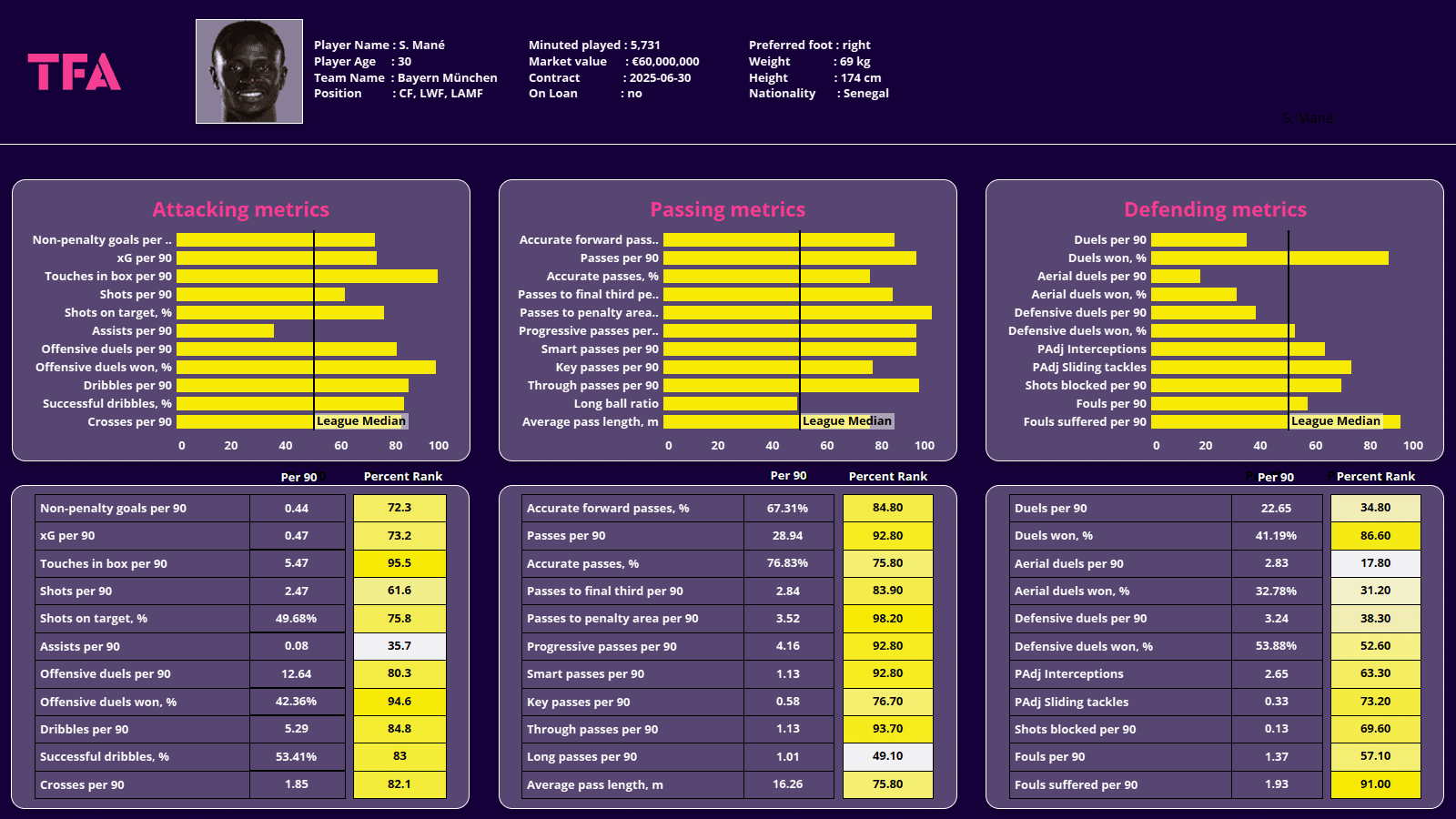
Sadio Mané is one of the best attackers in world football at the moment, having finished second in the 2022 Ballon d’Or to Real Madrid striker Karim Benzema, and he’ll be Senegal’s key man at the World Cup. If Senegal can get Mané on the ball in space in his favourite areas with regularity, that’ll make life extremely difficult for their opponents.
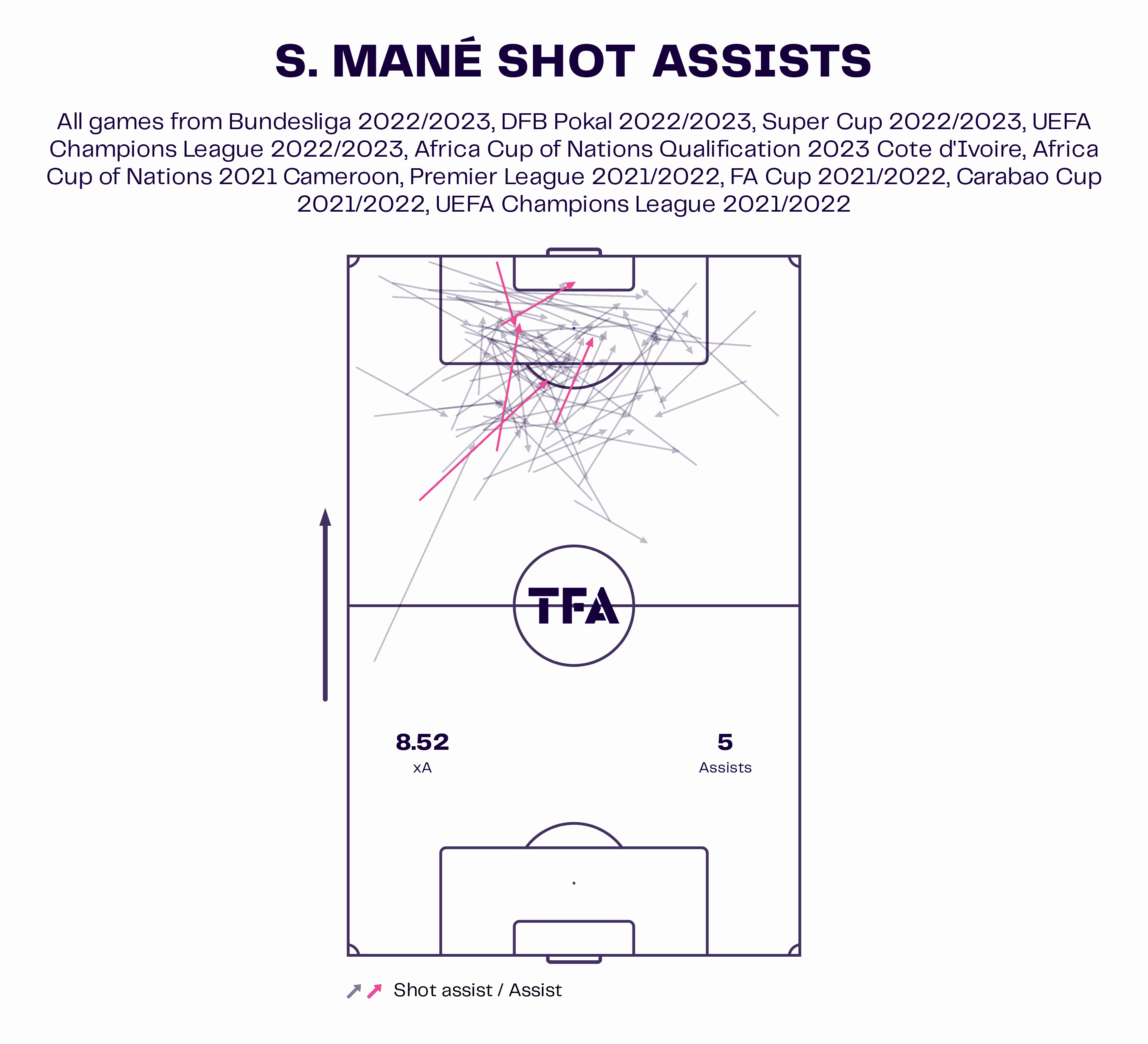
Mané is a top creator, as figure 15 indicates. He loves to create chances after drifting inside to the left half-space, not necessarily from wider areas. He frequently likes to get into these positions for Senegal and the centre-backs’ ability to find him when he moves inside via their line-breaking passes will be crucial to Senegal’s chance creation in Qatar.
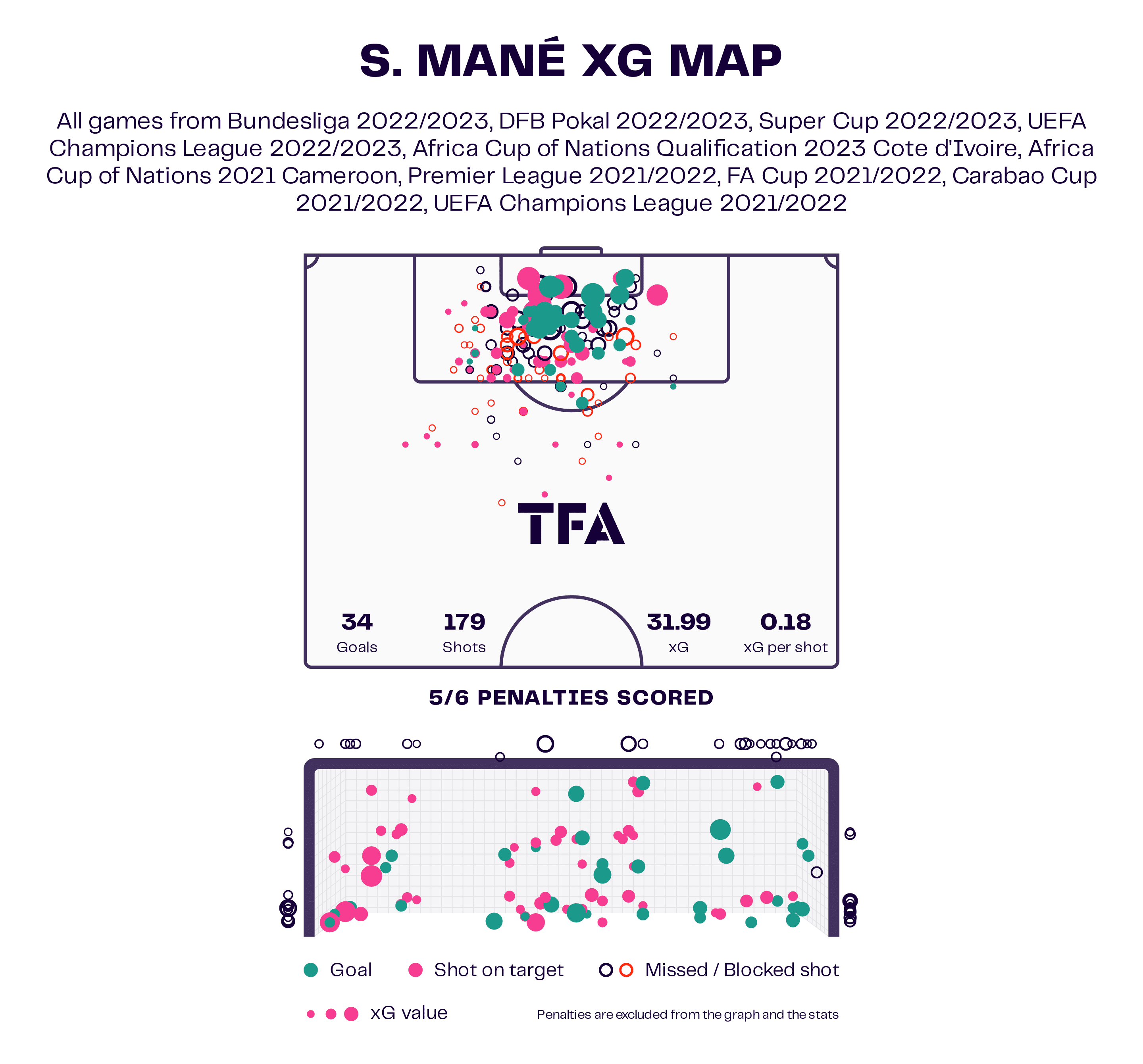
Additionally, of course, Mané is a brilliant goalscorer. After picking up the ball out wide or in the half-space, he’ll threaten to carry it into the box on the left side and curl a shot around to the opposite side of the net, which is how so many of his goals are scored. If Mané gets into his preferred shooting positions in the World Cup, he’ll be very difficult to prevent from hitting the back of the net thanks to his finishing quality.
Tournament Prediction
We think Senegal stand a great chance of getting out of the group stage in the World Cup for just the second time in their history this summer. From there, it’s anybody’s guess what will happen. They certainly have the quality to make it into the knockout stage and perhaps even to equal their best-ever showing by progressing into the quarter-finals. This may be a realistic and exciting goal for Cissé’s side in Qatar, given the strength of their squad.

