The well-travelled Jorge Sampaoli took charge of Olympique de Marseille back in March with a clear goal in mind, declaring that he would put “a playing philosophy” in place at Orange Vélodrome, with an immediate focus on “fundamentals, desire, [and] rhythm”. In his 11 games in charge last season, the Argentinian guided Les Olympiens to a fifth-placed finish, having taken over a side placed well behind the top four in March.
Back in May, I wrote a tactical analysis article looking into Sampaoli’s positive start to life in southern France after Marseille won five, drew two, and lost just one of their first eight games under the 61-year-old disciple of EPL side Leeds United boss Marcelo Bielsa. In that tactical analysis piece, I observed that Sampaoli followed in Bielsa’s footsteps not only by becoming Marseille manager — a role the Leeds United man held from July 2014 to August 2015 — but by deciding to line his Marseille team up in a formation with three centre-backs, similar to how Bielsa’s Marseille set up, as opposed to a two-centre-back shape like the one previous Marseille boss André Villas-Boas typically deployed.
As well as that, it was immediately apparent that Sampaoli’s vision for Marseille was that of a more possession-dominant, pass-heavy side than that of his predecessor, a set of tactics that would fit with the typical ‘aggressive, possession-based with incisive verticality’ playing philosophy the Bielsa-inspired coach has become well known for during his coaching career.
The intricacies of Sampaoli’s first two months in charge of Marseille, including explanations for why we arrived at the previously stated conclusions of his start at Orange Vélodrome, are analysed in far greater detail in our previous ‘Sampaoli at Marseille’ article from May (linked above). I’d recommend reading that piece before this one, almost as a ‘part one’ on Sampaoli’s time at Les Olympiens.
Since then, Sampaoli has had time to mould this Marseille side into his ideal image more and more. As a result, the 61-year-old manager has made some interesting tactical changes to his team. We’re coming off the back of a summer transfer window in which the Argentinian coach was backed heavily in the transfer market, with Marseille ending the window with the second-highest net transfer spend of any Ligue 1 side, per Transfermarkt.
Cengiz Ünder and Pau López (both on loan from Serie A side Roma), William Saliba and Mattéo Guendouzi (both on loan from EPL side Arsenal), Amine Harit (on loan from Schalke), Bamba Dieng (€400k), Gerson (€25m), Leonardo Balerdi (€11m), Pol Lirola (€6.5m), Luan Peres (€4.5m), and Konrad de la Fuente (€3m) are among those to have made the move to Marseille this summer and featured heavily so far in the 2021/22 campaign in what has been a major shakeup at Orange Vélodrome. However, Sampaoli’s new-look side have started the season well, winning four, drawing two, and losing just one of their first seven league games, leaving them sitting third in Ligue 1, one point behind second-placed Lens, who have played a game more than Marseille.
Along with new faces has come some new tactical ideas to fuel Les Olympiens’ positive start to the season and this tactical analysis piece highlights three key tactical changes Sampaoli has brought to Marseille this term. This tactical analysis looks to paint the picture of an evolved version of this Marseille side that Sampaoli has tweaked to fit his vision even more this season than during his start to life at the French club at the end of last season.
Build-up, central midfielders over wing-backs, and rotations
On arrival at Marseille, Sampaoli immediately switched from the typical 4-1-4-1/4-2-3-1 shape of Villas-Boas’ side to the 3-4-1-2/3-4-2-1 shape that his teams are known to play. Again, the intricacies of this immediate tactical decision are discussed in greater detail in our first piece on Sampaoli at Marseille. This switch in shape saw Marseille begin to use a 3-1 shape as a base for their build-up, with one of their two central midfielders dropping deeper to form a diamond with the back three, and his place in midfield being filled by either a winger or a striker — depending on whether Marseille were using a 3-4-1-2 or 3-4-2-1 base shape.

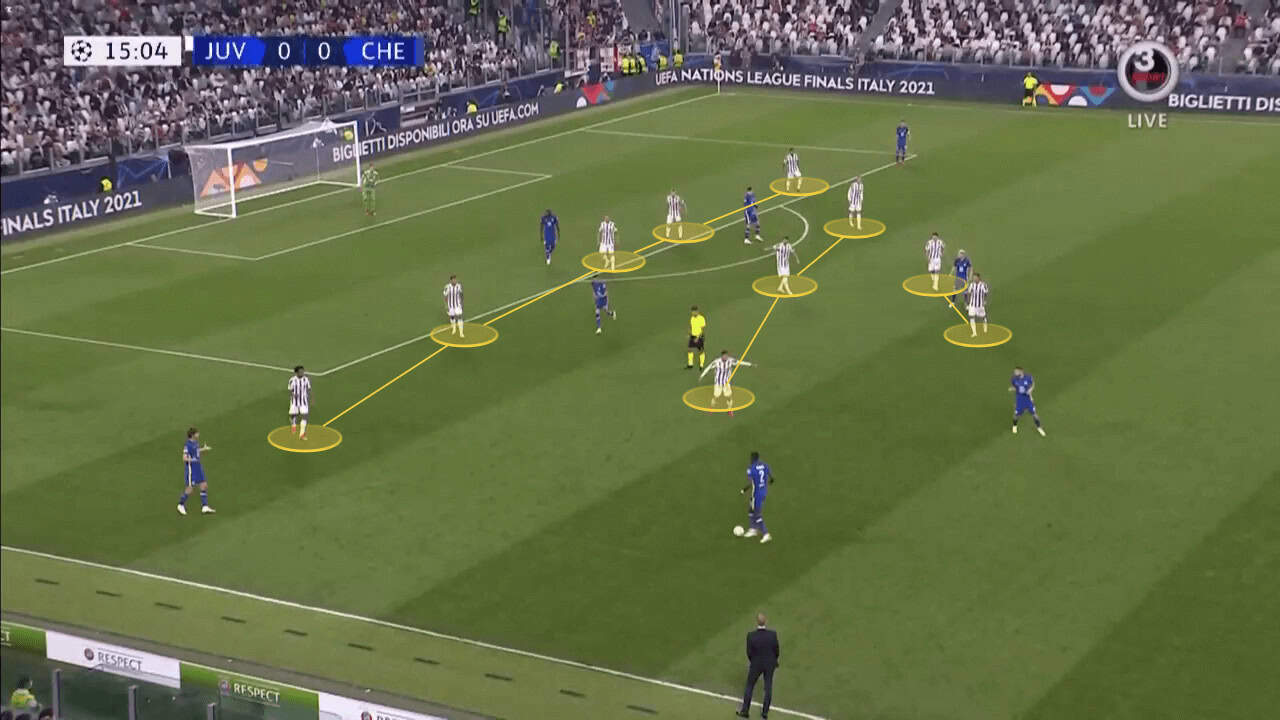
Figure 1 shows an example of Marseille’s general shape in possession under Sampaoli last season. This image highlights the 3-1 base and how the deep-lying midfielder’s place in central midfield was subsequently filled by a striker who also dropped deep, creating something of a 3-1-4-2 shape.
Marseille still use the 3-1 base in the build-up this season, that hasn’t changed. It’s a shape that creates good passing angles into midfield, and if those passing lanes into the deep-lying midfielder are blocked off for the centre-backs, then the opposition may leave passing lanes into the other central midfielders open, or at least the wide men, though Sampaoli likes his team to play through the centre if possible.


![Lazio Vs Napoli [0–2] – Serie A 2025/2026: Maurizio Sarri Zonal Marking Weaknesses And Unsuccessful Attacking Choices – Tactical Analysis](https://totalfootballanalysis.com/wp-content/uploads/2026/01/Lazio-Vs-Napoli-tactical-analysis--350x250.png "Lazio Vs Napoli [0–2] – Serie A 2025/2026: How Antonio Conte Tactics Exploited Structural Flaws – Tactical Analysis 6")