
Following their promotion back to Sweden’s top flight in the 2021 campaign, Helsingborgs IF have struggled in 2022’s Allsvenskan.
With just four wins from 23 leaving them in the drop zone, they find themselves a single point away from the relegation play-offs, and seven points adrift of total safety.
Some of you may remember that ex-SPL and Premier League star Henrik Larsson also played for Helsingborgs in two different spells in his career – it was during his second spell that the club had a bit of a resurgence.
Larsson also managed the club on two separate occasions.
While things haven’t gone to plan as a collective, there have been a couple of players whose stock has risen as a result of their individual performances, one of those being Casper Widell — a 19-year-old central defender who has appeared 16 times in the league this year after impressing in his 15 appearances last year.
This scout report will provide an analysis of Widell: his defensive capabilities (his 1v1 defending, anticipation, ability in duels, leaving strikers in isolation etc.) will be assessed, along with his ability in possession, particularly his passing.
We will provide an tactical analysis of how he operates in Helsingborgs’ backline and his role in their tactics.
Casper Widell Player profile
Casper Widell came through the ranks at Helsingborgs and is enjoying his first full season in Sweden’s top division.
With 38 total appearances for the club so far, he is fast becoming an extremely important player; with relegation looming for Helsingborgs, Widell may have to think about leaving the club if they do go down as sticking around to play in a lower division may hinder his development.
There may even be an argument for him featuring for a club at UEFA Europa League level in the near future.
His development so far has not gone unnoticed as he has nine caps for Sweden’s U19 side, at the time of writing.
Being consistently selected at that international level is a good indicator of his development and the opinion of those running the show behind the scenes for Sweden.
At 6’3”, Widell brings a physical and aerial presence that lends itself nicely to any backline he slots into.
Naturally right-footed, Widell plays as a right-sided centre-half in a back four, as we can see from his heatmap below.

Casper Widell Defensive dominance
In some ways, Widell has the qualities of an old-fashioned centre-half — aided by his tall but thin frame.
His defensive ability trumps his on-the-ball attributes, but his role in Helsingborgs’ tactics don’t require him to be anything special in possession.
This segment provides an analysis of Widell’s defensive contributions.
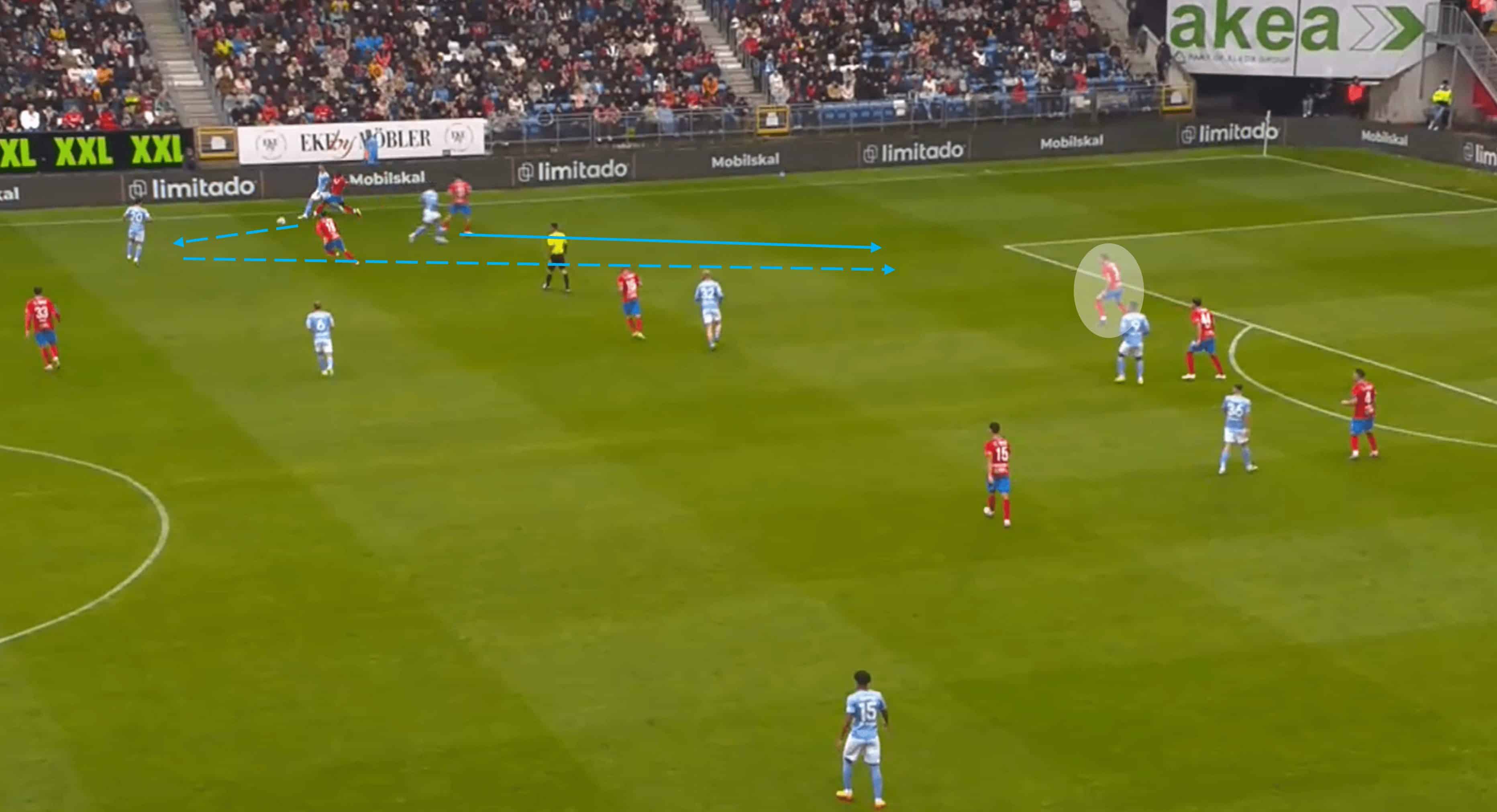

A key skill for any defender is the ability to read the game and adjust themselves accordingly to make an effective contribution.
We can see Widell demonstrating this in the analysis above, and it came at a critical moment as Helsingborg’s right-back got involved in the duel further up.
As the opposition midfielder lofted a ball into the channel, Widell was forced to act quickly.
He did so, with good timing and composure, shifting across to shut the space down and limit the attacking opportunity for the opposition.
Instead of diving in rashly, Widell stands off a yard or so, which also allows him to keep tabs on the attacking midfielder joining the attack.
The midfielder attempts a floated ball across the box, but Widell’s positioning and height allowed him to deflect it away from danger via a header.
Blocking seems to be a skill of Widell’s and not just with crosses.
The visual below gives us an idea of how he gets himself in the way of opposition shots.

With 11 shots blocked so far in this season’s Allsvenskan — four of those occurring inside the box — he doesn’t appear to think twice when putting himself in harm’s way.
A blocked xG of 0.75 also suggests he has blocked shots of quality and danger.
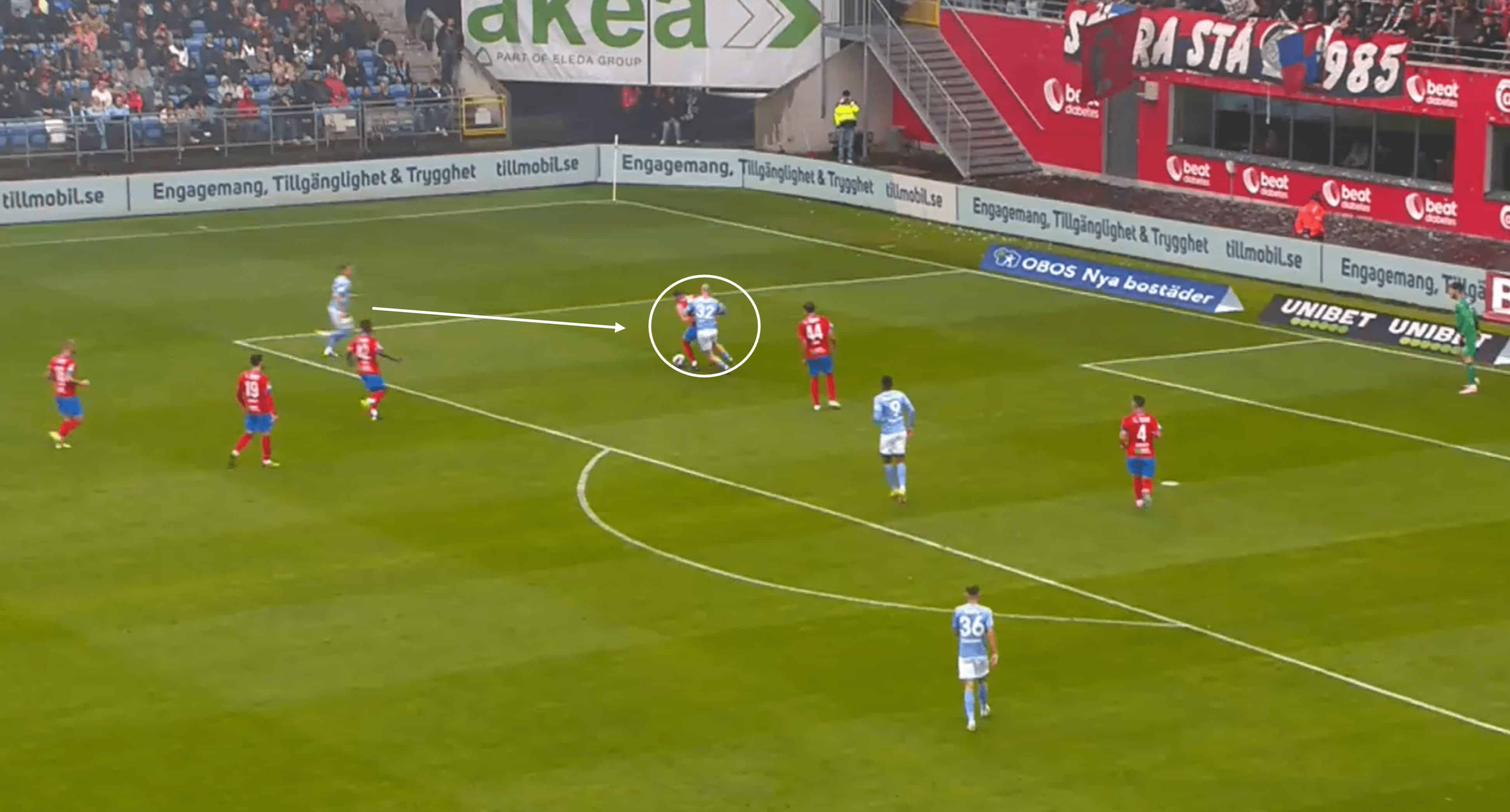

Widell has an element of composure to his game, as demonstrated above.
After a loose ball found its way into the Helsingborgs box, guarded by Widell, the opposition launched a two-man press which put immense pressure on the young centre-back, but he handled it well.
Having defended the ball effectively, he eventually found the pass to his teammate at right-back, who was left unmarked thanks to the second man joining the press.
This pass not only relieved pressure on Helsingborgs’ backline but presented an opportunity for a transitional attack/move into the midfield third.
Credit should also go to Widell for the accuracy of his pass under such pressure — another display of his composure.

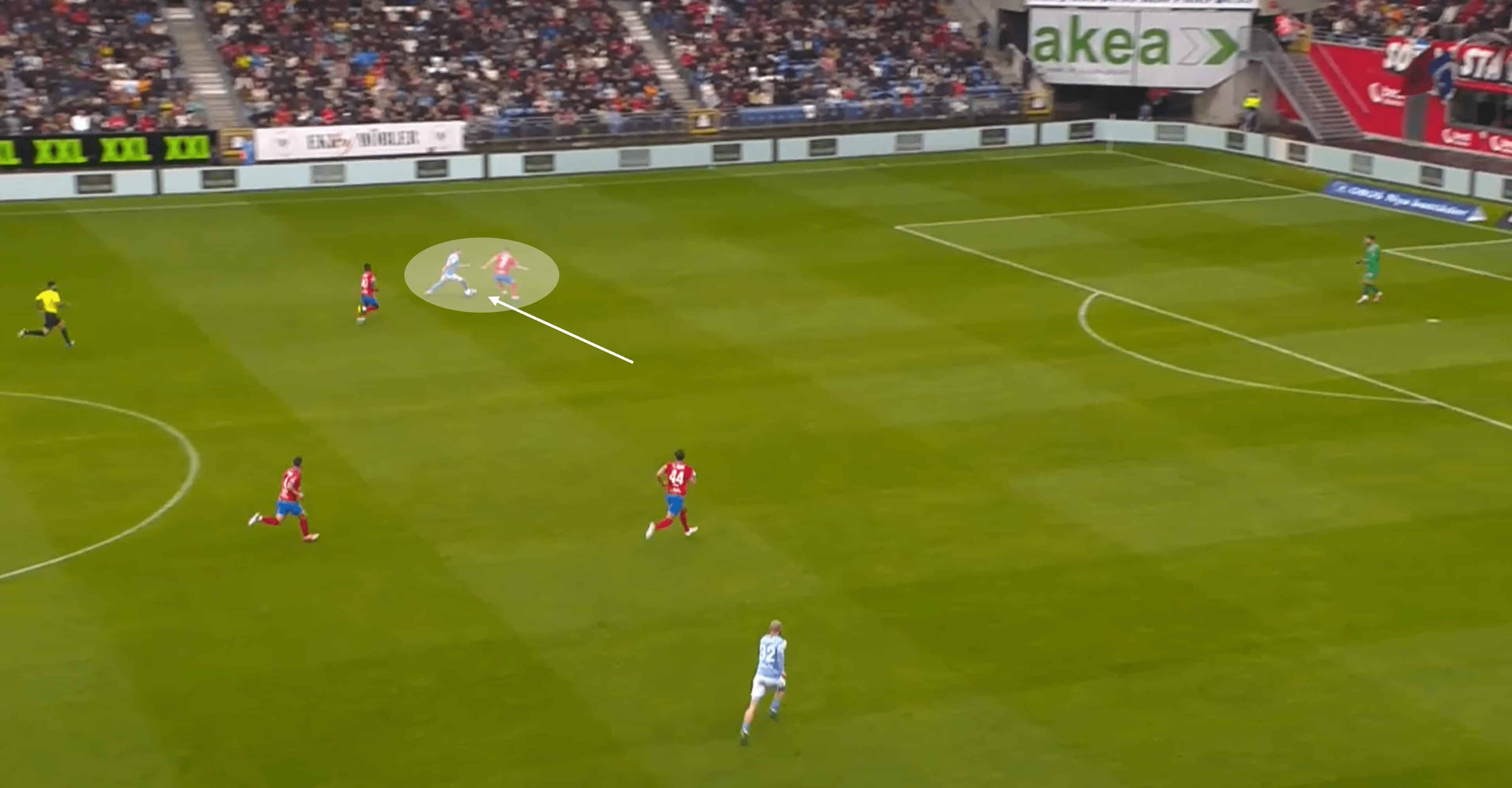
Here, we see another example of Widell’s ability to adjust his positioning with good timing to stifle an attack.
Caught off guard, Helsingborgs had a challenging task presented to them in stopping this quick attack from the opposition.
However, as the pass was fired through to the opposition forward who initially had some space ahead of him, Widell’s exceptional timing allowed him to close the ball down and recover it, making it look easy in the process.
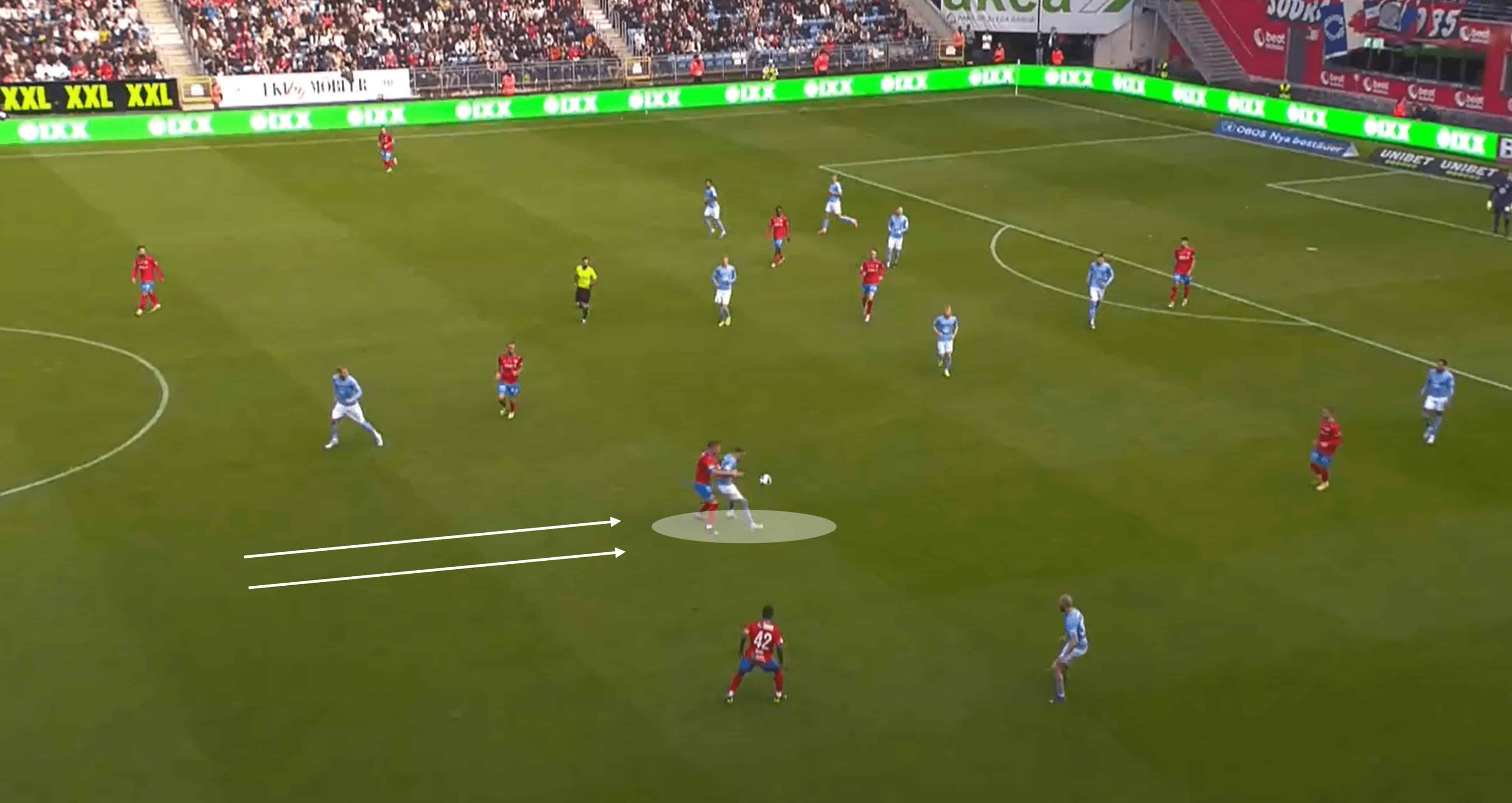
A tendency in Widell’s game is to leave his defensive line to apply unexpected pressure – this occurs more in the opposition half, usually when the risk is low if he loses out.
The timing of this move isn’t random either, he gauges when to pounce based on the positioning of his teammates.
His height and strength give him a significant advantage in these kinds of duels, as does the element of surprise.
Another thing that triggers his press is the opponent receiving the ball whilst still facing his own goal, sometimes with the quality of the pass being poor.

The visual above gives us a clearer idea of his ability to leave his line and apply pressure, specifically in the opposition half — 13 counterpressing recoveries highlight a real skill.
He has also made five high regains, recovering the ball in the attacking third.
Widell winning the ball in these dangerous areas gives his team a chance of breaking quickly.
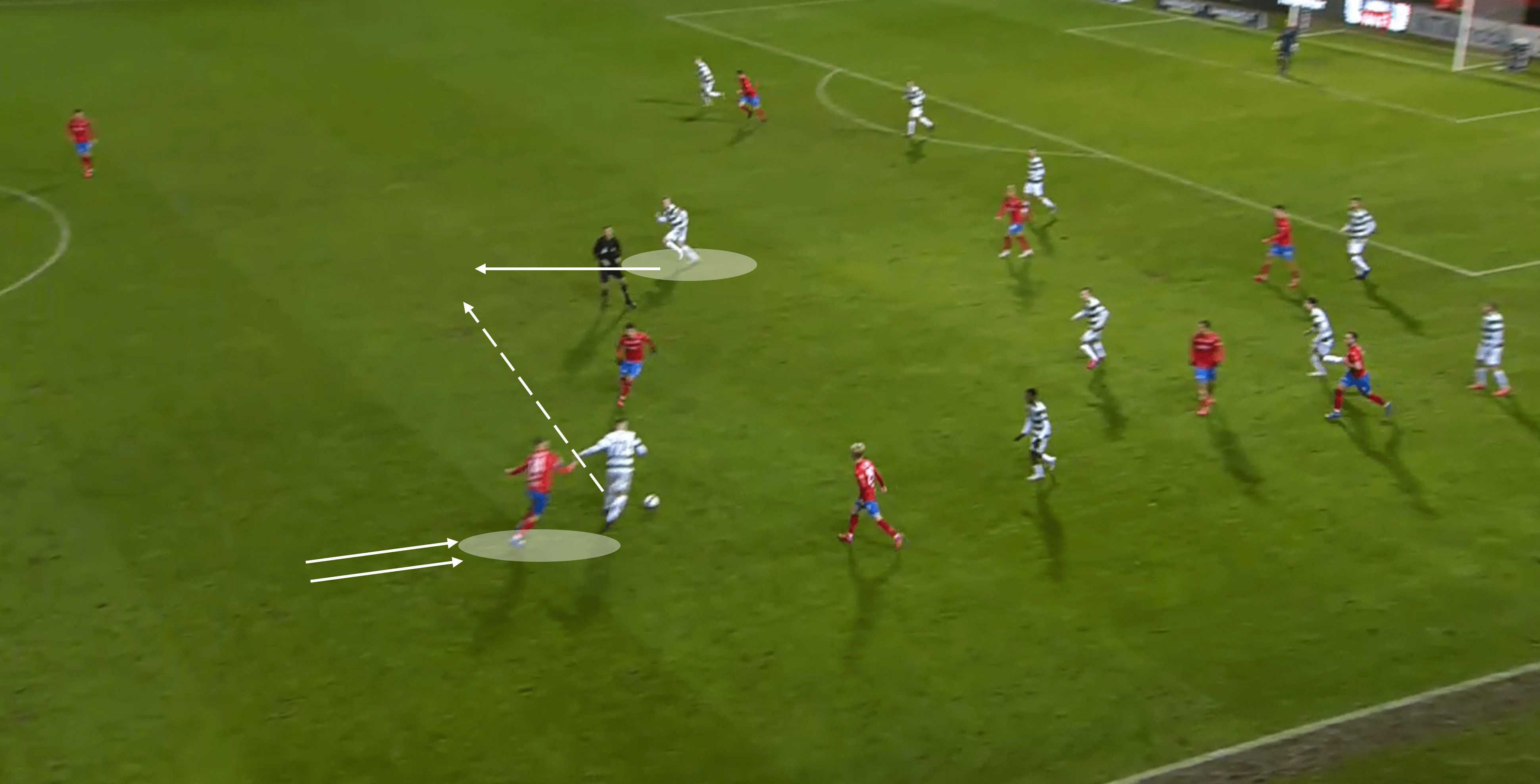
He does, however, misjudge when to execute this type of press on rare occasions, which obviously leaves the rest of his defensive unit slightly vulnerable, as seen in the image above.
With a high number of players committed forward, there are no midfield players central to stop the counter-attack immediately.
The mistimed press allowed the opponent to control the ball and play a pass to a teammate.
This is where he must master the timing and execution of this press to minimise the risk of failure and vulnerability to a transitional attack.
One of his most significant weaknesses is a physical element — his pace.
It is understandable that, given his height and build, he isn’t blessed with pace, which can see him at risk in some situations where pace is required.
This also increases the risk of leaving the backline to apply pressure, which is where his timing comes in handy.
Statistically, Widell doesn’t shine as much as when you see him in action, but it still highlights a need for improvement.
One of the more concerning defensive areas is his aerial ability overall.
Despite being a tall, commanding figure who often excels in aerial duels within his own box, he has an overall win rate of 53.6% in aerial duels.
We mentioned his blocking ability earlier when it came to defending opposing shots, which is reflected in his average of 6.8 interceptions per 90, highlighting his ability to break up plays, usually in the defensive third.
Casper Widell Passing range
Many centre-backs in the modern era are required to have a certain level of ability on the ball — the style depends on the club’s tactics, some clubs need CBs who can carry the ball out of the backline and into midfield, while others prefer defenders who have a good passing range in their locker.
This segment analyses Widell’s ability to identify a pass and execute it accordingly to progress the ball through the thirds.
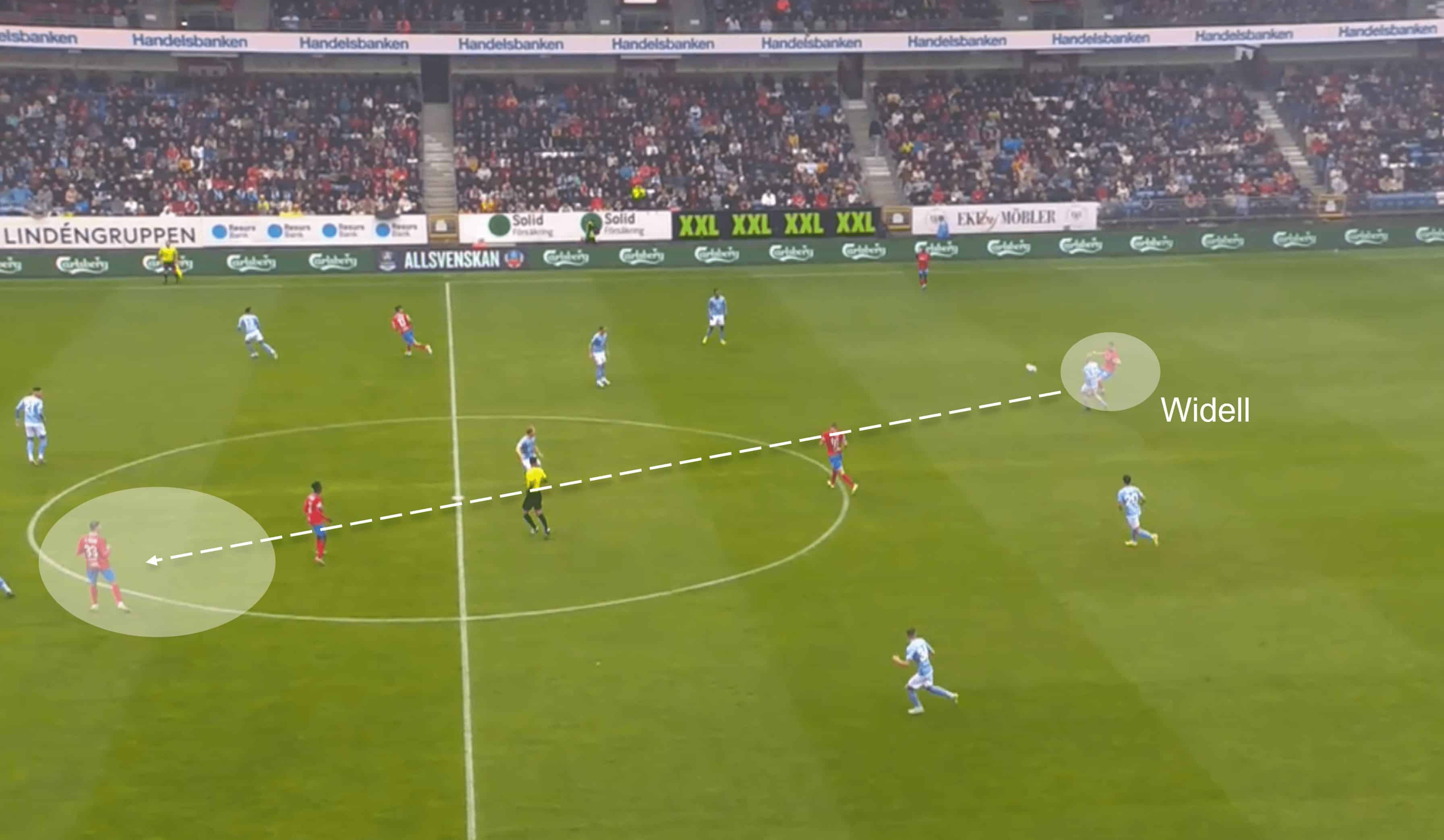
In most games, you will see a centre-back trying a hopeful punt forward as a long pass.
Widell has demonstrated the vision to make more productive long passes, as we see in the image above.
Widell identifies a significant space in the centre circle with two teammates available for a pass and coolly executes a lofted ball into that space.
His long pass accuracy rate stands at 39.4%, and this stat includes long passes made while under extreme pressure, which are often clearances.
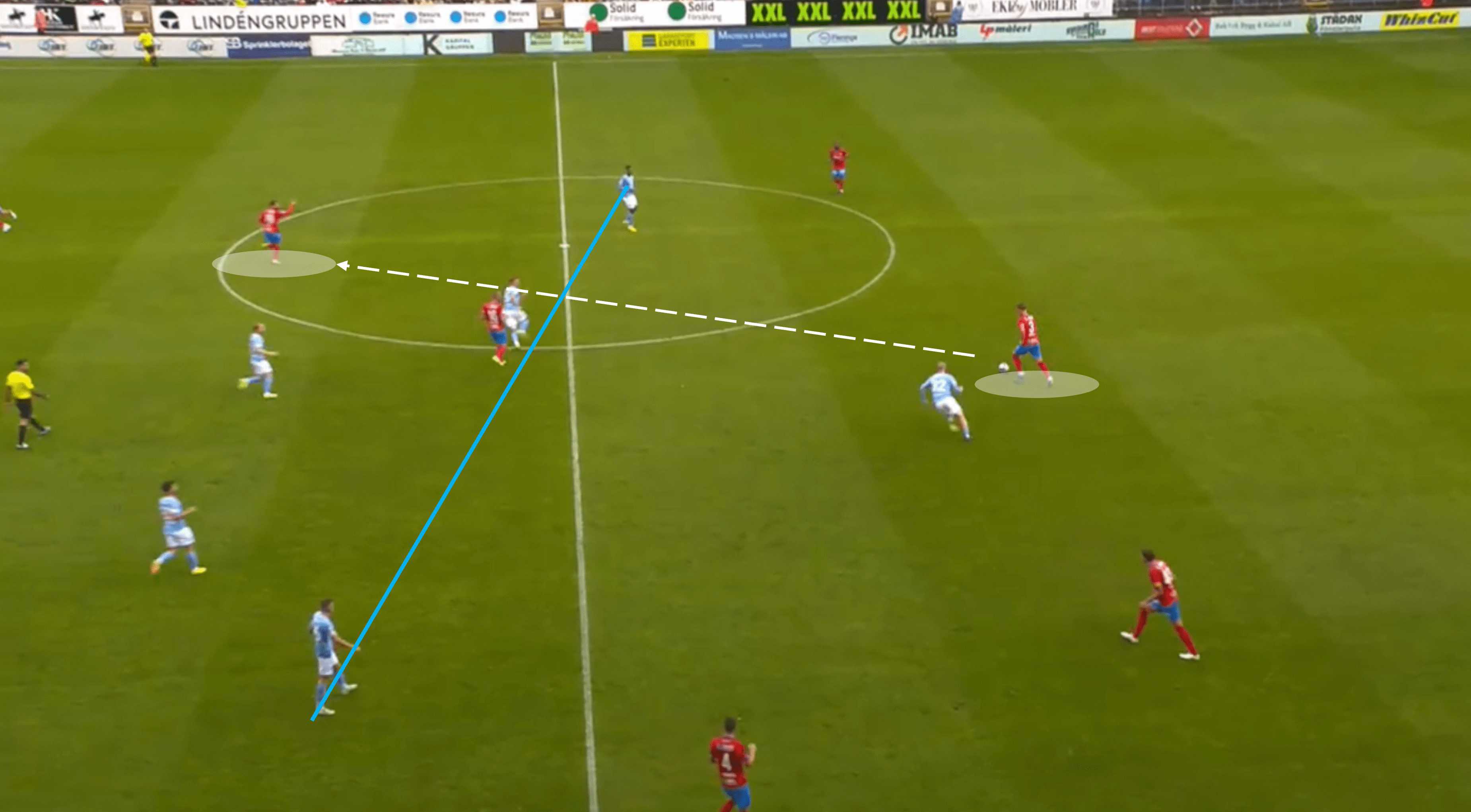
Widell has also shown the ability to play clever forward passes on the ground, as seen above.
While the obvious options for the next pass would’ve been the right back or the goalkeeper, Widell has shown the attacking determination to progress the ball quickly when suitable.
In the image above, he notices spaces between the opposition midfield and plays a line-breaking pass into an attacking midfield teammate who is in plenty of space.
The pass was played with a good pace, making it easy for his teammate to collect and progress.
He averages 16.09 forward passes per 90 minutes with an accuracy of 63.4%, showing some consistency in progressing the ball higher up the pitch.
Meanwhile, his overall pass accuracy of 81.8% could use some improvement, though that is expected to come over the next couple of years, especially if he remains in the top flight.
Conclusion
It is often difficult to look good in a struggling team, especially as a defender in a team facing relegation.
Still, Widell has put in some performances of a smart defender with a bright future ahead of him.
As mentioned, he needs another season or two and some fine-tuning in certain areas to take this game to the next level.
The most important thing for him now is that he stays in the Allsvenskan, even if his hometown club, Helsingborgs, fails to earn survival.
Widell has a good set of attributes, from his defensive strength to his 1v1 defending, with good passing ability as well.
In summary, he’s a defender that you may hear more about in the coming years, with the potential of him being a full Sweden international in the process.
